
product-demo-director
Turn product evidence and raw footage into narration-paced, source-bound demo films—with Codex or Claude Code directing cuts, zooms, render, and QA.
Install with your AI
Paste into Claude Code, Cursor, or any agent — it reads the repo and wires the tool into your project.
Install and set up product-demo-director (claude-skill project) into my current project.
Found on https://claudeers.com/product-demo-director
Repo: https://github.com/crimeacs/product-demo-director
Homepage/docs: —
Detected install method: claude-skill → # copy this skill into .claude/skills/product-demo-director/
Category: automation. Platforms: cli, api, web.
Read the repo's README for exact setup and env vars, then install it and wire it into my project.

Claudeers Health Verdict:
active; community-verified: false. Confirm the source before running anything.
# copy the skill dir into your project:
# .claude/skills/product-demo-director/   (or ~/.claude/skills/product-demo-director/ for all projects)
git clone https://github.com/crimeacs/product-demo-director
// compatibility
| Platforms | cli, api, web |
|---|---|
| Operating systems | — |
| AI compatibility | claude |
| License | MIT |
| Pricing | open-source |
| Language | Python |
Product Demo Director
Give Claude Code or Codex product evidence and footage. Product Demo Director turns them into a source-bound announcement film, locks every cut between complete spoken thoughts, and proves the exact file that ships.
Most product demos are either a flat screen recording nobody finishes or a polished presentation that no longer feels like a live product. Product Demo Director gives an agent a real production workflow: inspect the evidence, find the change, write the story, capture missing states, perform the narration, direct a full-frame edit, render, finish, and verify the delivery.
It's a Claude Code skill (see SKILL.md) and a
standalone pipeline — drive it by hand or hand the whole loop to an agent.
Why it is different
- The agent directs a story, not a screen recording. It finds the change, captures only the states that matter, and uses full-frame cuts and connected zooms to control attention.
- Speech controls picture. ElevenLabs character timing gives each narrated thought its own visual runway; cuts land between ideas instead of clipping them.
- The shipped file carries receipts. Source and claim hashes, exact frames, final-media decode, loudness, black/silence checks, and narration continuity are bound to the delivery artifact.
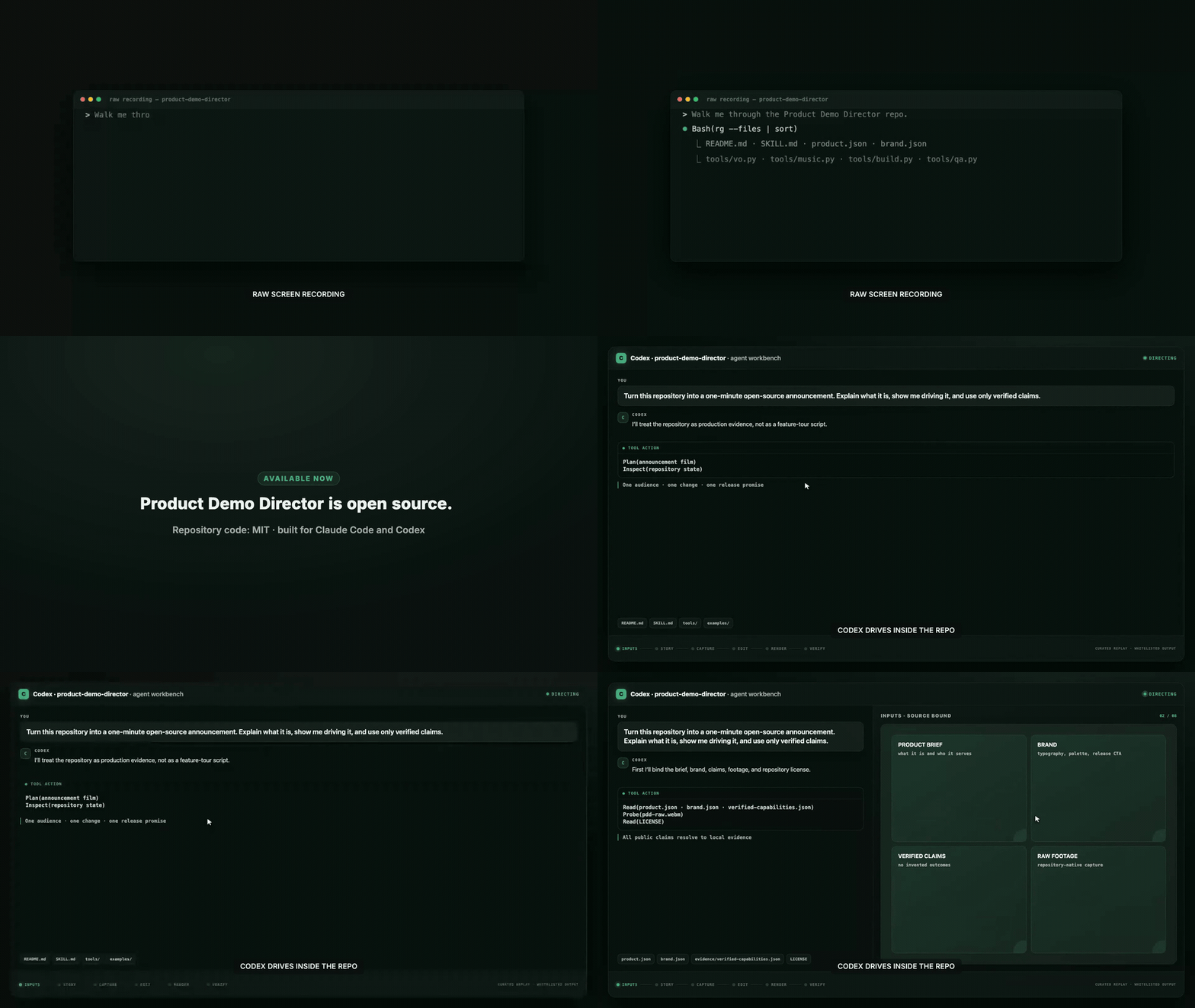
The one-minute repository announcement is made by the repository itself. A clearly labeled, reproducible workbench replay shows Codex driving the pipeline; the final film and its release asset remain bound to the exact sources, story, narration timing, frame plan, and QA receipt used to create them.
How it works
   product.json + a URL
        │
        ▼
   onboard.py  auto-extract the brand (palette/font/logo) → brand.json  (themes the whole engine)
   shoot.py    the director records the footage itself — a web app and/or a terminal/CLI session
   script.py   drafts a launch-film, Save-the-Cat, causal-workflow, or walkthrough script
   preflight.py validates the production contract before render
        │
        ▼
script.json + footage
        │
        ▼
   vo.py     aligned announcement narration — ElevenLabs; non-auto-paced VO may use Gemini TTS
   pace.py   uses ElevenLabs character timing to move picture cuts between complete spoken thoughts
   music.py  an instrumental bed sized to the runtime — ElevenLabs Music or Lyria 3 (auto by key)
   sfx.py    bespoke SFX palette — 3 variants/cue, a model listens and keeps the best
        │
        ▼
   build.py  →  Remotion engine (Timeline.tsx)
        │       full-frame shots · connected zooms · kinetic captions · SFX on real beats
        ▼
   out/demo.mp4 + build-plan.json + artifact.json
        │
        ▼
   finish.py optional two-pass -18 LUFS + BT.709 web-safe delivery master, frame-preserving
        │
        ▼
   qa.py     exact artifact/hash/frame/decode/audio/black/silence QA + proof sheets
        │
        ▼
   judge.py  Gemini watches AND hears the bound cut through story/truth/visual/buyer lenses
        │       pinned model · temperature 0 · median runs · weakest lens remains visible
        ▼
   compare.py requires candidate QA + artifacts, reverses display order, ships only a 2–0 sweep
        └──▶ feed proven fixes back; retain the champion on a split or noise-level change
Quickstart
Requirements: Python 3.10+, Node.js 18+, npm, and FFmpeg.
git clone https://github.com/crimeacs/product-demo-director.git
cd product-demo-director

./pdd install-skill         # install for Codex and Claude Code
./pdd setup                 # add --with-capture to install Playwright Chromium
cp .env.example .env        # add ElevenLabs for announcement narration alignment
./pdd doctor
./pdd new projects/my-demo --name "My Product"
# Add product.mp4, then tune narrationMap and shot in-points for your product:
./pdd demo projects/my-demo # narrate → pace → render → finish → deterministic QA
install-skill safely links this checkout into
~/.agents/skills/product-demo-director (Codex) and
~/.claude/skills/product-demo-director (Claude Code), so future pulls update both automatically.
Use ./pdd install-skill --target codex or --target claude to install only one. Re-running the
same command is safe; an unrelated existing file, directory, or symlink is never overwritten.
Restart an agent app that was already open, then ask it to use Product Demo Director for your repo.
When an agent works inside this checkout, Codex automatically reads
AGENTS.md and Claude Code reads CLAUDE.md. Those files define the
repository workflow, safety boundaries, exact commands, and what “done” means; SKILL.md remains
the detailed production playbook.
Add --judge to ./pdd demo for the optional AI taste review. The deterministic preflight and QA
gates always run; the judge never replaces them.
pdd new starts with a 60-second single-focus announcement contract. Save-the-Cat beats remain
invisible metadata grouped across nine full-frame sequences. Narration thoughts are authored once
in narrationMap; ElevenLabs returns exact character timing and pace.py moves cuts into the gaps
between thoughts before render. These new announcement projects require ELEVENLABS_API_KEY;
vo.py stops before synthesis with a clear error if only Gemini is configured. Gemini remains
available for legacy or explicitly non-auto-paced narration, Lyria music, and the optional judge.
Generated videos are ignored by Git by default, including everything under artifacts/, every
project's out/ directory, and the local projects/ workspace. The only committed video is the
small, deliberately broken calibration fixture used by judge.py --probe. Generated sound
palettes stay local too. Force-add media only when it is an intentional, documented public fixture.
Manual pipeline
The friendly CLI is only orchestration. Every stage remains directly callable when you need precise control:
# Optional if you prefer shell variables over the .env file loaded by ./pdd.
export ELEVENLABS_API_KEY=...      # required for auto-paced narration-map alignment
export GEMINI_API_KEY=...          # non-auto-paced Gemini TTS + Lyria music + optional judge

.venv/bin/python tools/vo.py    --project projects/my-demo
.venv/bin/python tools/pace.py  --project projects/my-demo --write # when autoPaceNarration is enabled
.venv/bin/python tools/music.py --project projects/my-demo
.venv/bin/python tools/sfx.py                                 # (optional) regenerate the sound palette
.venv/bin/python tools/preflight.py --project projects/my-demo --strict
.venv/bin/python tools/build.py --project projects/my-demo --contracts strict
.venv/bin/python tools/finish.py --input projects/my-demo/out/demo.mp4 \
  --out projects/my-demo/out/demo-final.mp4 --require-artifact
.venv/bin/python tools/qa.py --video projects/my-demo/out/demo-final.mp4 --project projects/my-demo --require-artifact --strict
.venv/bin/python tools/judge.py --video projects/my-demo/out/demo-final.mp4 --require-artifact --fps 4
Draft a compact dramatic product story directly:
.venv/bin/python tools/script.py --project projects/my-demo --format save-the-cat --seconds 60
.venv/bin/python tools/script.py --project projects/my-demo --format launch-film --seconds 60
Bring your own footage: drop clips in projects/<your-project>/assets/, write a script.json
(schema below), and point the tools at --project projects/<your-project>. Capture footage from
a live app with tools/capture.py.
For a three-minute causal investor/YC demo:
.venv/bin/python tools/script.py --project projects/my-demo --format causal-workflow --seconds 175
.venv/bin/python tools/preflight.py --project projects/my-demo --profile yc_3m --strict
.venv/bin/python tools/build.py --project projects/my-demo --profile yc_3m --contracts strict
.venv/bin/python tools/finish.py --input projects/my-demo/out/demo.mp4 \
  --out projects/my-demo/out/demo-final.mp4 --require-artifact
.venv/bin/python tools/qa.py --video projects/my-demo/out/demo-final.mp4 \
  --project projects/my-demo --require-artifact --strict
.venv/bin/python tools/judge.py --video projects/my-demo/out/demo-final.mp4 \
  --require-artifact --all-lenses --runs 1 --fps 6
See docs/PRODUCTION_CONTRACT.md for profiles, global human
narration, claims, continuity, cursor safety, and deterministic shipping gates.
The script
A script.json is a list of shots, each one of title | clip | stat | cta | score | bars | strip.
split remains available only for an explicitly opted-in legacy comparison; the announcement
profile rejects it so dense product UI stays readable.
{
  "fps": 30,
  "production": { "profile": "announcement", "singleFocus": true },
  "music": "calm confident minimal corporate underscore, soft pulse, no drums",
  "brand": { "name": "Product Demo ", "accent": "Director" },
  "shots": [
    { "n": 1, "kind": "clip", "src": "product.mp4", "continuityId": "product", "stateId": "problem", "durSec": 7 },
    { "n": 2, "kind": "clip", "src": "product.mp4", "continuityId": "product", "stateId": "change", "transitionReason": "the product advances", "durSec": 8,
      "zooms": [{ "atSec": 1, "durSec": 5, "scale": 1.25, "focusX": 60, "focusY": 45 }] },
    { "n": 3, "kind": "clip", "src": "product.mp4", "continuityId": "product", "stateId": "proof", "transitionReason": "the result is verified", "durSec": 8 },
    { "n": 4, "kind": "cta", "title": "Ship the story.", "durSec": 4 }
  ]
}
Add "accent": "success_chime" (or click / data_tick / confirm_cash / pivot_boom) to a
shot to fire that sound exactly on its beat. When a shot has vo, the on-screen caption defaults
to that exact line; captions may be suppressed when they would cover a dense live-product surface.
flash: true (or chapter: "AFTER") is a legacy before/after pivot and is not used by the
single-focus announcement profile. Full schema + knobs (production, narration, storyBeat, actor, actionRisk,
continuityId, preserveFraming, pronounce, voice_settings, split, in-points) are in
SKILL.md.
Repository layout
| Path | What |
|---|---|
engine/ | Self-contained Remotion project — the props-driven motion engine (src/Timeline.tsx), themed per project via brand.json. |
tools/onboard.py | Auto-extract a brand (palette/font/logo/name) from the product's URL → brand.json. |
tools/shoot.py | The director records footage itself — autonomous web shoots + terminal/CLI sessions. |
tools/term.py | Render a terminal / agent session as footage (for CLIs and Claude skills). |
tools/workbench.py | Render a JSON-driven Claude/Codex production workbench with prompt, tools, previews, timeline, render, and QA states. |
tools/script.py | Draft a Save-the-Cat, causal-workflow, before-after, or walkthrough script.json from the product, brand, and footage manifest. |
tools/preflight.py | Deterministic source/story/claim/audio/camera checks before render. |
tools/vo.py | ElevenLabs eleven_v3 or Gemini TTS, as per-shot lines or one continuous generated narration master; supplied human masters are staged by build.py. |
tools/pace.py | Retimes picture boundaries to timestamp-aligned narration gaps without accelerating or truncating speech. |
tools/music.py | ElevenLabs Music or Lyria bed, sized to the narrated runtime. |
tools/sfx.py | Forge a bespoke SFX palette; a model listens and keeps the best of each. |
tools/build.py | Maps the contract and script to exact-frame Remotion props, render, build plan, and artifact manifest. |
tools/finish.py | Frame-preserving, two-pass loudness and BT.709/yuv420p delivery master with inherited provenance. |
tools/qa.py | Binds and decodes the final artifact, measures delivery audio/black/silence, and generates proof sheets. |
tools/judge.py | Gemini video judge for subjective review after deterministic QA. |
tools/compare.py | Artifact-bound, order-reversed champion/candidate gate; a candidate ships only on a 2–0 sweep outside judge noise. |
tools/capture.py | Playwright recorder + page-probe used by shoot.py/term.py. |
docs/EDITING.md | The edit methodology — every rule was a real mistake first. |
docs/PRODUCTION_CONTRACT.md | Profiles, narration locks, claims, continuity, artifact binding, and acceptance gates. |
docs/CAPTURE.md | Capturing footage cleanly: web (autonomous planning), terminal, redaction. |
examples/save-the-cat/ | The reproducible one-minute story of Codex turning raw footage and verified inputs into a directed, QA-proven demo. |
examples/calibration/ | Committed known-bad cut for judge.py --probe — run it before trusting any improve loop. |
Craft rules (the short version)
- Choose a real story grammar. Use Save the Cat for dramatic transformation, causal workflow for consequential proof, before/after for a sourced short promo, or walkthrough for chaptered use.
- Progress must appear live. A finished answer visible before its initiating event reads as a preset.
- Authority is product behavior. Low-friction work may be automatic; consequential decisions keep the accountable human boundary.
- Captions are optional; subtitles are exact. Suppress duplicate text when it obscures the product.
- Use live takes for causality. Stills can explain a sourced fact but cannot prove state change.
- No same-screen crop resets. One screen/session gets one clip and connected camera regions.
- Protect people and cursors. Preserve moving human framing and keep the pointer inside its safe margin.
- No meta-commentary on screen. Strip anything that narrates how the cut was made.
- Pace by meaning. Remove inert time, not the setup or decision hold that makes the story legible.
- One visual focus. Sequence comparisons as full-frame evidence; never cut away in the middle of a spoken thought.
- Show the work. Include source evidence, an event/receipt, and one completed packet when claiming scale.
- Redact identifiers, never the value. Hide client marks; keep the proof sharp.
- Be honest. Only verified claims; show the real human/agent boundary; end once.
Full reasoning in docs/EDITING.md.
Why a judge?
A demo can pass every deterministic check and still be confusing or forgettable. judge.py has
Gemini watch and hear the artifact, then comment on story, tempo, motion, VO, proof, and polish.
It is deliberately downstream of preflight.py and qa.py: a model cannot waive a stale hash,
cropped source, unsupported claim, broken authority boundary, or bad frame count.
Run the improve loop as an experiment: pin the model, use the median of three, compare champion and candidate in both orders, and ship only a 2–0 winner. Treat a split or roughly two-point movement as noise. If three plausible in-point/zoom/pacing candidates fail, stop grinding cut mechanics; the next gain requires narration, product behavior, or fresh footage.
Community
Contributions are welcome—from focused bug fixes and tests to new capture or editing capabilities. Read the contribution guide before opening a pull request, and use the structured issue forms for reproducible bug reports, feature proposals, and usage questions.
By participating, you agree to the Code of Conduct. Report vulnerabilities privately according to the security policy, never in a public issue.
Built with
Motion by Remotion; voice and music by
ElevenLabs; optional judging by Google Gemini. Repository-owned code is MIT
licensed; Remotion and other dependencies retain their own terms—see
THIRD_PARTY_NOTICES.md.
// faq
What is product-demo-director?
Turn product evidence and raw footage into narration-paced, source-bound demo films—with Codex or Claude Code directing cuts, zooms, render, and QA.. It is open-source on GitHub.
Is product-demo-director free to use?
product-demo-director is open-source under the MIT license, so it is free to use.
What category does product-demo-director belong to?
product-demo-director is listed under automation in the Claudeers registry of Claude-compatible tools.
// embed badge

[](https://claudeers.com/product-demo-director)
// retro hit counter

[](https://claudeers.com/product-demo-director)
// reviews
// guestbook
// related in Automation & Workflows
 🔓
🔓 🔓
🔓The API to search, scrape, and interact with the web at scale. 🔥
 🔓
🔓🌐 Make websites accessible for AI agents. Automate tasks online with ease.
 🔓
🔓Taste-Skill - gives your AI good taste. stops the AI from generating boring, generic slop