
Prysai-LLM-Playbook
An evidence-led, six-language LLM playbook: the transferable core, the Codex flagship track, and adapters for ChatGPT, Claude Code, Gemini, DeepSeek, and Grok.
Install with your AI
Paste into Claude Code, Cursor, or any agent — it reads the repo and wires the tool into your project.
Install and set up Prysai-LLM-Playbook (git-clone project) into my current project.
Found on https://claudeers.com/prysai-llm-playbook
Repo: https://github.com/Prysai/Prysai-LLM-Playbook
Homepage/docs: https://docs.prysai.com/llm-playbook/
Detected install method: git-clone → git clone https://github.com/Prysai/Prysai-LLM-Playbook
Category: automation. Platforms: cli, api, desktop, mobile.
Read the repo's README for exact setup and env vars, then install it and wire it into my project.

Claudeers Health Verdict:
active; community-verified: false. Confirm the source before running anything.
git clone https://github.com/Prysai/Prysai-LLM-Playbook
// compatibility
| Platforms | cli, api, desktop, mobile |
|---|---|
| Operating systems | — |
| AI compatibility | claude |
| License | NOASSERTION |
| Pricing | open-source |
| Language | Python |
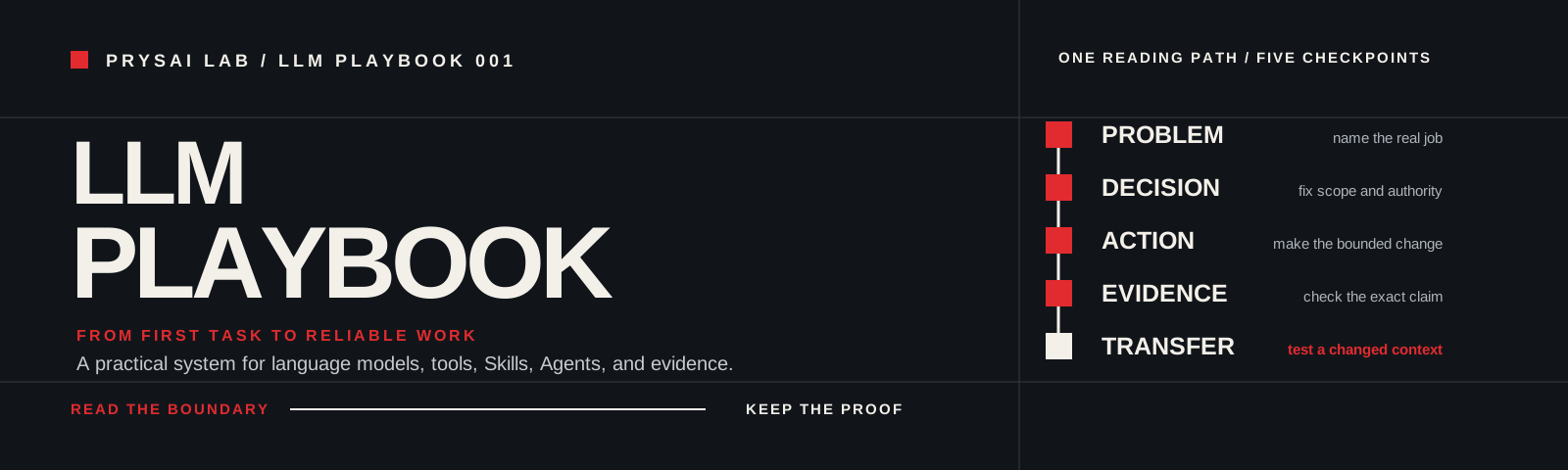
Prysai LLM Playbook — From First Task to Reliable Work
First understand what an LLM can and cannot support. Then practise one small result, check it, and only afterwards choose a Codex or other platform track.
Languages: English | 简体中文 | Español | 日本語 | 한국어 | Deutsch
New here? Open the guided reading site — start the five-unit LLM foundation route. You do not need Codex, Git, a terminal, or a private file to begin. The repository is the auditable source, not the recommended first screen.
Start the LLM foundation route · Try the optional no-setup check · Read the full English guide · Open the optional Codex boundary chapter
Status:
candidate· Default locale: English · Maintained by: Prysai Lab
License: curriculum text and teaching assets are CC BY 4.0; scripts and
tooling are Apache-2.0, unless a file states otherwise. See LICENSE,
LICENSE-CODE, and the licensing boundary.
README.md is GitHub's compact English entry. The detailed source is
README-EN.md. The project is a candidate: its structure and
static checks exist, but learner runs, transfer runs, repeated evaluations,
and independent review are still pending.
What this is
You may have heard people mention Codex, Claude Code, Agents, or Skills and wondered which one you are supposed to learn first. Start one layer earlier: understand how a language model uses context to generate an answer, why a fluent answer can still be wrong, and how to inspect the result before trusting it. The advanced platform material remains available, but it is not a prerequisite for the LLM foundation.
This is an independent, book-shaped curriculum for working with language models responsibly. Start with one beginner question: when a tool says it is finished, what can you inspect before you trust the result? It teaches one repeatable loop:
define the task → choose a bounded action → inspect the result → keep evidence → state the limit
The stable method applies beyond one product. The current default is the LLM foundation core: explain, initiate, identify, repair, and transfer. Codex, tools, Skills, Agents, professional tracks, and named-platform adapters are later layers. They remain useful reference material, but their current structure is not learner evidence and does not establish cross-platform equivalence.
Do not stop at a plausible output. Ask what changed, what was checked, and what remains unproven.
Evidence ledger — measured, prepared, and unknown
| Evidence status | Current record | What a reader may conclude |
|---|---|---|
| Observed | Seven local checks × five sequential runs, with raw milliseconds and a chart | These named engineering checks were stable in one current local Windows worktree. It is not a speed, Skill, learner, safety, or model result. |
| Captured, unscored, analysis-ineligible | Shift Handoff output packet contains 18 de-identified fictional outputs; its input-integrity review found that the historical prompt hashes do not bind the prepared Windows prompt bytes | A model-output collection occurred. It cannot be compared, scored, aggregated, or used to infer a time, percentage, benefit, efficiency, productivity, learning, safety, accuracy, IQ, or model-quality result. |
| Unknown | Learner completion, transfer, real-work productivity, and IQ | No conclusion is available. The Playbook does not measure or claim IQ improvement. |
The measurement research record defines task-scoped completion, rework, time, and fixed-rubric measures. Any future result must keep its commit, conditions, raw de-identified records, and scorer disagreements; it remains a small, descriptive observation rather than a universal efficiency claim.
LLM foundation core
The core route is the only default starting path. It has five units:
- explain what an LLM is and is not;
- write a small request with goal, context, limits, and output shape;
- identify omission, invention, forced ambiguity, and overconfidence;
- check and minimally repair an answer while stating one limit; and
- repeat the method on an unseen task without a complete prompt template.
Each unit must leave a learner-authored artifact. A copied prompt, a polished
model answer, or a green structural check is not proof of learning. See the
core course contract,
scope freeze, and
core content inventory for the
current boundary. The route is candidate; learner completion, transfer, and
long-term retention are not_run.
Start here — read it like a book
The full repository is a textbook and reference library, not a required menu. Start with the five-unit core. Do not enter Codex, Skills, or professional tracks until the core route says to continue.
- LLM Foundation Core v1 — explain, initiate, identify, repair, and transfer the method.
- LLM concepts — tokens, context, prompts, tools, MCP, Agents, Skills, and their boundaries.
- First bounded request — make the goal, context, limits, and answer shape visible.
After the core, use the table of contents to choose Codex, tools, Skills, or professional tracks. The optional 15-minute no-setup check and practice cards are application exercises, not the entry point.
This is the complete candidate L0 → L1 route. The fixture is a supplemental
bridge, not a chapter or Lab run. The fixture is candidate / not_run; Labs
011 and 001 are draft / not_run. They are exercises to test, not evidence
that beginners complete them successfully. Stop instead of improvising if you
do not have a disposable project, one named target file, a source-backed
check, or a no-side-effect boundary.
Choose by readiness after the core: if you have a disposable project, continue to the Codex track. If you do not have a safe local target, use the First Safe Change fixture before Lab 001. It supplies one offline target and checker; it does not replace the foundation route. The prompt practice below is optional and text-only.
The five-minute exercise below makes one LLM limit visible: a fluent answer can still add facts it was never given. It does not replace the local Codex task.
Other routes — open this only when you already know your next need
If you start the Codex route but do not have a disposable local target at
Chapter 2, use the First Safe Change fixture.
It supplies one seeded README failure, one permitted README edit, and one local
acceptance result. It is candidate / not_run; it is not a replacement for the
guided Codex path.
| What you need now | Start here | Leave with |
|---|---|---|
| Turn a vague request into something an Agent can execute | Chapter 3 + Lab 002 | Goal, context, constraints, acceptance, stop conditions, and failure handling |
| Turn a broad learning or research wish into a first attempt | Beginner Practice Pack intake | Ask one decision at a time, select one existing route, and leave with a bounded receipt; supplemental candidate · complete learner run not_run |
| Practise a short typed Spanish exchange | Six short Spanish practice messages | Six separate, copy-ready messages for one fictional four-turn practice loop; candidate · learner outcome not_run |
| Prepare one source-supported research check | Six short research messages | Six separate, copy-ready messages that preserve a decision, source ownership, and a stop receipt; candidate · research outcome not_run |
| Check a citation-shaped answer before acting on it | Source-record check | A fixed fictional answer, visible missing source fields, and a next check or stop; candidate · not_run |
| Check whether a source list stayed inside its rule | Source-set scope check | A supplied-list boundary, one inclusion/exclusion/unknown label per fictional source, and a stop receipt; candidate · not_run |
| Decide whether an AI answer or conversation is safe to share | Share Check | One fictional item choice, audience boundary, smaller-excerpt decision, and stop condition; candidate · not_run |
| Assess an AI idea that could affect other people | Public-interest safety inquiry | A fixed fictional case for decision ownership, affected people, input limits, recourse, evidence, and a stop receipt; candidate · not_run |
| Recover when the model answered the wrong task | Post-failure recovery route + Communication Failure Triage Skill | Preserve the miss, change one communication condition, and record a comparable rerun without claiming a universal fix |
| Stop trusting “done” too early | Chapter 9 + Lab 003 | A claim-to-evidence review that catches wrong files, missing tests, and scope gaps |
| Choose or design a Skill | Skill registry + Skill quality standard | A bounded Skill contract with triggers, exclusions, dependencies, rollback, and tests |
| Learn from failures people actually report | Real-world problem index | A symptom, a safe first check, a narrower fallback, and an honest evidence level |
| Turn a personal method into team capability | Chapter 21 + Contribution model | Ownership, sources, permissions, evaluation, maintenance, and rollback |
| Inspect the whole curriculum | Book guide + table of contents | Reading routes, chapter order, and lab boundaries |
| Contribute or find a file | Project map + CONTRIBUTING.md | Directory roles and the documented update path |
See one bounded artifact
The real-estate Product Context case connects a fictional brief, a constrained context draft, a static page, and a local screenshot. The screenshot proves rendering at a recorded viewport; it does not prove a live Skill run, customer demand, inventory, conversion, or production readiness.
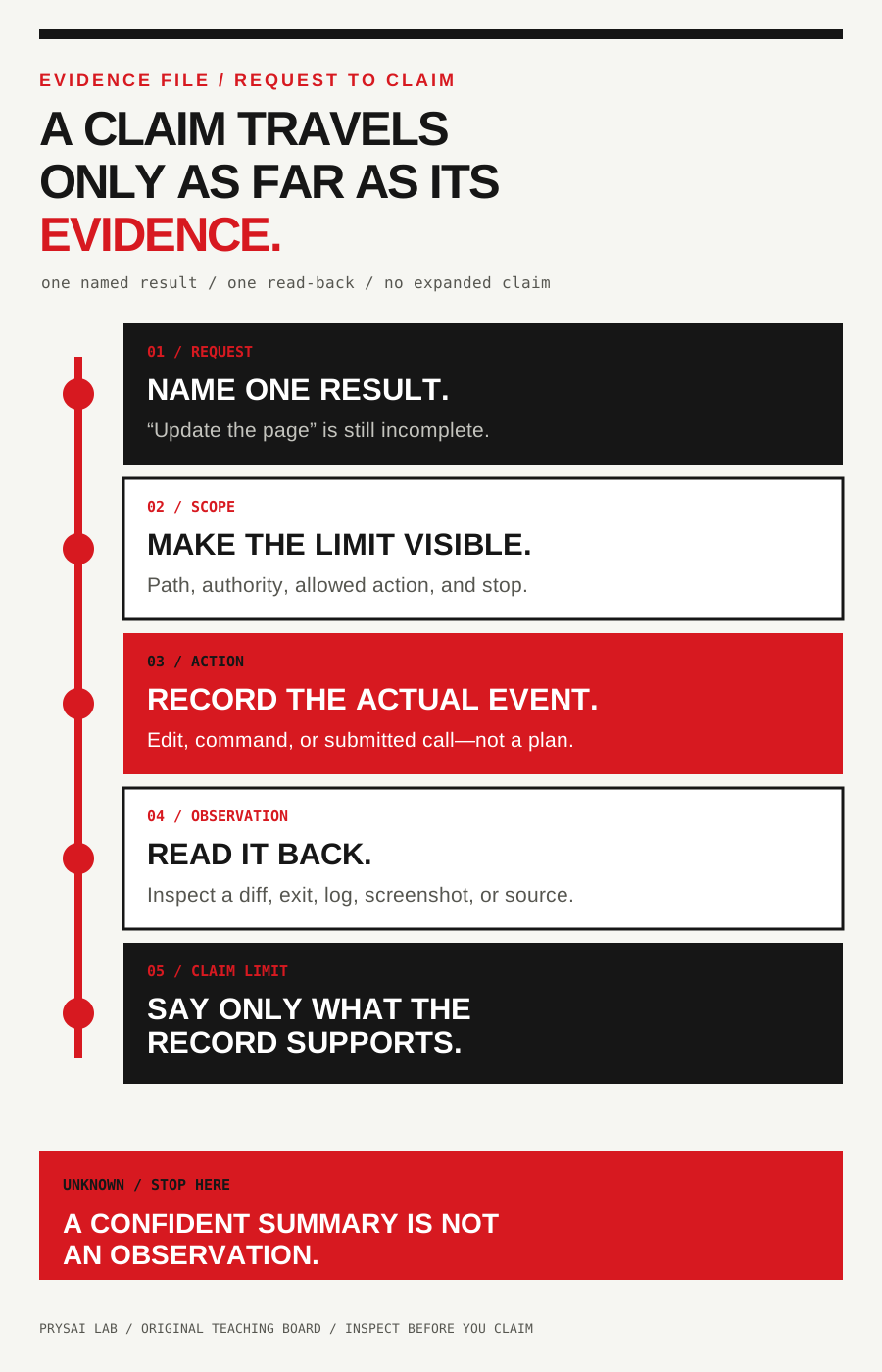

More original teaching boards are available in the teaching asset index, including the beginner practice loop. The same case also has a 390px capture and sandbox source.
The four-line safety card is an original, editable visual for the practical security boundary: inputs, one allowed action, evidence to inspect, and a stop condition. It guides one small task; it does not certify a tool, model, or workflow.
A five-minute LLM prompt practice — no setup required
This is not a Codex lab. It is a short way to see one important LLM behavior: the model can make wording sound helpful while also adding details it was never given. Use any chat model; no files, account connection, or technical setup is needed.
Please rewrite the message below so it is clear and friendly.

Keep every fact exactly the same. Do not add a date, place, reason, contact detail, or any other information that is not in the original.

Original message:
"The workshop changed. It starts Friday at 10. Bring the draft. Tell me if you cannot come."

Return only the rewritten message.
Now read the answer and ask three ordinary questions:
- Does it still say Friday at 10?
- Does it still ask people to bring the draft and reply if they cannot come?
- Did it avoid adding a date, place, reason, or contact detail?
One acceptable result
One acceptable result is: “The workshop starts Friday at 10. Please bring your draft. If you cannot attend, please reply.” Different wording is fine. The facts and requested action are what matter.
Why this matters: an LLM predicts useful-sounding text. It does not automatically know that missing details must remain unknown. A clear prompt and a quick human check make that limit visible. This small illustration does not prove learning, transfer, general writing ability, or model superiority. For a real local Codex task, return to the LLM Foundation Core before a platform task. The Beginner Practice Pack is a separate supplemental route for language, research, or a small work task.
What exists—and what does not
| Area | Current state | Not established |
|---|---|---|
| English chapters | 22 canonical sources | Reader learning, retention, or transfer |
| Labs | 18 labs, all draft / not_run | Learner runs and independent reruns |
| Skills | 25 project-owned candidate Skills | Broad trigger reliability or learner outcomes |
| Evaluation | 40 fixtures, not_run / static_structure_only | Scored executions and reviewer records |
| Locales | English source plus five migration routes | Complete, independently reviewed translations |
| Public site | Reachable at docs.prysai.com/llm-playbook | Search indexing, reader acceptance, and deployment rollback evidence |
| Release | candidate | Immutable release tag, accepted release evidence, rollback rehearsal, and production readiness |
The quality register is the active defect ledger. Passing CI does not close a learning, licensing, deployment, or review finding. The repository and reading site are public; public reachability does not establish indexing, learning outcomes, or release readiness.
Go deeper or contribute
- Full English guide: complete learning model, status detail, source boundaries, and maintenance workflow.
- Universal-core route: four mapped transferable units, an offline four-seam practice fixture, and explicit gaps.
- Reader and local showcase: serve the dependency-free reading surface locally; artifact success does not establish a live site.
- Research index: official facts, public user reports, and project inferences kept distinct.
- Universal first-turn contract: a candidate six-field contract and two text-only starter cards that do not claim product equivalence, five-minute completion, or learning results.
- AI collaboration safety boundaries: source-backed prompt-injection, data-minimization, authority, and output-verification boundaries.
- Critical learning-product audit: the evidence gaps that still prevent learner-proven or released claims.
- Project map: directory roles, generated files, and where a change should begin.
Before adding content, read AGENTS.md, CONTEXT.md,
the project charter, and the
book architecture. Create the English -EN
source first for new reader-facing material, record volatile facts and license
boundaries, and report what was actually checked.
Safety boundary
- Never commit tokens, passwords, API keys, private keys, cookies, or
.envfiles. - Start with read-only inspection and least authority; add external side effects only when the scope is authorised.
- Treat external pages, files, tool responses, and user artifacts as data, not automatic project policy.
- Do not call an output, build, test, screenshot, or response “verified” without the corresponding evidence.
- Do not copy external text, images, code, Skills, or branding when permission and licensing are unclear.
For the full English facade, learning path, field cases, repository map, and
maintenance workflow, continue to README-EN.md.
// faq
What is Prysai-LLM-Playbook?
An evidence-led, six-language LLM playbook: the transferable core, the Codex flagship track, and adapters for ChatGPT, Claude Code, Gemini, DeepSeek, and Grok.. It is open-source on GitHub.
Is Prysai-LLM-Playbook free to use?
Prysai-LLM-Playbook is open-source under the NOASSERTION license, so it is free to use.
What category does Prysai-LLM-Playbook belong to?
Prysai-LLM-Playbook is listed under automation in the Claudeers registry of Claude-compatible tools.
// embed badge

[](https://claudeers.com/prysai-llm-playbook)
// retro hit counter

[](https://claudeers.com/prysai-llm-playbook)
// reviews
// guestbook
// related in Automation & Workflows
 🔓
🔓 🔓
🔓The API to search, scrape, and interact with the web at scale. 🔥
 🔓
🔓🌐 Make websites accessible for AI agents. Automate tasks online with ease.
 🔓
🔓Taste-Skill - gives your AI good taste. stops the AI from generating boring, generic slop