
Z.A.E.B.A.L
Profanity-triggered self-audit protocol for coding agents (Claude Code, Codex CLI, Kimi CLI, OpenCode). Python stdlib only.
Install with your AI
Paste into Claude Code, Cursor, or any agent — it reads the repo and wires the tool into your project.
Install and set up Z.A.E.B.A.L (git-clone project) into my current project.
Found on https://claudeers.com/zaebal
Repo: https://github.com/howdeploy/Z.A.E.B.A.L
Homepage/docs: —
Detected install method: git-clone → git clone https://github.com/howdeploy/Z.A.E.B.A.L
Category: other. Platforms: cli, api, web.
Read the repo's README for exact setup and env vars, then install it and wire it into my project.

Claudeers Health Verdict:
active; community-verified: false. Confirm the source before running anything.
git clone https://github.com/howdeploy/Z.A.E.B.A.L
// compatibility
| Platforms | cli, api, web |
|---|---|
| Operating systems | — |
| AI compatibility | claude |
| License | — |
| Pricing | open-source |
| Language | Python |
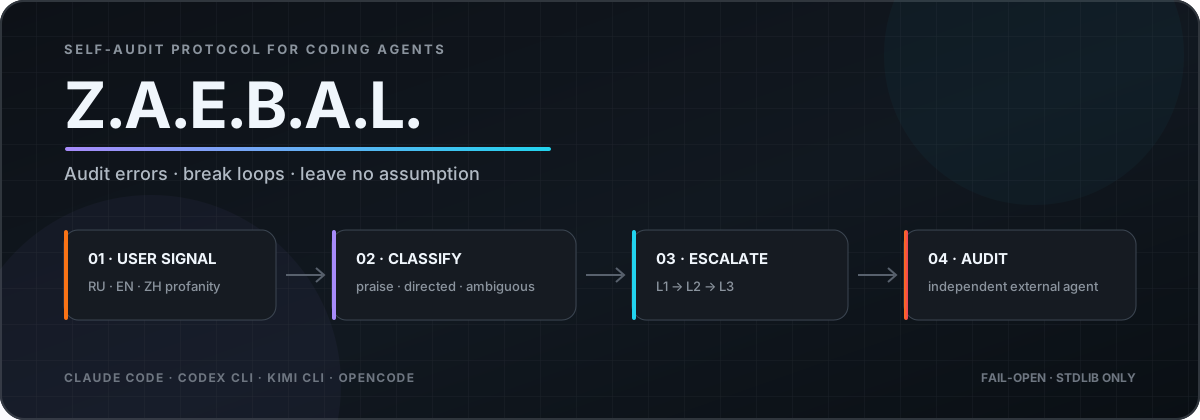
Zaebal? · Audit · Errors · Break · Analyze · Leave no assumption
Read this in other languages
🇺🇸 English ·
🇷🇺 Русский ·
🇨🇳 简体中文
Profanity-triggered self-audit for coding agents.
Z.A.E.B.A.L. treats user frustration as an operational signal: stop, re-check the
agent's assumptions, and escalate repeated failures to an independent auditor.
Capabilities · How it works · Install · Configuration · Architecture
Why it exists
When a coding agent gets stuck, it often repeats the same action with small variations because one underlying belief about the task or codebase is wrong. The agent still treats that belief as a fact, so another self-check can reproduce the same mistake.
Z.A.E.B.A.L. adds a feedback loop to the user-message boundary:
- profanity and direct complaints become an audit signal;
- positive profanity such as “fucking great” does not add to the streak and closes an active incident as an acknowledgment;
- repeated signals escalate from a local protocol to a full stop;
- at level 3, an external agent reads the transcript and repository evidence;
- work resumes only after an explicit user acknowledgment.
The current release does not install a technical tool lock. The protocol changes the agent's instructions and asks it to stop; the human always retains the final control.
Mutation-lock feasibility
Research completed on 2026-07-31 shows that a blocking mutation STOP is technically possible on all four adapters, but with different guarantees:
| Host | Blocking surface | Feasibility and caveat |
|---|---|---|
| Claude Code | PreToolUse can deny Bash, edit/write tools, and MCP calls. | Yes. Exit 2 or a structured deny blocks before execution; hook configuration still remains under host/user control. |
| Codex | PreToolUse can deny Bash, apply_patch, MCP, and local function tools. | Yes, broad coverage. Tool-coverage exceptions mean it is a guardrail rather than an absolute sandbox. |
| Kimi CLI | PreToolUse blocks with exit 2 or structured deny. | Yes, fail-open. A hook error, crash, or timeout allows the operation. |
| OpenCode | tool.execute.before can reject a tool call; permission can deny edit and shell actions. | Yes. A durable lock should combine protocol state with host permissions instead of relying only on a plugin exception. |
No lock or state machine is added yet. The text fixes and incident telemetry should first show whether a discipline-based STOP remains insufficient.
Capability map
| Capability | What it does | Implementation |
|---|---|---|
| Multilingual detection | Detects Russian, English, and Chinese profanity, including punctuation-separated and common leetspeak forms. | core/wordlists/{ru,en,zh}.txt + NFKC normalization |
| Intent classification | Separates praise, directed complaints, and ambiguous frustration before changing the streak. | classify(); weights 0, 1.0, and 0.5 |
| Session escalation | Tracks each session in a 30-minute sliding window and selects L1, L2, or L3. | Atomic JSON state + POSIX fcntl lock |
| Three audit protocols | Injects increasingly strict instructions: independent checks, assumption inventory, and full stop. | core/protocol/L1.md → L3.md |
| External auditor | Runs the same or a cross-vendor CLI against the transcript tail and repository evidence. | Claude, Codex, Kimi, or OpenCode |
| Four host adapters | Hooks Claude Code, Codex CLI, Kimi CLI, and OpenCode at user-message submission. | JSON hooks, TOML hook, or TypeScript plugin |
| Explicit recovery | Resets the incident only after acknowledgment such as continue, продолжай, or по плану. | Per-session state lifecycle |
| Metadata telemetry | Appends trigger, auditor, verdict, and acknowledgment events without message contents. | ~/.zaebal/incidents.jsonl |
| Fail-open safety | A malformed payload, missing auditor, timeout, or internal error never breaks the host session. | Silent exit 0; auditor errors become context |
How it works
User message
    │
    ▼
Host adapter
UserPromptSubmit / chat.message
    │
    ▼
core/zaebal.py
normalize → detect → classify
    │
    ├─ clean / praise ───────────────────────────────► silence
    │
    └─ directed (+1.0) / ambiguous (+0.5)
                         │
                         ▼
                per-session streak
                         │
              ┌──────────┼──────────┐
              ▼          ▼          ▼
             L1         L2         L3
              │          │          ├─ external auditor
              └──────────┴──────────┴─ protocol injected into context
Escalation levels
| Level | Streak weight | Agent behavior | External auditor |
|---|---|---|---|
| L1 | 1–1.5 | Stop, run two independent checks, inventory assumptions, prepare a micro-plan. | Optional |
| L2 | 2–3.5 | Remove unverified assumptions and compare the work against the original request. | Disabled by default |
| L3 | 4+ | Stop all agents and background work; show the user the belief, evidence, and mismatch. | Enabled by default |
Directed complaints add 1.0; profanity without a detected addressee adds 0.5.
The window is 30 minutes. Calm questions do not reset it. Genuine praise or an explicit
acknowledgment does.
Install
Requirements:
python3; the core uses only the standard library;- at least one supported agent CLI if external auditing is enabled.
From the repository root:
chmod +x install.sh
./install.sh
The installer detects available hosts, copies the core to ~/.zaebal/, and updates only
the relevant user configuration:
| Host | Integration | Default auditor command |
|---|---|---|
| Claude Code | UserPromptSubmit in ~/.claude/settings.json | claude -p with Read,Grep,Glob only |
| Codex CLI | UserPromptSubmit in ~/.codex/hooks.json | codex exec --sandbox read-only |
| Kimi CLI | hook block in ~/.kimi-code/config.toml | kimi -p |
| OpenCode | plugin in ~/.config/opencode/plugins/zaebal.ts | opencode run |
Installation is idempotent: existing Z.A.E.B.A.L. hook entries are replaced, while
unrelated settings and ~/.zaebal/config.json are preserved. Restart active agent
sessions after installation.
Verify the hook
Run the core directly without touching your normal state:
echo '{"session_id":"demo","prompt":"ты меня заебал"}' \
  | ZAEBAL_STATE_DIR="$(mktemp -d)" python3 core/zaebal.py --host kimi
The output should contain <zaebal level="1">.
Positive profanity should remain silent:
echo '{"session_id":"demo-praise","prompt":"this is fucking great"}' \
  | ZAEBAL_STATE_DIR="$(mktemp -d)" python3 core/zaebal.py --host kimi
Configuration
Defaults live in core/config.json. User overrides live in
~/.zaebal/config.json and are loaded on the next trigger:
{
  "auditor": "same",
  "audit_levels": [3],
  "auditor_timeout_sec": 90,
  "auditor_command": "",
  "transcript_tail_chars": 12000
}
| Key | Default | Meaning |
|---|---|---|
auditor | "same" | Same vendor as the host, a specific kimi / claude / codex / opencode, or "none". |
audit_levels | [3] | Levels that synchronously invoke an external auditor. Use [2, 3] for earlier audits. |
auditor_timeout_sec | 90 | Maximum time to wait for the auditor response. |
auditor_command | "" | Custom command; the audit prompt is appended as the final argument. |
transcript_tail_chars | 12000 | Maximum transcript tail sent to the auditor. |
Example: use Claude to audit a Codex session:
{
  "auditor": "claude"
}
Architecture
zaebal/
├── core/
│   ├── zaebal.py          # detection, state, escalation, transcript and auditor
│   ├── config.json        # default runtime configuration
│   ├── protocol/          # L1.md, L2.md, L3.md
│   └── wordlists/         # ru.txt, en.txt, zh.txt
├── adapters/
│   ├── claude-code/       # JSON hook example
│   ├── codex/             # JSON hook example
│   ├── kimi-cli/          # TOML hook block
│   └── opencode/          # chat.message plugin
├── skills/zaebal/         # agent-facing protocol and configuration reference
├── tests/                 # unit and end-to-end contract tests
├── install.sh             # idempotent host integration
└── uninstall.sh           # hook removal and config backup
The Python core is the single source of runtime behavior. Host adapters only translate their event payload into the shared JSON contract and inject non-empty stdout back into the agent context.
Runtime state is stored under ~/.zaebal/:
~/.zaebal/
├── core/          # installed copy
├── config.json    # optional user overrides
├── state.json     # per-session weighted trigger history
├── incidents.jsonl # metadata-only trigger and acknowledgment events
└── state.lock     # POSIX lock for concurrent hooks
The auditor subprocess receives ZAEBAL_INTERNAL=1, preventing the globally installed
hook from reacting to profanity quoted inside its own audit prompt.
Tests
cd tests
python3 -m unittest test_zaebal -v
The suite covers normalization, RU/EN/ZH detection, meta-mention false positives, praise handling, weighted escalation, concurrent state writes, telemetry, portable installer paths, acknowledgment, anti-recursion, auditor sandbox arguments, failures, and end-to-end protocol injection.
Known limitations
- Detection is heuristic. Sarcasm and unusual context can still produce false positives or false negatives.
- The detector does not identify non-profane action loops; adding a general loop detector would be a separate product with its own false-positive model.
- State locking uses POSIX
fcntl; concurrent hooks on Windows can lose updates. - The Kimi and OpenCode auditor commands are not technically sandboxed by Z.A.E.B.A.L.; they rely on the audit prompt and any restrictions already configured in those hosts.
- External audits are synchronous on configured levels, so the user waits for the auditor or timeout.
Uninstall
./uninstall.sh
Hooks, the OpenCode plugin, installed skills, and ~/.zaebal/ are removed. If a user
configuration exists, it is copied to ~/zaebal-config.backup.json first.
// faq
What is Z.A.E.B.A.L?
Profanity-triggered self-audit protocol for coding agents (Claude Code, Codex CLI, Kimi CLI, OpenCode). Python stdlib only.. It is open-source on GitHub.
Is Z.A.E.B.A.L free to use?
Z.A.E.B.A.L is open-source, so it is free to use.
What category does Z.A.E.B.A.L belong to?
Z.A.E.B.A.L is listed under other in the Claudeers registry of Claude-compatible tools.
// embed badge

[](https://claudeers.com/zaebal)
// retro hit counter

[](https://claudeers.com/zaebal)
// reviews
// guestbook
// related in Other
 🔓
🔓 🔓
🔓Anti-AI-slop design skill for Claude Code, Cursor, and Codex.
 🔓
🔓Open source Ghostty-based macOS terminal with vertical tabs and notifications for AI coding agents. Built for multitasking, organization, and programmability.
 🔓
🔓Huashu Design · HTML-native design skill for Claude Code · Claude Code 里 HTML 原生的设计 skill · 高保真原型 / 幻灯片 / 动画 + 20 设计哲学 + 5 维评审 + MP4 导出 · Agent-agnostic