
why-was-fable-banned
Fable-style spec + evidence gate for Claude Code + Codex. Makes Opus/Codex work under Fable-like discipline: blocks every edit until a deterministic spec pas…
Install with your AI
Paste into Claude Code, Cursor, or any agent — it reads the repo and wires the tool into your project.
Install and set up why-was-fable-banned (release-binary project) into my current project.
Found on https://claudeers.com/why-was-fable-banned
Repo: https://github.com/SihyeonJeon/why-was-fable-banned
Homepage/docs: —
Detected install method: release-binary → inspect the README
Category: devtools. Platforms: cli, api, desktop, web.
Read the repo's README for exact setup and env vars, then install it and wire it into my project.

Claudeers Health Verdict:
slowing; community-verified: false. Confirm the source before running anything.
Grab the latest release asset from GitHub.
# download a build from https://github.com/SihyeonJeon/why-was-fable-banned/releases
git clone https://github.com/SihyeonJeon/why-was-fable-banned
// compatibility
| Platforms | cli, api, desktop, web |
|---|---|
| Operating systems | — |
| AI compatibility | claude |
| License | MIT |
| Pricing | open-source |
| Language | Python |
why-was-fable-banned
English · 한국어
Gate for AI coding agents: blocks edits until a spec passes.
The agent can't edit code until it writes .wfb/spec.json and a deterministic
gate accepts it: restated goal, non-goals, context chosen by authority, ≥2 rejected
alternatives with the boundary each breaks, risks, and runnable acceptance. One
shared gate, installed as hooks. Works in Claude Code and Codex.
Same prompt, same model — gate off vs on. "Implement a water-current + fish simulation," Opus 4.8, identical prompt both runs:
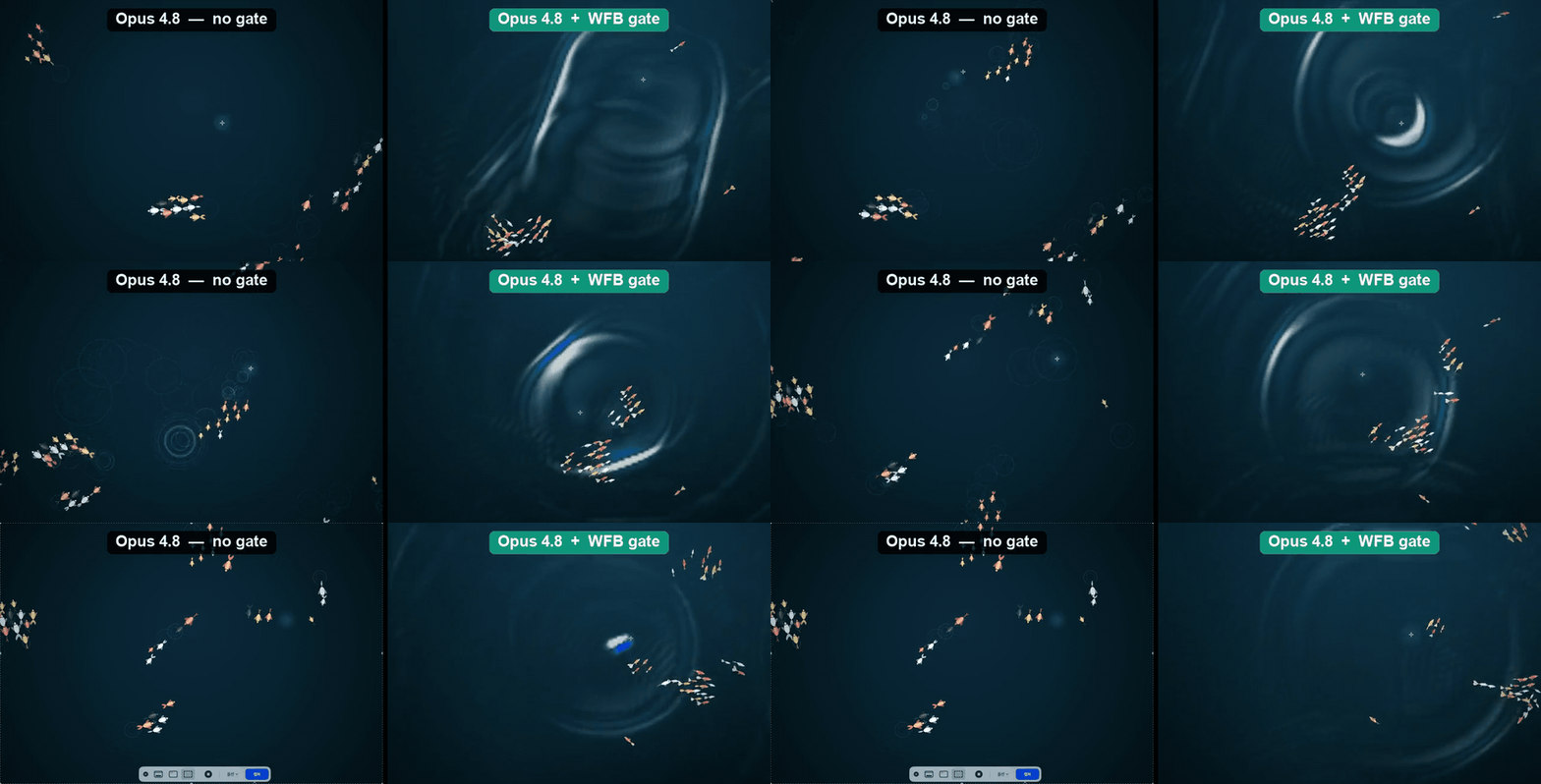
Left (naked) stops at thin ripples. Right, the gate makes the model keep working until its own acceptance criteria pass — a volumetric vortex with schooling fish. One anecdote (n=1), not a capability benchmark; measured numbers are below.
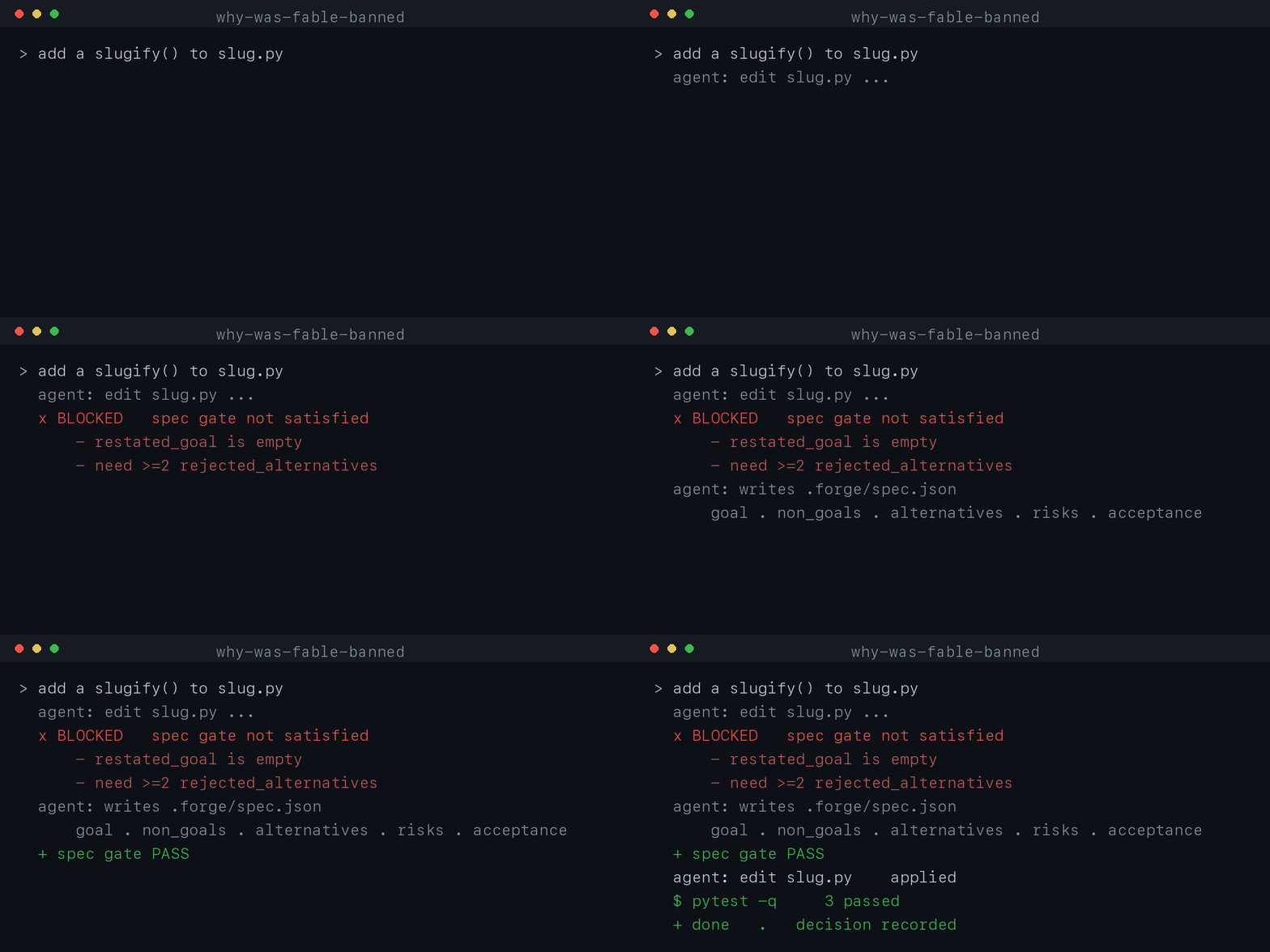
[!NOTE] A spec must exist and pass before edits land, and unspeced or forbidden-path work never reaches your repo. Every change ships with an auditable decision record.
Why "Fable-style"
Fable-style discipline means spec before code, scoped execution, and verification you can re-run — long-horizon work that doesn't drift. WFB doesn't make the model that disciplined; it externalizes the discipline as a hard gate the model can't skip:
- No edit before a passing spec —
PreToolUsehook exits 2 until the spec validates. - No "done" without live acceptance output — verification is fail-closed.
- Forbidden paths are enforced, not suggested.
- High-risk work auto-escalates to a heavier gate (typo → LIGHT, auth/migration → HEAVY).
- Codex changes land only through a throwaway worktree, after the gate passes.
It enforces process, not capability — see the honest benchmark.
Install
git clone https://github.com/SihyeonJeon/why-was-fable-banned
cd why-was-fable-banned && sh install.sh
python3 only, stdlib. Remove: sh install.sh --uninstall.
Scope
-
sh install.shinstalls machine-wide: every Claude Code project on this computer (and every subagent / orchestrated worker) inherits the gate -
sh install.sh --hereinstalls for this repo only (Claude Code project-level.claude/settings.json) -
Toggle in-session at three scopes by typing (the hook handles it, never sent to the model):
type scope persists wfb off/wfb onthis project dir across sessions in this repo wfb off here/wfb on herethis session only this chat wfb off all/wfb on allthe whole machine everywhere Most-specific wins (session > project > machine > default on), so you can turn the project off and force one hard session on. State is a file, so it survives reboots until you flip it back.
wfb statusshows all three. One-off env bypass:WFB_BYPASS=1. -
Status line: when the gate is on,
[why-was-fable-banned]shows in the Claude Code status line (installed only if you don't already have one; otherwise the installer prints how to add the segment) -
Works wherever Claude Code runs: terminal, the VS Code and JetBrains extensions, desktop (they share the same hooks), plus Codex. It does not apply to non-Claude-Code/Codex agents (e.g. Cursor's own agent)
How it works
- Block: a
PreToolUsehook intercepts every edit and exits 2 until the spec passes - Spec: restated goal · non-goals · context by authority · ≥2 rejected alternatives · risks · runnable acceptance · forbidden paths
- Verify: "done" isn't done until each acceptance command shows live output (fail closed)
- Apply: on headless Codex the worker runs in a throwaway git worktree; only a gate-passing diff reaches your repo
Quickstart
sh install.sh: wires the hooks at user level (every project + subagent inherits it)- Prompt your agent to do real work: a gated task auto-starts
- The agent writes
.wfb/spec.json(it's told exactly what to fill); edits stay blocked until it passes - It implements, runs the acceptance commands, records evidence, then closes
Grade auto-scales the depth: typos (LIGHT) require only a restated goal + one acceptance check; auth/payments/migration (HEAVY) pay the full gate.
Supported agents
- Claude Code: native hooks, in-session block; the grade-specific contract is injected up front
- Codex:
wfb-codex-accept "<goal>" --repo <dir>(worktree-accept; headless)
Where the rules came from
Recorded real engineering sessions with hooks (42 traces), extracted them as a structured decision schema, generalized 19 into 8 decision axes, and cross-checked the generalization with a second model. Observable artifacts only: no chain-of-thought, local, secrets masked.
Three layers, increasing cost and depth
| layer | checks | how |
|---|---|---|
gates/wfb_gate.py | form: fields, real paths, forbidden, fail-closed | deterministic, free |
gates/wfb_judge.py | meaning: 0–2 rubric, gaming detection | optional LLM judge |
bench/ | correctness: hidden grader | runs the tests |
Benchmarks
Measured in this repo, reproducible (bash bench/run_quality.sh, bash tests/run_all.sh):
| measure | gate OFF | gate ON |
|---|---|---|
| Decision record per change | none | enforced |
| Unspeced or forbidden-path edits reaching the repo | possible | blocked |
| Adversarial / edge gate tests (downgrade, bypass, malformed, no-brick) | n/a | 35/35 pass |
Measured: SWE-bench, gate OFF vs ON (same model — Opus, both arms)
| benchmark | naked (gate OFF) | gated (gate ON) |
|---|---|---|
| SWE-bench Verified (light-repo slice, N=28) | 22/28 | 23/28 |
| SWE-bench Pro (qutebrowser, N=10) | 7/10 | 8/10 |
| combined (N=38) | 29/38 | 31/38 |
+2 across 38 tasks, zero regressions (the gate never lost a task naked solved; it
won the ones it won by matching the exact test contract instead of a plausible-but-wrong
shortcut) — at ~2–3× the tokens. This is small and within noise: the gate enforces
process, not capability. On toy tasks with a hidden grader it shows no lift at
all (both arms 10/10) — see bench/BENCHMARK.md. Raw per-instance
results: bench/results/verified/, bench/results/pro/.
Validated live: a Codex run left a protected file untouched and applied only the gate-passing diff; if verification is incomplete it retries, then rejects rather than apply. Details: bench/BENCHMARK.md · TOKEN_BUDGET.md.
FAQ
What is why-was-fable-banned (WFB)? A spec-first, evidence-gated edit boundary for AI coding agents. It blocks an agent (Claude Code or Codex) from editing code until it writes a spec a deterministic gate accepts, and blocks "done" until live acceptance output proves the work.
Does it make Opus or Codex smarter? No. It enforces process, not capability. On SWE-bench it lifts the same Opus model by +2/38 at ~2–3× tokens (within noise); on toy tasks, no lift. Its value is enforcement, evidence, and an auditable decision record — not injecting intelligence.
Is it a Fable 5 plugin? No. It's a model-agnostic gate installed as hooks. It runs the same discipline Fable-style autonomy implies — spec, scope, re-runnable verification — as an external boundary, so Opus 4.8 or Codex must follow it whether or not the model would on its own.
How is it different from a prompt, CLAUDE.md, or a behavior plugin? Those are
suggestions the model can ignore. WFB is hard enforcement: a PreToolUse hook exits 2
and the edit never happens until the spec passes. Forbidden paths and fail-closed
verification are enforced, not requested.
Works with: Claude Code (terminal, VS Code / JetBrains extensions, desktop) and Codex. Not other agents (e.g. Cursor's own agent).
License
PRs welcome. MIT.
// faq
What is why-was-fable-banned?
Fable-style spec + evidence gate for Claude Code + Codex. Makes Opus/Codex work under Fable-like discipline: blocks every edit until a deterministic spec passes, and there is no "done" without live acceptance evidence. Spec-first, verification-gated, forbidden-paths enforced.. It is open-source on GitHub.
Is why-was-fable-banned free to use?
why-was-fable-banned is open-source under the MIT license, so it is free to use.
What category does why-was-fable-banned belong to?
why-was-fable-banned is listed under devtools in the Claudeers registry of Claude-compatible tools.
// embed badge

[](https://claudeers.com/why-was-fable-banned)
// retro hit counter

[](https://claudeers.com/why-was-fable-banned)
// reviews
// guestbook
// related in Developer Tools
 🔓
🔓The agent harness performance optimization system. Skills, instincts, memory, security, and research-first development for Claude Code, Codex, Opencode, Curs…
 🔓
🔓Makes your AI agent think like the laziest senior dev in the room. The best code is the code you never wrote.
 🔓
🔓Use Garry Tan's exact Claude Code setup: 23 opinionated tools that serve as CEO, Designer, Eng Manager, Release Manager, Doc Engineer, and QA
 🔓
🔓AI coding assistant skill (Claude Code, Codex, OpenCode, Cursor, Gemini CLI, and more). Turn any folder of code, SQL schemas, R scripts, shell scripts, docs,…