
useagent
Hand off the work. Get back the result. The open-source AI coworker for your team: agents with their own cloud computer, your tools and context, handing back…
Install with your AI
Paste into Claude Code, Cursor, or any agent — it reads the repo and wires the tool into your project.
Install and set up useagent (git-clone project) into my current project.
Found on https://claudeers.com/useagent
Repo: https://github.com/useagenthq/useagent
Homepage/docs: https://useagent.org
Detected install method: git-clone → git clone https://github.com/useagenthq/useagent
Category: devtools. Platforms: cli, api, desktop, web.
Read the repo's README for exact setup and env vars, then install it and wire it into my project.

Claudeers Health Verdict:
active; community-verified: false. Confirm the source before running anything.
git clone https://github.com/useagenthq/useagent
// compatibility
| Platforms | cli, api, desktop, web |
|---|---|
| Operating systems | — |
| AI compatibility | claude |
| License | AGPL-3.0 |
| Pricing | open-source |
| Language | TypeScript |
useAgent
Hand off the work. Get back the result.
The open-source AI coworker for your team.
Quick Start · Self-hosting · Documentation · Architecture
Alpha software. useAgent is under active development: expect rough edges, and APIs/schemas may change between releases. It already runs real daily workloads, but pin a tag if you need stability.
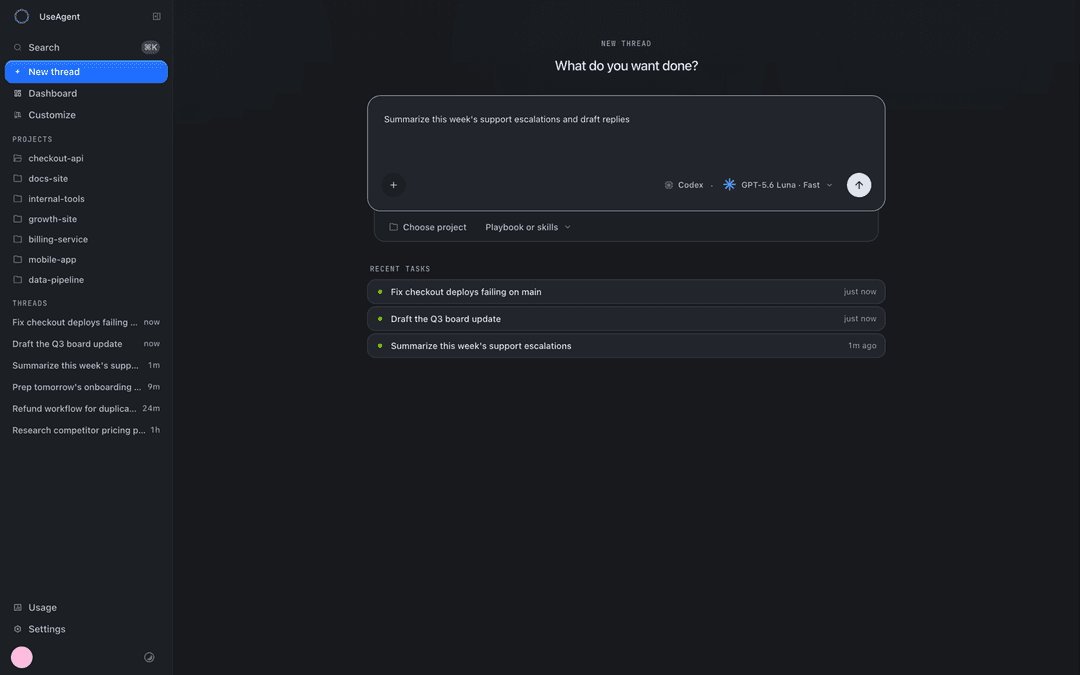
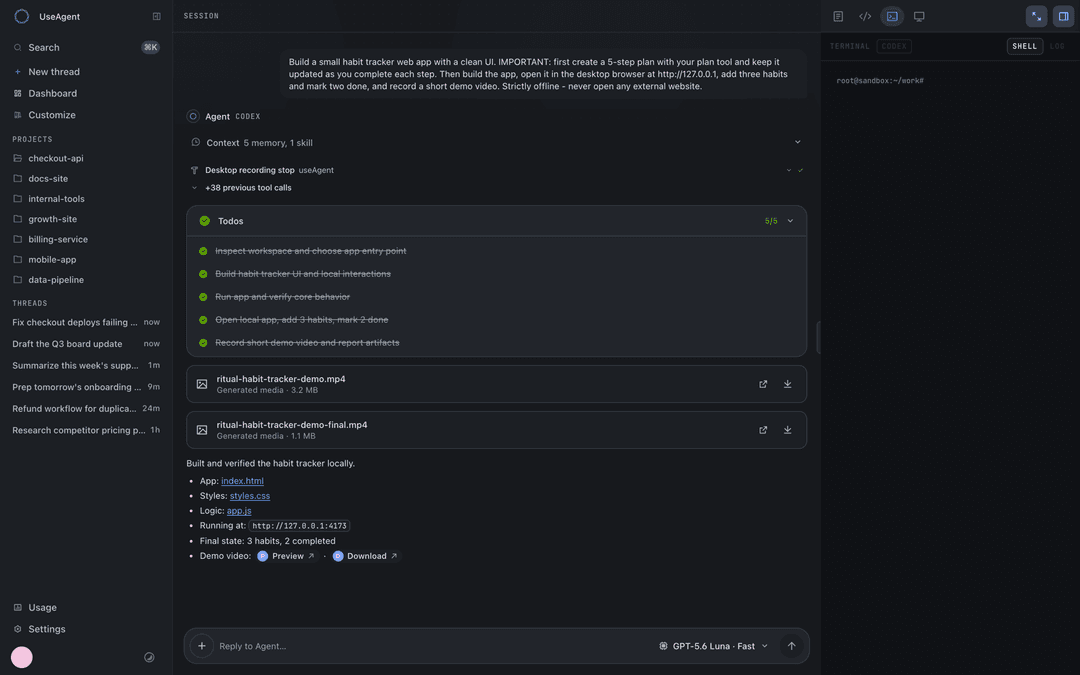
useAgent turns the AI agents you already use - Claude Code, Codex, OpenCode - into coworkers with their own cloud computer, your tools, and your company context. They hand back finished work, not just answers: live websites, decks, spreadsheets, research reports, and tested pull requests.
Under the hood: durable, threaded sessions in isolated Linux sandboxes. One event contract, one UI, your infrastructure.
Every run is an event-sourced timeline in Postgres: it survives restarts, renders through one session grammar regardless of engine, and stays inspectable after the fact.
Features
- Any agent, one interface - Codex (API key or ChatGPT subscription), Claude Code, and OpenCode behind one provider-neutral event contract.
- Durable runs - runs survive backend restarts; recovery re-probes live sessions and adopts finished work instead of failing it.
- Real sandboxes - each thread gets an isolated Linux workstation: terminal, repositories, browser, and a visible desktop (noVNC) with MP4 recording. Daytona and Cube behind one sandbox contract.
- Trusted gateway - credentials never enter the sandbox; knowledge, memory, skills, GitHub, web search, desktop control, and artifact publishing are typed tools served by the backend.
- Human-in-the-loop - destructive tools pause on an approval card (web or Slack) and resume with a one-shot, argument-bound capability.
- Skills from GitHub - import
SKILL.mdfiles as versioned skills, auto-resync, and rank them into every turn. - Knowledge, wiki, and team memory - org-scoped retrieval with citations and a human-reviewed learning lane.
- Slack-native - mention-to-run, threaded replies, attachments, artifacts, and approvals in the thread.
- Native artifacts - DOCX, XLSX, PPTX, and PDF with revisioned editing and native renderers.
Integrations
Work arrives from anywhere and tools stay behind the gateway:
| Channels in | Web app, Slack, REST API, schedules - every channel enters through the same run door |
| Native | Slack (mentions, threads, approvals, delivery), GitHub (App auth, clones, PRs) |
| Via connectors | Gmail, Linear, Notion, HubSpot - OAuth handled by the broker, tokens sealed server-side |
| Workspace surfaces | Knowledge base, team memory, skills and playbooks, scheduled automations |
Quick Start
Requires bun and Postgres 16+ with the pgvector extension (stock Postgres images do not include it). No Postgres handy? One container does it:
docker run -d --name useagent-pg -p 5432:5432   -e POSTGRES_HOST_AUTH_METHOD=trust pgvector/pgvector:pg16
export DATABASE_URL=postgres://postgres@localhost:5432/postgres
for workspace in \
  packages/agent-harness packages/artifact-workspace \
  packages/agent-client packages/artifact-formats packages/conformance \
  backend frontend; do
  (cd "$workspace" && bun install)
done

bun run dev:backend    # API + orchestration on :3201
bun run dev:frontend   # UI on :3400 (proxies /api/* to the backend)
bun run typecheck covers every package.
Self-hosting
useAgent runs on any Linux host - AWS, Google Cloud, Azure, Hetzner, or
bare metal. See infra/self-host/ for the full
guide, including the one-command Hetzner reference host (Terraform) and the
provider-agnostic deploy-app.sh:
SERVER_IP=<host-ip> PG_PASSWORD=... OPENROUTER_API_KEY=... \
  infra/self-host/deploy-app.sh /path/to/this/repo
Sandboxes are pluggable: Daytona (managed service - pairs with a host on
any cloud, easiest start) or CubeSandbox (self-hosted runtime on your own
hardware - full data locality). Production deploy lanes are documented in
infra/self-host/; the provisioning is provider-agnostic
and addresses the host over SSH.
Architecture
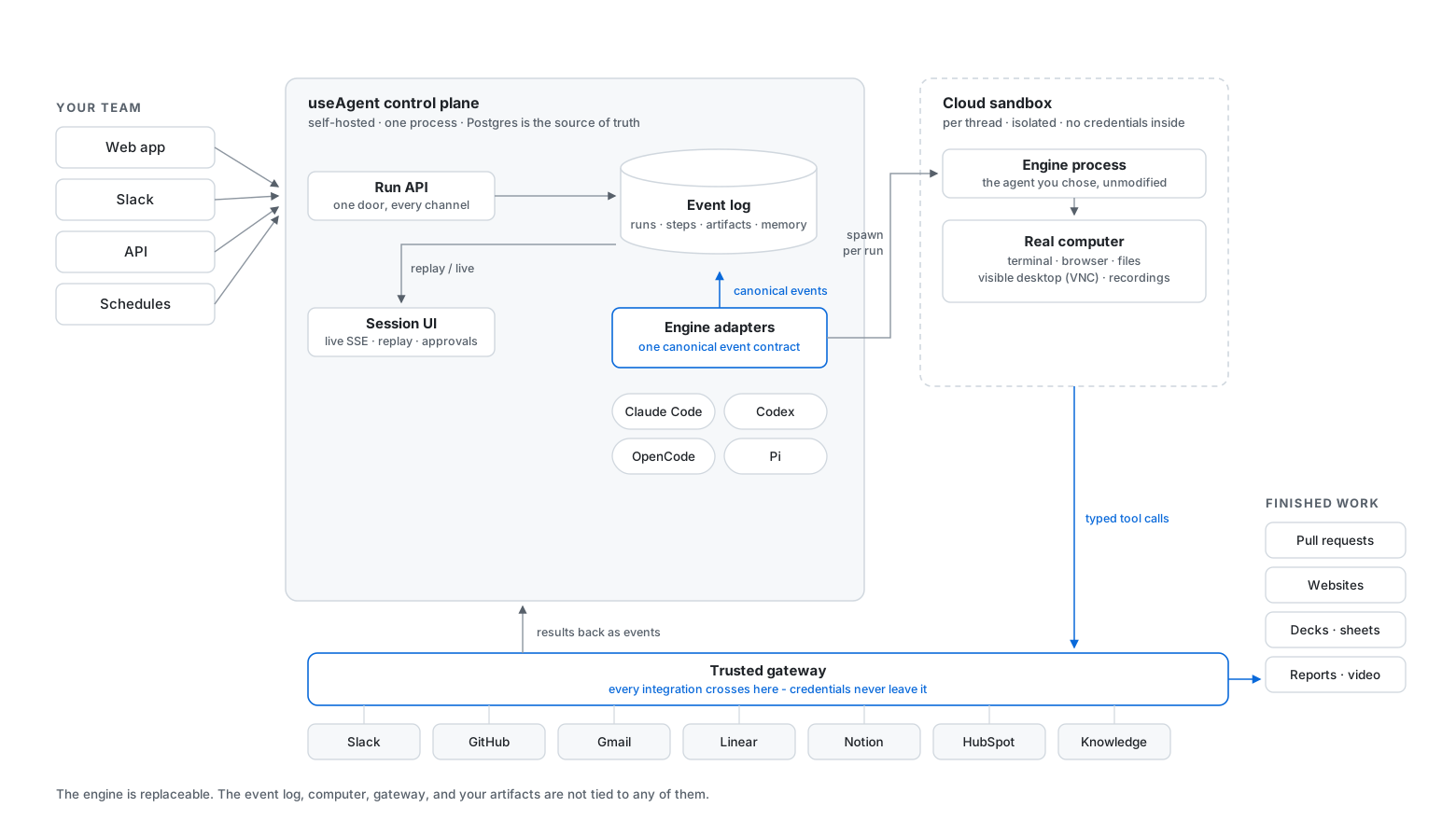
Three properties do the heavy lifting:
- The engine is a plug. Claude Code, Codex, OpenCode, and Pi all speak one canonical event contract through the engine adapters - swap engines and your threads, artifacts, and memory stay.
- Every run is an event log. Postgres is the source of truth: runs survive backend restarts, replay exactly, and stay inspectable after the fact.
- Credentials never enter the sandbox. The agent's computer is isolated; every integration call crosses the trusted gateway as a typed tool, and the keys live only on your control plane.
| Path | What it owns |
|---|---|
frontend/ | Product UI: chat, sessions, skills, playbooks, wiki, artifacts, automations, settings |
backend/ | Control plane: auth, runs, sandboxes, engines, knowledge, memory, artifacts, connectors |
packages/ | Shared contracts: thread events, canonical engine events, workpieces, renderers |
docs-site/ | Documentation site: concepts, architecture, API, operations |
infra/self-host/ | Self-hosting on any provider + Hetzner reference Terraform |
memory/ | Optional team-memory service |
Deeper reading: the documentation site and the interactive request-flow diagram.
The additive immutable-container release lane is documented in
docs/operations/immutable-releases.md.
License
useAgent is free and open-source software under the GNU AGPL v3.0 (AGPL-3.0-only). You may use, modify, and self-host useAgent under the AGPL.
If you want to embed useAgent into proprietary software, distribute it without AGPL obligations, build an OEM or white-label product, or obtain different terms, a commercial license is available.
Contributions are accepted under the CLA. The useAgent name and logo are covered by the trademark policy, not the code license. Third-party components are listed in NOTICE; vendored and ported files carry per-file attribution headers.
// faq
What is useagent?
Hand off the work. Get back the result. The open-source AI coworker for your team: agents with their own cloud computer, your tools and context, handing back finished work - websites, decks, spreadsheets, reports, PRs. Runs Claude Code, Codex, OpenCode on your subscription.. It is open-source on GitHub.
Is useagent free to use?
useagent is open-source under the AGPL-3.0 license, so it is free to use.
What category does useagent belong to?
useagent is listed under devtools in the Claudeers registry of Claude-compatible tools.
// embed badge

[](https://claudeers.com/useagent)
// retro hit counter

[](https://claudeers.com/useagent)
// reviews
// guestbook
// related in Developer Tools
 🔓
🔓The agent harness performance optimization system. Skills, instincts, memory, security, and research-first development for Claude Code, Codex, Opencode, Curs…
 🔓
🔓Makes your AI agent think like the laziest senior dev in the room. The best code is the code you never wrote.
 🔓
🔓Use Garry Tan's exact Claude Code setup: 23 opinionated tools that serve as CEO, Designer, Eng Manager, Release Manager, Doc Engineer, and QA
 🔓
🔓AI coding assistant skill (Claude Code, Codex, OpenCode, Cursor, Gemini CLI, and more). Turn any folder of code, SQL schemas, R scripts, shell scripts, docs,…