
unsnooze
Auto-resume Claude Code, Codex CLI & Grok sessions in tmux when the usage limit (5-hour/weekly) resets
Install with your AI
Paste into Claude Code, Cursor, or any agent — it reads the repo and wires the tool into your project.
Install and set up unsnooze (npm project) into my current project.
Found on https://claudeers.com/unsnooze
Repo: https://github.com/saaranshM/unsnooze
Homepage/docs: https://www.npmjs.com/package/unsnooze
Detected install method: npm → npm install unsnooze
Category: devtools. Platforms: cli, api, desktop.
Read the repo's README for exact setup and env vars, then install it and wire it into my project.

Claudeers Health Verdict:
active; community-verified: false. Confirm the source before running anything.
npm install unsnooze
git clone https://github.com/saaranshM/unsnooze
// compatibility
| Platforms | cli, api, desktop |
|---|---|
| Operating systems | — |
| AI compatibility | claude |
| License | MIT |
| Pricing | open-source |
| Language | JavaScript |

Claude Code · Codex CLI · Grok — when they hit the 5-hour or weekly usage limit
("You've hit your usage limit"), your session just… stops.
unsnooze auto-resumes them: it tracks every limit-stopped session across all
your projects and wakes each one up in tmux the moment the usage limit resets.
npm install -g unsnooze && unsnooze setup
Why unsnooze
Overnight and long-running agent work dies at the 5-hour / weekly limit, and every existing tool solves only a slice of it:
| unsnooze | claude-auto-retry | autoclaude | hydra | |
|---|---|---|---|---|
| Multi-CLI (Claude Code + Codex + Grok) | ✅ | ❌ Claude only | ❌ Claude only | ✅ |
| GUI sessions (VS Code ext, desktop apps) | ✅ watcher daemon | ❌ | ❌ | ❌ |
| Waits for reset & resumes the same session | ✅ | ✅ | ✅ | ❌ switches provider |
| All sessions at once (shared ledger + one daemon) | ✅ | ❌ one pane | ✅ | ✅ |
| Revives sessions whose pane/process is gone | ✅ --resume <id> | ❌ | ❌ | ❌ |
| Survives laptop sleep & weekly-scale waits | ✅ epoch polling | partial | partial | n/a |
| Settings + first-run wizard | ✅ | ❌ | ❌ | ❌ |
Supported CLIs
- Claude Code — dual-channel detection: the
StopFailurehook (authoritative, carriessession_id) plus tmux pane scraping for banners and the interactive limit menu (always answered with "Stop and wait for limit to reset", never a blind Enter). Dead sessions revive viaclaude --resume <id>. - OpenAI Codex CLI — scrape-based (Codex fires no event on limits). Detects
the exact
■ You've hit your usage limit …banner strings from the Codex source, parsestry again at 3:51 PM/Feb 23rd, 2026 9:01 PM/in 4 days 20 hours 9 minutes. Dead sessions revive viacodex resume <id> "<message>"— the prompt travels in argv. - Grok Build (xAI) — ⚠️ experimental. Hook channel works (Grok reads
Claude-compatible hooks, including
StopFailure); the limit banner text is not publicly documented, so detection uses generic patterns with a safe fallback. Hit a banner unsnooze missed? Rununsnooze reportand paste the capture into an issue — that's how this adapter gets good.
GUI surfaces (VS Code extension, desktop apps)
Terminal sessions are watched through the shell wrapper + tmux. Sessions in
Claude Code's VS Code extension / desktop app and Codex's IDE
extension / desktop app have no pane to scrape — so unsnooze daemon tails
the session files those surfaces already write:
- Claude Code records every rate-limit stop as a structured entry in its
~/.claude/projects/**.jsonltranscript (session id, cwd, reset time) — shared by the CLI and the VS Code extension. - Codex writes a
rate_limitssnapshot (usage %, exact epoch reset time) into every rollout under~/.codex/sessions/— shared by the CLI, IDE extension, and desktop app. - Claude desktop (cowork) sessions (experimental, macOS) run in
sandboxes under
~/Library/Application Support/Claude; unsnooze watches those too and revives with the session's isolatedCLAUDE_CONFIG_DIR(plus the keychain-scope override that keeps auth working — verified against a real desktop session).
When the limit resets, the session is revived in a tmux window with
claude --resume <id> / codex resume <id> — it's the same session file, so
the continued conversation stays visible in the GUI's own history. (Resuming
inside the GUI panel isn't possible today: no extension/app exposes an
IPC/URI that can send a prompt.)
Enable it in unsnooze setup (installs a launchd agent / systemd user unit),
or run unsnooze install --daemon / unsnooze daemon yourself. Turn it off
anytime with unsnooze config set guiWatch off.
How it works
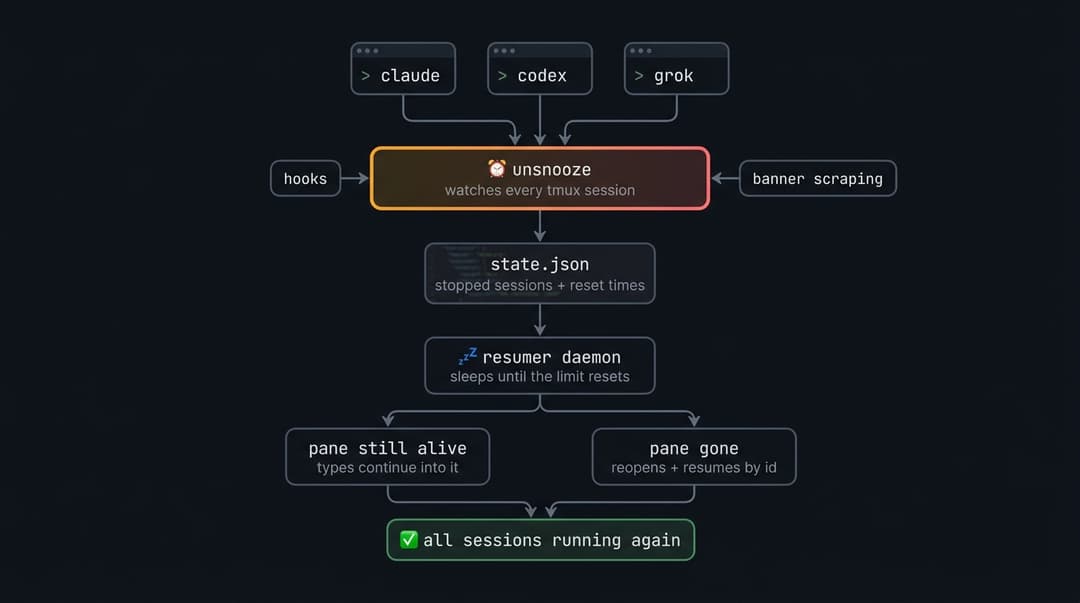
text version
claude / codex / grok (shell wrapper) ──► unsnooze _run <agent> ──► CLI in tmux pane
                                              │
                                              ├─ per-pane monitor (scrapes for limit
                                              │  banners, drives Claude's limit menu,
                                              │  seconds-scale retry on 5xx/overload)
                                              │
StopFailure hook (claude, grok) ──────────────┤
                                              ▼
                                ~/.unsnooze/state.json
                                { agent, sessionId, cwd, pane, resetAt, status }
                                              │
                                              ▼
                                resumer daemon (singleton, epoch-polling —
                                survives laptop sleep and weekly-scale waits)
                                              │
                          ┌───────────────────┴────────────────────┐
                 pane still alive?                          pane gone?
                 send resume message into it                tmux new-window,
                 (only if the CLI is foreground             `unsnooze _run <agent>
                 and not mid-stream)                        --resume <id>`, verify
Limit events are never persisted by the CLIs themselves; the reset time is parsed from the banner text, DST-safe, with a 5-hour fallback when unparseable — and every resume is verified afterwards (banner came back → reschedule from the fresh banner, capped at 5 attempts).
Usage
claude / codex / grok           # normal usage — wrapped automatically
unsnooze status                 # tracked sessions + reset countdowns
unsnooze resume-now [id|--all]  # don't wait for the reset time
unsnooze cancel [id|--all]      # stop tracking a session
unsnooze message <id> "text"    # per-session wake message (--clear to reset)
unsnooze config list            # settings (see below)
unsnooze config set <k> <v>     # e.g. autoResume off
unsnooze logs [-f]              # what unsnooze has been doing
unsnooze update                 # update unsnooze itself
unsnooze daemon                 # persistent GUI-session watcher (usually run
                                # by launchd/systemd via `install --daemon`)
unsnooze report [agent]         # capture a pane to report an undetected banner
unsnooze uninstall [--purge]    # remove wrappers + hooks (+ state with --purge)
unsnooze help                   # full command list (also -h / --help)
Settings
unsnooze setup writes ~/.unsnooze/config.json; change anything later with
unsnooze config set:
| key | default | meaning |
|---|---|---|
autoResume | true | Master switch. Off = stops are still tracked, but nothing is resumed until you run unsnooze resume-now or turn it back on. |
menuAutoAnswer | true | May unsnooze answer Claude's limit menu (send keys in your pane)? Off = watch-only. |
notifications | true | Desktop notification on limit detected / session resumed / gave up. |
guiWatch | true | May the daemon watch session files for GUI-surface stops (VS Code extension, desktop apps)? Needs the daemon running (unsnooze install --daemon). |
resumeMessage | "Continue where you left off…" | The message sent to wake a session. Override it for a single session with unsnooze message <id> "…" — visible in unsnooze status. |
resumeMessages.claude / .codex / .grok | "" | Per-agent override of resumeMessage. Empty = use the global message; clear one with unsnooze config set resumeMessages.claude "". |
agents.claude / agents.codex / agents.grok | true / true / false | Which CLIs are guarded. |
workspaceGuard | inform | Repo changed while a session slept? inform wakes it with a heads-up in the message; pause holds it (desktop notification, diff shown on resume-now); off disables. |
updateCheck | true | Daily new-version check (a plain GET to the npm registry, nothing identifying is sent). Notices after commands + one desktop toast per version. |
Every setting also has a UNSNOOZE_* env override (see src/settings.js), and
all timings/paths are tunable via UNSNOOZE_* env vars (see src/config.js).
Safety properties
- Never injects blind: keys are only sent when the pane's foreground process is the agent CLI and no "esc to interrupt"-style busy footer is visible. Recycled pane ids can't receive stray messages.
- Never picks a menu option blind: if Claude's limit menu layout can't be read, unsnooze does not press Enter (that could confirm "Upgrade your plan").
- Sleep-safe waits: the resumer polls wall-clock against the target epoch every 30s instead of one long timer — a laptop asleep past the reset fires on the next tick. Weekly limits are just a bigger epoch.
- Verified resumes: after dispatch it re-captures the pane; if the limit banner reappears (reset time misparsed / not actually reset), it reschedules from the fresh banner, capped at 5 attempts.
- Concurrent-writer safe: state updates go through a mkdir lock + atomic rename; corrupt state is quarantined, never fatal (the hook path must never block the CLI).
- Overload ≠ limit: 5xx/529/429 transient errors take a seconds-scale backoff path ([30,60,120,240,300]s ± jitter) and never enter the ledger.
- Stale-workspace guard: the repo's HEAD + dirty state are fingerprinted
when a session stops. If another session (or you) changed the repo before
the wake, the resumed agent is told to re-read before acting — or, with
workspaceGuard=pause, the session is held andunsnooze resume-nowshows the diff first.
Requirements
- Node ≥ 20 and tmux
- macOS, Linux, or Windows via WSL (see below)
- zsh or bash (the wrappers are installed into
~/.zshrc/~/.bashrc)
Windows / WSL
unsnooze is built on tmux, so on Windows it runs inside WSL — which is where the agent CLIs live on Windows anyway:
# inside your WSL distro (Ubuntu etc.)
sudo apt install tmux
npm install -g unsnooze && unsnooze setup
Everything works as on Linux, including desktop notifications: inside WSL,
unsnooze raises native Windows toasts through powershell.exe (no
notify-send or X server needed). Native Windows (PowerShell/cmd, no WSL) is
not supported — without tmux there is nothing to watch; unsnooze will tell you
so and run your CLI unwatched instead of breaking it.
FAQ
What does "You've hit your usage limit" mean in Claude Code?
Claude subscription plans meter usage in a rolling 5-hour window plus a weekly
cap. When either runs out, Claude Code stops mid-task and shows the banner with
a reset time ("resets 3pm"). Nothing is lost — the session can be resumed with
claude --resume <id> once the limit resets. unsnooze does exactly that,
automatically, for every stopped session.
What about Codex — "You've hit your usage limit. Try again at …"?
Same idea: ChatGPT-plan Codex has 5-hour and weekly windows. The Codex TUI
stays open at the composer after the banner, so unsnooze either types into the
live pane or reopens the session with codex resume <id> at the reset time it
parsed from the banner.
Does this get around the rate limit?
No. unsnooze waits for the reset exactly like you would, resumes once, and verifies the limit actually lifted. It replaces the 4am alarm, not the limit.
How do I update, and how do I know when to?
unsnooze update (or npm i -g unsnooze). unsnooze checks the npm registry at most once a day and
tells you when a newer version exists (a line after CLI commands, plus one
desktop notification per version); after updating, the next command shows a
short "what's new" from the changelog. It's a plain registry GET with nothing
identifying — turn it off with unsnooze config set updateCheck off.
What if another session changed the repo while one was stopped?
unsnooze fingerprints the workspace (HEAD + uncommitted state) at stop time
and re-checks at wake. By default the session still resumes, but the wake
message includes what changed ("HEAD abc1234 → def5678 — re-read before
continuing"). Set workspaceGuard to pause to hold such sessions for a
manual unsnooze resume-now (which prints the diff stat), or off to
disable the check.
Does it work if my laptop was asleep or the terminal was closed?
Yes — reset times are stored as absolute timestamps and checked every 30 seconds, so a laptop that slept through the reset resumes on the next tick, and dead panes are reopened by session id in a fresh tmux window.
Development
npm test                     # unit tests (node:test)
./scripts/e2e-simulate.sh    # full detect → wait → re-open cycle in a
                             # scratch tmux session (no real limits needed)
License
// faq
What is unsnooze?
Auto-resume Claude Code, Codex CLI & Grok sessions in tmux when the usage limit (5-hour/weekly) resets. It is open-source on GitHub.
Is unsnooze free to use?
unsnooze is open-source under the MIT license, so it is free to use.
What category does unsnooze belong to?
unsnooze is listed under devtools in the Claudeers registry of Claude-compatible tools.
// embed badge

[](https://claudeers.com/unsnooze)
// retro hit counter

[](https://claudeers.com/unsnooze)
// reviews
// guestbook
// related in Developer Tools
 🔓
🔓The agent harness performance optimization system. Skills, instincts, memory, security, and research-first development for Claude Code, Codex, Opencode, Curs…
 🔓
🔓Makes your AI agent think like the laziest senior dev in the room. The best code is the code you never wrote.
 🔓
🔓Use Garry Tan's exact Claude Code setup: 23 opinionated tools that serve as CEO, Designer, Eng Manager, Release Manager, Doc Engineer, and QA
 🔓
🔓AI coding assistant skill (Claude Code, Codex, OpenCode, Cursor, Gemini CLI, and more). Turn any folder of code, SQL schemas, R scripts, shell scripts, docs,…