
lanes
Token-efficient multi-lane orchestration for Claude Code: DeepSeek/GLM coding relays, Codex reviews, guarded subagents
Install with your AI
Paste into Claude Code, Cursor, or any agent — it reads the repo and wires the tool into your project.
Install and set up lanes (git-clone project) into my current project.
Found on https://claudeers.com/lanes
Repo: https://github.com/thebpandey/lanes
Homepage/docs: —
Detected install method: git-clone → git clone https://github.com/thebpandey/lanes
Category: skills. Platforms: cli, api.
Read the repo's README for exact setup and env vars, then install it and wire it into my project.

Claudeers Health Verdict:
unknown; community-verified: false. Confirm the source before running anything.
git clone https://github.com/thebpandey/lanes
// compatibility
| Platforms | cli, api |
|---|---|
| Operating systems | — |
| AI compatibility | claude |
| License | MIT |
| Pricing | open-source |
| Language | Shell |
lanes
lanes coordinates independent software tasks in Git worktrees from Claude Code or Codex. The orchestrator plans, dispatches and integrates; each worker gets a short, complete task in its own worktree, and an independent reviewer checks every completed lane.
Current release: 0.2.0 · GitHub Pages · Changelog
Infographics
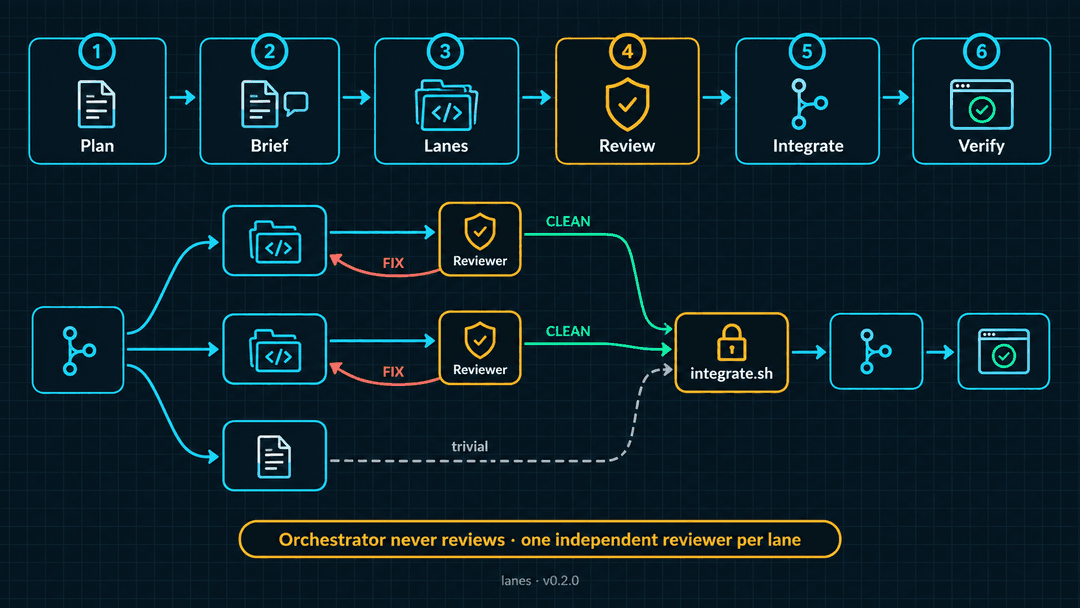
Workflow: Plan → Brief → Lanes → Review → Integrate → Verify. Each lane gets its own independent reviewer; FIX goes back to that lane, trivial prose edits bypass review, and integrate.sh gates every merge.
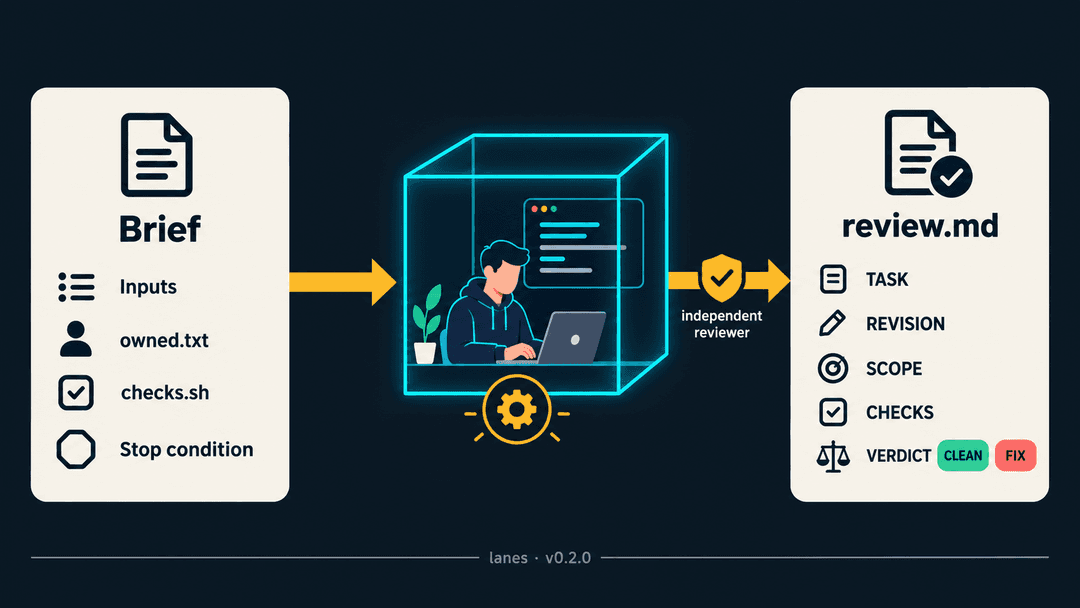
Task handoff: each brief defines inputs, owned.txt, checks.sh and a stop condition; an independent reviewer returns a revision-bound verdict in review.md.
How work moves
- The orchestrator checks the project's instructions, current tracker and worktrees, then makes a short dependency-aware plan.
- Each brief names the task inputs and completed boundary, exact file ownership, acceptance checks, token limits and stop condition.
- Workers implement only in assigned worktrees. DeepSeek and GLM receive simple, bounded tasks only; neither receives secrets or private data.
- Completion events replace repeated status scans. Each completed lane goes to an independent reviewer (Opus 5.5 at medium effort in Claude Code,
gpt-5.6-terraat medium in Codex), never to the orchestrator. The reviewer runslane/scope-check.sh(changed-file hashes, out-of-scope paths, uncommitted work) and returns a revision-bound CLEAN or FIX verdict. - The orchestrator acts on the verdict: CLEAN for the lane's current revision is integrated; FIX findings go back to the same lane, and the new revision is reviewed again.
lane/integrate.shis the only merge path and refuses unreviewed work. Trivial prose edits (≤ 40 lines of.md/.txt-style files, no deletes, no agent-instruction, control or legal files) skip review; the script decides, not the orchestrator. The main worktree is for orchestration, planning, integration andsession-detailarchives before context compaction.
Model and effort routing
| Work | Recommended routing |
|---|---|
| Routine coordination | Codex gpt-6.1-sol, medium effort |
| Lane review (every completed lane) | lane-reviewer (Opus 5.5, medium) in Claude Code; codex-review with gpt-5.6-terra, medium, in Codex |
| Claude Code orchestration | Opus 5.5, medium effort |
| Legal meaning, security, difficult defects, final acceptance | High effort |
| Bounded structural checks | Codex Luna or deterministic scripts |
| Simple, self-contained implementation | DeepSeek; GLM for the smallest mechanical tasks |
| Moderate coding delegated to Claude | sonnet-lane, medium effort |
The per-task usage ledger records input tokens, cached input, output tokens, failures or retries, and acceptance. Default caps are 2,000/500 tokens for structural work or short drafts, 12,000/4,000 for routine work, and 24,000/8,000 for moderate work (input/output). Stop and rebrief when a cap is reached. Keep worker summaries to 10–12 lines and routine tool results to 1,000–2,000 tokens.
Requirements
- Claude Code,
git,python3,curl, andbashon Linux or macOS for the Claude provider relays. The watchdog timer is Linux/systemd only. DEEPSEEK_API_KEYandOPENROUTER_API_KEYfor external worker providers. Export them in your shell startup file; this skill never stores their values.- Optional: Codex CLI for Codex review and Luna structural checks; Docker for disposable test databases; Beads (
bd) for issue tracking.
Install
git clone https://github.com/thebpandey/lanes ~/.claude/skills/lanes
bash ~/.claude/skills/lanes/install.sh
The installer checks prerequisites, keeps backups of replaced files and tells you how to configure missing keys. Restart Claude Code after installation so its lane agents load.
It installs the DeepSeek and GLM provider relays, Codex review launcher, worktree helpers, and Claude agent definitions in ~/.claude/agents/.
Use
Start Claude Code in a Git project and use /lanes start, lane update, lane update all, pause lanes, or resume the lanes. The orchestrator checks the active tracker and resumes from existing worktrees without resetting local changes.
Direct commands:
cd <worktree> && RELAY_WAIT_S=6000 model-relay deepseek < brief.md  # or glm for a simple bounded task
cd <worktree> && RELAY_WAIT_S=6000 codex-review main owned.txt < checklist.md   # Codex lane review
~/.claude/skills/lanes/lane/scope-check.sh <base> owned.txt   # the reviewer's scope gate; checks.sh beside owned.txt holds the acceptance checks
~/.claude/skills/lanes/lane/integrate.sh [--classify] <lane-dir> <branch>   # from the main worktree; the only merge path
~/.claude/skills/lanes/lane/new-worktree.sh <branch>
~/.claude/skills/lanes/lane/lane-status.sh
~/.claude/skills/lanes/lane/secret-scan.sh <base> [head]  # required before any push; exit 0 = clean
CODEX_MODEL selects the review model (default gpt-5.6-terra); CODEX_EFFORT selects medium (default) or high. DEEPSEEK_MODEL and GLM_MODEL override provider models.
Safety
- Work in assigned worktrees. Never give external providers credentials,
.envcontents, customer data or private records. - Never use shared or live databases for tests; use a task-owned disposable environment.
- Preserve user changes, stage explicit paths, and follow the project's authorization for commits, pushes, deployments and external writes.
- Before context compaction, create a full
session-detailarchive once per session, then incrementals from verified checkpoints before later compactions.
MIT licensed. Not affiliated with Anthropic, OpenAI, DeepSeek, Z.ai or OpenRouter.
// faq
What is lanes?
Token-efficient multi-lane orchestration for Claude Code: DeepSeek/GLM coding relays, Codex reviews, guarded subagents. It is open-source on GitHub.
Is lanes free to use?
lanes is open-source under the MIT license, so it is free to use.
What category does lanes belong to?
lanes is listed under skills in the Claudeers registry of Claude-compatible tools.
// embed badge

[](https://claudeers.com/lanes)
// retro hit counter

[](https://claudeers.com/lanes)
// reviews
// guestbook
// related in Claude Skills
 🔓
🔓An agentic skills framework & software development methodology that works.
 🔓
🔓 🔓
🔓💫 Toolkit to help you get started with Spec-Driven Development
 🔓
🔓AI coding assistant skill (Claude Code, Codex, OpenCode, Cursor, Gemini CLI, and more). Turn any folder of code, SQL schemas, R scripts, shell scripts, docs,…