
KnowNote
A local-first AI knowledge base & NotebookLM alternative built with Electron. More convenient, more lightweight, and understands you better!
Install with your AI
Paste into Claude Code, Cursor, or any agent — it reads the repo and wires the tool into your project.
Install and set up KnowNote (git-clone project) into my current project.
Found on https://claudeers.com/knownote
Repo: https://github.com/mrsibe/KnowNote
Homepage/docs: https://knownote.pages.dev
Detected install method: git-clone → git clone https://github.com/mrsibe/KnowNote
Category: uncategorized. Platforms: api, desktop, web.
Read the repo's README for exact setup and env vars, then install it and wire it into my project.

Claudeers Health Verdict:
unknown; community-verified: false. Confirm the source before running anything.
git clone https://github.com/mrsibe/KnowNote
// compatibility
| Platforms | api, desktop, web |
|---|---|
| Operating systems | — |
| AI compatibility | claude |
| License | GPL-3.0 |
| Pricing | open-source |
| Language | TypeScript |
KnowNote
A local-first research workspace.
Research your documents. Trust every answer.
Desktop · Local RAG · Bring your own model · Open source
KnowNote turns your own documents into a knowledge base you can question, and answers from those documents with a reference back to the passage the answer came from.
It is a desktop application rather than a self-hosted stack: no Docker, no server, no account. Parsing, splitting, embedding and vector search all run inside the app, and the only thing that leaves your machine is the request you send to the model endpoint you configured. If that endpoint is a local server, nothing leaves at all.
The website is the full story: knownote.pages.dev — the mechanism, the limits, and an honest comparison with NotebookLM and AnythingLLM.
Preview
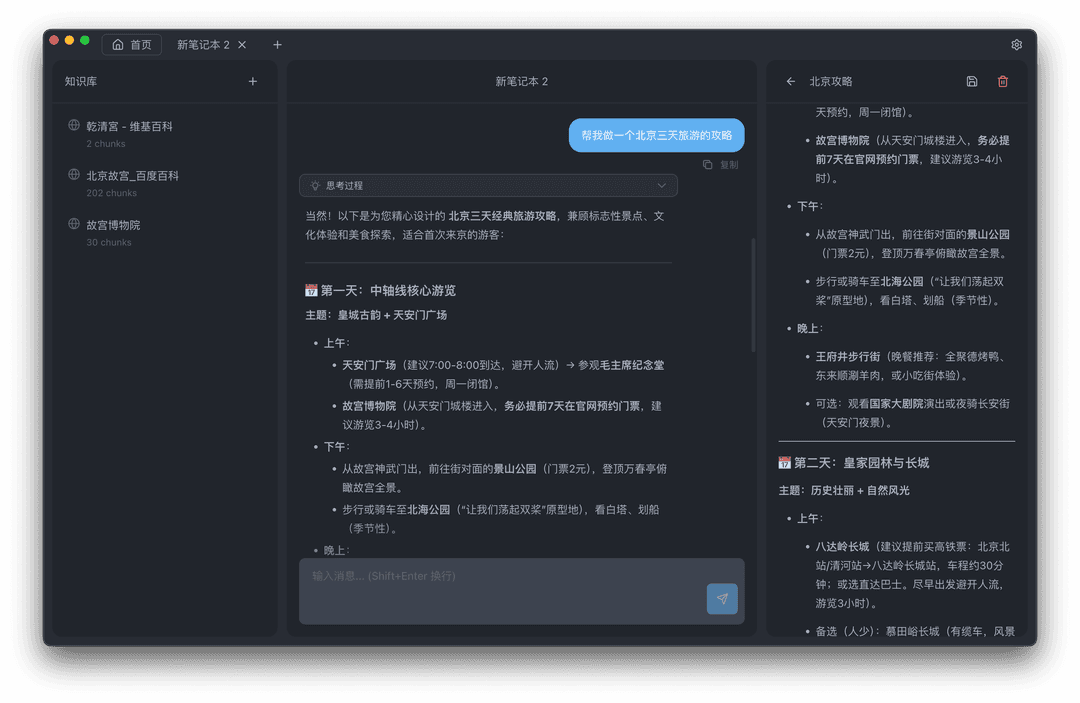
Three-column layout: Knowledge Library · AI Q&A · Note Output
What it does
- Local retrieval (RAG). Import PDF, Word, PowerPoint and web pages. Text is split into passages and embedded by a model that runs in-process, so retrieval keeps working with the network off.
- Traceable answers. Every answer keeps the passages it was built from, along with where each passage sat in the extracted text — so you can inspect what the answer was actually based on instead of taking it on faith.
- Bring your own model. Any OpenAI-, Anthropic- or Google-compatible endpoint, or a local server such as Ollama. No bundled chat model and no account.
- Notes and mind maps. Save what you concluded as structured notes beside the sources, and turn a notebook into a mind map.
- No deployment. Download, open, start reading. The embedder downloads once and then runs on your machine.
What is not here yet
Written down because the alternative is that you find out after installing.
- Audio upload and transcription, quiz generation and slide generation are in development. They are not in any release.
- There is no Linux build, and the macOS build is Apple Silicon only.
- Builds are unsigned and not notarised — see the install steps below.
- No accounts, no sync, no collaboration and no telemetry: KnowNote is a single-user desktop tool.
Quick start
Install
Download the build for your platform from GitHub Releases:
- Windows:
knownote-{version}-setup.exe - macOS (Apple Silicon):
knownote-{version}-arm64.dmg
The builds are unsigned. There is no Apple Developer ID certificate in the release pipeline, so macOS refuses to launch the app on first run and Windows SmartScreen flags the installer. Neither means the download is broken — both are one-time prompts, and the steps below clear them.
macOS
-
Open the
.dmgand drag KnowNote into Applications. -
Clear the quarantine flag once:
sudo xattr -rd com.apple.quarantine /Applications/KnowNote.app -
Launch it as usual.
Intel Macs are not built at the moment — the release ships an arm64 build only.
Without step 2, macOS reports "KnowNote is damaged and can't be opened" or "Apple cannot check it for malicious software". Only run this command on an app taken from this repository's Releases page.
Windows
If SmartScreen shows "Windows protected your PC", choose More info → Run anyway.
First run
Nothing is configured out of the box: open Settings, add at least one model connection under Models (any OpenAI-, Anthropic- or Google-compatible endpoint, or a local server such as Ollama), then start asking questions. Notebooks, notes and embeddings all stay on your machine.
Development
git clone https://github.com/MrSibe/KnowNote.git
cd KnowNote
npm install
npm run dev
CONTRIBUTING.md has the full command list, the Node version CI uses, and the checks that are gates before a pull request.
Architecture
A short version. The website goes further on local RAG and citations, and DESIGN.md covers the interface.
- Shell — Electron with React, TypeScript and TailwindCSS, bundled by electron-vite. Tiptap for the note editor.
- Parsing —
pdfjs-dist,mammoth,officeparserandturndown. Each format keeps the structure it has: page boundaries, headings, slides. - Splitting — passages of roughly 500 characters with about 50 characters of overlap. Each passage records its start and end offset in the extracted text, and that is what lets a citation point at a passage rather than a file.
- Embedding —
Xenova/multilingual-e5-smallthrough ONNX, running in the Electron main process. 384 dimensions,q8, the revision pinned, and remote model loading disabled. Downloaded on demand and cached on disk. - Storage — SQLite with
sqlite-vec, through Drizzle ORM. Each notebook gets its own vector table carrying its own width, so vectors produced by different embedding spaces are never compared. - Models — the chat model is whatever endpoint you configure; it is not part of the application.
KnowNote/
├── src/
│   ├── main/              # Electron main process
│   │   ├── db/            # Database configuration and schema
│   │   ├── services/      # Core logic (document parsing, RAG, etc.)
│   │   └── models/        # Model connection resolution and API protocol adapters
│   ├── renderer/          # React renderer process
│   ├── preload/           # Electron preload scripts
│   └── shared/            # Shared types and utilities
├── resources/             # App resources (icons, etc.)
├── build/                 # Build configuration
└── out/                   # Build output
Contributing
Issues, discussions and pull requests are all welcome. If you have ideas about learning workflows, knowledge visualization, or the model-connection layer, they are especially useful. See CONTRIBUTING.md before you start.
License
GPL-3.0. See LICENSE.
Acknowledgments
- Google NotebookLM — inspiration for the workflow
- Electron — cross-platform desktop framework
- React — UI framework
- SQLite & sqlite-vec — local storage and vector retrieval
Star History
If this project resonates with you, feel free to try it, star it, or leave feedback. Thanks for checking it out 🙏
Built with ❤️ by @MrSibe
// faq
What is KnowNote?
A local-first AI knowledge base & NotebookLM alternative built with Electron. More convenient, more lightweight, and understands you better!. It is open-source on GitHub.
Is KnowNote free to use?
KnowNote is open-source under the GPL-3.0 license, so it is free to use.
What category does KnowNote belong to?
KnowNote is listed under uncategorized in the Claudeers registry of Claude-compatible tools.
// embed badge

[](https://claudeers.com/knownote)
// retro hit counter

[](https://claudeers.com/knownote)
// reviews
// guestbook
// related in Uncategorized / Others
 🔓
🔓Fair-code workflow automation platform with native AI capabilities. Combine visual building with custom code, self-host or cloud, 400+ integrations.
 🔓
🔓The agent engineering platform.
 🔓
🔓FULL Augment Code, Claude Code, Cluely, CodeBuddy, Comet, Cursor, Devin AI, Junie, Kiro, Leap.new, Lovable, Manus, NotionAI, Orchids.app, Perplexity, Poke, Q…
 🔓
🔓100+ AI Agent & RAG apps you can actually run — clone, customize, ship.