
Dive-into-Claude-Code
A Systematic Analysis and Discussion of Claude Code for Designing Today's and Future AI Agent Systems
Install with your AI
Paste into Claude Code, Cursor, or any agent — it reads the repo and wires the tool into your project.
Install and set up Dive-into-Claude-Code (git-clone project) into my current project.
Found on https://claudeers.com/dive-into-claude-code
Repo: https://github.com/VILA-Lab/Dive-into-Claude-Code
Homepage/docs: https://arxiv.org/abs/2604.14228
Detected install method: git-clone → git clone https://github.com/VILA-Lab/Dive-into-Claude-Code
Category: mcp-servers. Platforms: cli, api, web, mobile.
Read the repo's README for exact setup and env vars, then install it and wire it into my project.

Claudeers Health Verdict:
active; community-verified: false. Confirm the source before running anything.
git clone https://github.com/VILA-Lab/Dive-into-Claude-Code
// compatibility
| Platforms | cli, api, web, mobile |
|---|---|
| Operating systems | — |
| AI compatibility | claude |
| License | NOASSERTION |
| Pricing | open-source |
| Language | — |
Dive into Claude Code
English | 中文
A comprehensive source-level architectural analysis of Claude Code (v2.1.88, ~1,900 TypeScript files, ~512K lines of code), combined with a curated collection of community analyses, a design-space guide for agent builders, and cross-system comparisons.
[!TIP] TL;DR -- Only 1.6% of Claude Code's codebase is AI decision logic. The other 98.4% is deterministic infrastructure -- permission gates, context management, tool routing, and recovery logic. The agent loop is a simple while-loop; the real engineering complexity lives in the systems around it. This repo dissects that architecture and distills it into actionable design guidance for anyone building AI agent systems.
Key Highlights
- 98.4% Infrastructure, 1.6% AI -- The agent loop is a simple while-loop; the real complexity is permission gates, context management, and recovery logic.
- 5 Values → 13 Principles → Implementation -- Every design choice traces back to human authority, safety, reliability, capability, and adaptability.
- Defense in Depth with Shared Failure Modes -- 7 safety layers, but all share performance constraints. 50+ subcommands bypass security analysis.
- 4 CVEs Reveal a Pre-Trust Window -- Extensions execute before the trust dialog appears.
- The Cross-Cutting Harness Resists Reimplementation -- The loop is easy to copy; hooks, classifier, compaction, and isolation are not.
Reading Guide
| If you are a... | Start here | Then read |
|---|---|---|
| Agent Builder | Build Your Own Agent | Architecture Deep Dive |
| Security Researcher | Safety and Permissions | Architecture: Safety Layers |
| Product Manager | Key Highlights | Values and Principles |
| Researcher | Full Paper (arXiv) | Community Resources |
1,884 files · ~512K lines · v2.1.88 · 7 safety layers · 5 compaction stages · 54 tools · 27 hook events · 4 extension mechanisms · 7 permission modes
Architecture at a Glance
Claude Code answers four design questions that every production coding agent must face:
| Question | Claude Code's Answer |
|---|---|
| Where does reasoning live? | Model reasons; harness enforces. ~1.6% AI, 98.4% infrastructure. |
| How many execution engines? | One queryLoop for all interfaces (CLI, SDK, IDE). |
| Default safety posture? | Deny-first: deny > ask > allow. Strictest rule wins. |
| Binding resource constraint? | ~200K (older models) / 1M (Claude 4.6 series) context window. 5 compaction layers before every model call. |
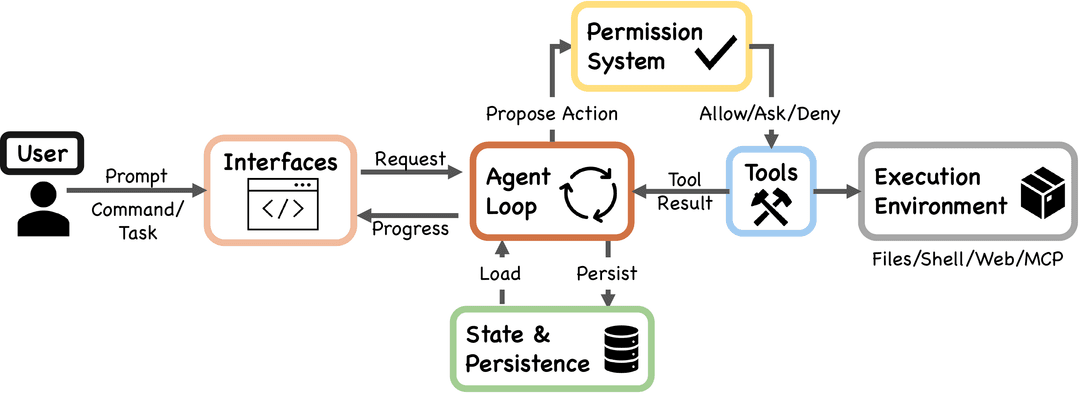
The system decomposes into 7 components (User → Interfaces → Agent Loop → Permission System → Tools → State & Persistence → Execution Environment) across 5 architectural layers.

[!NOTE] For the full architectural deep dive -- 7 safety layers, 9-step turn pipeline, 5-layer compaction, and more -- see docs/architecture.md.
Values and Design Principles
The architecture traces from 5 human values through 13 design principles to implementation:
| Value | Core Idea |
|---|---|
| Human Decision Authority | Humans retain control via principal hierarchy. When a 93% prompt-approval rate revealed approval fatigue, response was restructured boundaries, not more warnings. |
| Safety, Security, Privacy | System protects even when human vigilance lapses. 7 independent safety layers. |
| Reliable Execution | Does what was meant. Gather-act-verify loop. Graceful recovery. |
| Capability Amplification | "A Unix utility, not a product." 98.4% is deterministic infrastructure enabling the model. |
| Contextual Adaptability | CLAUDE.md hierarchy, graduated extensibility, trust trajectories that evolve over time. |
The 13 Design Principles
| Principle | Design Question |
|---|---|
| Deny-first with human escalation | Should unrecognized actions be allowed, blocked, or escalated? |
| Graduated trust spectrum | Fixed permission level, or spectrum users traverse over time? |
| Defense in depth | Single safety boundary, or multiple overlapping ones? |
| Externalized programmable policy | Hardcoded policy, or externalized configs with lifecycle hooks? |
| Context as scarce resource | Single-pass truncation or graduated pipeline? |
| Append-only durable state | Mutable state, snapshots, or append-only logs? |
| Minimal scaffolding, maximal harness | Invest in scaffolding or operational infrastructure? |
| Values over rules | Rigid procedures or contextual judgment with deterministic guardrails? |
| Composable multi-mechanism extensibility | One API or layered mechanisms at different costs? |
| Reversibility-weighted risk assessment | Same oversight for all, or lighter for reversible actions? |
| Transparent file-based config and memory | Opaque DB, embeddings, or user-visible files? |
| Isolated subagent boundaries | Shared context/permissions, or isolation? |
| Graceful recovery and resilience | Fail hard, or recover silently? |
The paper also applies a sixth evaluative lens -- long-term capability preservation -- citing evidence that developers in AI-assisted conditions score 17% lower on comprehension tests.
The Agentic Query Loop
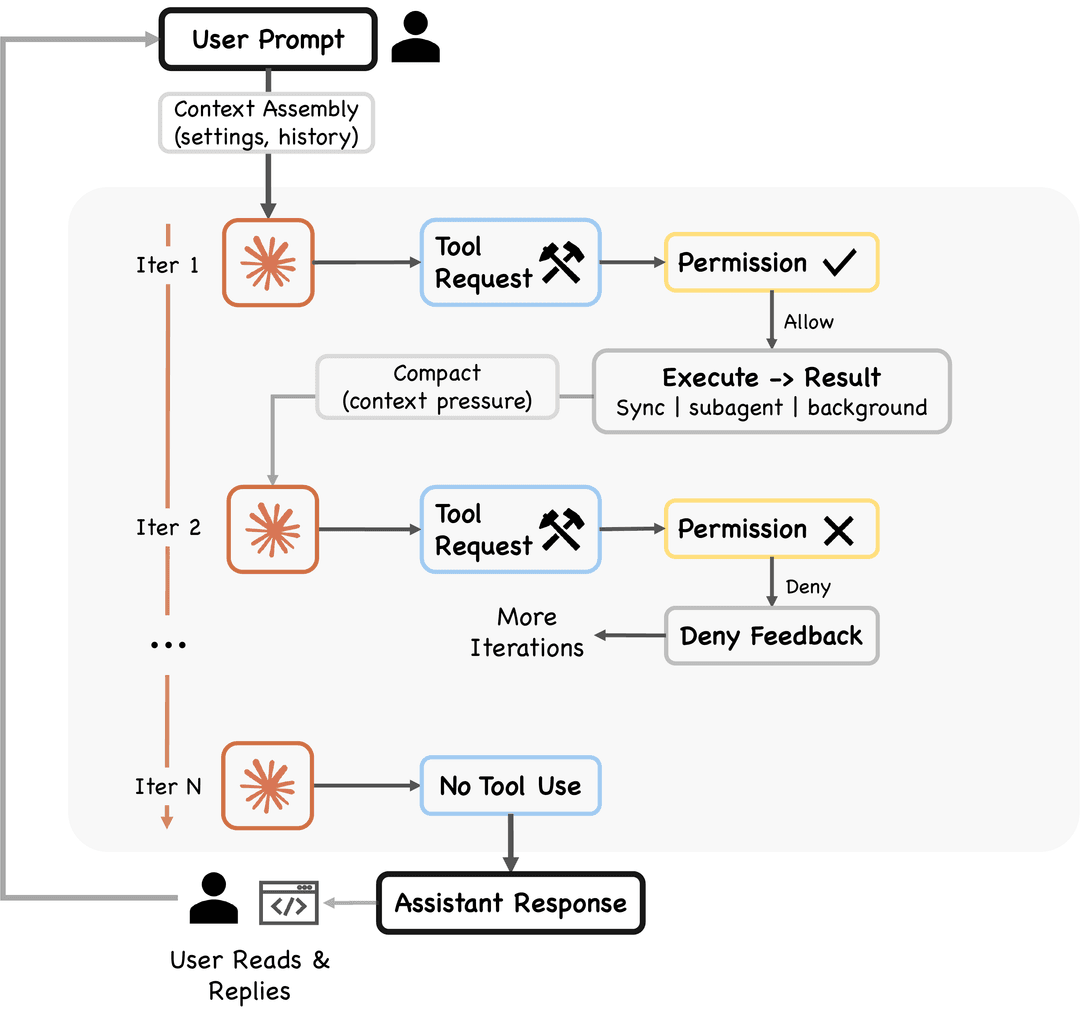
The core is a ReAct-pattern while-loop: assemble context → call model → dispatch tools → check permissions → execute → repeat. Implemented as an AsyncGenerator yielding streaming events.
Before every model call, five compaction shapers run sequentially (cheapest first): Budget Reduction → Snip → Microcompact → Context Collapse → Auto-Compact.
9-step pipeline per turn: Settings resolution → State init → Context assembly → 5 pre-model shapers → Model call → Tool dispatch → Permission gate → Tool execution → Stop condition
Two execution paths:
StreamingToolExecutor-- begins executing tools as they stream in (latency optimization)- Fallback
runTools-- classifies tools as concurrent-safe or exclusive
Recovery: Max output token escalation (3 retries), reactive compaction (once per turn), prompt-too-long handling, streaming fallback, fallback model
5 stop conditions: No tool use, max turns, context overflow, hook intervention, explicit abort
Safety and Permissions
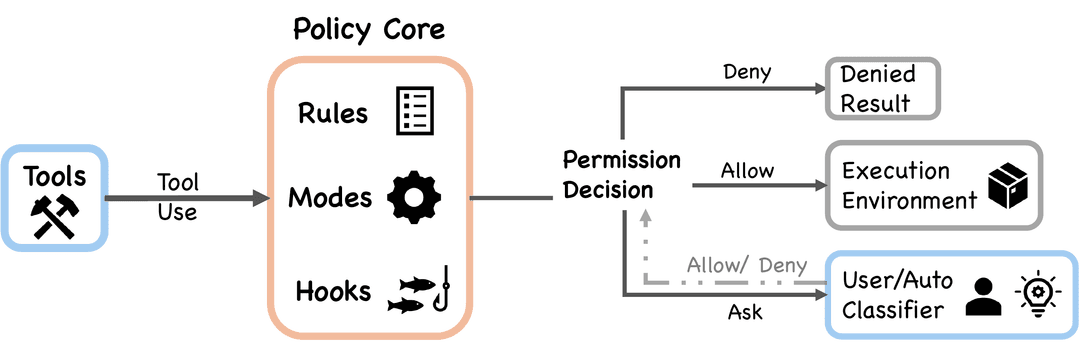
7 permission modes form a graduated trust spectrum: plan → default → acceptEdits → auto (ML classifier) → dontAsk → bypassPermissions (+ internal bubble).
Deny-first: A broad deny always overrides a narrow allow. 7 independent safety layers from tool pre-filtering through shell sandboxing to hook interception. Permissions are never restored on resume -- trust is re-established per session.
[!WARNING] Shared failure modes: Defense-in-depth degrades when layers share constraints. Per-subcommand parsing causes event-loop starvation -- commands exceeding 50 subcommands bypass security analysis entirely to prevent the REPL from freezing.
More details: authorization pipeline, auto-mode classifier, CVEs
Authorization pipeline: Pre-filtering (strip denied tools) → PreToolUse hooks → Deny-first rule evaluation → Permission handler (4 branches: coordinator, swarm worker, speculative classifier, interactive)
Auto-mode classifier (yoloClassifier.ts): Separate LLM call with internal/external permission templates. Two-stage: fast-filter + chain-of-thought.
Pre-trust execution window: 2 patched CVEs share this root cause -- hooks and MCP servers execute during initialization before the trust dialog appears, creating a structurally privileged attack window outside the deny-first pipeline.
Extensibility
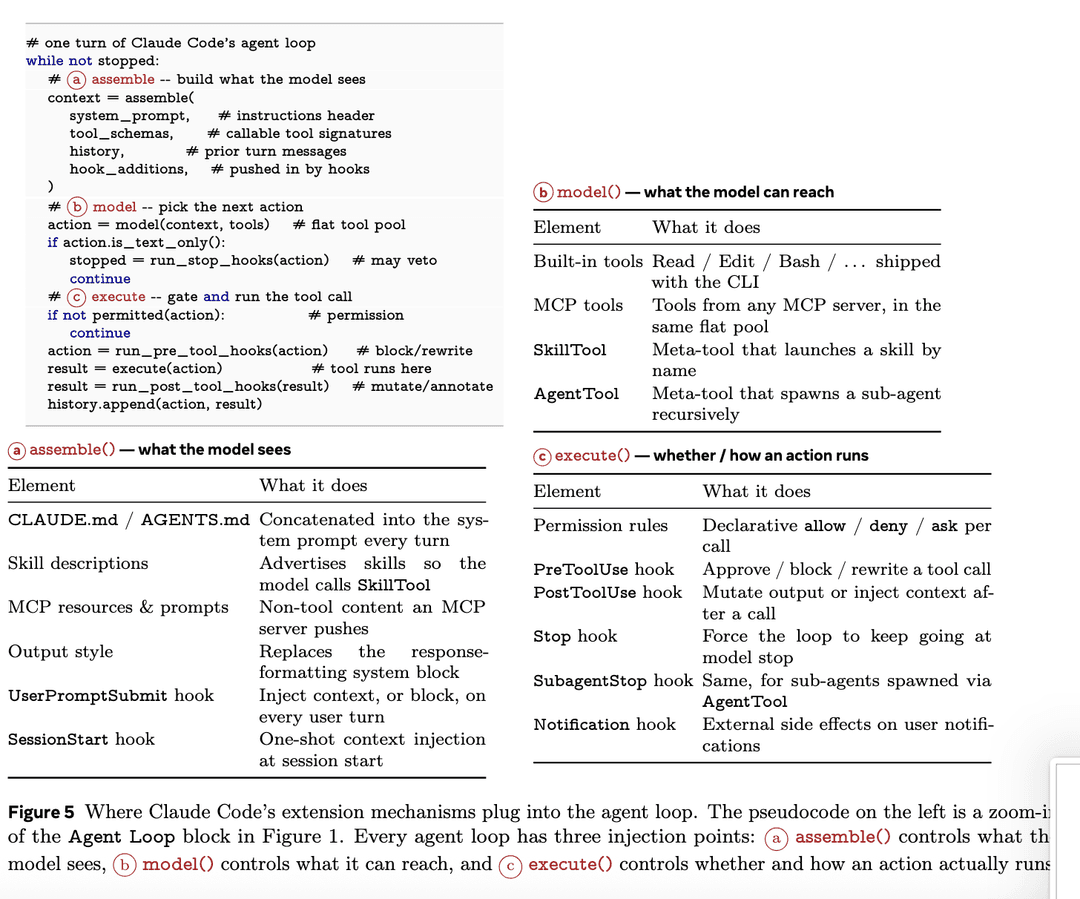
Four mechanisms at graduated context costs: Hooks (zero) → Skills (low) → Plugins (medium) → MCP (high). Three injection points in the agent loop: assemble() (what the model sees), model() (what it can reach), execute() (whether/how actions run).
Tool pool assembly (5-step): Base enumeration (up to 54 tools) → Mode filtering → Deny pre-filtering → MCP integration → Deduplication
27 hook events across 5 categories with 4 execution types (shell, LLM-evaluated, webhook, subagent verifier)
Plugin manifest accepts 10 component types: commands, agents, skills, hooks, MCP servers, LSP servers, output styles, channels, settings, user config
Skills: SKILL.md with 15+ YAML frontmatter fields. Key difference -- SkillTool injects into current context; AgentTool spawns isolated context.
Context and Memory
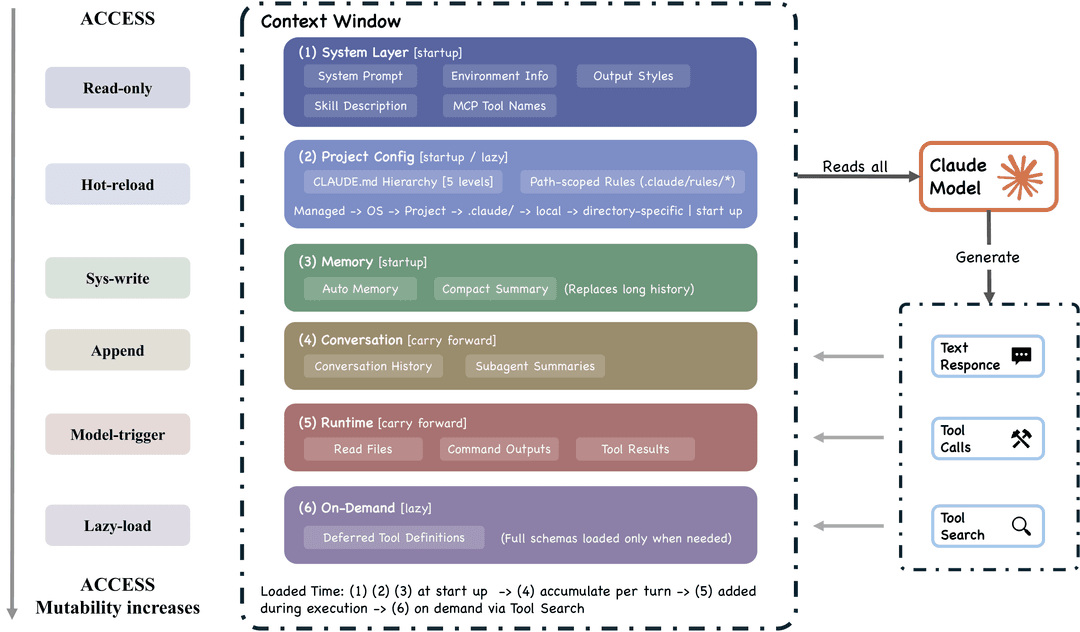
9 ordered sources build the context window. CLAUDE.md instructions are delivered as user context (probabilistic compliance), not system prompt (deterministic). Memory is file-based (no vector DB) -- fully inspectable, editable, version-controllable.
4-level CLAUDE.md hierarchy: Managed (/etc/) → User (~/.claude/) → Project (CLAUDE.md, .claude/rules/) → Local (CLAUDE.local.md, gitignored)
5-layer compaction (graduated lazy-degradation): Budget reduction → Snip → Microcompact → Context Collapse (read-time projection, non-destructive) → Auto-Compact (full model summary, last resort)
Memory retrieval: LLM-based scan of memory-file headers, selects up to 5 relevant files. No embeddings, no vector similarity.
Subagent Delegation
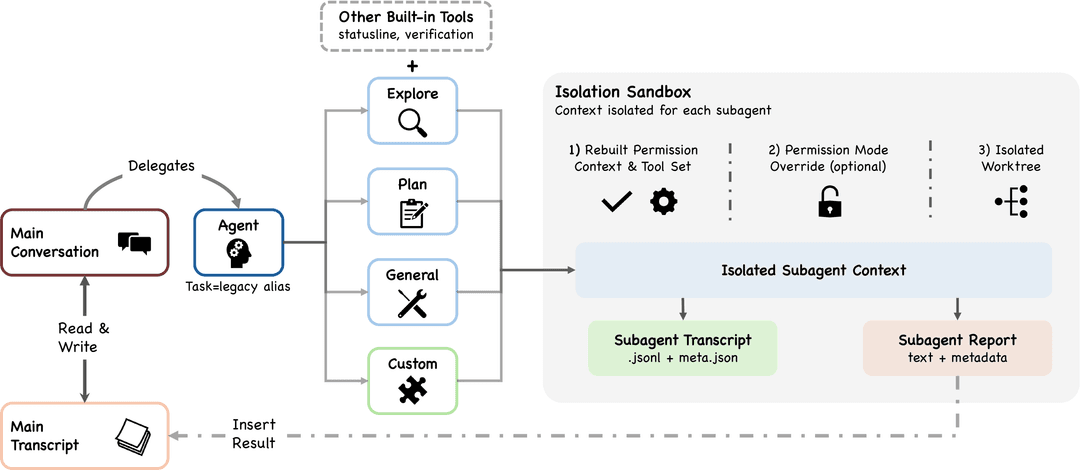
6 built-in types (Explore, Plan, General-purpose, Guide, Verification, Statusline) + custom agents via .claude/agents/*.md. Sidechain transcripts: only summaries return to parent (parent's context is protected from subagent verbosity). Three isolation modes: worktree, remote, in-process. Coordination via POSIX flock().
SkillTool vs AgentTool: SkillTool injects into current context (cheap). AgentTool spawns isolated context (expensive, but prevents context explosion).
Permission override: Subagent permissionMode applies UNLESS parent is in bypassPermissions/acceptEdits/auto (explicit user decisions always take precedence).
Custom agents: YAML frontmatter supports tools, disallowedTools, model, effort, permissionMode, mcpServers, hooks, maxTurns, skills, memory scope, background flag, isolation mode.
Session Persistence
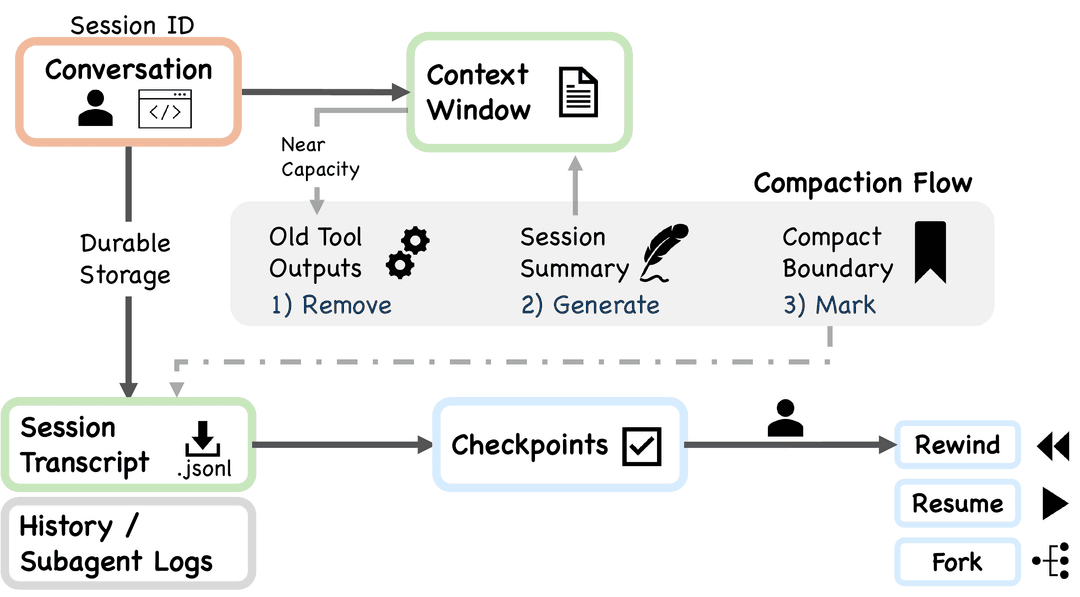
Three channels: append-only JSONL transcripts, global prompt history, subagent sidechains. Permissions never restored on resume -- trust is re-established per session. Design favors auditability over query power.
Chain patching: Compact boundaries record headUuid/anchorUuid/tailUuid. The session loader patches the message chain at read time. Nothing is destructively edited on disk.
Checkpoints: File-history checkpoints for --rewind-files, stored at ~/.claude/file-history/<sessionId>/.
New Signals in the Agent Design Space
New agent-system developments reinforce the same lesson Claude Code makes clear: agent capability is not a model property alone. It comes from the runtime, context layer, execution boundary, tool supply chain, the controls humans have over it, and the evaluation loop around the model.
| Design Implication | What it means for agent builders | Representative signals |
|---|---|---|
| Runtime and control plane are first-class design concerns | Durable execution, checkpoints, sandboxes, agent inventory, policy, and observability should be designed as parts of the system that users can see, not hidden deployment details. | Cursor cloud agents, Google Managed Agents, Microsoft Agent 365, Databricks Omnigent |
| Context is managed infrastructure | Prompts, files, skills, IDE indexes, workspace state, memory namespaces, and interpreter state need lifecycle, provenance, review, and rollback. | LangChain Context Hub, AWS AgentCore, Anthropic managed-agent memory |
| Execution boundary is the safety boundary | Permissions, network reachability, filesystem access, credential custody, tenant isolation, and OS sandboxing are core architecture, not late-stage hardening. | Codex Windows sandbox, Running Codex safely, Anthropic self-hosted sandboxes |
| Tools and skills are a supply chain | MCP servers, skills, plugins, and agent-to-agent protocols need registries, allowlists, identity, semantic review, versioning, and revocation. | NSA MCP security, GitHub MCP allowlists, A2A milestone |
| Humans become managers and verifiers | Agent products should support goals, plans, approvals, interrupts, reviewable diffs, escalation, and constrained multi-agent write authority. | Codex from anywhere, Copilot cloud agent, Cognition multi-agents |
| Observability must close the improvement loop | Traces should feed evaluation, failure clustering, policy enforcement, and prompt/tool repair rather than ending as passive logs. | LangSmith Engine, OpenAI agent improvement loop, AWS AgentCore Evaluations |
These signals do not replace Claude Code's design space; they make its boundaries clearer. The agent loop is the small part. The harness around it is where most capability, safety, and reliability decisions now live. For month-level source notes, see docs/agent-design-space-source-notes_zh.md.
Build Your Own AI Agent: A Design Guide
Not a coding tutorial. A guide to the design decisions you must make, derived from architectural analysis.
Every production agent must navigate these decisions:
| Decision | The Question | Key Insight |
|---|---|---|
| Reasoning placement | How much logic in the model vs. harness? | As models converge in capability, the harness becomes the differentiator. |
| Safety posture | How do you prevent harmful actions? | Defense-in-depth fails when layers share failure modes. |
| Context management | What does the model see? | Design for context scarcity from day one. Graduated > single-pass. |
| Extensibility | How do extensions plug in? | Not all extensions need to consume context tokens. |
| Subagent architecture | Shared or isolated context? | Agent teams in plan mode cost ~7× tokens. Subagent summary-only returns prevent context blow-up. |
| Session persistence | What carries over? | Never restore permissions on resume. Auditability > query power. |
Read the full guide: docs/build-your-own-agent.md
Cross-System Comparison: Claude Code vs OpenClaw vs Hermes-Agent
The same recurring design questions admit different architectural answers when the deployment context changes. The table below contrasts Claude Code v2.1.88 with two notable peers — OpenClaw, a local-first multi-channel personal-assistant gateway, and NousResearch/hermes-agent, a self-improving multi-deployment agent — across the six design dimensions Section 10 of the paper uses for the OpenClaw comparison. Cells are source-grounded; this is not a feature scoreboard.
| Design Dimension | Claude Code (v2.1.88) | OpenClaw | Hermes-Agent |
|---|---|---|---|
| System scope & deployment | Per-user CLI / SDK / IDE interface for coding; one queryLoop async generator across entry points. | Local-first WebSocket gateway (default port 18789, loopback-bound by default; other binds available); routes ~23 messaging channels to an embedded agent runtime; companion apps for macOS, iOS, Android. | Three entry points: hermes (interactive CLI), hermes-agent (programmatic runtime), hermes-acp (ACP server); gateway adapters route messages to per-session AIAgent instances cached LRU-style (max 128, 1 h idle TTL); also runs as MCP server via hermes mcp serve. |
| Trust model & security | Deny-first per-action evaluation; 7 permission modes; LLM-based auto-mode classifier (yoloClassifier / sideQuery); session-scoped permission state (session bypass flag, app allowlist state) is not restored on resume. | Single trusted operator per gateway; DM pairing codes, sender allowlists, gateway authentication; per-agent allow / deny tool policy; opt-in sandboxing via Docker / SSH / OpenShell, off by default; non-main mode sandboxes only non-main sessions; hostile multi-tenant isolation explicitly not supported. | Dangerous-command pattern detection with per-session approval state; CLI interactive prompts and gateway async prompts; auxiliary-LLM smart approval auto-approves low-risk commands; permanent allowlist persisted in config.yaml; subagent worker threads default to auto-deny dangerous commands (opt-in subagent_auto_approve for batch / cron runs). |
| Agent runtime & tools | Single queryLoop async generator with streamed event yields; environment- and feature-gated tool registry; before-API compaction (Snip, Microcompact, Context Collapse, Auto-Compact) runs conditionally, with Auto-Compact first attempting session-memory compaction. | Embedded agent runtime inside the gateway's RPC dispatch (the agent RPC validates parameters, accepts immediately, runs asynchronously, and streams lifecycle / stream events back over the gateway protocol); per-session queue serialization with an optional global lane. | While-loop with explicit per-turn iteration budget and grace-call slot; per-turn checkpoint dedup; gateway step_callback hook fires on each iteration; auxiliary-model context compression summarizes middle turns while protecting head and tail. |
| Extension architecture | Four mechanisms at graduated context cost: hooks → skills → plugins → MCP; 27 hook events; 10 plugin component types. | Manifest-first plugin system with 12 documented capability categories; central registry exposes tools, channels, provider setup, hooks, HTTP routes, CLI commands, services; separate skills layer with multiple sources (workspace highest precedence) plus the ClawHub public registry; openclaw mcp provides both an MCP server interface and an outbound client registry for other MCP servers. | 12 bundled plugins under plugins/ (context_engine, disk-cleanup, example-dashboard, google_meet, hermes-achievements, image_gen, kanban, memory, observability, platforms, spotify, strike-freedom-cockpit); MCP server (mcp_serve.py) exposes 10 tools; ACP adapter (acp_adapter/) exposes Hermes as an ACP server. |
| Memory & context | 4-level CLAUDE.md hierarchy; before-API compaction (Snip, Microcompact, Context Collapse, Auto-Compact); LLM-based selection from file-based Markdown memory files. | Workspace bootstrap files (AGENTS.md, SOUL.md, TOOLS.md, IDENTITY.md, USER.md) plus conditional BOOTSTRAP.md / HEARTBEAT.md / MEMORY.md; separate memory system (MEMORY.md, daily notes under memory/YYYY-MM-DD.md, optional DREAMS.md); hybrid vector + keyword search when an embedding provider is configured; experimental dreaming for long-term promotion; pluggable compaction providers. | SQLite state store with FTS5 full-text search and WAL-mode concurrent readers; sessions linked by parent_session_id chains for compression-triggered splits; 8 swappable memory backends under plugins/memory/ (byterover, hindsight, holographic, honcho, mem0, openviking, retaindb, supermemory); auxiliary-LLM compression as a separate context-management layer. |
| Multi-agent architecture | Sub-agent delegation via sidechain transcripts; 6 built-in agent definitions (availability conditional on build / mode) plus custom; a single summary message returns to parent (in-process / viewable transcript cases preserve more internal detail); agent-isolation settings include worktree and remote, with an in-process teammate backend in the swarm path. | Two layers. (1) Multi-agent routing: per-channel isolated agents with their own workspace, auth profiles, session store, and model configuration, dispatched via deterministic binding rules. (2) Sub-agent delegation: maxSpawnDepth range 1–5, default 1, recommended 2; tool policy varies by depth; project vision (VISION.md) rejects agent-hierarchy frameworks as the default. | delegate_task tool spawns child AIAgent instances in a ThreadPoolExecutor (parent blocks until children complete); each child has fresh conversation history, its own task_id, and a restricted toolset (DELEGATE_BLOCKED_TOOLS strips delegate_task, clarify, memory, send_message, execute_code); default depth MAX_DEPTH = 1 (configurable up to cap 3); default 3 concurrent children. |
What this contrast reveals. Three observations follow from the table. First, deployment context drives the rest of the design: a per-user coding CLI converges on per-action approval and a single execution loop, a multi-channel gateway converges on perimeter trust and channel-bound agents, and a multi-deployment messaging-and-cloud agent converges on opt-in container/cloud isolation, an LLM-based smart approval, and a swappable-backend memory layer. Second, the extension layer is where each system most clearly differentiates: Claude Code stratifies four mechanisms by context cost, OpenClaw treats extension as registry-managed capabilities at the gateway, and Hermes-Agent ships bundled plugins plus dual MCP server / ACP server interfaces other agents can connect to. Third, memory architectures sit on a spectrum: file-based and inspectable Markdown (Claude Code), file-based plus optional vector + experimental dreaming (OpenClaw), or full-text indexed (FTS5) plus eight swappable plugin backends including dedicated vector / RAG providers (Hermes-Agent). The table is best read not as a scoreboard but as three different fixed points in the same design space.
Community Projects & Research
A curated map of the repos, reimplementations, and academic papers surrounding Claude Code's architecture.
Official Anthropic Resources
Primary sources referenced throughout the paper — Anthropic's own engineering and research publications, plus product documentation.
Research & Engineering Blogs
| Article | Topic |
|---|---|
| Building Effective Agents | Foundational: simple composable patterns over heavy frameworks. |
| Effective Context Engineering for AI Agents | Context curation and token-budget management. |
| Prompt Caching with Claude | Cache reads at 10% cost, writes at 125%; 5-min default TTL. The platform feature that makes Claude Code's cache-aware compaction architecturally meaningful. |
| Harness Design for Long-Running Application Development | Harness architecture for autonomous full-stack dev; multi-agent patterns. |
| Claude Code Auto Mode: A Safer Way to Skip Permissions | ML-classifier approval automation; source of the 93% approval-rate finding. |
| Beyond Permission Prompts: Making Claude Code More Secure and Autonomous | Sandbox-based security; 84% reduction in permission prompts. |
| How We Contain Claude Across Products | Containment across claude.ai, Claude Code, and Cowork (May 2026); Claude Code's human-in-the-loop sandbox, approval fatigue, and capping the blast radius. |
| Measuring AI Agent Autonomy in Practice | Longitudinal usage: auto-approve rates grow from ~20% to 40%+ with experience. |
| Our Framework for Developing Safe and Trustworthy Agents | Governance framework for responsible agent deployment. |
| When AI Builds Itself | Anthropic Institute on recursive self-improvement: AI accelerating AI development, the direction-setting and research-taste gaps, and governance scenarios. |
| Scaling Managed Agents: Decoupling the Brain from the Hands | Hosted-service architecture separating reasoning, execution, and session. |
| An Update on Recent Claude Code Quality Reports | Postmortem on three bugs behind perceived quality drops: a reasoning-effort default, a cache optimization bug, and a system-prompt change. |
| Introducing Claude Opus 4.8 | May 2026 model update: sharper judgment and honesty (~4x fewer unremarked code flaws), longer autonomous runs; introduces dynamic workflows in research preview. |
| Claude Fable 5 and Claude Mythos 5 | June 2026 Mythos-class tier sitting above Opus; Fable 5 is the general-use configuration (risky queries fall back to Opus 4.8), with state-of-the-art software-engineering and agentic-coding performance. Access was suspended globally on June 12, 2026 (see next row). |
| Statement on Suspending Access to Fable 5 and Mythos 5 | Anthropic's statement on suspending Fable 5 and Mythos 5. A US export-control directive (June 12, 2026) restricted access for foreign nationals, but Anthropic disabled both models for all users worldwide, just days after launch. A rare case of regulation forcing a deployed frontier model offline, and a concrete example of the compliance and safety pressures that agent systems face in deployment. |
Product Documentation
| Document | Topic |
|---|---|
| How Claude Code Works | Official overview of the agent loop, tools, and terminal automation. |
| Permissions | Tiered permission system, modes, granular rules. |
| Hooks | 27-event hook reference, execution models, lifecycle events. |
| Memory | CLAUDE.md hierarchy, auto memory, learned preferences. |
| Sub-agents | Specialized isolated assistants, custom prompts, tool access. |
| Orchestrate Subagents at Scale with Dynamic Workflows | Claude writes a JavaScript orchestration script; a background runtime fans out to up to 1,000 subagents, with intermediate state held in script variables outside the context window (v2.1.154+, research preview). |
| What's New in Claude Opus 4.8 | Mid-conversation system messages (prompt-cache-preserving), lower cacheable-prompt minimum, fewer compactions and better compaction recovery. |
| Claude Code CHANGELOG | Release notes; dynamic workflows and Opus 4.8 land in v2.1.154. |
Architecture Analysis
Deep dives into Claude Code's internal design.
| Repository | Description |
|---|---|
| ComeOnOliver/claude-code-analysis | Comprehensive reverse-engineering: source tree structure, module boundaries, tool inventories, and architectural patterns. |
| alejandrobalderas/claude-code-from-source | 18-chapter technical book (~400 pages). All original pseudocode, no proprietary source. |
| liuup/claude-code-analysis | Chinese-language deep-dive — startup flow, query main loop, MCP integration, multi-agent architecture. |
| sanbuphy/claude-code-source-code | Quadrilingual analysis (EN/JA/KO/ZH) — multi-domain reports covering telemetry, codenames, KAIROS, unreleased tools. |
| cablate/claude-code-research | Independent research on internals, Agent SDK, and related tooling. |
| Yuyz0112/claude-code-reverse | Visualize Claude Code's LLM interactions — log parser and visual tool to trace prompts, tool calls, and compaction. |
| Piebald-AI/claude-code-system-prompts | Version-tracked prompt corpus across 170+ Claude Code releases — main system prompt, builtin tool descriptions, sub-agent prompts (Plan/Explore/Task), and ~40 system reminders. Updated within minutes of each release. |
Open-Source Reimplementations
Clean-room rewrites and buildable research forks.
| Repository | Description |
|---|---|
| chauncygu/collection-claude-code-source-code | Meta-collection of community Claude Code source artifacts -- includes claw-code (Rust port), nano-claude-code (Python), and the extracted original source archive. |
| 777genius/claude-code-working | Working reverse-engineered CLI. Runnable with Bun, 450+ chunk files, 31 feature flags polyfilled. |
| T-Lab-CUHKSZ/claude-code | CUHK-Shenzhen buildable research fork — reconstructed build system from raw TypeScript snapshot. |
| ruvnet/open-claude-code | Nightly auto-decompile rebuild — 903+ tests, 25 tools, 4 MCP transports, 6 permission modes. |
| Enderfga/openclaw-claude-code | OpenClaw plugin — unified ISession interface for Claude/Codex/Gemini/Cursor. Multi-agent council. |
| memaxo/claude_code_re | Reverse engineering from minified bundles — deobfuscation of the publicly distributed cli.js file. |
| agentforce314/clawcodex | Python rebuild with multi-provider LLM support. |
Claude Code Guides & Learning
Tutorials and hands-on learning paths for Claude Code itself.
| Repository | Description |
|---|---|
| shareAI-lab/learn-claude-code | "Bash is all you need" — 19-chapter 0-to-1 course with runnable Python agents, web platform. ZH/EN/JA. |
| FlorianBruniaux/claude-code-ultimate-guide | Beginner-to-power-user guide with production-ready templates, agentic workflow guides, and cheatsheets. |
| affaan-m/everything-claude-code | Agent harness optimization — skills, instincts, memory, security, and research-first development. |
General Harness Engineering Design Space Resources
External resources that complement this paper's design-space analysis — concept essays, curricula, and code that illuminate the harness layer as an engineering practice.
| Repository | Description |
|---|---|
| deusyu/harness-engineering | Learning archive — original concept essays, independent thinking pieces, and curated translations of harness-engineering writing; from concept to independent practice. |
| walkinglabs/learn-harness-engineering | Project-based English course with PDF coursebooks, syllabus, and capstone, organized around five harness subsystems: instructions, state, verification, scope, and session lifecycle. |
| china-qijizhifeng/agentic-harness-engineering | Observability system that auto-evolves a coding agent's harness — a meta-agent reads execution traces and rewrites system prompts, tools, middleware, skills, sub-agents, and memory. |
| ZhangHanDong/harness-engineering-from-cc-to-ai-coding | The "Horse Book" (《马书》) — Chinese mdBook framing Claude Code v2.1.88 as a Harness Engineering case study; covers architecture, prompt engineering, context management, prompt cache, security, and lessons for builders. |
Blog Posts & Technical Articles
| Article | What Makes It Valuable |
|---|---|
| Marco Kotrotsos — "Claude Code Internals" (15-part series) | Most systematic pre-leak analysis. Architecture, agent loop, permissions, sub-agents, MCP, telemetry. |
| Alex Kim — "The Claude Code Source Leak" | Anti-distillation mechanisms, frustration detection, Undercover Mode, ~250K wasted API calls/day. |
| Haseeb Qureshi — Cross-agent architecture comparison | Claude Code vs Codex vs Cline vs OpenCode — architecture-level comparison. |
| George Sung — "Tracing Claude Code's LLM Traffic" | Complete system prompts and full API logs. Discovered dual-model usage (Opus + Haiku). |
| Agiflow — "Reverse Engineering Prompt Augmentation" | 5 prompt augmentation mechanisms backed by actual network traces. |
| Engineer's Codex — "Diving into the Source Code Leak" | Modular system prompt, ~40 tools, large query/tool subsystem, anti-distillation. |
| MindStudio — "Three-Layer Memory Architecture" | In-context memory, MEMORY.md pointer index, CLAUDE.md static config. Best single resource on memory. |
| WaveSpeed — "Claude Code Architecture: Leaked Source Deep Dive" | 512K-line TS source deep dive; context compression and anti-distillation. |
| Zain Hasan — "Inside Claude Code: An Architecture Deep Dive" | Layered architecture, 5 entry modes, multi-agent walkthrough. |
| Addy Osmani — "Agent Harness Engineering" | Frames harness engineering as a discipline with named primitives (filesystem/git state, sandboxes, AGENTS.md memory, compaction, planning loops, hooks); cites Claude Code as the canonical mature example. |
| Addy Osmani — "Loop Engineering" | The essay that named "loop engineering": instead of writing prompts for the agent yourself, you build the loop that prompts it for you. Its parts (automations, worktrees, skills, connectors, sub-agents, and a file that tracks progress) are the harness pieces this paper analyzes. |
| Andrej Karpathy — "Sequoia Ascent 2026" | Argues for "agentic engineering": humans orchestrate and verify rather than write code. "LLMs and reinforcement learning automate what you can verify"; "you can outsource your thinking, but you can't outsource your understanding." |
Cross-Vendor Code-Agent Engineering
Official engineering posts from other vendors building code agents — useful for seeing how the same design questions are answered outside Claude Code.
| Resource | Vendor | What's Notable |
|---|---|---|
| Harness Engineering: Leveraging Codex in an Agent-First World | OpenAI | Frames the "harness" as the constraints, feedback loops, and documentation that make agents reliable; reports a roughly 1M-line beta built with essentially no hand-written code. |
| Best Practices for Coding with Agents | Cursor | Articulates an agent harness as three components — Instructions, Tools, and Model — orchestrated per model. |
| Build with Google Antigravity | Agent-first platform: a Manager view for asynchronous multi-agent orchestration, with Artifacts (plans, screenshots, recordings) as the verification mechanism instead of raw logs. | |
| Codex Security: Now in Research Preview | OpenAI | Application-security agent that builds a project-specific threat model, then finds and pressure-tests vulnerabilities in sandboxed validation environments. |
Related Academic Papers
| Paper | Venue | Relevance |
|---|---|---|
| Architectural Design Decisions in AI Agent Harnesses | arXiv | Source-grounded study of 70 agent-system projects identifying recurring design dimensions; closest contemporary peer to this paper's design-space framing. |
| Decoding the Configuration of AI Coding Agents | arXiv | Empirical study of 328 Claude Code configuration files — SE concerns and co-occurrence patterns. |
| On the Use of Agentic Coding Manifests | arXiv | Analyzed 253 CLAUDE.md files from 242 repos — structural patterns in operational commands. |
| Context Engineering for Multi-Agent Code Assistants | arXiv | Multi-agent workflow combining multiple LLMs for code generation. |
| OpenHands: An Open Platform for AI Software Developers | ICLR 2025 | Primary academic reference for open-source AI coding agents. |
| SWE-Agent: Agent-Computer Interfaces | NeurIPS 2024 | Docker-based coding agent with custom agent-computer interface. |
How This Paper Differs
While the projects above focus on engineering reverse-engineering or practical reimplementation, this paper provides a systematic values → principles → implementation analytical framework — tracing five human values through thirteen design principles to specific source-level choices, and using OpenClaw comparison to reveal that cross-cutting integrative mechanisms, not modular features, are the true locus of engineering complexity.
See the full curated list with more resources: docs/related-resources.md
Other Notable AI Agent Projects
A broader map of the agent design space surrounding Claude Code. The Cross-System Comparison above analyzes the three closest peers (Claude Code, OpenClaw, Hermes-Agent) in depth; the entries below give wider context across coding-agent peers, frameworks, memory systems, harness extensions, the MCP ecosystem, and specialized agents.
Coding Agent CLIs and IDE Harnesses
| Repository | Launch | Focus |
|---|
// faq
What is Dive-into-Claude-Code?
A Systematic Analysis and Discussion of Claude Code for Designing Today's and Future AI Agent Systems. It is open-source on GitHub.
Is Dive-into-Claude-Code free to use?
Dive-into-Claude-Code is open-source under the NOASSERTION license, so it is free to use.
What category does Dive-into-Claude-Code belong to?
Dive-into-Claude-Code is listed under mcp-servers in the Claudeers registry of Claude-compatible tools.
// embed badge

[](https://claudeers.com/dive-into-claude-code)
// retro hit counter

[](https://claudeers.com/dive-into-claude-code)
// reviews
// guestbook
// related in MCP Servers
 🔓
🔓f.k.a. Awesome ChatGPT Prompts. Share, discover, and collect prompts from the community. Free and open source — self-host for your organization with complete…
 🔓
🔓A cross-platform desktop All-in-One assistant for Claude Code, Codex, OpenCode, OpenClaw, Gemini CLI & Hermes Agent. Only official website: ccswitch.io
 🔓
🔓🪨 why use many token when few token do trick — Claude Code skill that cuts 65% of tokens by talking like caveman
 🔓
🔓An open-source AI agent that brings the power of Gemini directly into your terminal.