
cc-fleet
🚢 Run Claude Code's ⚙️ Dynamic Workflows, 👥 Agent Teams & ⚡ Subagents on any third-party model — DeepSeek · GLM · Kimi · Qwen … or your Codex subscription.…
Install with your AI
Paste into Claude Code, Cursor, or any agent — it reads the repo and wires the tool into your project.
Install and set up cc-fleet (claude-plugin project) into my current project.
Found on https://claudeers.com/cc-fleet
Repo: https://github.com/ethanhq/cc-fleet
Homepage/docs: —
Detected install method: claude-plugin → /plugin install cc-fleet@ethanhq/cc-fleet
Category: plugins. Platforms: cli, api.
Read the repo's README for exact setup and env vars, then install it and wire it into my project.

Claudeers Health Verdict:
active; community-verified: false. Confirm the source before running anything.
/plugin marketplace add ethanhq/cc-fleet
/plugin install cc-fleet@ethanhq/cc-fleet
git clone https://github.com/ethanhq/cc-fleet
// compatibility
| Platforms | cli, api |
|---|---|
| Operating systems | — |
| AI compatibility | claude |
| License | Apache-2.0 |
| Pricing | open-source |
| Language | Go |

🚢 cc-fleet
🤖 Plug any third-party model into Claude Code's ⚙️ Dynamic Workflows, 👥 Agent Teams, and ⚡ Subagents — from DeepSeek · GLM · Kimi · Qwen … to your Codex subscription, with your main session's auth untouched; no Claude subscription needed to run a full Claude Code on any provider 🚀
English · 简体中文
Claude Code's multi-agent orchestration — Dynamic Workflows, Agent Teams, Subagents — only runs Anthropic's own models. cc-fleet lets any model with an Anthropic- or OpenAI-compatible API, even your Codex subscription, join as a workflow leaf, a long-lived teammate, or a one-shot subagent — scheduled by your main session, with the same identity and capabilities as a native Claude agent.
Every third-party worker is a real claude process with its LLM backend swapped to the provider, so Claude Code drives it exactly like a native agent. Your main session's own auth (OAuth subscription or API key) is untouched, and provider keys never enter env, argv, or shell history — zero leak risk.
Two steps to get going: one-line install, register a provider. Then state your intent in Claude Code with /workflow, /team, or /subagent — or just describe the task in plain language, and Claude figures out the rest.
No Claude subscription? ccf run <provider> starts an interactive session driven by that provider — the same claude you know, just running on the provider's model.
Install
0. Install Claude Code first — cc-fleet drives the official claude CLI, so install it if you don't have it yet (skip if claude is already on your PATH):
macOS / Linux:
curl -fsSL https://claude.ai/install.sh | bash
Windows (PowerShell):
irm https://claude.ai/install.ps1 | iex
1. Install cc-fleet with the one-line script (recommended) — one command does it all: downloads and verifies the CLI, puts it on your PATH (with a ccf alias, so ccf launches it from then on), and installs the Claude Code plugin (skill + session hook) via the marketplace. Ready to use right after:
macOS / Linux:
curl -fsSL https://raw.githubusercontent.com/ethanhq/cc-fleet/main/install.sh | sh
Windows (PowerShell):
irm https://raw.githubusercontent.com/ethanhq/cc-fleet/main/install.ps1 | iex
Other channels (npm / go install / Releases / source) and adding the Claude Code plugin, installer overrides, and requirements & maintenance live in Install & maintenance.
Common commands:
ccf                      # open the interactive TUI
ccf doctor               # health check: dependencies, providers, plugin status
ccf update               # self-update by install channel + refresh the plugin
ccf uninstall --all      # remove the binary and plugin too
Once installed, run ccf to register a provider and start delegating.
Quickstart
|
🔌 Provider management — one API key, connected 
|
🖥️ 
|
|
⚙️ Dynamic Workflows — the same orchestration API as native workflows 
|
👥 Agent Teams — native multi-agent collaboration in tmux panes 
|
|
⚡ Subagents — the lightest one-shot delegation 
|
📊 The TUI board — your whole fleet on one screen 
|
Deep dive
cc-fleet's capabilities fall into two groups:
- Three delegation lanes (Workflow / Agent Team / Subagent) — scheduled automatically by Claude: say what you want and the skills pick the lane and the model for you, no manual choice.
- Provider and
ccf run— tools you configure and use directly.
⚙️ Dynamic Workflows
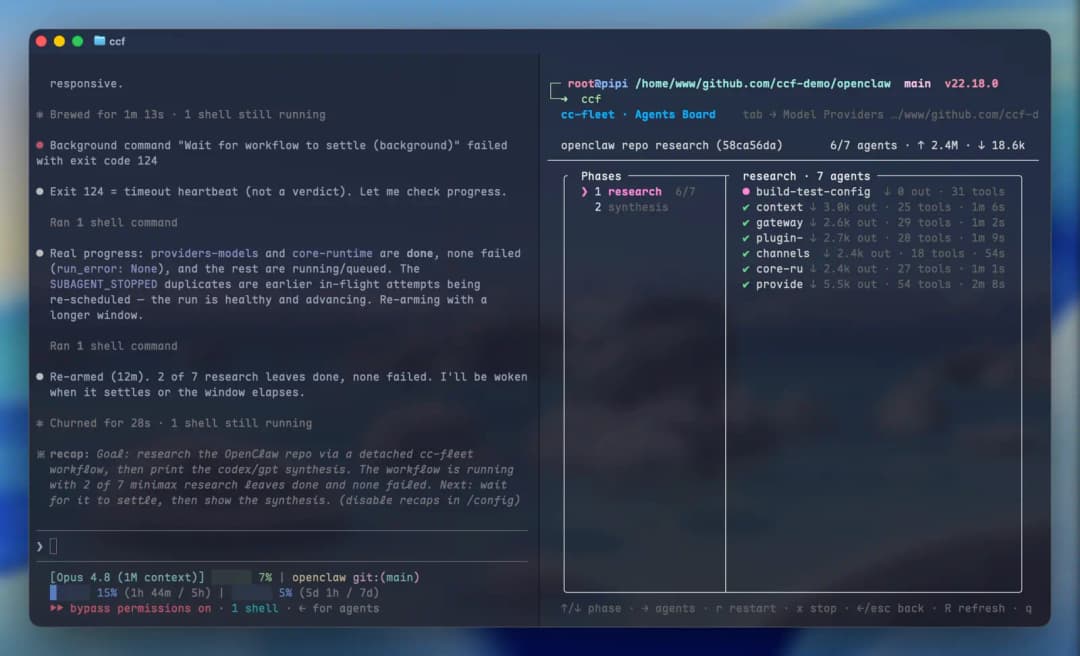 Agents Board: the phase → leaf tree | 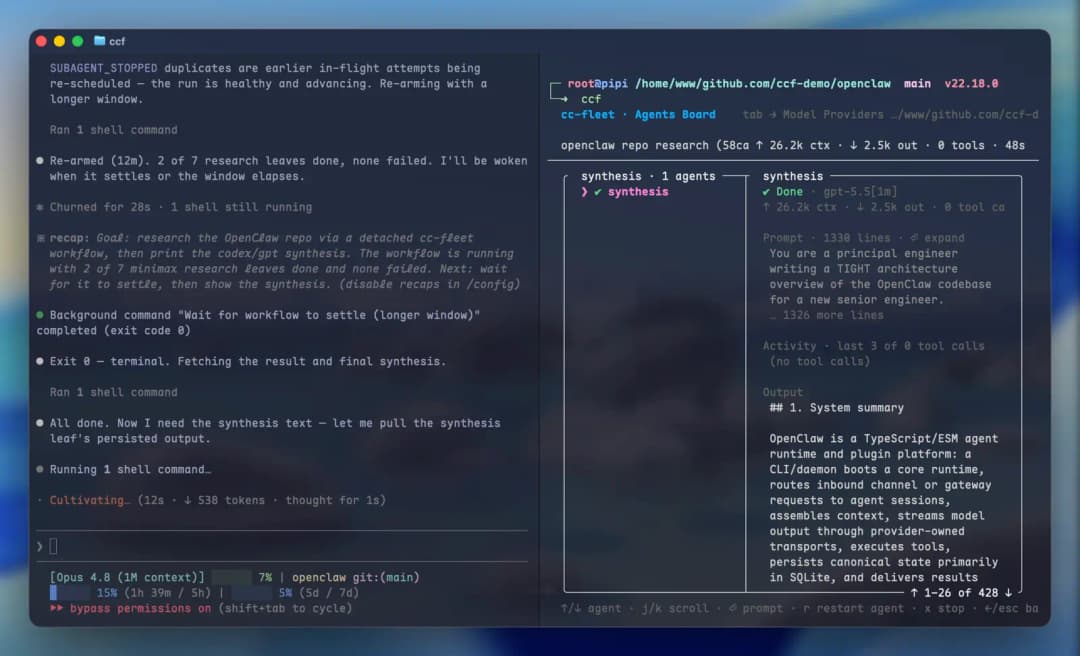 drill into one leaf: full prompt and synthesized output |
Orchestration API: multi-phase orchestration lives in a JavaScript file, with an API identical to Claude Code's native Workflow tool — agent() starts a node, parallel() fans out, pipeline() chains a flow. The one difference is that agent() takes a provider option to assign each node's model, so different vendors mix and run in parallel within a single run:
const meta = {
  name: "api audit",
  description: "map endpoints, then draft audit checklists",
  phases: [{ title: "map" }, { title: "build" }, { title: "judge" }],
};

phase("map");
const maps = (await parallel(
  ["auth", "billing", "users"].map((m) =>
    () => agent("List the exported endpoints in module " + m, { provider: "deepseek" }))
)).filter(Boolean);

phase("build");
const checklists = await pipeline(maps,
  (endpoints, _, i) => agent("Draft an audit checklist:\n" + endpoints,
                             { provider: "glm", label: "build:" + i }));

phase("judge");
const verdict = await agent("Pick the strongest one and say why:\n" + checklists.join("\n---\n"),
                            { provider: "claude", model: "opus", label: "judge" });
return { checklists, verdict };
Running and managing: once kicked off, the whole run executes in a background engine, managed by a small command set. Runs are journaled by content hash, and budgets cap spend in USD or tokens:
RUN=$(ccf workflow run audit.js)            # starts in the background, prints the run id
ccf workflow wait "$RUN" --timeout 10m      # blocks until done, event-driven
ccf workflow stop "$RUN" --leaf build:1     # hold a single leaf (run keeps going)
ccf workflow restart "$RUN" --leaf build:1  # resume it
ccf workflow run audit.js --resume "$RUN"   # replay the journal, finished leaves hit cache
Holding and restarting: ccf workflow stop --leaf / --phase doesn't fail the run — it just pauses the named node: the run keeps going and other nodes carry on, until you restart it to run again. If every node currently running gets paused, the whole run settles into a parked state that needs you to step in before it continues.
Wait without polling: ccf workflow wait blocks until the run ends, then exits — drop it in the background and come back when it exits, no repeated checking. The exit code states the outcome: 0 succeeded, 1 failed, 3 parked and waiting, 124 wait timed out (run still going), 130 interrupted.
Budget-adaptive: budget.spent() / budget.remaining() are readable live inside the script (USD or tokens), so a workflow can decide for itself whether to dispatch another batch.
Mixing in your own subscription: a node assigned provider: "claude" runs on your own Claude login — the judge above uses your subscription, not a provider key, which suits a synthesis-and-finish node.
👥 Agent Teams
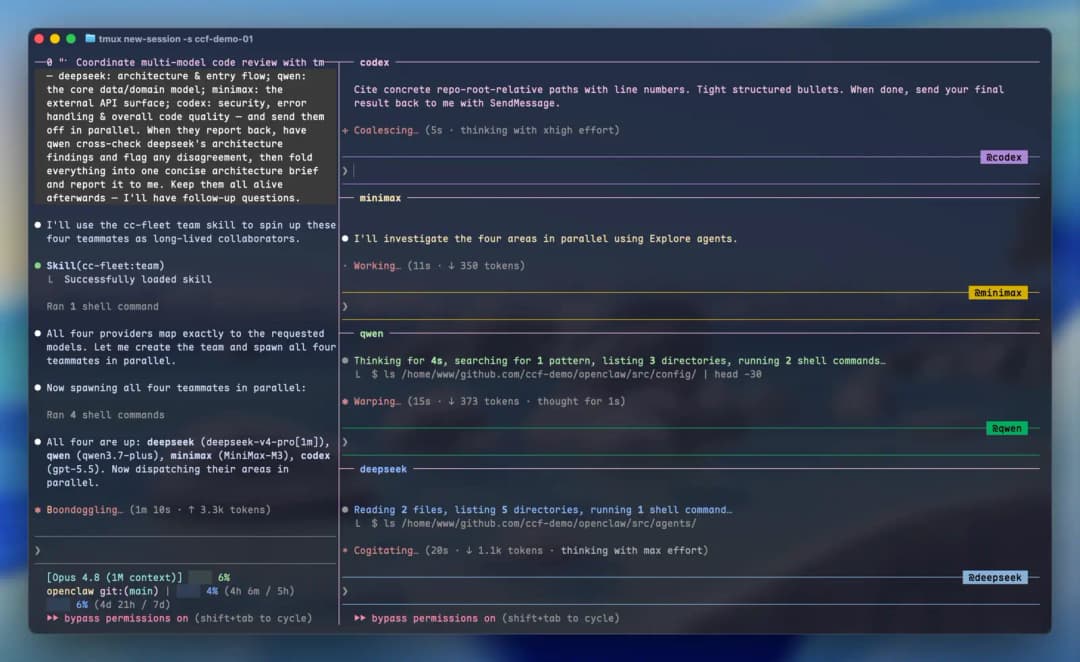 four teammates working side by side in tmux panes | 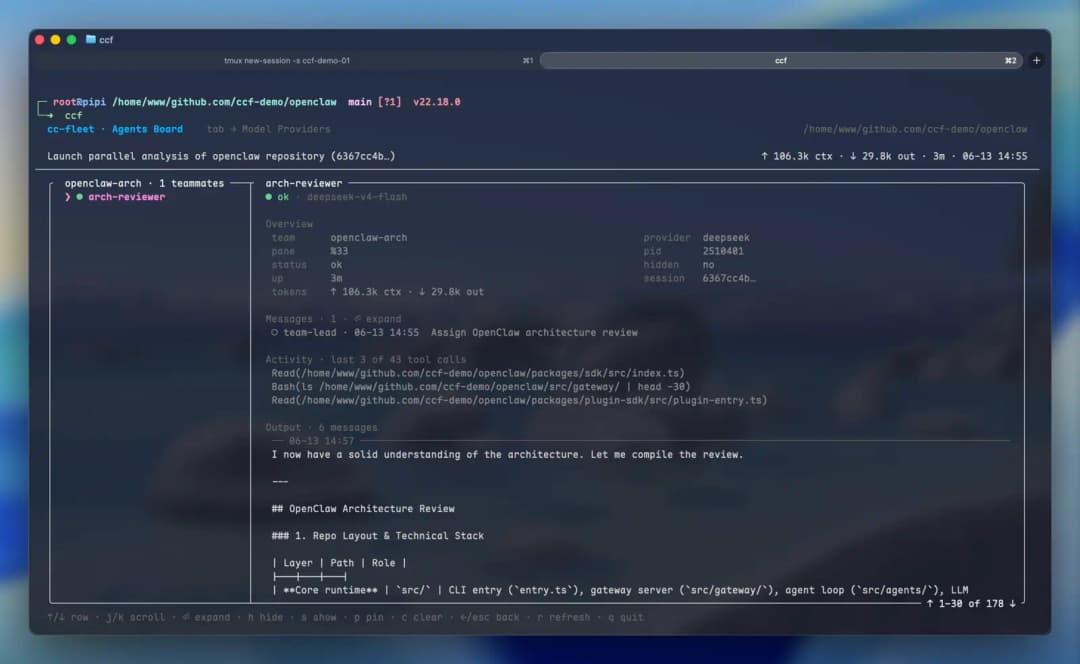 a teammate's overview / messages / output on the board |
Prerequisites: Agent Team is the only lane that needs setup up front, and because it relies on tmux it doesn't support Windows yet. Two conditions before you use it:
- Be inside a tmux session (
tmux new-session -s work) so teammate panes can show up alongside you; - Enable Claude Code's agent-teams: the first time you run
ccfit detects this isn't on and offers to write it in for you — or add it once yourself to~/.claude/settings.json:
{ "env": { "CLAUDE_CODE_EXPERIMENTAL_AGENT_TEAMS": "1" } }
How they collaborate: each teammate is a real claude process; Claude builds the team with native TeamCreate and assigns work with native SendMessage, and teammates stay alive across turns so you can keep adding tasks. One team can use several providers at once, then have one teammate gather and compare the results.
Permission inheritance: each teammate inherits your main session's permission posture (plan / acceptEdits / default). If that can't be detected, it falls back to the safest default and won't open up risky permissions on its own.
Park and restore: ccf hide tucks a teammate's pane out of the way while the process keeps running — messages and context are never lost — and ccf show brings it back. At cleanup, ccf teardown thoroughly clears every related process, including ones still running in the background and consuming the key after their pane was closed, so no ghost quietly bills you.
Outside tmux: the teammate runs in a background cc-fleet-swarm-<team> session, exactly the same flow with the pane just not on screen. To look in, attach with tmux -L cc-fleet-swarm-<team> attach.
⚡ Subagents
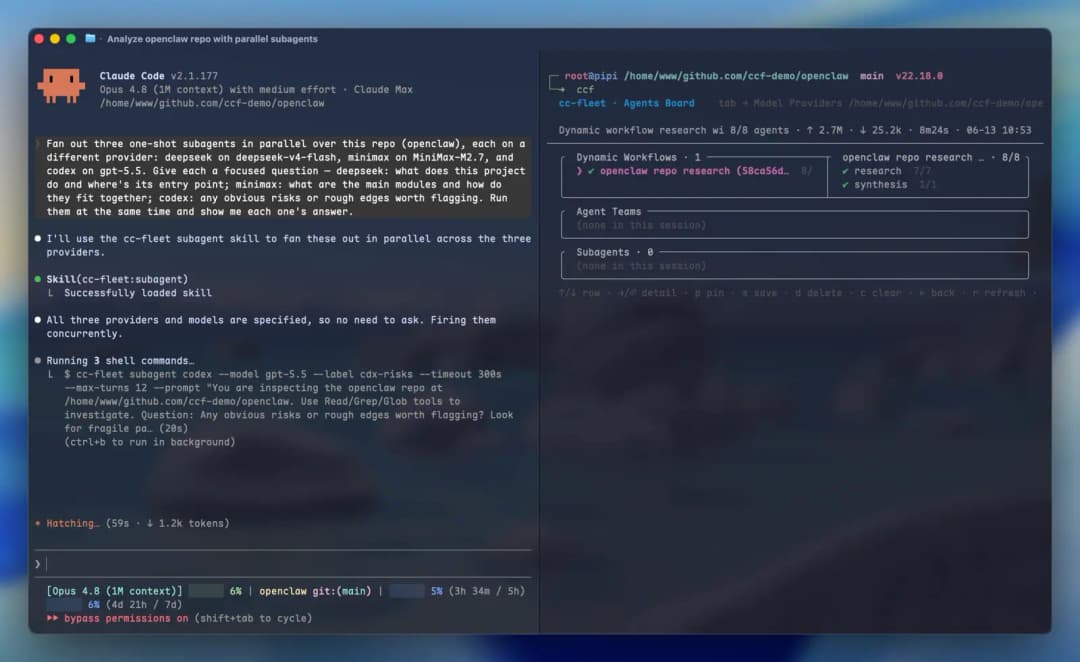 fan out three subagents in parallel from one ask | 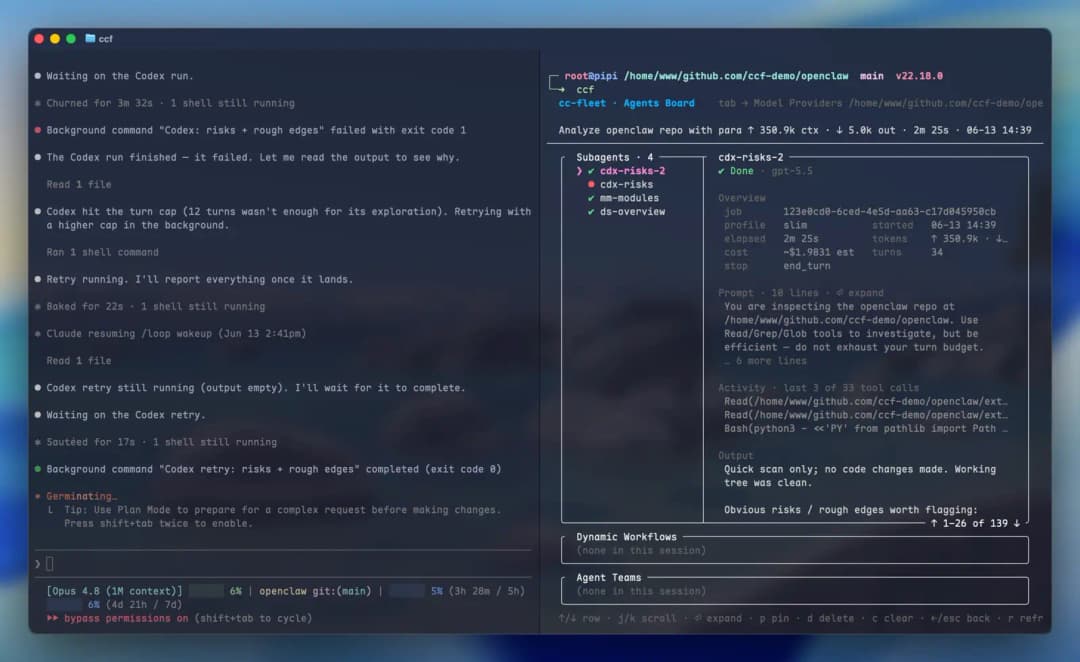 the job list and one job's detail |
Three run modes: the default slim sends the model a trimmed system prompt with a narrowed tool set, so the first request is much smaller than a full session — cheaper and faster on metered providers. --profile slim-ro is read-only, with tools cut to inspection only (Bash / Glob / Grep / Read / Skill) and no creating, editing, or deleting files, so a provider can read code and check logs without touching your workspace. Use --profile full when you need full-session capability.
Tool trimming and parallelism: --tools takes a comma-separated list to set exactly which tools are open (a replacement, not an addition to the defaults), --skills=false turns off the Skill tool, and --mcp controls whether the host MCP config carries over. A subagent builds no team, takes no pane, and holds no locks, so running many against one provider doesn't interfere — ideal for large batches in parallel.
Background and wake-up: add --background to send a long job to the background, then ccf subagent-status <job> --wait blocks until it's done and wakes the session that launched it — no repeated checking. Each job is capped by spend (USD), turns, and timeout, and a failure returns a fixed error_code your program can branch on.
Structured result: with --json you get a result object with fixed fields, easy for scripts to parse — besides the answer text it includes the model id that actually responded, the call's spend, token usage, turns, and session_id.
Run key nodes on your own subscription: as with Workflow, setting the provider to the reserved name claude (ccf subagent claude --model opus …) uses your own Claude login and bills your subscription — good for a synthesis-and-finish node, not large parallel batches.
🔌 Provider management
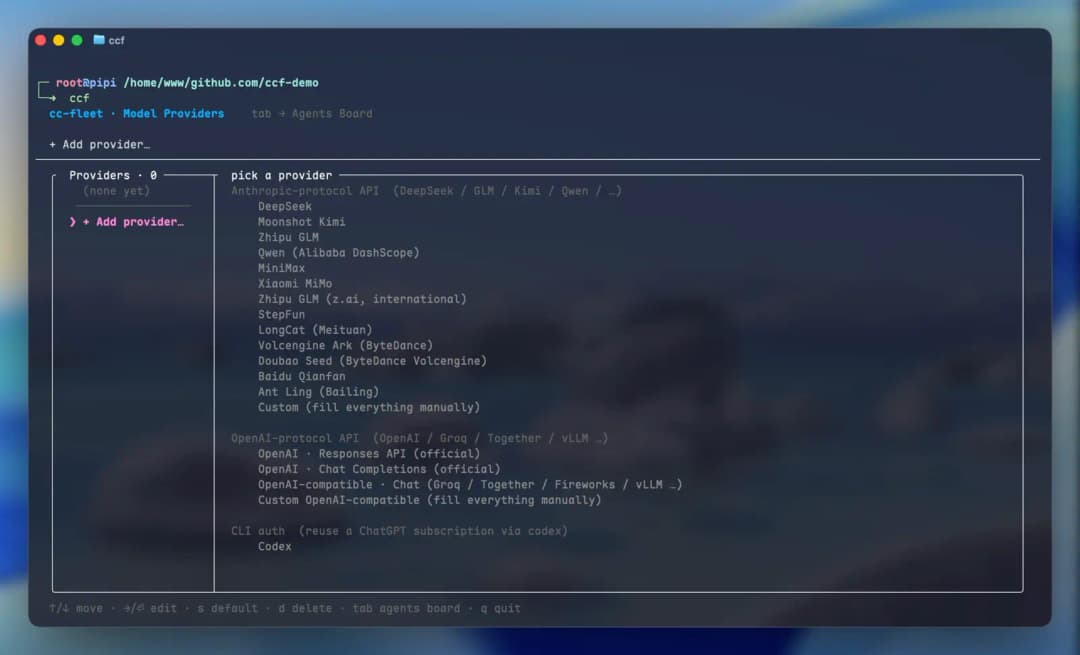 presets for many vendors | 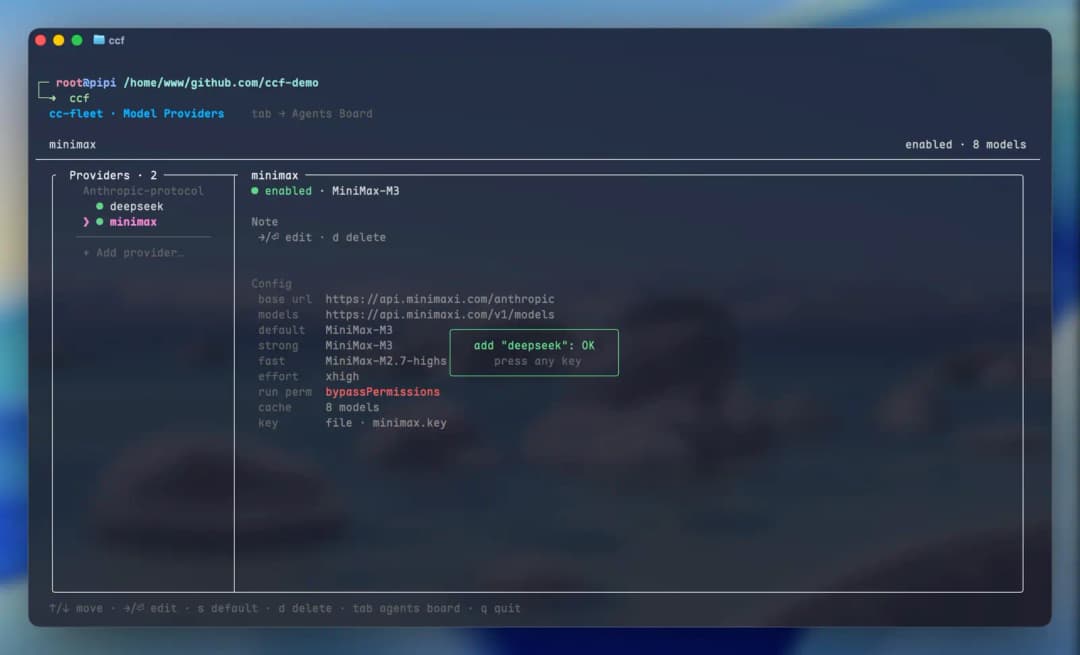 set each tier's model, effort, and permission |
Broad compatibility: works with any Anthropic- or OpenAI-compatible API endpoint — the former includes DeepSeek, Kimi, GLM, Qwen, and more; the latter Groq, Together, Fireworks, a local vLLM, and OpenAI itself. Common vendors ship as presets — select one and the endpoint and protocol are filled in, no manual entry; for anything not listed, pick Custom and enter the address.
Model tiers: each provider can carry default / strong / fast model slots, each separately taggable with 1M context and a reasoning effort. So Claude just asks for "the strong model" — no hardcoded model IDs. ccf default <provider> sets the fleet-wide default provider, and any call that doesn't name one goes to it.
Multi-key rotation: one provider can hold several API keys, rotated by off / round_robin / random to spread quota and avoid rate limits.
API key protection: a key is fetched only at request time, emitted once, and never written into environment variables, command-line arguments, or shell history; a worker process starts with the main session's credentials cleared, so the two never leak into each other. On disk it's saved 0600, readable only by you, or handed to pass, 1Password, Vault, or your OS keyring; every UI and log shows the key masked (sk-…238).
Codex (ChatGPT subscription): one device-code login and your ChatGPT subscription becomes a regular provider — usable across Workflow / Team / Subagent / run.
[!WARNING] Codex is unofficial. Reusing a ChatGPT subscription outside the codex CLI may violate OpenAI's terms, and
ccf codex loginasks you to confirm first. The OAuth token lives only inside the local conversion daemon; cc-fleet keeps its own login chain and never touches the codex CLI's auth.
🖥️ ccf run
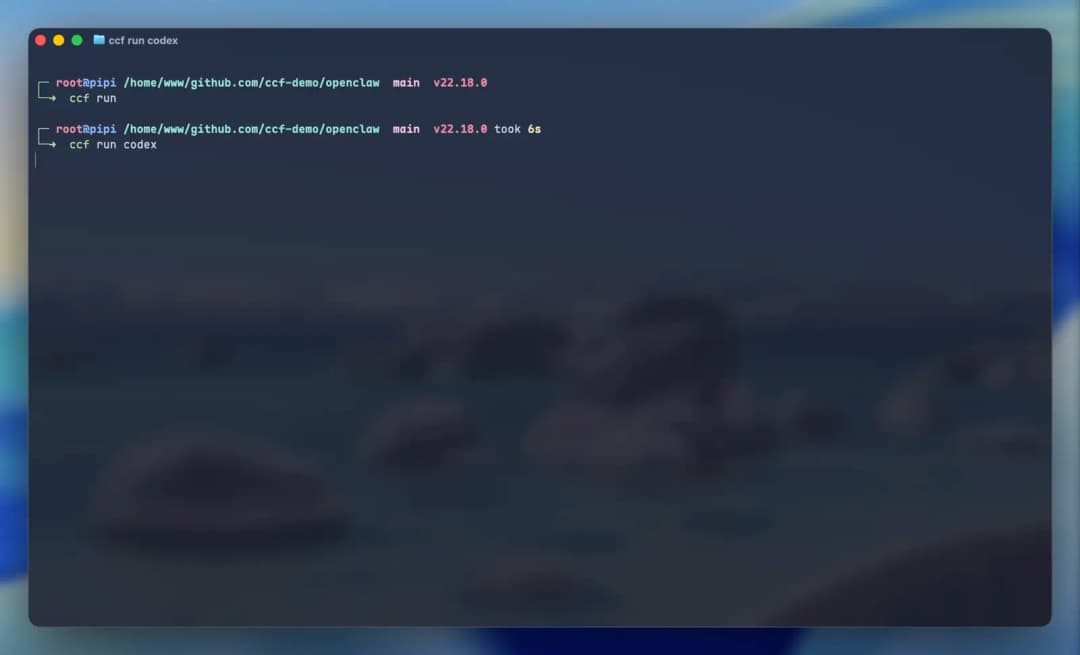 one-line launch: ccf run / ccf run codex | 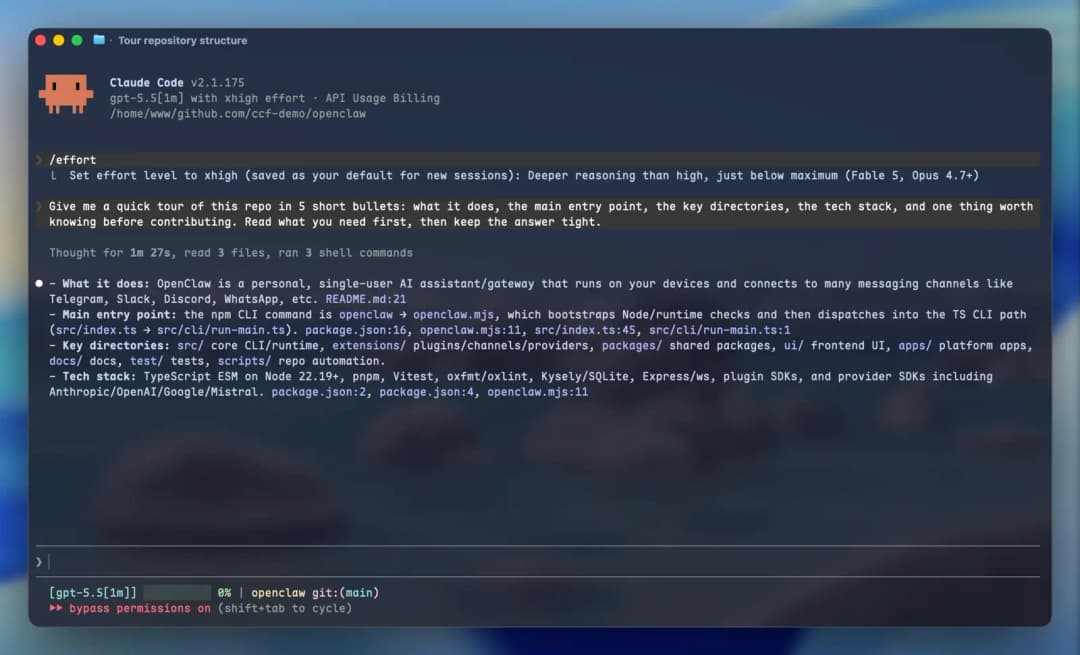 inside, it's a full claude — here on gpt-5.5 |
Launch: ccf run <provider> opens an interactive claude on the named provider; with no provider (ccf run) it resolves to the fleet-wide default.
ccf run deepseek # an interactive claude, on DeepSeek, billing the provider key
It's just native claude: ccf run adds no extra process layer — it replaces itself with claude, cc-fleet steps out entirely, and from then on it's a plain claude process whose feel and exit behavior match typing claude yourself.
Credentials isolated automatically: even if you run it from inside a logged-in Claude Code session, it first clears any leftover Anthropic auth from the environment and uses the chosen provider's auth instead — so billing lands on the provider's key, never your own subscription.
Flags:
--model strong / fast— override the default with the provider's strong or fast model--permission-mode— set the permission posture-- <claude args>— everything after is passed through verbatim to the underlyingclaude
[!NOTE] This lane is for hands-on interactive use: it needs a real terminal and doesn't support pipes or redirects — for non-interactive, one-shot output use a Subagent instead.
Documentation
- CLI reference & advanced usage — every command, flag, and envelope.
- Writing workflows — the JS scripting API for the workflow lane.
- Architecture — how spawning, key safety, the conversion daemon, and the workflow engine actually work.
ccf <cmd> --help— always authoritative.
Contributing
PRs are very welcome — bug fixes, new provider presets, docs, tests, features. Please read the contribution guide first; a few house rules:
- UI changes and bug fixes need a screenshot or GIF in the PR.
- AI-assisted commits credit the tool with a
Co-Authored-Bytrailer. - Fully AI-authored PRs add an autonomous-PR marker at the bottom of the PR body.
License
// faq
What is cc-fleet?
🚢 Run Claude Code's ⚙️ Dynamic Workflows, 👥 Agent Teams & ⚡ Subagents on any third-party model — DeepSeek · GLM · Kimi · Qwen … or your Codex subscription. No Anthropic subscription needed. | 🚢 让 Claude Code 的 ⚙️ Dynamic Workflow、👥 Agent Team、⚡ Subagent 用上任意第三方模型 — DeepSeek · GLM · Kimi · Qwen…… 或你的 Codex 订阅,无需 Claude 订阅. It is open-source on GitHub.
Is cc-fleet free to use?
cc-fleet is open-source under the Apache-2.0 license, so it is free to use.
What category does cc-fleet belong to?
cc-fleet is listed under plugins in the Claudeers registry of Claude-compatible tools.
// embed badge

[](https://claudeers.com/cc-fleet)
// retro hit counter

[](https://claudeers.com/cc-fleet)
// reviews
// guestbook
// related in Claude Plugins
 🔓
🔓A single CLAUDE.md file to improve Claude Code behavior, derived from Andrej Karpathy's observations on LLM coding pitfalls.
 🔓
🔓Claude Code is an agentic coding tool that lives in your terminal, understands your codebase, and helps you code faster by executing routine tasks, explainin…
 🔓
🔓"CLI-Anything: Making ALL Software Agent-Native" -- CLI-Hub: https://clianything.cc/
🔓financial-services — a Claude ecosystem project on GitHub.