
biomate-bioconductor-kb
BioMate-KB Bioconductor Skills — 200 packages (top 100 by downloads + 100 rising stars) as vignette-grounded Claude/agent skills, with per-package workflow r…
Install with your AI
Paste into Claude Code, Cursor, or any agent — it reads the repo and wires the tool into your project.
Install and set up biomate-bioconductor-kb (git-clone project) into my current project.
Found on https://claudeers.com/biomate-bioconductor-kb
Repo: https://github.com/bioMate-AI/biomate-bioconductor-kb
Homepage/docs: —
Detected install method: git-clone → git clone https://github.com/bioMate-AI/biomate-bioconductor-kb
Category: education. Platforms: api, web, mobile.
Read the repo's README for exact setup and env vars, then install it and wire it into my project.

Claudeers Health Verdict:
slowing; community-verified: false. Confirm the source before running anything.
git clone https://github.com/bioMate-AI/biomate-bioconductor-kb
// compatibility
| Platforms | api, web, mobile |
|---|---|
| Operating systems | — |
| AI compatibility | claude |
| License | NOASSERTION |
| Pricing | open-source |
| Language | Python |
BioMate-KB — Bioconductor Skills
200 Bioconductor packages — the top 100 most-downloaded plus the top 100 rising stars — formatted as Claude Code Skills.
A skill bundle in Claude Code Skills format. It covers the 100 most-used Bioconductor packages and the top 100 rising-star packages (newly released since ~2021 and fast-growing) from the BioMate-KB knowledge base. Each skill teaches Claude when to choose a package, the workflows it supports (each analysis as a recipe), what parameters to set, how to interpret results, and what pitfalls to avoid.
What's here
skills/  (200 packages · 12 domains)                  ⭐ = rising star
├── transcriptomics/  (97 — DESeq2, edgeR, limma  ·  ⭐ standR, Voyager, sechm, crisprScore)
├── genomics/         (33 — GenomicRanges, Biostrings  ·  ⭐ rBLAST, syntenet, ggmanh)
├── general/          (19 — Biobase, DOSE  ·  ⭐ immunotation, faers, mosbi)
├── proteomics/       (16 — MSnbase, mixOmics, mzR  ·  ⭐ MatrixQCvis, MsDataHub, TargetDecoy)
├── epigenomics/      (10 — ChIPseeker, minfi  ·  ⭐ HiCExperiment, HiContacts, epigraHMM)
├── single-cell/      (8  — SingleCellExperiment  ·  ⭐ demuxmix, hoodscanR, MuData)
├── variant-calling/  (4  — VariantAnnotation, snpStats, vsn)
├── metagenomics/     (4  — phyloseq, microbiome, DirichletMultinomial)
├── imaging/          (4  — flowCore, EBImage  ·  ⭐ lisaClust, cytoviewer)
├── annotation/       (2  — biomaRt, KEGGgraph)
├── enrichment/       (2  — enrichplot, ReactomePA)
└── metabolomics/     (1  — ⭐ rgoslin)
A package that supports multiple analyses lists each as a ### recipe under a ## Workflows section (e.g. DESeq2 → standard / multi-factor / LRT; crisprscore → on-target / off-target / indel scoring). The most-used 100 cover ~56% of Bioconductor analysis-package download volume; the rising-star 100 surface newly-important methods before they reach the top by volume. Beyond this 200-package sample, the full BioMate KB has runnable workflows for 1,818 Bioconductor packages — ~87% of analysis-package download volume — available via BioMate Cloud.
Bioconductor version: these skills are grounded against Bioconductor 3.21 (pinned explicitly — release is a moving pointer that drops packages as it advances, e.g. several rising stars dropped out of 3.23). The pinned version is recorded in MANIFEST.json (bioconductor_version); re-fetch a different snapshot with BIOC_VERSION=… python3 extraction/fetch_authoritative_sources.py.
Full package list
All 200 packages — with category, description, and the workflows each one supports — are in PACKAGES.md (one page, four columns; ⭐ marks rising stars).
Packages per domain

Workflows per domain
A package with multiple analyses contributes one ### recipe subsection per workflow — 390 workflows
across the 200 packages; 89 are multi-workflow (e.g. DESeq2 → DE / multi-factor / QC-transform /
LRT; crisprScore → 6 scoring recipes).

How these 200 were selected
Two ranked sets of 100:
- Top 100 by downloads — ranked purely by the official Bioconductor download score
(
bioc_pkg_scores.tab). These cover ~56% of Bioconductor analysis-package download volume. Because the rank is by raw volume, this set includes both analysis tools (DESeq2, edgeR, limma, fgsea, …) and the foundational data-structure / I/O / annotation packages nearly every analysis imports (GenomicRanges, Biostrings, SingleCellExperiment, AnnotationHub, …). - Top 100 rising stars — restricted to analysis packages (infrastructure, data-container, and GUI packages excluded), recently released (first release ≥ 2021) and fast-growing in 2025 (year-over-year download growth + ≥ 3,000 distinct download IPs), ranked by 2025 downloads. They surface newly-important methods before they reach the top by raw volume.
Together these 200 packages cover ~57% of Bioconductor's analysis-package download volume (foundational infrastructure and data-container packages — which alone are ~40% of raw downloads — are not counted as analysis volume). The full BioMate-KB goes much further: runnable workflows for 1,818 analysis packages — ~87% of analysis-package download volume.
Note on domains. Domain labels come from BioMate's catalog and are intentionally coarse — transcriptomics is a broad catch-all that absorbs most single-cell, spatial, and gene-set tools (scater / scran / monocle / SingleR are single-cell; fgsea / GSVA are enrichment) — which is why it dominates the charts, and why the small single-cell (8) and annotation (2) folders are remnants of the same imperfect classifier rather than clean boundaries. We keep BioMate's labels for traceability; treat the domain folders as a rough guide, not a strict ontology.
Our contribution — unique among public skill libraries:
- The only per-R/Bioconductor-package library — 200 packages here, 1,818 in the full KB. Every other public set is task-oriented or Python-centric; none provide per-package R/Bioconductor knowledge at this depth (the closest R one, wolf5996, has 13 skills and covers R packaging, not Bioconductor analysis).
- Vignette-grounded & fact-verified — every R function named in a skill is verified to appear in that package's own Bioconductor vignette (mean verify 0.91), not free-form LLM prose.
- Per-package workflow recipes — a package's distinct analyses are explicit
###recipes (390 across the 200) — how to run it, not just what it is. - Executable backing — the same knowledge runs as managed, validated workflows on BioMate Cloud for 1,818 packages.
Tutorial: Bulk RNA-seq → DESeq2 → STRINGdb Gene Interaction Network
This walkthrough shows how BioMate routes a plain-English bulk RNA-seq request through DESeq2, GO enrichment, and an interactive STRINGdb protein-protein interaction panel — without writing R code.
What the demo covers:
- Natural-language workflow routing to DESeq2 + clusterProfiler
- Differential expression on 120 samples (human GRCh38, control vs treated)
- GO enrichment (enrichGO) identifying apoptotic regulation as the top pathway
- Interactive gene interaction panel — STRINGdb network visualization of the top 2,841 DEGs, with nodes coloured by log₂FC and edges weighted by STRING confidence score
- AI findings summary + citable methods section + citation export
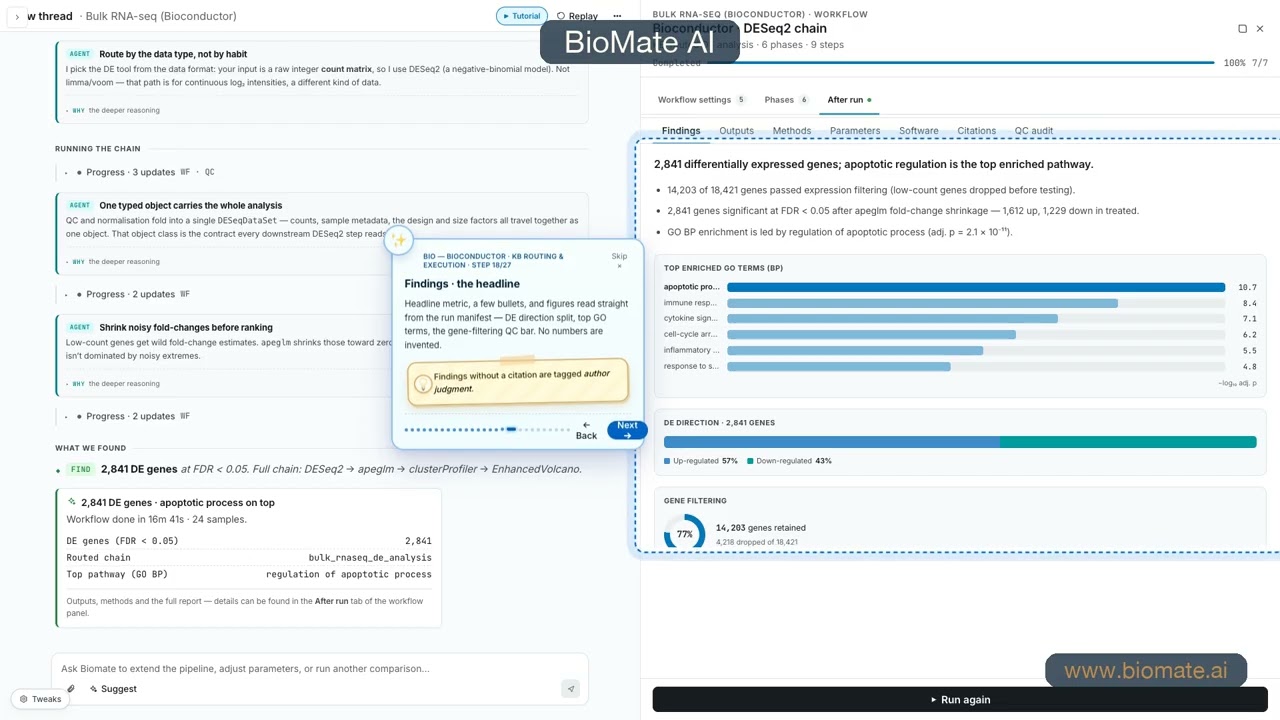
▶ Click the image above to watch the tutorial on YouTube.
For all tutorials (single-cell Seurat, DNA methylation, bispecific antibody design, CAR-T, base editing, GLP-1 modality selection, BCMA myeloma triage) see the BioMate Tutorial Page →
Want the full collection?
This bundle covers 200 Bioconductor packages (top 100 by downloads + 100 rising stars). BioMate AI gives you:
- Broad Bioconductor coverage — runnable workflows for 1,818 packages (~87% of analysis-package download volume), plus nf-core and drug-discovery pipelines across genomics, proteomics, and more
- Efficient parallel computing — workflows run in the cloud with automatic scaling, no cluster setup required
- Interactive visualization & analysis — inspect, filter, and re-run results through linked charts and per-step QC dashboards, with AI-assisted interpretation that links every claim back to the underlying data
- Reproducible reporting — methods and results documents generated with complete parameter and software-version provenance, formatted for publication and audit
Free for academic and non-profit researchers — register at www.biomate.ai (no credit card required). Commercial plans available. Questions or collaboration inquiries: [email protected]
How to use
# Clone
git clone https://github.com/bioMate-AI/biomate-bioconductor-kb.git
cd biomate-bioconductor-kb

# Install all skills into Claude Code (global)
find skills -name "SKILL.md" | while read f; do
  pkg=$(dirname "$f" | xargs basename)
  cp "$f" ~/.claude/skills/bioconductor-${pkg}.md
done
Or copy a single domain:
# Only RNA-seq DE skills
find skills/transcriptomics -name "SKILL.md" | while read f; do
  pkg=$(dirname "$f" | xargs basename)
  cp "$f" ~/.claude/skills/bioconductor-${pkg}.md
done
Each SKILL.md is a self-contained Claude Code skill file — Claude discovers it automatically once it's in ~/.claude/skills/ (global) or .claude/skills/ (project-level).
Ranking source
Packages are ordered by Bioconductor's official monthly download score:
- Source: https://bioconductor.org/packages/stats/bioc/bioc_pkg_scores.tab
- Snapshot taken: 2026-05-21
- Top 100 by download score + 100 analysis rising stars = 200 packages, together ~57% of Bioconductor analysis-package download volume
Because the ranking is by download volume, the bundle includes both analysis tools (DESeq2, edgeR, limma, fgsea, …) and the core data-structure, I/O, and annotation packages that nearly every analysis depends on (GenomicRanges, Biostrings, SingleCellExperiment, AnnotationHub, …) — the latter rank highly precisely because they are imported everywhere. Both are useful to an agent: the analysis packages teach how to analyze, the foundational ones how to represent and load the data.
Knowledge layer, not pipelines
These skills are the knowledge layer — when and why to use each package, with parameters, assumptions, pitfalls, and alternatives. They are not runnable pipelines and carry no infrastructure details.
BioMate hosts and executes these workflows for you — managed compute, automated QC, and reproducible outputs — powered by this same Bioconductor know-how. For end-to-end cloud execution, see BioMate.
License
- Skill content (
skills/**/*.md,MANIFEST.json): CC-BY-4.0 — share + adapt with attribution. - Extraction scripts (
extraction/*.py): Apache-2.0 — use, modify, distribute. - Underlying Bioconductor packages retain their own (mostly Artistic-2.0 / GPL) licenses.
Citation
If you use this skill bundle in research, please cite:
Zhang, Y. (2026). BioMate-KB: A Real-Execution-Validated Workflow Knowledge Base for Bioconductor (3.0). Zenodo. https://doi.org/10.5281/zenodo.20616356
And, for the execution-grounding methodology:
Zhang, Y. (2026). Structure Grounding Is Not Enough: Real Execution as the Ground Truth for LLM-Generated Bioinformatics Workflows (Version v3). Zenodo. https://doi.org/10.5281/zenodo.20616544
Concept DOIs (always resolve to the latest version): BioMate-KB — https://doi.org/10.5281/zenodo.20616355 · Structure Grounding — https://doi.org/10.5281/zenodo.20616543
Regenerating the bundle
# Re-fetch the latest Bioconductor download scores
curl -O https://bioconductor.org/packages/stats/bioc/bioc_pkg_scores.tab

# Regenerate the download-ranked set (top 100 by default).
# The 100 rising-star skills are a separately-curated set (analysis packages,
# first release >= 2021, ranked by 2025 download growth) generated per-package
# via extract_skill.py, then vignette-grounded with enrich_v2_grounded.py.
python3 extraction/generate_bundle.py --top 100

# Single package
python3 extraction/extract_skill.py \\
    --db <path-to-biomate-knowledge-db> \\
    --pkg DESeq2 \\
    --out my-deseq2-skill.md
The extraction code (extraction/extract_skill.py) is intentionally minimal (~300 lines) and reads only from BioMate's public knowledge fields — tool_knowledge.{use_cases, limitations, alternatives, recommended_parameters, primary_citation, benchmark_papers} and tools.scientific_context. Internal and infrastructure fields are excluded.
Versioning
v2.0.0 (2026-06-15) — full history in CHANGELOG.md. Skills are pinned to
Bioconductor 3.21 (recorded in MANIFEST.json).
Since v1.0.0: coverage doubled to 200 packages (added the top 100 rising stars), per-package
## Workflows recipes, and a full package table + coverage charts.
Planned: track new Bioconductor releases, expand coverage (top-1000 if community demand justifies),
and refine SKILL.md sections (Q&A, gotchas, more examples).
Contributing
Open an issue or PR for:
- Errors in any SKILL.md
- Suggestions for new sections to extract
- Packages missing from the top-100 / rising-star sets that should be included
Acknowledgments
Bioconductor download statistics published by the Bioconductor Core Team. SKILL.md format from Anthropic Claude Code.
// faq
What is biomate-bioconductor-kb?
BioMate-KB Bioconductor Skills — 200 packages (top 100 by downloads + 100 rising stars) as vignette-grounded Claude/agent skills, with per-package workflow recipes. It is open-source on GitHub.
Is biomate-bioconductor-kb free to use?
biomate-bioconductor-kb is open-source under the NOASSERTION license, so it is free to use.
What category does biomate-bioconductor-kb belong to?
biomate-bioconductor-kb is listed under skills in the Claudeers registry of Claude-compatible tools.
// embed badge

[](https://claudeers.com/biomate-bioconductor-kb)
// retro hit counter

[](https://claudeers.com/biomate-bioconductor-kb)
// reviews
// guestbook
// related in Education & Learning
 🔓
🔓Skills for Real Engineers. Straight from my .claude directory.
 🔓
🔓Course to get into Large Language Models (LLMs) with roadmaps and Colab notebooks.
 🔓
🔓Learn it. Build it. Ship it for others.
 🔓
🔓A collection of learning resources for curious software engineers