
agent-html-kit
Demo: HTML pages from a coding agent at markdown token cost. A component kit, a Claude Code skill, and the 72-run benchmark behind it.
Install with your AI
Paste into Claude Code, Cursor, or any agent — it reads the repo and wires the tool into your project.
Install and set up agent-html-kit (git-clone project) into my current project.
Found on https://claudeers.com/agent-html-kit
Repo: https://github.com/leex279/agent-html-kit
Homepage/docs: —
Detected install method: git-clone → git clone https://github.com/leex279/agent-html-kit
Category: mcp-servers. Platforms: cli, api, web.
Read the repo's README for exact setup and env vars, then install it and wire it into my project.

Claudeers Health Verdict:
active; community-verified: false. Confirm the source before running anything.
git clone https://github.com/leex279/agent-html-kit
// compatibility
| Platforms | cli, api, web |
|---|---|
| Operating systems | — |
| AI compatibility | claude |
| License | MIT |
| Pricing | open-source |
| Language | HTML |
agent-html-kit
HTML pages from a coding agent at markdown token cost.
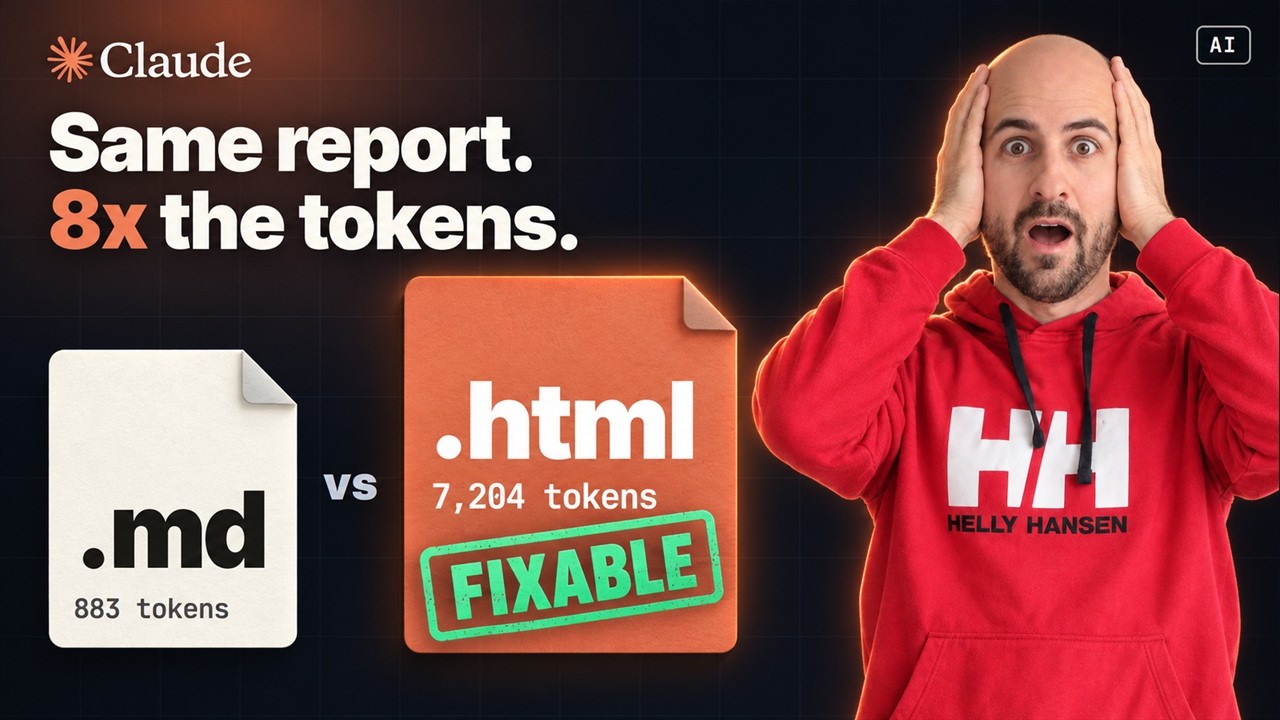
Video: this repo comes from a YouTube video that walks through the benchmark: the four formats, where the tokens go, and what the kit changes.
[!NOTE] A demo, not a product. This repo shows the approach behind the benchmark: move the design into one file, and let the agent write only content. It is here to learn from and to reproduce the numbers. It is not a finished, production-ready library: the kit covers a few components, has no tests, and has only been tried on the pages in
examples/. Copy the idea, adapt the code to your own documents, and expect to fix things.
When an agent writes a freeform HTML page, most of the tokens go into design: CSS,
hand-placed SVG coordinates, and JavaScript the page doesn't need. This kit moves all of
that into one script file (kit/kit.js). The agent writes only content, using a few
components, so an HTML report costs about the same as the markdown version.
The repo also contains the benchmark behind that claim: 72 real Claude Code runs,
every number taken from claude -p --output-format json usage receipts.
Background: Thariq from the Claude Code team makes the case for HTML over markdown as agent output in Using Claude Code: The Unreasonable Effectiveness of HTML. This repo measures what that costs in tokens, and how to keep the HTML without paying for it.
Results
Model claude-opus-5-5 in Claude Code 2.1.296, 3 runs per cell, median shown. Run on
2026-10-12. Each call ran in an empty temp folder with settings files off
(--setting-sources ""), no MCP servers, skills or slash commands, and only the tools the
job needs. Claude Code's built-in plugins and agents stayed loaded, the same for every format.
Output tokens per job
| Job | A · markdown | B · freeform HTML | C · HTML + kit | D · markdown + renderer |
|---|---|---|---|---|
| Weekly status report | 883 | 7,204 | 726 | 569 |
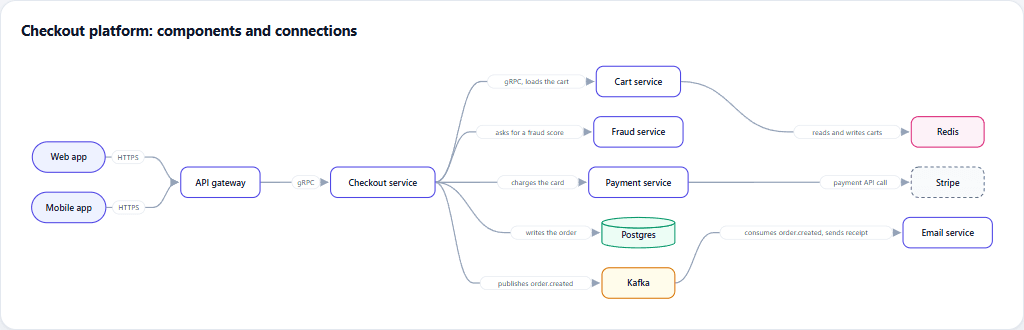
| Architecture diagram | 1,672 | 17,314 | 1,015 | 1,651 |
| Drag-and-drop triage board | 790 | 16,987 | 615 | 698 |
| Implementation plan | 8,599 | 25,376 | 8,911 | 9,086 |
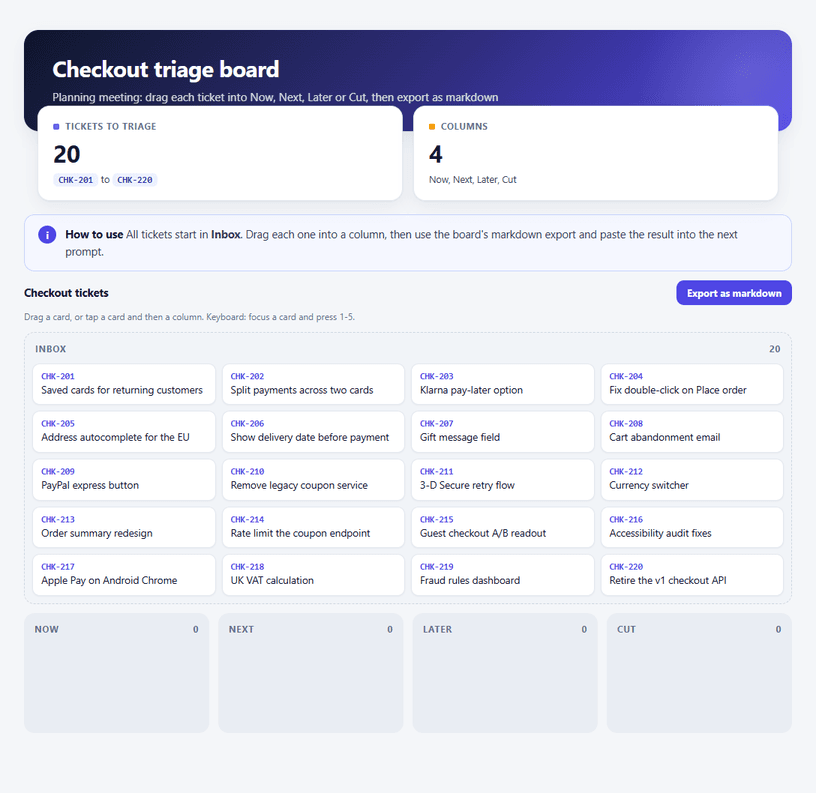
Output tokens include thinking. Without it the gap stays or widens: the report is 707 vs 6,782 artifact tokens, the board 432 vs 10,848. Markdown cannot drag cards, so the A board is a static list. The closer board comparison is B vs C, 16,987 vs 615 output tokens for the same task (drag tickets into columns, export as markdown). Not an identical feature set: the freeform boards also added extras such as saved state and reset buttons, which is part of what freeform costs.
API time per job (seconds)
| Job | A | B | C | D |
|---|---|---|---|---|
| Report | 7.5 | 55.5 | 5.9 | 4.9 |
| Diagram | 14.5 | 143.6 | 8.2 | 15.2 |
| Board | 7.9 | 136.7 | 5.1 | 6.2 |
| Plan | 70.2 | 197.8 | 74.3 | 77.0 |
A second agent builds a module from each plan (19 hidden tests it never sees)
| Plan format | Tests passed (3 runs) | Input tokens | Cost (USD, list price) |
|---|---|---|---|
| A · markdown | 19, 19, 19 | 85,954 | 0.126 |
| B · freeform HTML | 19, 19, 19 | 234,403 | 0.209 |
| C · HTML + kit | 19, 19, 19 | 83,887 | 0.092 |
| D · markdown + renderer | 19, 19, 19 | 66,500 | 0.077 |
Every build passed the test suite. The freeform HTML plan cost about two thirds more: the bigger plan stays in the context of every later request (mostly as cache reads), and turn counts differ between runs too. The 19 tests cover the spec's main rules, not every edge: two builds (B-1, C-2) raise an error for an empty cart with an unknown coupon where the other ten return zeros, and no test checks that case.
One small edit ("CHK-102 is now done, update everything that depends on it"):
all 12 edits were correct (checked by hand from the diffs; the outputs are in
bench/results/edit/). In the kit version the diff is two lines; in the freeform
version the same fact lives in six places (progress bar widths, legend, filter counts,
the row's status pill, its note, next week).
Full numbers: bench/results/summary.json. Generated files for every run sit next to
their receipts in bench/results/<job>/, exactly as the agent wrote them. The kit pages
there load kit/kit.js from their own folder, so to view one, copy kit/ next to it or
open the copies in examples/.
Use the kit
Copy kit/ next to your documents. An HTML document starts with one line, then content:
<!doctype html><meta charset="utf-8"><script src="kit/kit.js" defer></script>
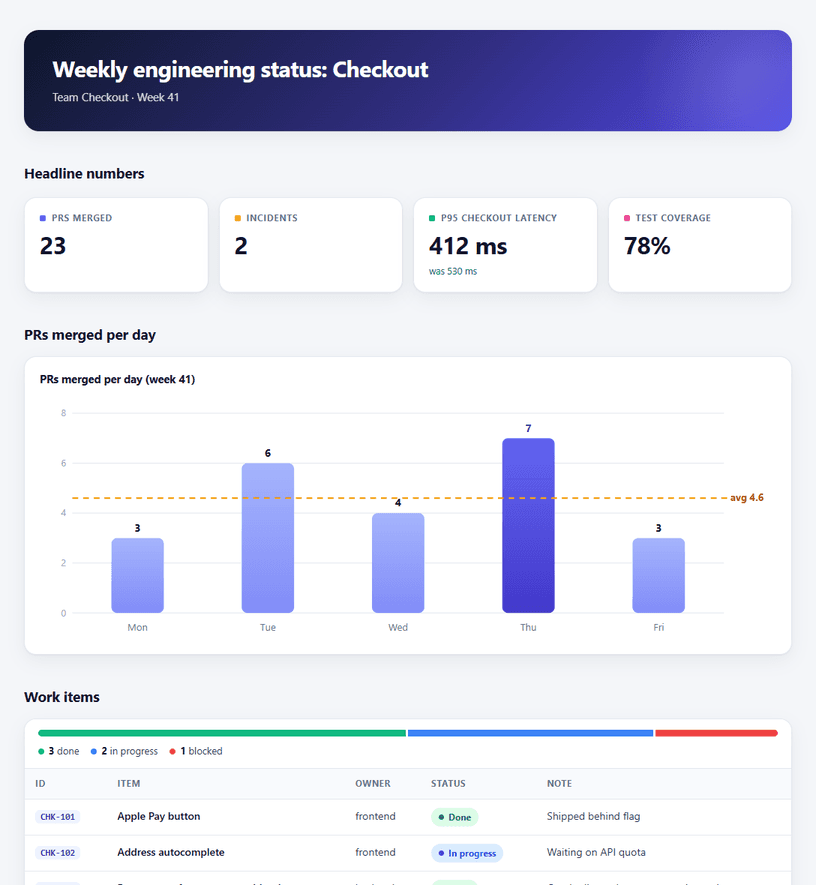
<rk-header title="Weekly Engineering Status" sub="Team Checkout, week 41"></rk-header>
<rk-stats>
23 | PRs merged | +5 vs last week
</rk-stats>
<rk-chart type="bar" title="PRs merged per day">
Mon: 3
Tue: 6
</rk-chart>
Components: rk-header, rk-stats, rk-chart, rk-table, rk-callout,
rk-diagram, rk-steps, rk-board, rk-cols. In any text, **bold**, `code`,
[done]-style status pills and ticket IDs like CHK-101 are formatted. The full contract
the agent gets is bench/contracts/html.txt (634 input tokens per call). Examples are in
examples/; open them in a browser.
The board is a real drag-and-drop page with a markdown export. On a touch screen, tap a card and then a column; with a keyboard, focus a card and press the column's number.
Prefer markdown? Write it with the fenced chart, diagram, steps and board
blocks and render it:
node kit/md2html.js report.md          # -> report.html with kit components
node kit/md2html.js report.md --plain  # -> same markdown, plain GitHub-like look
The renderer covers the markdown agents write (headings, nested lists, task lists, tables, code, quotes, links, images). It is not a full CommonMark implementation.
Claude Code skill
skill/SKILL.md teaches the agent the kit contract. Install it together with the kit, so
the agent can copy kit/ next to the documents it writes:
mkdir -p .claude/skills/html-kit                 # or ~/.claude/skills/html-kit
cp skill/SKILL.md .claude/skills/html-kit/
cp -R kit .claude/skills/html-kit/
Run the benchmark yourself
Needs the Claude Code CLI and Python 3. The full run is 72 task runs plus 20 short token-counting calls (more if a call is retried), and it uses real tokens on your account.
bash bench/run_all.sh                     # everything, into bench/results-local
AHK_RESULTS=bench/results-mine python3 bench/run.py gen --scenario report --runs 3  # one job
AHK_RESULTS=bench/results-mine python3 bench/run.py summary                         # its summary
A run never writes into the committed bench/results. Receipts already in the target
folder are skipped, so an interrupted run picks up where it stopped. Your numbers will
differ from ours; model, Claude Code version and day all move them.
Limits
- One model (Opus 5.5) and three runs per cell. Treat the numbers as directional.
- The freeform prompt (B) asks for a polished page: inline CSS, real SVG, JavaScript where interaction is needed. A terser freeform prompt would cost less; that was not measured.
- Dollar amounts are list prices from the receipts (
costBasis: "list"). On a subscription you pay in usage limits instead. - Writing a kit is not free.
kit/kit.jsmeasured 20,564 tokens in the benchmark (v1.0; the v1.1 fixes make the file about 12% larger). That is the size of the file, not what it took to develop it. Each kit report saves about 6,478 output tokens against a freeform one (726 vs 7,204), so the kit file pays for itself by the fourth report. - The kit only knows its components. A page that needs something it doesn't have costs the freeform price.
- Pages need JavaScript to render. Links and images in kit text accept only http(s), mailto and relative URLs, but a page still runs whatever HTML it contains: open pages you or your agent wrote, not untrusted ones.
- Raw
claude -pevent streams are not committed (they contain local paths and session ids). One build reply inbench/results/implement/B-2.jsonhad a local temp path, redacted to%TEMP%.
Changes
-
v1.1 (after a review, including an independent one by a second model):
- Plain
<p>/<li>/callout text gets the same formatting as components (**bold**and`code`showed raw in v1.0); code spans stay literal. - Security: chart
unitis escaped (v1.0 let markup through);javascript:and other non-web links are dropped; formatting no longer runs inside link targets. - Charts show values as written (0.126 showed as 0.1), read
1e3, and refuse negative values with a visible note instead of drawing them wrong. Axis ticks stay round. - Flowchart labels no longer slide off the left edge.
- Markdown:
~~strike~~, images, nested lists, h5/h6. UTF-8, SHA-256 & co. are no longer styled as ticket IDs. - Phones: tables and diagrams scroll, board columns wrap; the board works by touch and keyboard.
md2html.jsencodes the script path; the benchmark writes fresh runs to their own folder andrun_all.shworks on macOS/Linux.
Rendering and tooling only: the benchmark numbers are unchanged.
- Plain
-
v1.0: the version measured in the benchmark (tag
v1.0).
License
MIT
// faq
What is agent-html-kit?
Demo: HTML pages from a coding agent at markdown token cost. A component kit, a Claude Code skill, and the 72-run benchmark behind it.. It is open-source on GitHub.
Is agent-html-kit free to use?
agent-html-kit is open-source under the MIT license, so it is free to use.
What category does agent-html-kit belong to?
agent-html-kit is listed under mcp-servers in the Claudeers registry of Claude-compatible tools.
// embed badge

[](https://claudeers.com/agent-html-kit)
// retro hit counter

[](https://claudeers.com/agent-html-kit)
// reviews
// guestbook
// related in MCP Servers
 🔓
f.k.a. Awesome ChatGPT Prompts. Share, discover, and collect prompts from the community. Free and open source — self-host for your organization with complete…
 🔓
A cross-platform desktop All-in-One assistant for Claude Code, Codex, OpenCode, OpenClaw, Gemini CLI & Hermes Agent. Only official website: ccswitch.io
 🔓
🪨 why use many token when few token do trick — Claude Code skill that cuts 65% of tokens by talking like caveman
 🔓
An open-source AI agent that brings the power of Gemini directly into your terminal.