
academic-humanizer
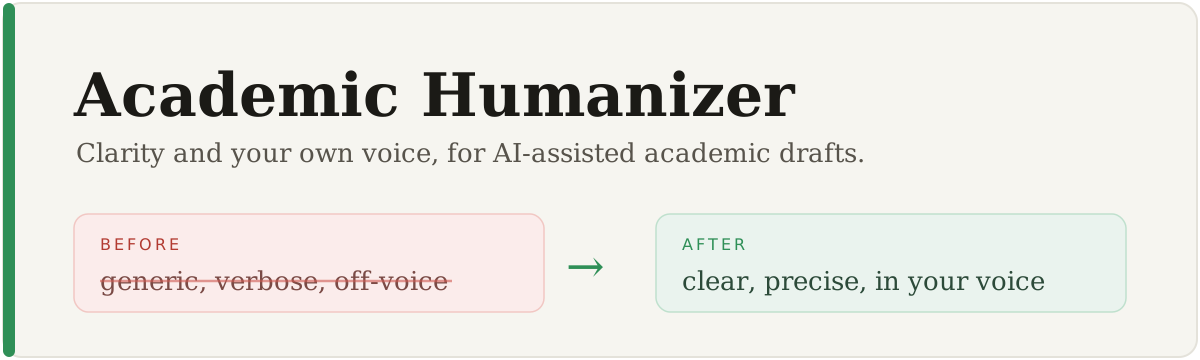
Strip AI-writing tells from papers and grant proposals (NSF/NIH), while keeping scholarly voice and tying claims to evidence. A skill for Claude Code, Codex,…
Install with your AI
Paste into Claude Code, Cursor, or any agent — it reads the repo and wires the tool into your project.
Install and set up academic-humanizer (claude-skill project) into my current project.
Found on https://claudeers.com/academic-humanizer
Repo: https://github.com/AIScientists-Dev/academic-humanizer
Homepage/docs: https://morphmind.ai
Detected install method: claude-skill → # copy this skill into .claude/skills/academic-humanizer/
Category: other. Platforms: cli.
Read the repo's README for exact setup and env vars, then install it and wire it into my project.

Claudeers Health Verdict:
slowing; community-verified: false. Confirm the source before running anything.
# copy the skill dir into your project:
# .claude/skills/academic-humanizer/   (or ~/.claude/skills/academic-humanizer/ for all projects)
git clone https://github.com/AIScientists-Dev/academic-humanizer
// compatibility
| Platforms | cli |
|---|---|
| Operating systems | — |
| AI compatibility | claude |
| License | NOASSERTION |
| Pricing | open-source |
| Language | — |
Why we built this
Some of us write a lot of papers and grant proposals, and our team started using AI to help with drafts. The catch is that AI writing is easy to spot: the "In recent years..." openers, the puffed-up phrasing, the very long sentences, the em-dashes. Reviewers pick up on it.
There are tools called "humanizers" that try to remove that AI flavor, but they're made for blogs and marketing. Run one on a paper or an NSF proposal and it cuts the precision along with the AI flavor. The careful wording academic writing depends on is the first thing to go.
So we put together our own for the group. To get the rules, we had the AI compare its own drafts with our team's accepted papers and funded proposals, and we went through the differences by hand. It's nothing fancy, and it isn't about gaming review or adding fake novelty. We just wanted AI-polished drafts to still read like a person wrote them, with the numbers, citations, and claims left alone.
See it work
[!CAUTION] Before (AI-generated, every tell present):
In recent years, continual learning has attracted increasing attention and achieved remarkable success. However, existing methods still face crucial challenges. In this proposal, we propose a novel framework that leverages cutting-edge techniques to delve into these intricate problems, paving the way for a transformative paradigm that will revolutionize the field.
[!TIP] After (the AI tells are gone; the vision and ambition stay):
Continual learning matters, but today's methods stay empirical and their principles are unclear. That limits reliability and progress. This proposal builds a principled framework on three fronts: adaptation, soft supervision, and cross-domain knowledge. We demonstrate it on autonomous driving and network management.
More before/after passes are in examples/before-after.md: a general
example, an NIH Specific Aims page, and a funded NSF CAREER summary.
What it does
- Removes the usual AI tells: "paves the way", "extensive experiments", "to the best of our knowledge", "In recent years...", delve/underscore/tapestry, rule-of-three, very long sentences, and em-dashes.
- Keeps claims tied to evidence: no verb stronger than the data (
prove→show empirically), and vague magnitudes become attributed ranges. - Leaves real scholarship alone: evidence-tied hedging, passive voice where it fits,
we, definitions, symbols, and every citation. It doesn't change a number or a reference. - Has a separate mode for grant proposals (NSF, NIH): it keeps the vision a paper would trim, and spends most of the effort on the first pages, since that's what reviewers score.
Install
git clone https://github.com/AIScientists-Dev/academic-humanizer ~/.claude/skills/academic-humanizer
It is a plain SKILL.md plus examples, so it also runs as a skill or system prompt for Codex and
MorphMind. Point your agent at SKILL.md.
Use
/academic-humanizer
[paste a section, or point at main.tex]
# optionally: "match my voice from prior_paper.pdf; target venue: ICLR"
How it works
Six layers: general AI-tell catalog → academic-specific tells → preserve scholarly conventions →
claim↔evidence matching → voice/venue calibration → funding-proposal mode (NSF/NIH structure,
first-page primacy, claim↔feasibility). The audit→rewrite loop is defined in SKILL.md.
References
Layer 6 distills the stable structure of NSF and NIH proposals. For current, binding requirements (page limits, formatting, deadlines), consult the source:
- NSF: Proposal & Award Policies & Procedures Guide (PAPPG)
- NSF: CAREER program
- NIH: Write Your Application (Specific Aims, Significance, Innovation, Approach)
Acknowledgments
- blader/humanizer (MIT). Focus: removing general AI-writing patterns for blog, casual, and encyclopedic text. This skill reuses its general AI-tell catalog (Layer 1) and extends it for academic prose.
- koaeraser/ARMS. Focus: an autonomous pipeline for statistics/methodology research papers (idea → validated, revised manuscript). A complementary, broader-scope project that informed the claim-evidence and numerical-precision emphasis here.
This skill is the narrower piece: a single-purpose editing pass that de-AI-ifies existing academic prose and matches claims to evidence while preserving scholarly voice.
License
MIT.
// faq
What is academic-humanizer?
Strip AI-writing tells from papers and grant proposals (NSF/NIH), while keeping scholarly voice and tying claims to evidence. A skill for Claude Code, Codex, and MorphMind.. It is open-source on GitHub.
Is academic-humanizer free to use?
academic-humanizer is open-source under the NOASSERTION license, so it is free to use.
What category does academic-humanizer belong to?
academic-humanizer is listed under skills in the Claudeers registry of Claude-compatible tools.
// embed badge

[](https://claudeers.com/academic-humanizer)
// retro hit counter

[](https://claudeers.com/academic-humanizer)
// reviews
// guestbook
// related in Other
 🔓
🔓 🔓
🔓Anti-AI-slop design skill for Claude Code, Cursor, and Codex.
 🔓
🔓Open source Ghostty-based macOS terminal with vertical tabs and notifications for AI coding agents. Built for multitasking, organization, and programmability.
 🔓
🔓Huashu Design · HTML-native design skill for Claude Code · Claude Code 里 HTML 原生的设计 skill · 高保真原型 / 幻灯片 / 动画 + 20 设计哲学 + 5 维评审 + MP4 导出 · Agent-agnostic