
a-fable-of-codexes
Claude Code skills that make Claude (Fable) the conductor of AI worker fleets: many parallel OpenAI Codex workers plus Opus design agents, organized into cam…
Install with your AI
Paste into Claude Code, Cursor, or any agent — it reads the repo and wires the tool into your project.
Install and set up a-fable-of-codexes (release-binary project) into my current project.
Found on https://claudeers.com/a-fable-of-codexes
Repo: https://github.com/jvogan/a-fable-of-codexes
Homepage/docs: —
Detected install method: release-binary → inspect the README
Category: skills. Platforms: cli, api, web.
Read the repo's README for exact setup and env vars, then install it and wire it into my project.

Claudeers Health Verdict:
active; community-verified: false. Confirm the source before running anything.
Grab the latest release asset from GitHub.
# download a build from https://github.com/jvogan/a-fable-of-codexes/releases
git clone https://github.com/jvogan/a-fable-of-codexes
// compatibility
| Platforms | cli, api, web |
|---|---|
| Operating systems | — |
| AI compatibility | claude |
| License | MIT |
| Pricing | open-source |
| Language | Python |
A Fable of Codexes
Claude Code skills that make Claude (Fable, or Opus when Fable is unavailable) the conductor of an AI worker fleet. The conductor surveys and plans, dispatches many parallel OpenAI Codex CLI workers for implementation and Claude Opus agents for design judgment, then integrates, reviews, and verifies what comes back.
One session directs the whole effort: workers spend their own context on implementation while the conductor's stays free for judgment, git worktrees let many writers land in parallel without collisions, and campaign state lives in the repo so any later session resumes mid-campaign without setup.
Skills
campaign-conductor
Runs a project as an orchestrated campaign.
- Bootstrap. First use in a repo copies templates from
assets/campaign-hq/intodocs/campaign-hq/:CAMPAIGN.mdfor the plan and fleet table,LEARNINGS.mdfor distilled lessons,preferences.mdfor worker routing, andschemas/worker-result.jsonfor reports. It also adds a pointer to the project's CLAUDE.md so later sessions resume from repo state. - Routing. Fable/Opus stays on planning, judgment, verification, and memory.
Codex CLI handles implementation, tests, research, and mechanical refactors
when available. Claude worker agents use the same briefs and reports when
Codex is unavailable or exhausted. Live worker, model, and effort requests win
over defaults, are written to
preferences.md, and persist across sessions. - Campaign sizing. Small projects get a directly written plan. Large or unfamiliar ones get a parallel survey fan-out that drafts the plan for sign-off first.
- Parallel fleets. One writer per tree: git worktree and branch per worker, a fleet table tracking every dispatch with its session id, integration handled as its own dispatched task, and big campaigns structured as waves: dispatch, collect, integrate, verify. Finished Codex sessions resume with context intact for incremental corrections.
- Squads. For cohesive sub-goals, a Claude squad lead dispatches its own Codex workers, integrates, verifies, and returns one branch, with a hard depth cap, an exclusive branch namespace, and per-leaf evidence required in its report.
- Review gates. Fixed-schema worker reports, cross-model review (Claude reviews Codex diffs and Codex reviews Claude's), and same-brief bake-offs judged on artifacts for high-stakes tasks.
- Worker capabilities. Doctrine covers Codex web search for research scouts, image input for UI fixes from screenshots, native image generation for assets, and review mode.
- Permissions. The worker power envelope is set once at kickoff and recorded (Codex sandbox level, network access, Claude permission mode), so no wave stalls on a mid-run prompt.
- Compounding memory. Every dispatch outcome and user correction is logged, then compacted into standing rules so the files stay cheap to read at session start.
- Progressive disclosure. The main SKILL.md is a short conductor checklist.
Detailed Codex dispatch, worktree/wave operations, squads, and review gates
live in
references/and load only when needed.
examples/campaign-hq/ shows the state files
mid-campaign, including a worked worker brief and the report schema.
Orchestration patterns
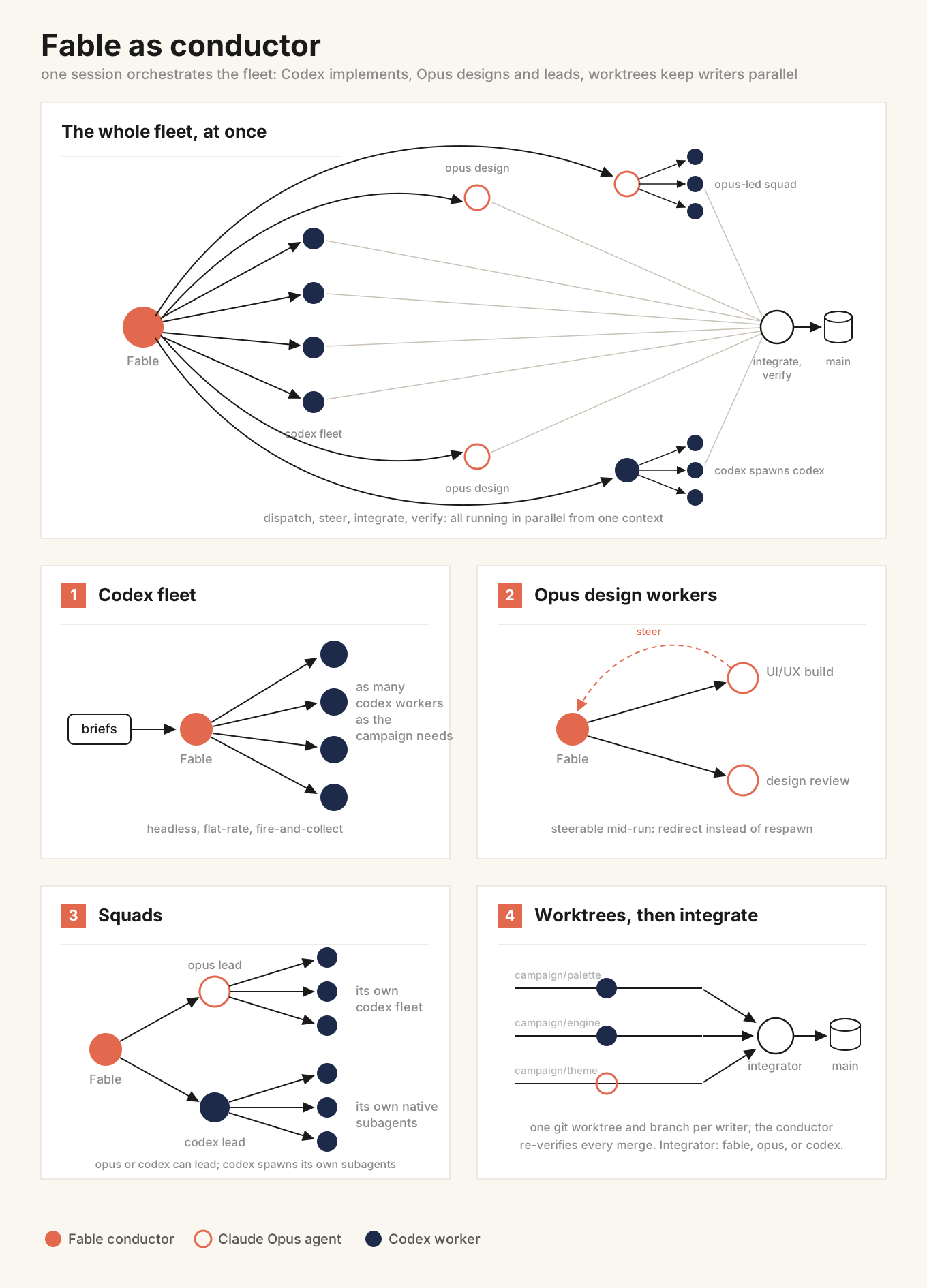
The panels are worked examples. Any capable worker can lead, integrate, or review, and a campaign composes whatever shape the work needs.
Squads nest the fan-out: a squad lead (Opus or Codex) dispatches its own parallel workers, integrates their branches, and hands the conductor one verified branch. Tested end to end both ways: a spawned Opus lead ran Codex workers in parallel worktrees, each landing its own commit, and a Codex lead fanned out its native subagents inside one workspace.
flowchart TD
    C[Fable conductor] -->|sub-goal briefs| S1[Squad lead · Opus]
    C --> S2[Squad lead · Codex]
    S1 --> A1[Codex] & A2[Codex] & A3[Codex]
    S2 --> B1[Codex] & B2[Codex] & B3[Codex]
    A1 & A2 & A3 --> I1[campaign/search<br>integration branch]
    B1 & B2 & B3 --> I2[campaign/billing<br>integration branch]
    I1 --> V[Conductor merges,<br>re-verifies]
    I2 --> V
    V --> M[(main)]
Campaign state lives in the project, so any later session resumes it:
docs/campaign-hq/
├── CAMPAIGN.md      plan, phases, fleet table
├── LEARNINGS.md     standing rules + dispatch log
├── preferences.md   worker routing, permission envelope
├── briefs/          one file per dispatch
├── out/             collected worker reports
└── schemas/         worker-result.json
Install
npx skills add jvogan/a-fable-of-codexes --skill campaign-conductor
or manually:
git clone --depth 1 https://github.com/jvogan/a-fable-of-codexes.git /tmp/afoc
cp -r /tmp/afoc/skills/campaign-conductor ~/.claude/skills/
Use
Install the skill, then say in any project:
start a campaign
Claude bootstraps docs/campaign-hq/, sizes the plan to the project, and
begins dispatching workers. From then on, every session in that repo picks up
the campaign automatically. Direct it in plain language:
- "add a phase for the billing migration"
- "use sonnet for tests from now on" (persists in
preferences.md) - "status" (reads the plan and fleet table)
Requirements
-
Claude Code. The skill uses the Agent and Workflow tools.
-
OpenAI Codex CLI (github.com/openai/codex). Install with
npm install -g @openai/codex(orbrew install codex), then runcodex login. ChatGPT-plan auth consumes plan usage and limits vary by plan; API-key auth is token-priced. Size worker waves to your available limits and spend tolerance. Set the default worker model and reasoning effort in~/.codex/config.toml, for example:model = "gpt-5.5" model_reasoning_effort = "xhigh"Without Codex installed, the skill runs Claude-only fleets: Sonnet workers take the implementation role, Opus keeps design and squad-lead duty, and the briefs, worktrees, squads, and reports stay the same.
-
Codex plugin for Claude Code (optional, github.com/openai/codex-plugin-cc). Adds
/codex:review,/codex:adversarial-review, and background-delegation slash commands for single interactive tasks. Install inside Claude Code:/plugin marketplace add openai/codex-plugin-cc /plugin install codex@openai-codex
Validation
python3 scripts/validate.py
npx --yes skills add . --list
Checks every skill against the
Agent Skills spec: frontmatter
fields, name format, and description length, plus this repo's 500-line body
limit and relative-link integrity. The skills command verifies that the
package is discoverable by the installer. CI runs both commands on every push
and pull request.
License
MIT
// faq
What is a-fable-of-codexes?
Claude Code skills that make Claude (Fable) the conductor of AI worker fleets: many parallel OpenAI Codex workers plus Opus design agents, organized into campaigns, waves, squads, and review gates.. It is open-source on GitHub.
Is a-fable-of-codexes free to use?
a-fable-of-codexes is open-source under the MIT license, so it is free to use.
What category does a-fable-of-codexes belong to?
a-fable-of-codexes is listed under skills in the Claudeers registry of Claude-compatible tools.
// embed badge

[](https://claudeers.com/a-fable-of-codexes)
// retro hit counter

[](https://claudeers.com/a-fable-of-codexes)
// reviews
// guestbook
// related in Claude Skills
 🔓
🔓An agentic skills framework & software development methodology that works.
 🔓
🔓 🔓
🔓💫 Toolkit to help you get started with Spec-Driven Development
 🔓
🔓AI coding assistant skill (Claude Code, Codex, OpenCode, Cursor, Gemini CLI, and more). Turn any folder of code, SQL schemas, R scripts, shell scripts, docs,…