
vocaloid-style-mv-pipeline
Production pipeline and Claude Code skill for Vocaloid-style hand-drawn (手書き) lyric music videos: deterministic Canvas2D/WebGL2 animation engine, JIZURA lyri…
Install with your AI
Paste into Claude Code, Cursor, or any agent — it reads the repo and wires the tool into your project.
Install and set up vocaloid-style-mv-pipeline (git-clone project) into my current project.
Found on https://claudeers.com/vocaloid-style-mv-pipeline
Repo: https://github.com/EGSECDA/vocaloid-style-mv-pipeline
Homepage/docs: —
Detected install method: git-clone → git clone https://github.com/EGSECDA/vocaloid-style-mv-pipeline
Category: skills. Platforms: cli, web.
Read the repo's README for exact setup and env vars, then install it and wire it into my project.

Claudeers Health Verdict:
unknown; community-verified: false. Confirm the source before running anything.
git clone https://github.com/EGSECDA/vocaloid-style-mv-pipeline
// compatibility
| Platforms | cli, web |
|---|---|
| Operating systems | — |
| AI compatibility | claude |
| License | MIT |
| Pricing | open-source |
| Language | JavaScript |
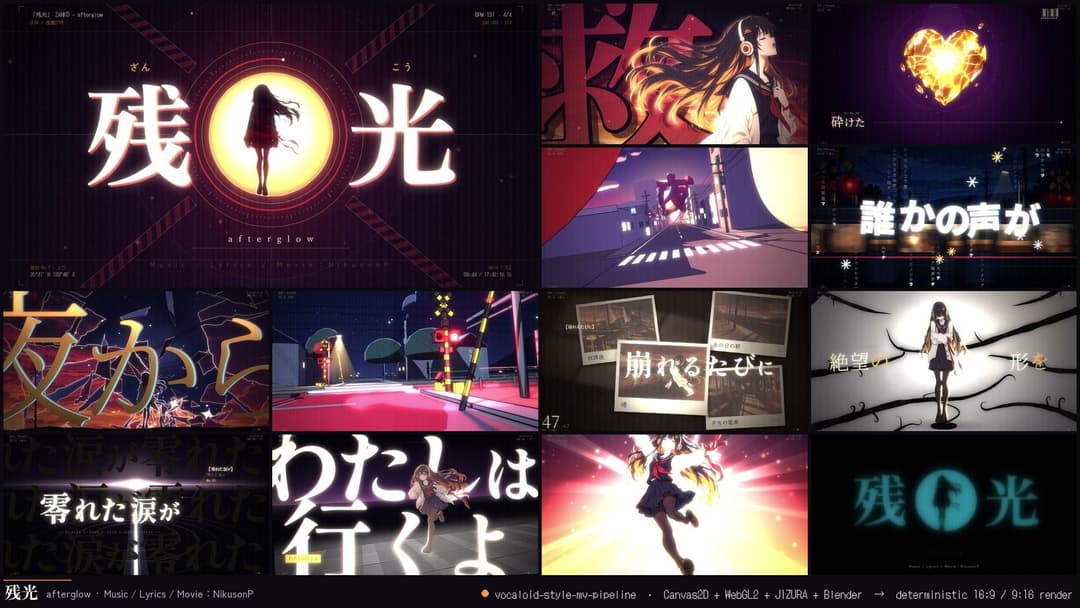
Vocaloid-Style MV Pipeline
vocaloid-style-mv-pipeline
A Claude Code skill and project template for Vocaloid-style 手書き (tegaki) lyric MVs and motion-graphics showreels.
A deterministic front-end animation engine renders every frame.
Author: NikusonP · MIT License · showcase: 「残光」 (Music / Lyrics / Movie:NikusonP)
What it is
Give an AI agent a song and its lyrics, and this kit lets it produce a finished, showreel-quality lyric music video in the ボカロ / V家手书 / 文字PV tradition. You get a 1920×1080 master, a natively re-laid-out 1080×1920 vertical version, and share encodes.
It is front-end animation. Every frame is drawn by HTML Canvas2D and composited by WebGL2 in a
headless browser. Playwright captures the frames and ffmpeg encodes them. No After Effects, no timeline editor.
A frame is a pure function of song time t, so the film is code: re-rendering always gives the same result,
parallel workers can render any frame, and an agent can review, fix and re-render a 4-minute MV in minutes.
The kit has two parts:
- The skill (
skills/vocaloid-style-mv/):SKILL.mdplus method references that take an agent from listen → concept → assets → storyboard → build → review → deliver. - The project template (
skills/vocaloid-style-mv/template/): the engine, a scene library, the JIZURA 字面 lyric-motion layer, audio-analysis and lyric-timing tools, AI image-generation tooling, Blender toon-3D shot scripts and the renderer. Every new MV project starts as a copy of it.
The skill was written for Claude Code, but it is plain Markdown plus scripts, so other agents such as Codex can follow it too.
Showcase: 「残光」
「残光」 (Zankō, "Afterglow"). Music / Lyrics / Movie:NikusonP. A 3:46 MV with an original V家-style singer, 灯 (Akari). The sky cracks like glass, she falls into the night, keeps a small flame alive, gathers the pieces of her shattered heart, and walks a road made of her own tears toward the dawn. It has 68 beat-locked shots, JIZURA typography, two Blender toon-3D sequences, and a hard cut on the song's dead stop to a cyan afterimage. The full 1080p30 film renders in ≈4 minutes on an RTX 3080 (6,796 frames, 3 workers, ≈31 fps).
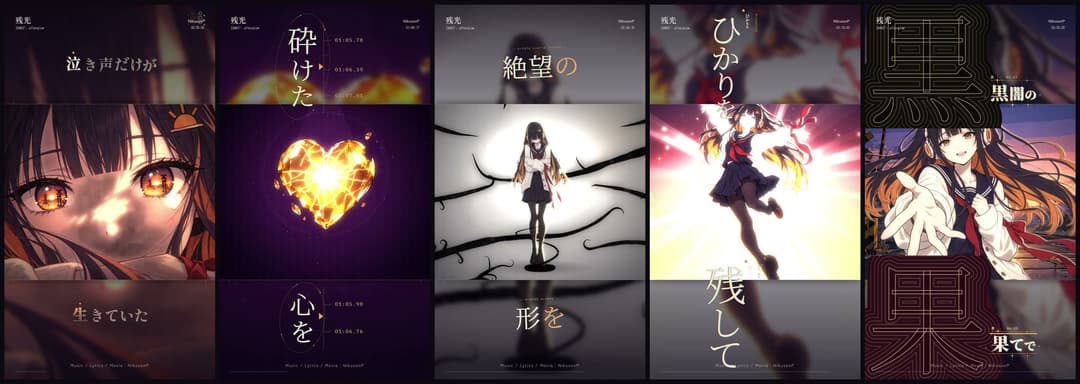
The 9:16 version is a re-layout, not a crop: JIZURA re-typesets every lyric natively for the tall frame.
 |  |
 |  |
More in the gallery (click to open full size):
| what | files |
|---|---|
| Review contact sheets of the final render, one frame every 1.8 s | 0:00–0:43 · 0:45–1:28 · 1:30–2:13 · 2:15–2:58 · 3:00–3:43 · end card |
| 9:16 vertical version | part 1 · part 2 |
| Blender toon 3D | A: dusk street of kanji · B: night railway crossing |
| Typography and colour | JIZURA style probe · palette system |
| Generated assets | character masters · poses · more poses · story poses · fixes · backgrounds · night backgrounds + props |
The full case study (logline, colour script, shot structure, signature moments and how each was built) is in
examples/zanko/.
Features
- Deterministic renderer. Each frame is a pure function of
t: seeded noise, closed-form particles, no wall-clock time. Parallel headless-browser workers seek arbitrary frames, and the segments join without seams. - Layered compositing. Each frame has a scene layer (Canvas2D illustration, camera, particles), a text layer (JIZURA lyrics, custom typography, HUD), a foreground layer (the character drawn in front of the lyrics, so text can pass behind her), and a WebGL2 post pass. The post pass does line boil on 2s, OKLab palette gradient maps, bloom, chromatic aberration, glitch, zoom blur, grain, flashes and letterbox. Text stays crisp because the scene-only effects never touch it.
- Scene library. 24 parameterised scenes are included:
illust,kanjiSlam,typeCard,titleRiff,ember,heart,skyShatter,fall,flame,ink,thread,wetFloor,train,memories,road,panels,burst,tunnel,converge,afterimage,ref(freeze / rewind / melt another shot),seq(image sequences),jz,solid. There are also 13 transitions: cut, xfade, flash, black, iris, irisClose, barrier, wipe, slices, push, zoom, ink, shatter. All of them are a toolbox to adapt, not a look to reuse. - JIZURA 字面 lyric layer. The upstream engine is built unmodified into a deterministic layer, with several plans (styles) per film, curated deny-lists, centre-free layouts for character shots, and native 9:16 re-typesetting.
- A beat-locked edit.
librosaanalysis gives beats, downbeats, bars, sections, stops, impacts and per-frame envelopes, and it handles tempo drift. Timeline helpers snap every cut to a real bar or beat. - Lyric timing. Official lyrics come first. faster-whisper, vocal-stem separation and forced alignment are
there for timings, or for the case where no text exists. The output is an LRC file with JIZURA markup
(
/cut,*emphasis*,!キメ line). - An original character and consistent assets. The pipeline goes character bible → master candidates → every pose generated with the master as a reference image → chroma key to RGBA. Batch generation runs through the Codex CLI, and any image model works with the same method.
- Toon 3D. The Blender 5.x shot scripts use EEVEE, Shader-to-RGB cel shading and Grease Pencil line art, at about 0.7 s per 1080p frame. Cameras are keyed to the beat grid, and the result plays back in the engine as an image sequence.
- Delivery. You get a 16:9 master (NVENC CQ16 or x264), a share encode, a 9:16 vertical re-layout and 720p previews, plus review tools: stills, contact sheets, review sheets every N seconds, and a JIZURA cut inspector.
Pipeline
flowchart LR
  A["song.wav + official lyrics"] --> B["Listen<br/>librosa beats · bars · sections<br/>lyric timing (LRC)"]
  B --> C["Concept<br/>thesis · colour script<br/>motifs · character bible"]
  C --> D["Assets<br/>Codex image gen<br/>chroma key → RGBA"]
  C --> E["Storyboard<br/>→ engine/timeline.js"]
  D --> F["Build<br/>engine scenes + JIZURA lyrics<br/>+ Blender toon 3D"]
  E --> F
  F --> G["Render<br/>Playwright + headless Edge<br/>+ ffmpeg NVENC"]
  G --> H["Review<br/>stills · contact sheets"]
  H -- "fix, 2–3 passes" --> F
  H --> I["Deliver<br/>16:9 master · share · 9:16"]
What happens inside one frame:
 song time t ─┬─► scene layer       Canvas2D 1920×1080: illustration, camera, particles ──┐
              ├─► text layer        JIZURA 字面 + custom typography + HUD (transparent) ──┼─► WebGL2 post ─► frame
              └─► foreground layer  the character, in front of the lyrics ────────────────┘   line boil · palette LUT · bloom
                                                                                              CA · glitch · grain · flash
Quick start
1. Check the machine.
python skills/vocaloid-style-mv/scripts/check_env.py
2a. Install the skill (recommended). Copy it to your Claude Code skills folder:
# macOS / Linux / Git Bash
mkdir -p ~/.claude/skills && cp -r skills/vocaloid-style-mv ~/.claude/skills/
# Windows PowerShell
New-Item -ItemType Directory -Force "$env:USERPROFILE\.claude\skills" | Out-Null
Copy-Item -Recurse -Force skills\vocaloid-style-mv "$env:USERPROFILE\.claude\skills\"
Then put your song and lyrics in a folder, open Claude Code there and ask:
make a V家手書き MV for this song (song.wav, lyrics.txt)
The skill scaffolds a project, analyses the song, proposes a concept for you to check, generates the art, builds and renders the film, and reviews it. It stops at a few checkpoints along the way: the concept, the character master, the first stills and the first full render.
2b. Or use the template directly.
python skills/vocaloid-style-mv/scripts/new_project.py ../my-mv --song path/to/song.wav --lyrics path/to/lyrics.lrc --setup
cd ../my-mv
--setup installs Playwright and the Python packages, downloads the fonts, and clones and builds JIZURA.
--title, --title-sub, --artist and --credit set the film's title, Latin subtitle, artist name and credit
line in engine/timeline.js. Open your agent in ../my-mv and ask for the MV as above. Agents without skill
support can be pointed at skills/vocaloid-style-mv/SKILL.md.
No song yet? Leave out --song / --lyrics and use a throwaway folder (the demo writes its own song and lyrics
into the project). The new project then prints the commands for the procedural demo film 「蛍火」 (24 s; about
30 s to render on an RTX 3080), a smoke test that the machine renders end to end. Expected result:
16:9 clip · contact sheet ·
9:16 sheet.
The main commands the agent runs (all from the project root)
python tools/analyze_audio.py                                   # audio/song.wav → analysis/audio.json (+ overview.png)
python tools/imagegen.py assets/char/jobs_core.jsonl --out-dir assets/char --concurrency 8
node tools/stills.mjs --times 12.5,62.6,130.8 --sheet check     # stills + contact sheet → render/stills/
node tools/render_final.mjs --name mv                           # full render + audio mux → render/mv.mp4
python tools/review_sheets.py render/mv.mp4 --step 1.8 --out render/review1
The skill's references/01-workflow.md has the full
sequence, acceptance criteria and time budget. A procedural demo song in template/demo/ is a smoke test that
proves a new machine renders end to end. Its film, 「蛍火」: 16:9 clip ·
contact sheet · 9:16 sheet.
Requirements
| what | notes | |
|---|---|---|
| required | Node.js 20+ | Playwright, the render and stills scripts |
| required | Python 3.10+ | librosa, numpy, scipy, soundfile, pillow, matplotlib (setup installs them) |
| required | ffmpeg + ffprobe on PATH | encoding, audio mux, frame extraction |
| required | Microsoft Edge or Google Chrome | headless WebGL2 through Playwright (msedge / chrome channel) |
| required | git | setup clones JIZURA |
| optional | NVIDIA GPU (NVENC) | GPU WebGL plus hardware H.264. Without it, encoding falls back to x264, and software WebGL is about 10× slower |
| optional | Blender 5.x | toon 3D sequences. Without it, the agent stages the 3D moments in 2.5D |
| optional | Codex CLI, or another image generator | character and background art. Any model works with the reference-image + chroma-key method |
| optional | faster-whisper (+ CUDA) | only when no official lyrics exist, or to align timings |
Windows 11 (PowerShell 5.1 or Git Bash) is the tested platform. macOS and Linux are supported through the cross-platform scripts but have seen less testing. Reference numbers from 「残光」 on an RTX 3080: audio analysis under 1 min; one generated image 30–110 s (8–10 in parallel); Blender ≈0.7 s/frame; full 1080p render ≈4 min.
Setup clones JIZURA at the tested commit fc16bfe; the template's deny-lists and scheme indices are checked
against it. To use another version, set the environment variable JIZURA_REF to a branch, tag or full commit
sha for setup (e.g. main to follow upstream). JIZURA_DIR points setup at an existing local clone and takes precedence.
Repository layout
vocaloid-style-mv-pipeline/
├── README.md · README.zh-CN.md · README.ja.md
├── LICENSE · THIRD_PARTY_NOTICES.md
├── skills/
│   └── vocaloid-style-mv/              ← the installable skill (copy to ~/.claude/skills/)
│       ├── SKILL.md                  ← entry point: phases, principles, checkpoints
│       ├── references/               ← method: workflow, creative direction, audio & lyrics, assets,
│       │                               engine, JIZURA, Blender, render & delivery, QA & lessons
│       ├── scripts/                  ← new_project.py (scaffold), check_env.py (environment check)
│       └── template/                 ← copied into every new MV project
│           ├── engine/               ← core/ (util, assets, gl, draw, trans, main), scenes/ (library),
│           │                           index.html, vertical.html + vertical.js, fonts/
│           ├── jizura/app/           ← JIZURA adapter + host pages (bundle built at setup from vendor/JIZURA)
│           ├── tools/                ← analysis, lyric timing, image gen, stills, render, review sheets
│           ├── blender/              ← toon 3D shot scripts
│           ├── assets/               ← style/ (palettes + LUTs), char/, bg/
│           ├── analysis/ · audio/    ← filled per song
│           └── demo/                 ← procedural smoke-test song
├── examples/
│   └── zanko/                        ← 「残光」 case study: storyboard, timeline, prompts, gallery
└── docs/images/                      ← README images
Similar craft, different film
The kit aims for another film of the same quality, not a 残光 clone. A few ideas carry through the skill:
- The concept comes from the new song. The agent reads your lyrics and structure first. From them it finds a thesis (what the song is about visually), a colour script, master shapes and motifs, a character, and 6–10 signature moments placed on the song's real chorus downbeats, stops and instrumental hits.
- The scene library is a toolbox. Most shots are generic
illustshots (background, camera, character, effects). The special scenes show techniques such as shatter, ink growth, strobing silhouettes, image-sequence playback and per-beat slams. A new song needs new metaphors, so the agent adapts these scenes or writes new ones. examples/zankois a case study, not a preset. Learn how a lyric became an image and how a section built up. Do not reuse its cracked sky, glass heart, ribbon or palettes for a song that never mentions them. The skill's creative-direction reference has a variation matrix (world, time arc, palette, shape, material, line style, character, typography, 3D role, transitions, ending). If a new plan matches 残光 on more than three axes, the agent pushes further.- Night or daylight. The template's defaults are tuned for 残光's dusk and night; for a bright, daytime film the agent re-tunes the lyric colours, the post look and the palettes before the first still.
- The character is original. Every pose is generated from one master reference. Existing characters are never imitated.
- Look at every result. Stills and contact sheets get reviewed like an art director would, then fixed and re-rendered. Most of the quality comes from this review loop.
Credits
- Kit, 「残光」 song, lyrics and movie: NikusonP. Music / Lyrics / Movie:NikusonP
- JIZURA 字面 by 852wa: lyric-motion engine, MIT, © 2026 hakoniwa (fetched at setup, not vendored)
- Fonts: Google Fonts families (Noto Sans/Serif JP & SC, Zen Old Mincho, Zen Kaku Gothic New, Shippori Mincho B1, Kaisei Tokumin, Klee One, Yuji Syuku, DotGothic16, Dela Gothic One, Rampart One, Reggae One, M PLUS Rounded 1c), SIL OFL 1.1
- Playwright (Apache-2.0) · librosa (ISC) · NumPy / SciPy (BSD-3-Clause) · Pillow (MIT-CMU) · soundfile (BSD-3-Clause) · faster-whisper (MIT) · CTranslate2 (MIT) · ONNX Runtime (MIT)
- External tools: Blender (GPL), FFmpeg (LGPL/GPL), Codex CLI (illustrations generated with an AI image model), Microsoft Edge
- Built with Claude Code.
Full details, including the optional models and their terms: THIRD_PARTY_NOTICES.md.
License
The kit's code, skill and documentation are released under the MIT License, © 2026 NikusonP.
The song 「残光」, its lyrics, the character 灯 and the MV frames in examples/zanko/ and docs/images/ are
© 2026 NikusonP, all rights reserved — they are not covered by the MIT License and are included only as a case study. The song audio and the full-resolution artwork are not
in this repository. Please don't reuse the 残光 material as the material of your own MV. Make your own from
your song; that is what the kit is for. Third-party components keep their own licences; see
THIRD_PARTY_NOTICES.md.
Trademark notice. VOCALOID is a registered trademark of Yamaha Corporation. This is an independent project, not affiliated with, sponsored or endorsed by Yamaha Corporation; "Vocaloid-style" describes the visual genre of fan-made music videos (ボカロMV / V家手书).
Author: NikusonP
// faq
What is vocaloid-style-mv-pipeline?
Production pipeline and Claude Code skill for Vocaloid-style hand-drawn (手書き) lyric music videos: deterministic Canvas2D/WebGL2 animation engine, JIZURA lyric motion, AI illustration, Blender toon 3D, headless rendering to 16:9 and 9:16.. It is open-source on GitHub.
Is vocaloid-style-mv-pipeline free to use?
vocaloid-style-mv-pipeline is open-source under the MIT license, so it is free to use.
What category does vocaloid-style-mv-pipeline belong to?
vocaloid-style-mv-pipeline is listed under skills in the Claudeers registry of Claude-compatible tools.
// embed badge

[](https://claudeers.com/vocaloid-style-mv-pipeline)
// retro hit counter

[](https://claudeers.com/vocaloid-style-mv-pipeline)
// reviews
// guestbook
// related in Claude Skills
 🔓
🔓An agentic skills framework & software development methodology that works.
 🔓
🔓 🔓
🔓💫 Toolkit to help you get started with Spec-Driven Development
 🔓
🔓AI coding assistant skill (Claude Code, Codex, OpenCode, Cursor, Gemini CLI, and more). Turn any folder of code, SQL schemas, R scripts, shell scripts, docs,…