
uniqent
Any brain, any agent. Package an AI agent's brain — persona, MCP stack, skills, memory, config — into one open, signed bundle and install it into any framewo…
Install with your AI
Paste into Claude Code, Cursor, or any agent — it reads the repo and wires the tool into your project.
Install and set up uniqent (git-clone project) into my current project.
Found on https://claudeers.com/uniqent
Repo: https://github.com/RiggdAI/uniqent
Homepage/docs: https://uniqent.ai
Detected install method: git-clone → git clone https://github.com/RiggdAI/uniqent
Category: devtools. Platforms: cli, api, web.
Read the repo's README for exact setup and env vars, then install it and wire it into my project.

Claudeers Health Verdict:
slowing; community-verified: false. Confirm the source before running anything.
git clone https://github.com/RiggdAI/uniqent
// compatibility
| Platforms | cli, api, web |
|---|---|
| Operating systems | — |
| AI compatibility | claude |
| License | Apache-2.0 |
| Pricing | open-source |
| Language | TypeScript |
Uniqent ☉
Any brain, any agent. Package an AI agent's whole brain once — persona, MCP stack, skills,
memory, config — into one open, signed .uniqent file, and install it into whatever framework you
run (Claude Code, Hermes, OpenClaw) in one command.
Think n8n, but for whole agents: a visual builder to assemble the thing, and a portable artifact you can install anywhere. Uniqent is the builder + packager + translator + installer — it sits above the frameworks so one brain travels between all of them.
▶ Try it in one command
No clone, no config, no API key — install a complete research-analyst brain into your agent:
npx @uniqent/cli try research-analyst
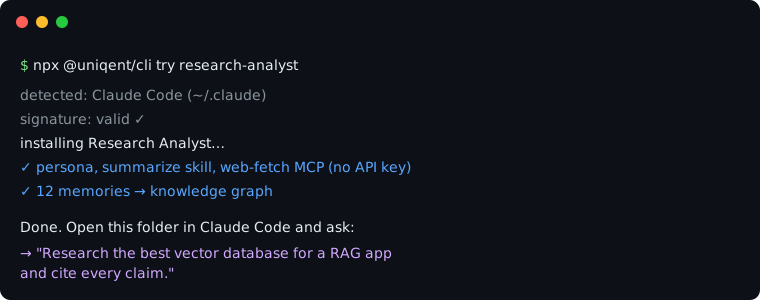
It auto-detects your framework, installs the persona + skill + web-fetch MCP + a linked memory
graph, then tells you exactly what to ask. Run npx @uniqent/cli try --list to see the featured
brains.
What is Uniqent?
Today an agent's "brain" is locked inside whatever framework you built it in — there's no portable
unit for "a whole agent." Uniqent makes that unit and the workflow around it: build → package →
share → install. You compose a brain in Uniqent Studio (a local-first visual builder) — or
capture one you already have — and export a single signed .uniqent bundle that carries no
secrets. Anyone installs it into the framework they run; a per-framework adapter translates
the brain into that framework's native layout and asks only for the recipient's own credentials.
What you can do
-
🚀 Try a brain instantly —
npx @uniqent/cli try <name>installs a featured, signed, creds-free brain into your agent in one command. -
🧩 Build one visually — compose persona, MCP stack, skills, memory, channels, and flows on an n8n-style canvas in Studio, with credentials wired as "needs" edges, then export one
.uniqent.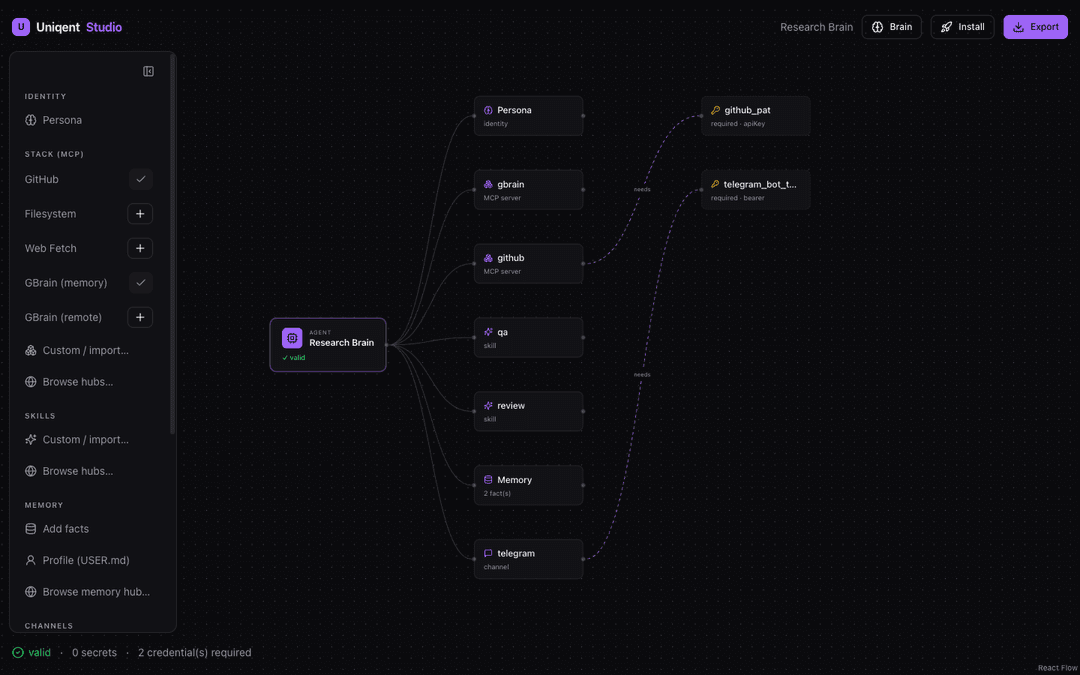
Memory isn't a flat list: write facts with Obsidian-style
[[entities]]and#tagsand Studio parses them into an interactive memory brain — a force-directed graph (zoom / pan / drag, plus a 3D mode) of how facts, people, and topics connect.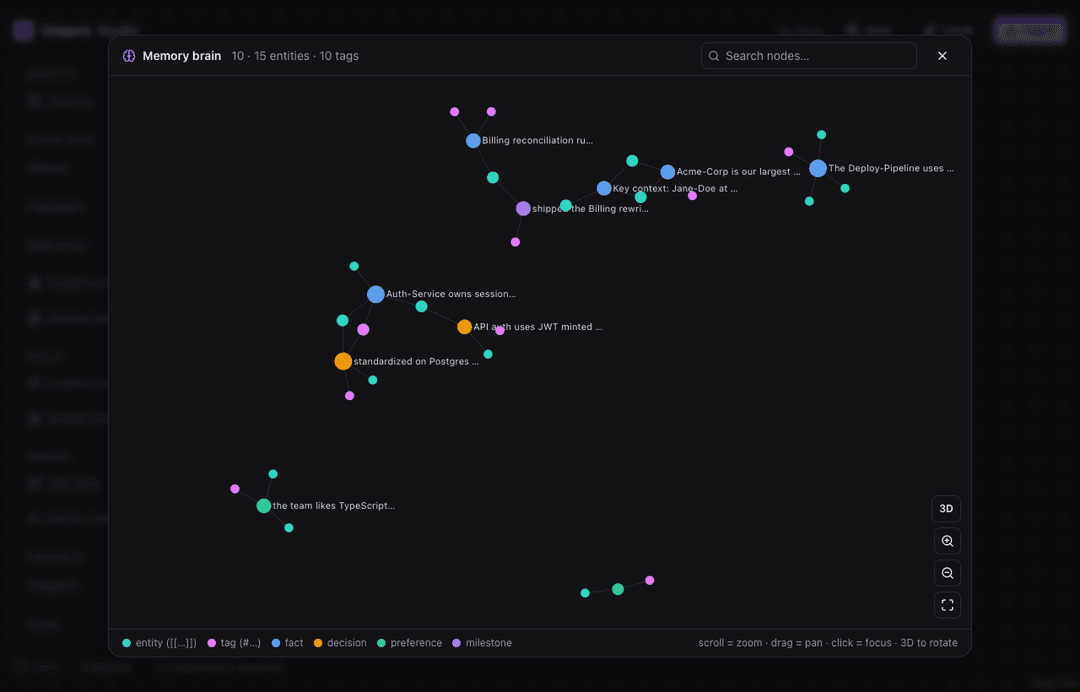
-
📥 Bring what you have —
uniqent exportcaptures a running agent;uniqent import-vaultturns an Obsidian / "second-brain" vault into a brain (SOUL.md→ persona,USER.md→ profile,MEMORY.md+ notes → memory,[[wikilinks]]/#tagspreserved). -
🔁 Install anywhere — the same bundle installs into Claude Code, Hermes, or OpenClaw; the adapter translates it and resolves your credentials locally.
How it works
Build → Pack → Share → Install — one open bundle, any framework:
- Build a brain in Studio (or capture an existing agent / vault).
- Pack + sign it into a
.uniqent(Ed25519 signature over a content digest) — a fail-closed secret-scan guarantees no API keys travel in the bundle. - Share it as a raw file or URL (e.g. straight from GitHub) — no hosted service required.
- Install it: the adapter verifies the signature, shows a permission sheet, resolves your credentials locally, dry-runs in a sandbox, then writes the framework's native layout.
What makes it defensible — four things .dotagents-style sharing lacks:
- Install is a translation, not a copy. One canonical format → per-adapter native output. When a target can't hold something (e.g. Hermes' memory limits) it truncates/transforms and reports exactly what changed. Lossy is acceptable; silent loss is not.
- Secrets never travel in a bundle. It carries the wiring (which MCP server, transport, auth type), never the keys — safe to post publicly and still instantly runnable.
- No hosted dependency. Install from a file or URL; a registry is optional convenience.
- Trust is first-class. Signing, a permission sheet, a redactable memory preview, and a sandboxed dry-run — all in v1.
A "brain" = everything that makes an agent that agent
| Part | What it is |
|---|---|
| Persona | personality, voice, role, goals — the identity |
| About | a README + avatar describing the brain (travels in the bundle) |
| Stacks (MCP) | the MCP servers it can use (GitHub, filesystem, web, …) and which tools |
| Skills | reusable, cross-agent SKILL.md capabilities |
| Memory | durable facts, decisions, preferences, a user/agent profile |
| Tools | native built-ins it has on (web search, browser, code exec, …) |
| Automations | scheduled/triggered tasks (e.g. a daily briefing) |
| Channels | where it's reachable (Telegram, Discord, Slack, …) |
| Config | model/provider prefs, autonomy level, allowlists |
Install into any agent
| Framework | How the brain lands | Status |
|---|---|---|
| Claude Code | skills → .claude/skills, persona+memory → AGENTS.md, MCP → .mcp.json | ✅ v1 |
| Hermes | persona → SOUL.md, bounded memory (prioritized + trimmed, reported), MCP/channels → hermes.json | ✅ v1 |
| OpenClaw | persona → SOUL.md, memory → MEMORY.md, skills → skills/, MCP/channels → openclaw.json | ✅ v1 |
| Codex · Cursor · Gemini | — | planned |
CLI
npm i -g @uniqent/cli # or use npx @uniqent/cli <command>
| Command | What it does |
|---|---|
try <brain> | One-command install of a featured brain (auto-detects your framework). --list to browse. |
install <file|url|slug> | Install a brain into --target <claude-code|hermes|openclaw> (--root <dir>, --cred ref=val). |
inspect <file> | Show a bundle's manifest, components, and permissions. |
export --root <dir> | Capture a running agent into a .uniqent (auto-detects the framework). |
import-vault <dir> | Turn an Obsidian / second-brain vault into a signed brain. |
pack <dir> · validate <dir|file> | Build / check a brain from a source directory. |
search <q> · hub <mcp|skills> <q> | Find brains in a registry index; discover MCP servers + skills across hubs. |
keygen · sign <file> | Generate an Ed25519 keypair; sign a bundle. |
A few real flows:
# Install a brain into your framework, resolving your own credentials locally:
uniqent install my-brain.uniqent --target claude-code --root .

# Install straight from a raw URL (no registry needed):
uniqent install https://example.com/dev-powerpack.uniqent --target openclaw --root .

# Or by slug from any hosted index.json:
export UNIQENT_REGISTRY=https://raw.githubusercontent.com/RiggdAI/uniqent/main/registry/index.json
uniqent search coding && uniqent install dev-powerpack --target hermes --root . --cred github_pat=…
Studio (visual builder)
pnpm --filter @uniqent/studio start # local-first; open the URL it prints
Build from source
Requires Node 22.13+ and pnpm (corepack enable provisions the pinned version).
pnpm install && pnpm build && pnpm test
Docs
| Doc | What's in it |
|---|---|
docs/SPEC.md | The .uniqent bundle-format reference (generated from the zod schema). |
docs/BUILD_PLAN.md | Full engineering spec + milestone plan. |
docs/UX-REVIEW.md | CLI UX review + roadmap of gaps. |
docs/CONTRIBUTING.md · docs/GOVERNANCE.md | How to contribute + project governance. |
docs/SECURITY.md | Security policy + disclosures. |
Status — pre-1.0, core loop works today
- Spec · core · builder — schema, bundle read/write + validation + secret-scan + Ed25519 signing, and a framework-agnostic engine to assemble a brain. ✅
- Studio — local-first React canvas to build a brain and export a signed
.uniqent. ✅ - Bring what you have —
uniqent import-vault+uniqent export. ✅ - Install — three adapters (Claude Code, Hermes, OpenClaw) + the CLI + Studio's Install button;
the same signed
.uniqentinstalls into all three. ✅ - Distribute —
@uniqent/clion npm; example brains inexamples/; a file-based registry; memory-pack publishing. ✅ - Next — a hosted registry (accounts/web search) + a
uniqent://web "Install" handoff; Codex/Cursor/Gemini adapters.
License
- Code (CLI + adapters + core): Apache-2.0 (
LICENSE) - Spec text + schema: CC0 (
LICENSE-SPEC) — any framework can implement an adapter without asking permission.
Contributing & community
Contributions welcome — see docs/CONTRIBUTING.md and
docs/GOVERNANCE.md. Report security issues via
docs/SECURITY.md.
// faq
What is uniqent?
Any brain, any agent. Package an AI agent's brain — persona, MCP stack, skills, memory, config — into one open, signed bundle and install it into any framework (OpenClaw, Hermes, Claude Code) in one click.. It is open-source on GitHub.
Is uniqent free to use?
uniqent is open-source under the Apache-2.0 license, so it is free to use.
What category does uniqent belong to?
uniqent is listed under devtools in the Claudeers registry of Claude-compatible tools.
// embed badge

[](https://claudeers.com/uniqent)
// retro hit counter

[](https://claudeers.com/uniqent)
// reviews
// guestbook
// related in Developer Tools
 🔓
🔓The agent harness performance optimization system. Skills, instincts, memory, security, and research-first development for Claude Code, Codex, Opencode, Curs…
 🔓
🔓Makes your AI agent think like the laziest senior dev in the room. The best code is the code you never wrote.
 🔓
🔓Use Garry Tan's exact Claude Code setup: 23 opinionated tools that serve as CEO, Designer, Eng Manager, Release Manager, Doc Engineer, and QA
 🔓
🔓AI coding assistant skill (Claude Code, Codex, OpenCode, Cursor, Gemini CLI, and more). Turn any folder of code, SQL schemas, R scripts, shell scripts, docs,…