
ultracodex
Run Claude Code workflow scripts, unmodified, on the OpenAI Codex CLI — fable plans, codex executes, fable verifies. Parallel agent fleets, builder–verifier…
Install with your AI
Paste into Claude Code, Cursor, or any agent — it reads the repo and wires the tool into your project.
Install and set up ultracodex (claude-plugin project) into my current project.
Found on https://claudeers.com/ultracodex-2
Repo: https://github.com/YuanpingSong/ultracodex
Homepage/docs: https://www.npmjs.com/package/ultracodex
Detected install method: claude-plugin → /plugin install ultracodex@YuanpingSong/ultracodex
Category: devtools. Platforms: cli, api.
Read the repo's README for exact setup and env vars, then install it and wire it into my project.

Claudeers Health Verdict:
active; community-verified: false. Confirm the source before running anything.
/plugin marketplace add YuanpingSong/ultracodex
/plugin install ultracodex@YuanpingSong/ultracodex
git clone https://github.com/YuanpingSong/ultracodex
// compatibility
| Platforms | cli, api |
|---|---|
| Operating systems | — |
| AI compatibility | claude |
| License | Apache-2.0 |
| Pricing | open-source |
| Language | TypeScript |
ultracodex
Run Claude Code workflow scripts, unmodified, on the OpenAI Codex CLI.
Claude Code's Workflow tool has a great orchestration format: plain-JS scripts that fan agents out in parallel, pipeline work through stages, enforce token budgets, and adversarially verify results. But running them upstream — under Claude Code itself — spends Claude quota on execution-grade work.
ultracodex is a compatible runtime for those same scripts — byte-identical,
no transpilation — that routes each agent() call to
Codex instead (or to any configured
backend, per label). The pattern it exists for:
fable plans, codex executes, fable verifies (fable = Claude's frontier model; substitute your planner of choice)
Your most capable model authors and judges the work; cheaper/faster coding agents do the bulk of it; one script, one journal, one budget.
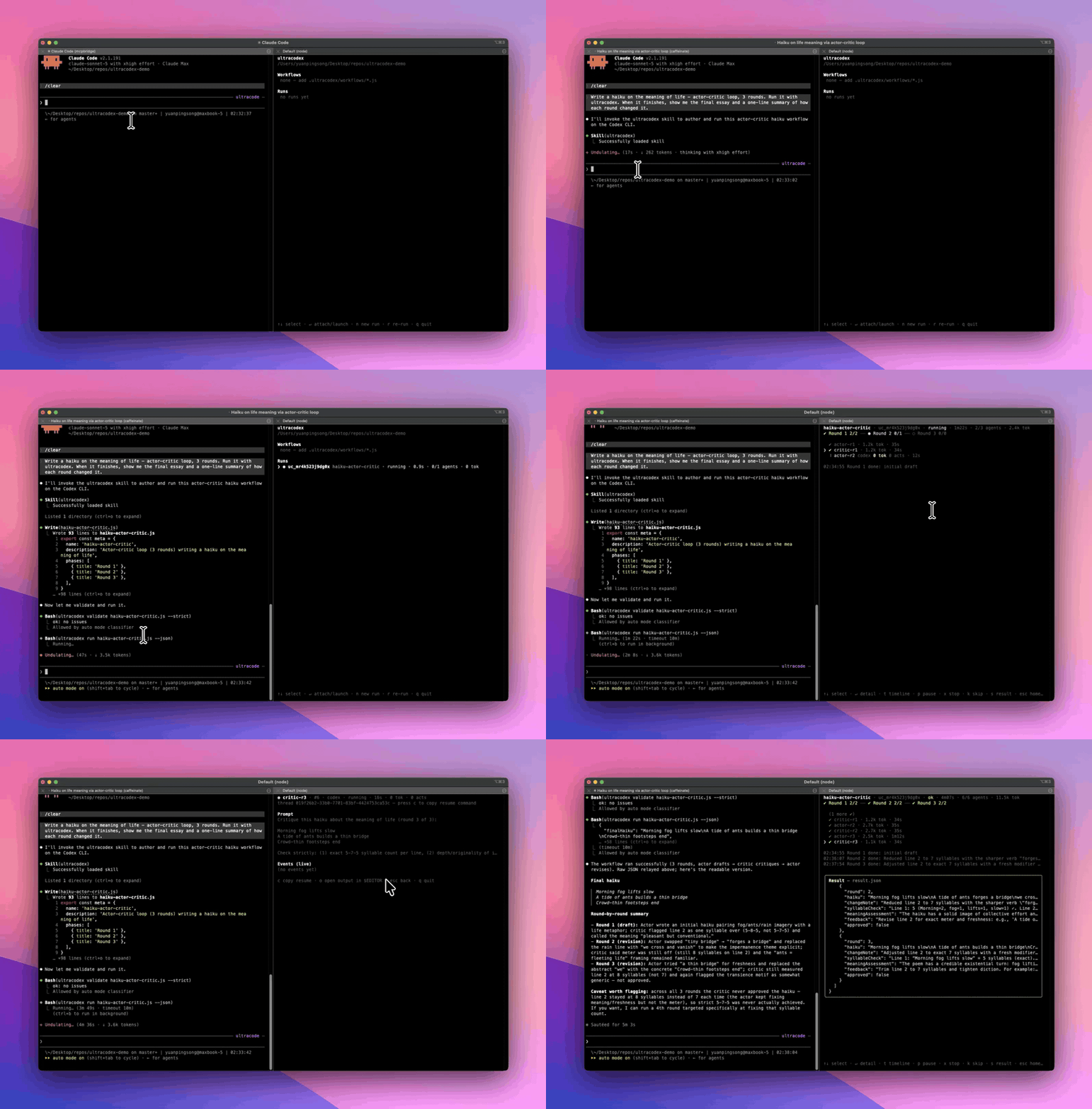
Claude Code (right) is asked: "Write an essay on the meaning of life — actor–critic loop, 3 rounds. Run it with ultracodex." It authors the workflow, kicks it off, the TUI (left) watches Codex agents execute the loop, and the result JSON lands back in Claude. Sped up 1.3×. (HD video)
Why
- Quota arbitrage. Offload execution to Codex (or another backend); keep Claude for judgment. Zero Claude tokens spent on implementation.
- Cross-vendor verification. Route
critique:*to a different model family than the one that did the work. Same-vendor self-review tends to rubber-stamp; making the judge a different model family is one config line here. - Durable, inspectable runs. No daemon. A run is a detached process and a directory of plain files; an append-only journal is the single source of truth for the TUI, the CLI, and machine consumers alike. Close your terminal; the run doesn't care.
Agent Script in 60 seconds
A script is an ES module: a pure-literal meta export, then a plain-JS
async body over eight injected globals. No imports, no TypeScript.
export const meta = {
  name: 'review-files',
  description: 'Fan out reviewers, verify findings, report',
  phases: [{ title: 'Review' }, { title: 'Verify' }],
}

const FILES = args?.files ?? ['src/auth.ts', 'src/api.ts']

phase('Review')
const findings = (await parallel(FILES.map(f => () =>
  agent(`Review ${f} for bugs. Return via the schema.`, {
    label: `review:${f}`,
    schema: { type: 'object', properties: { bugs: { type: 'array', items: { type: 'string' } } }, required: ['bugs'] },
  })
))).filter(Boolean)                    // failed agents are null, never throws

phase('Verify')
const verified = await pipeline(       // no barrier — each item flows independently
  findings.flatMap(f => f.bugs),
  (bug) => agent(`Try to refute: ${bug}`, { label: 'verify' }),
  (verdict, bug) => ({ bug, verdict }), // verdict may be null (failed verifier) — check it
)

return { verified: verified.filter(v => v && v.verdict) }
| global | what it does |
|---|---|
agent(prompt, opts?) | run one agent; resolves final text, a schema-validated object, or null on failure (never rejects — except budget/caps, which throw) |
parallel(thunks) | barrier over concurrent thunks; a thrown thunk becomes null |
pipeline(items, ...stages) | per-item stage chains, no cross-item barrier; stages get (prev, item, index); the first stage's prev is the item itself. A stage that throws drops its item to null; a stage that resolves null (e.g. a failed agent) flows onward — later stages must null-check prev |
phase(title) | progress grouping for subsequent agents |
log(msg) | narrator line in the TUI / --watch output |
args | the run's --args input, verbatim |
budget | { total, spent(), remaining() } — output-token ceiling; exceeding it makes further agent() calls throw |
workflow(name, args?) | run a saved workflow inline (one nesting level) |
agent() opts: label (display + routing), phase, schema (JSON Schema),
model / effort (advisory tiers, mapped in config), isolation: 'worktree'
(fresh git worktree, auto-removed only if pristine), agentType (config
profile, e.g. read-only explorer).
Loops are the point
Scripts are plain JavaScript, so loops are native — and builder→verifier
loops are the pattern this tool is built to make easy. The runtime gives
loops their guardrails: a hard output-token budget (further agent()
calls throw once it's spent), a 1000-agent lifetime cap, and live
pause/skip/stop controls on every run.
let attempt = null, feedback = 'none — first attempt'
while (budget.remaining() > 20_000) {                    // rail 1: budget governor
  attempt = await agent(`Build X. Reviewer feedback: ${feedback}`, { label: 'build' })
  if (attempt === null) continue                          // rail 2: builders can fail
  const verdict = await agent(`Try to refute this: ${attempt}`, {
    label: 'verify:attempt',                              // route to another vendor in config
    schema: { type: 'object', properties: { pass: { type: 'boolean' }, issues: { type: 'array', items: { type: 'string' } } }, required: ['pass', 'issues'] },
  })
  if (verdict?.pass) break                                // rail 2 again: judge can fail too
  feedback = verdict ? verdict.issues.join('; ') : 'verifier unavailable'
}
return { attempt }
Three axes, one format: parallel() is breadth, pipeline() is flow,
loops are depth — iterate until verified good, with budget as the
governor and the run's live controls (pause/skip/stop) as the brakes. The
full pattern — max rounds, feedback threading, cross-vendor judging — is
examples/03-builder-verifier.js. Route
"verify:*" = "claude" in config and the builder's judge is a different
model family; the loop doesn't change.
The full normative definition — grammar, semantics, loop patterns,
conformance — is in docs/agent_script_spec.md.
The same file runs under Claude Code's Workflow tool and ultracodex;
ultracodex validate --strict checks a script stays in the portable subset.
Quickstart
Prerequisites: Node ≥ 20, pnpm, and the
Codex CLI installed and authenticated
(codex login). Developed and tested against codex-cli 0.142.4
(ultracodex doctor prints your version). Optional: Claude Code for
claude-routed agents.
npm install -g ultracodex      # or: pnpm add -g ultracodex
ultracodex doctor              # checks node, codex, auth, config
From source instead:
git clone https://github.com/YuanpingSong/ultracodex && cd ultracodex
pnpm install && pnpm build
pnpm link --global             # → `ultracodex` on PATH (or keep using node dist/cli.js)
The examples ship with the package — run them first (from the checkout, or
from the installed package via $(npm root -g)/ultracodex/):
ultracodex run examples/01-hello.js --watch          # one agent, streamed events
ultracodex run examples/02-fanout-critique.js        # fan-out + schemas, opens the TUI
ultracodex run examples/03-builder-verifier.js --watch --budget 200k   # the loop
ultracodex ls                                        # every run, pid-liveness checked
ultracodex show <runId> --json                       # machine-readable result
For real work, run from your project's root — agents work in your cwd.
run launches a detached runner — quitting the TUI never kills a run.
--json blocks and prints the result (this is what a driving LLM calls);
--watch streams events line-by-line; --detach just prints the runId and
exits; --budget takes output tokens as an integer with optional k/m
suffixes (--budget 500k).
Driving ultracodex from Claude Code
That's what the demo above shows, and it needs one command of setup:
ultracodex sync-skills # installs the `ultracodex` skill for Claude Code
The skill teaches Claude the whole contract — author the script exactly as
for the Workflow tool, execute with ultracodex run <file> --json [--budget 500k], relay the result verbatim. After that, the prompt is just
the task:
Write an essay on the meaning of life — actor–critic loop, 3 rounds. Run it with ultracodex.
Without the skill, prompt it explicitly — two variants depending on what's in the session's context:
Option A — schema-native (session has the Workflow tool, e.g. ultracode mode; Claude already knows the format as that tool's schema):
Author the workflow exactly as you would for the Workflow tool — same script, byte for byte — but instead of invoking the tool, save it to a file and run
ultracodex run <file> --json --budget 300k. Relay the result JSON verbatim; if the run fails, report the failure.
Option B — teach from the spec (plain sessions, headless claude -p,
other agents entirely): as Option A, but point at the format docs —
"using the Agent Script format in docs/agent_script_spec.md" — and state
the task. (That's how this repo validated itself: a fresh headless Claude
authored staged build workflows from the spec and drove them through this
CLI to rebuild the project with Codex agents.)
Saved workflows + skills
Drop scripts in .ultracodex/workflows/<name>.js and they become runnable
by name (ultracodex run <name>) and visible in the TUI launcher (bare
ultracodex). Then:
ultracodex sync-skills
generates a Claude Code skill per workflow, so Claude can trigger your saved workflows by name without being asked — the fully-automatic tier of the same integration.
Routing & configuration
.ultracodex/config.toml (project) or ~/.ultracodex/config.toml (global):
[route]                        # first match wins: label, then phase
"critique:*" = "claude"        # judgment goes to Claude
"verify:*"   = "claude"        # loop verifiers too, if you want cross-vendor judging
"*"          = "codex"         # execution goes to Codex

[backends.codex]
sandbox        = "workspace-write"
default_model  = "gpt-5.5"
default_effort = "xhigh"
service_tier   = "standard"    # never inherit fast mode from ~/.codex
model_map      = { opus = "gpt-5.5", sonnet = "gpt-5.4", haiku = "gpt-5.4-mini" }

[run]
concurrency = 6                # default: min(16, cores-2)
Routing lives in config, never in scripts — that's what keeps scripts portable across runtimes and backends.
CLI
ultracodex                        TUI home: saved workflows + recent runs
ultracodex run <script|name>      [--args JSON] [--budget 500k] [--watch|--json|--detach] [--strict]
ultracodex ls                     runs with liveness-checked status
ultracodex show <ref>             [--json] [--wait [--timeout-ms N]]   (ref = unique runId prefix)
ultracodex attach <ref>           TUI onto a live run
ultracodex pause|resume <ref>     soft pause: stop launching new agents
ultracodex skip <ref> <n>         resolve agent n to null
ultracodex kill <ref>             graceful stop → SIGTERM → SIGKILL
ultracodex logs <ref> [n]         raw runner / per-agent event logs
ultracodex validate <script>      dual-runnability lint (--strict = portable subset)
ultracodex sync-skills            workflows/ → .claude/skills/
ultracodex doctor                 environment + auth checks
Every run directory (.ultracodex/runs/<runId>/) is plain files: the
journal, per-agent prompts/events/outputs, result.json, a pidfile. Any
agent's Codex session can be continued interactively — the TUI's agent
detail view (and show) surface codex resume <threadId>.
How it works
script.js ──▶ loader (acorn meta parse + vm) ──▶ runtime (semantics, caps,
              budget, semaphore) ──▶ executors per [route]:
                codex  → `codex app-server` JSON-RPC, one process per slot
                claude → headless `claude -p`
              journal.jsonl ◀── every event        control.jsonl ◀── pause/stop/skip
              TUI / show / --json = pure folds over the journal
Structured output is belt-and-suspenders: schemas ride the wire where the backend supports it (Codex strict mode), and are always enforced on our side (prompt contract + ajv validation + repair turns on the same session). The entire test suite (340+ tests) runs hermetically against a scripted fake of the codex app-server — no API keys in CI.
Deeper reading: docs/ARCHITECTURE.md · docs/OPERATIONS.md · docs/agent_script_spec.md · docs/agent-script-plan.md (roadmap: pluggable backends, OpenCode adapter, packaged loop workflows, loop-aware convergence display).
Status
M1–M3 shipped: runner core, app-server executor, TUI, CLI, claude backend, validate, sync-skills. Validated end-to-end on live Codex, including a clean-room rebuild of this project by Codex agents orchestrated through ultracodex itself. See docs/PROGRESS.md.
License
Apache-2.0. The app-server turn state machine adapts patterns from OpenAI's Codex plugin for Claude Code (Apache-2.0) — see NOTICE.
// faq
What is ultracodex?
Run Claude Code workflow scripts, unmodified, on the OpenAI Codex CLI — fable plans, codex executes, fable verifies. Parallel agent fleets, builder–verifier loops, token budgets, full-screen TUI.. It is open-source on GitHub.
Is ultracodex free to use?
ultracodex is open-source under the Apache-2.0 license, so it is free to use.
What category does ultracodex belong to?
ultracodex is listed under devtools in the Claudeers registry of Claude-compatible tools.
// embed badge

[](https://claudeers.com/ultracodex-2)
// retro hit counter

[](https://claudeers.com/ultracodex-2)
// reviews
// guestbook
// related in Developer Tools
 🔓
🔓The agent harness performance optimization system. Skills, instincts, memory, security, and research-first development for Claude Code, Codex, Opencode, Curs…
 🔓
🔓Makes your AI agent think like the laziest senior dev in the room. The best code is the code you never wrote.
 🔓
🔓Use Garry Tan's exact Claude Code setup: 23 opinionated tools that serve as CEO, Designer, Eng Manager, Release Manager, Doc Engineer, and QA
 🔓
🔓AI coding assistant skill (Claude Code, Codex, OpenCode, Cursor, Gemini CLI, and more). Turn any folder of code, SQL schemas, R scripts, shell scripts, docs,…