
toknotch
See how many times over each AI plan has paid for itself — Claude Code, Codex and the rest, priced against the published API rates, at the edge of your Mac's…
Install with your AI
Paste into Claude Code, Cursor, or any agent — it reads the repo and wires the tool into your project.
Install and set up toknotch (release-binary project) into my current project.
Found on https://claudeers.com/toknotch
Repo: https://github.com/ReffWu/toknotch
Homepage/docs: https://github.com/ReffWu/toknotch
Detected install method: release-binary → inspect the README
Category: devtools. Platforms: api.
Read the repo's README for exact setup and env vars, then install it and wire it into my project.

Claudeers Health Verdict:
unknown; community-verified: false. Confirm the source before running anything.
Grab the latest release asset from GitHub.
# download a build from https://github.com/ReffWu/toknotch/releases
git clone https://github.com/ReffWu/toknotch
// compatibility
| Platforms | api |
|---|---|
| Operating systems | — |
| AI compatibility | claude |
| License | MIT |
| Pricing | open-source |
| Language | Swift |
TokNotch
How many times over has each AI plan paid for itself?

Free · macOS 14 or later · Signed and notarized by Apple
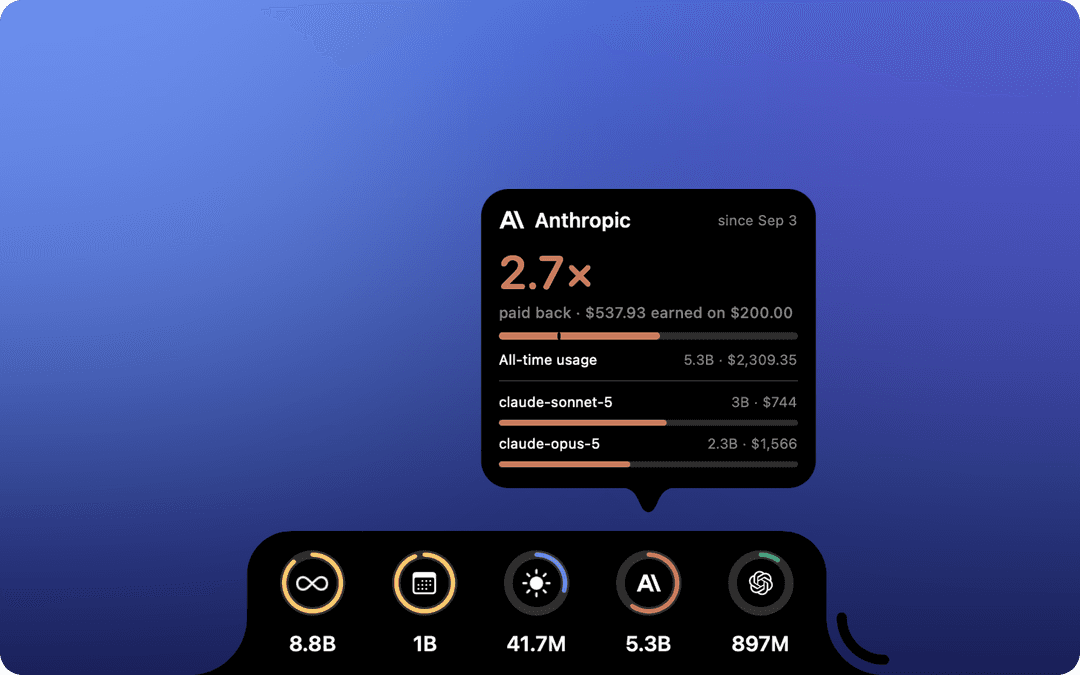
Claude Code, Codex and the rest — priced against the published API rates, sitting at the edge of your screen.
You know what you pay every month. You don't know what you got for it.
TokNotch adds up everything your coding tools actually ran, prices it at what the same work would have cost on the published API rates, and puts one number in front of you:
13.4× paid back
Or, when a plan hasn't earned its keep yet: $18 to go.
The payback number
Tell TokNotch what a plan costs and when it renews. That's the whole setup.
For Claude Code it usually doesn't even ask — the plan is recognised from
~/.claude.json, the ordinary config file Claude Code already keeps. For
Codex it reads the ChatGPT plan the same way. For everyone else you pick
your plan by name from a list (Claude Pro, ChatGPT Plus, Google AI Ultra…)
rather than looking a price up, or type any figure you like.
It then counts by your real billing period, not the calendar month. A plan billed on the 3rd paid for the 3rd through the 2nd — judging it on what happened since the 1st quietly mixes in days the last payment already covered. On the 2nd of the month that's nearly a whole period of somebody else's usage.
And three rings, always on
Today · This month · All time. Token counts, at the edge of the screen.
The arcs aren't decoration. Today is measured against your best day in the last thirty, this month against the same days last month, all time against the next milestone. Every card says what it's comparing against.
A full ring means you beat your own record. It's never a warning, and there's nothing here to run out of.
What it counts
Everything your coding tools have actually run, grouped by who made the model rather than who billed for it — so a Qwen you ran locally still counts as Qwen, and a GLM billed through someone else's plan still counts as Zhipu.
Anthropic · OpenAI · Google · DeepSeek · Qwen · Zhipu GLM · Moonshot Kimi · MiniMax · xAI · Xiaomi MiMo · NVIDIA · Meta · Mistral
Each can have a ring of its own. They're all off by default, and the list you choose from is built from what this Mac has really run — vendors you've never touched never appear.
The counting is done by tokscale, which ships inside the app.
Nothing to install. Nothing leaves your Mac.
No Homebrew. No npm. No Node. No account, no sign-in, no API key.
TokNotch reads the session logs your coding tools already write in your home folder. It never opens the keychain, never shows you a password prompt, and never sends anything anywhere.
Codex is the one exception worth spelling out: its plan lives inside
~/.codex/auth.json, which is a credential file. Only the three plan claims
are ever read from it — the plan type and its dates. The access token, refresh
token and API key sitting beside them are never read, never copied, never
logged.
Where it sits
Any of the four edges. Left or right as a slim column; top or bottom as a wide bar. On a MacBook with a notch, the top edge runs up to meet it so the two read as one shape — which is why that is where it starts on a Mac that has one.
Out of the way until you want it. At rest it's a small pill at the edge — reach for it and it opens. Or keep it open always.
Out of your Dock unless you want it. A small icon in the menu bar opens a panel with this period's payback, today, this month and all time. Settings can put it in the Dock too, or take it out of a crowded menu bar.
It knows about your Dock and your menu bar, and moves when they do.
It speaks your language
English · 简体中文 · 繁體中文 · 日本語 · 한국어 · Deutsch · Français · Español · Italiano · Português (Brasil) · Nederlands · Polski · Русский · Türkçe · Tiếng Việt · العربية
Not just the words. Numbers, money and dates follow each language's own conventions — 万 and 亿 in Chinese, k/M/B in English, Mrd. in German.
Getting it
Download TokNotch.dmg, open it and drag TokNotch to Applications. It is signed with a Developer ID and notarized by Apple, opens like any other app, starts with your Mac, and keeps itself up to date after that. Every build is on the Releases page.
Requires macOS 14 (Sonoma) or newer.
Building it yourself
brew install xcodegen
make run
A Debug build, ad-hoc signed, which is enough to run and develop against. See CONTRIBUTING.md for the rest, and docs/RELEASING.md for how a release is cut.
Under the hood
docs/ARCHITECTURE.md walks through the pieces. The short
version: a borderless NSPanel that draws a real notch shape, a poller around
the bundled tokscale binary, and a SwiftUI card that unfolds out of the edge.
Credits
TokNotch began as a fork of vinzdg/codenotch and was rewritten around local usage accounting. The original is MIT licensed and its copyright is kept in LICENSE.
Usage figures come from tokscale (MIT),
bundled in Vendor/tokscale/. Updates use Sparkle (MIT).
See THIRD_PARTY_NOTICES.md.
License
MIT.
// faq
What is toknotch?
See how many times over each AI plan has paid for itself — Claude Code, Codex and the rest, priced against the published API rates, at the edge of your Mac's screen.. It is open-source on GitHub.
Is toknotch free to use?
toknotch is open-source under the MIT license, so it is free to use.
What category does toknotch belong to?
toknotch is listed under devtools in the Claudeers registry of Claude-compatible tools.
// embed badge

[](https://claudeers.com/toknotch)
// retro hit counter

[](https://claudeers.com/toknotch)
// reviews
// guestbook
// related in Developer Tools
 🔓
🔓The agent harness performance optimization system. Skills, instincts, memory, security, and research-first development for Claude Code, Codex, Opencode, Curs…
 🔓
🔓Makes your AI agent think like the laziest senior dev in the room. The best code is the code you never wrote.
 🔓
🔓Use Garry Tan's exact Claude Code setup: 23 opinionated tools that serve as CEO, Designer, Eng Manager, Release Manager, Doc Engineer, and QA
 🔓
🔓AI coding assistant skill (Claude Code, Codex, OpenCode, Cursor, Gemini CLI, and more). Turn any folder of code, SQL schemas, R scripts, shell scripts, docs,…