
tokenscope
MacOS menu-bar dashboard for Claude CLI token usage, estimated cost, and per-model / MCP / Skill breakdowns.
Install with your AI
Paste into Claude Code, Cursor, or any agent — it reads the repo and wires the tool into your project.
Install and set up tokenscope (git-clone project) into my current project.
Found on https://claudeers.com/tokenscope
Repo: https://github.com/HduSy/tokenscope
Homepage/docs: https://tokenscope.app
Detected install method: git-clone → git clone https://github.com/HduSy/tokenscope
Category: data. Platforms: cli, api, desktop, web.
Read the repo's README for exact setup and env vars, then install it and wire it into my project.

Claudeers Health Verdict:
slowing; community-verified: false. Confirm the source before running anything.
git clone https://github.com/HduSy/tokenscope
// compatibility
| Platforms | cli, api, desktop, web |
|---|---|
| Operating systems | — |
| AI compatibility | claude |
| License | MIT |
| Pricing | open-source |
| Language | Rust |
Tokenscope
English · 中文

A menu-bar / system-tray app for macOS and Windows that shows your Claude CLI daily token usage, estimated cost, and per-model / MCP / Skill call breakdown.
Stack: Tauri 2 + React + TypeScript (frontend) / Rust (data layer).
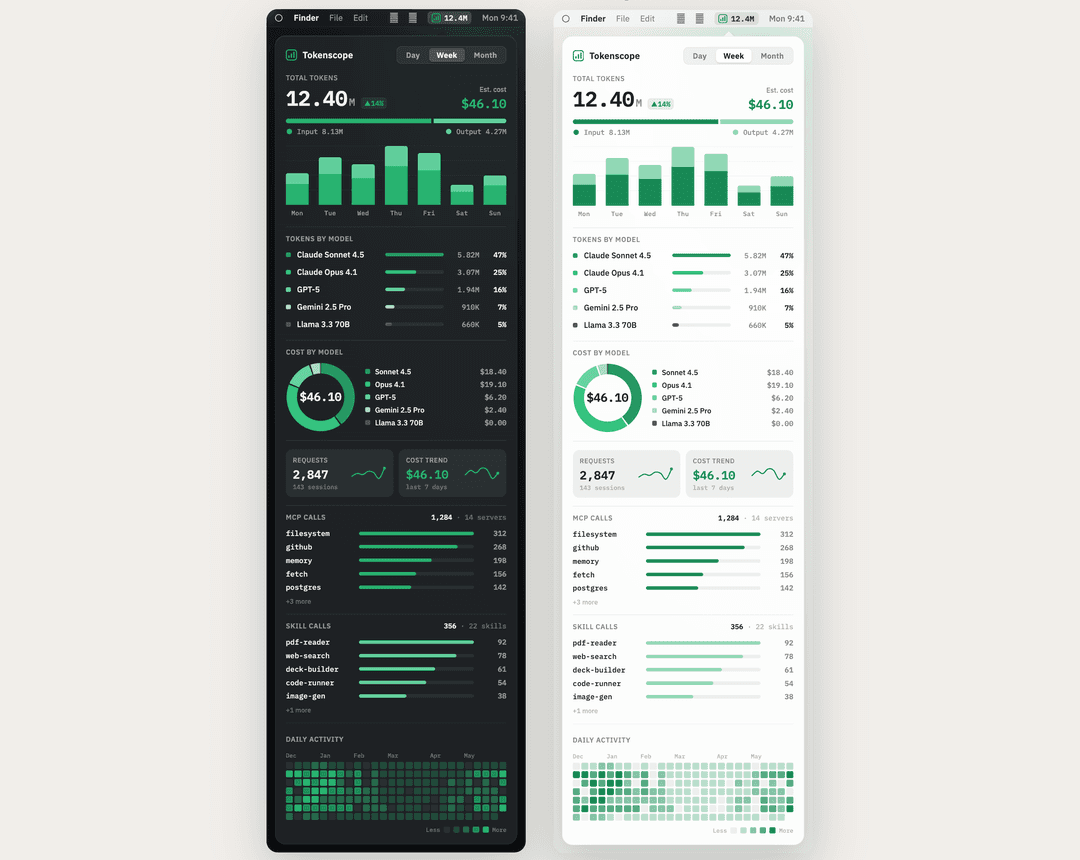
What it does
- Shows today's token count next to the menu-bar icon (e.g.
⬡ 14.00M) - Click to open the panel: Day / Week / Month toggle
- Metrics: total tokens (input/output), estimated cost, requests / sessions
- Three breakdowns: by model / by MCP call / by Skill call
- Cost donut (hover for a single model), year-long activity heatmap
- Counts only the MCP servers / Skills you installed yourself — all Claude built-in tools and Anthropic's bundled MCP servers are filtered out
Data sources (zero-intrusion, read-only)
| Purpose | Path |
|---|---|
| Session logs (tokens / model / tool calls) | ~/.claude/projects/**/*.jsonl |
| User MCP whitelist | ~/.claude.json → mcpServers + projects[*].mcpServers |
| User Skill whitelist | ~/.claude/skills/ directory |
| Model prices | Primary: models.dev (bare model names, matching Claude CLI logs) → Fallback: LiteLLM → built-in snapshot. Cached in ~/Library/Caches/tokenscope/, refreshed every 24h, with offline fallback |
Key processing
- Deduplicated by
message.id(streaming/retries repeat the same usage); when one message spans multiple lines, its tool calls are merged and the token usage is counted once - Token split:
input(uncached) /cache(creation+read) /output; the UI folds cache into "In" by default and shows a separate "cached %" - Price matching: exact id → normalized id (strip vendor prefix +
.↔p, e.g.glm-5.1⇄glm-5p1); models.dev's official bare-name price wins - Cost is priced per the four token types; each model carries a
pricedflag — models not found in either source still count tokens but are labelled "no price" in the UI - Logs contain only the bare model name (no vendor) → third-party models default to the official vendor price (an estimate)
- Tool classification:
mcp__<server>__*where the server is in your config → MCP; a Skill call (theSkilltool'sinput.skill, or a/skillslash command) whose name is in your skills directory → Skill; everything else is ignored
Cost is an estimate based on public prices; subscription users should read it as "equivalent spend value".
Token types & cost formula
Every assistant message's usage reports four mutually exclusive token counts (they never double-count the same token):
| Stage | usage field | What it is | Price (relative to input) |
|---|---|---|---|
| Input (uncached) | input_tokens | New prompt tokens sent this turn | 1× |
| Cache write | cache_creation_input_tokens | Context written into the prompt cache | ~1.25× |
| Cache read (hit) | cache_read_input_tokens | Context replayed from the cache | ~0.1× (much cheaper) |
| Output | output_tokens | Tokens the model generated | ~5× |
Tokens (per period, summed over messages):
total  = input + cache_creation + cache_read + output
# the UI shows:  In = input + cache_creation + cache_read,  Out = output,  cached % = cache_read / total
Cost (each stage priced at its own per-token rate from the price table):
cost = input            × price.input
     + cache_creation   × price.cache_creation
     + cache_read       × price.cache_read     # cache hits billed at the discounted read rate
     + output           × price.output
So a cache hit is not billed as normal input — it uses the dedicated (cheaper) cache_read rate, which is why heavily-cached usage shows a huge token count but a modest cost. The UI folds cache into "In" for display only; billing always uses the four separate rates above.
Install
Option 1: Homebrew (recommended)
brew install --cask hdusy/tokenscope/tokenscope
The cask's postflight strips the quarantine attribute (xattr -cr) automatically, so it opens on first launch without the "Apple cannot verify" prompt.
After you open it once it registers as a login item, then launches in the menu bar automatically on every boot.
Upgrade:
brew update && brew upgrade --cask tokenscope
Option 2: Download the .dmg
- Download the latest
Tokenscope_*_universal.dmgfrom Releases (works on both Apple Silicon and Intel) - Drag it into Applications
- Because the build is unsigned / unnotarized, Gatekeeper blocks the first launch — pick one:
- Right-click the app → Open → confirm Open again, or
- Run once in the terminal:
xattr -cr /Applications/Tokenscope.app && open /Applications/Tokenscope.app
Unsigned is a current known limitation. A true "double-click to open" experience requires Apple Developer ID signing + notarization — see
PRD.md§6.4.
Option 3: Install on Windows
- Download the latest
Tokenscope_*_x64-setup.exefrom Releases - Double-click to install. Because the build is unsigned, Windows SmartScreen will warn on first run — click More info → Run anyway
- The app installs per-user (no admin required) and registers itself for launch at login automatically
- Requirements: Windows 10 1803+ / Windows 11 with the WebView2 runtime (preinstalled on Windows 11; Windows 10 users without it will be prompted by the installer)
After first launch
- macOS: an icon plus today's token count appears in the menu bar (e.g.
⬡ 12.40M) - Windows: the tray icon appears in the notification area. The Windows tray API doesn't show a label beside the icon — hover the tray icon to see today's token count in the tooltip (e.g.
Tokenscope · today 12.40M) - Left-click the icon to toggle the panel; right-click for the menu (Open / Refresh / Quit)
- Launch-at-login is set up automatically — no manual configuration needed
Develop
pnpm install
pnpm tauri dev         # launch the desktop app (requires the Rust toolchain)
Frontend-only preview (using the real-data snapshot public/dev-dashboard.json):
pnpm dev               # http://localhost:1420
# refresh the snapshot:
cd src-tauri && cargo run --example dump > ../public/dev-dashboard.json
Build
pnpm tauri build # outputs .app / .dmg on macOS, .exe (NSIS) on Windows to src-tauri/target/release/bundle/
For distribution see PRD.md §6.3 (Homebrew Cask recommended on macOS; direct .dmg / .exe downloads benefit from code signing + notarization).
Structure
src/                  React frontend
  data.ts             types + Tauri bridge + theme + formatting
  charts.tsx          chart primitives (bars / donut / sparkline / heatmap / segmented control)
  App.tsx             main panel
src-tauri/src/
  store.rs            incremental JSONL ingest (dedup by message.id + multi-line merge)
  parser.rs           aggregation (Day/Week/Month + heatmap)
  pricing.rs          models.dev / LiteLLM price loading and costing
  config.rs           user MCP / Skill whitelist
  model.rs            data structures returned to the frontend
  lib.rs              Tauri commands + menu-bar tray
Bug log
Notable bugs found during development — symptom, root cause, and fix — are collected in docs/BUGFIXES.md.
// faq
What is tokenscope?
MacOS menu-bar dashboard for Claude CLI token usage, estimated cost, and per-model / MCP / Skill breakdowns.. It is open-source on GitHub.
Is tokenscope free to use?
tokenscope is open-source under the MIT license, so it is free to use.
What category does tokenscope belong to?
tokenscope is listed under data in the Claudeers registry of Claude-compatible tools.
// embed badge

[](https://claudeers.com/tokenscope)
// retro hit counter

[](https://claudeers.com/tokenscope)
// reviews
// guestbook
// related in Data & Analytics
 🔓
🔓Wrap Antigravity, ChatGPT Codex, Claude Code, Grok Build as an OpenAI/Gemini/Claude/Codex compatible API service, allowing you to enjoy the free Gemini 3.1 P…
 🔓
🔓Marketing skills for Claude Code and AI agents. CRO, copywriting, SEO, analytics, and growth engineering.
 🔓
🔓Apache Airflow - A platform to programmatically author, schedule, and monitor workflows
 🔓
🔓CLI tool for configuring and monitoring Claude Code