
tiger-team
Senior expert agents for technical & application integration projects — Claude Code plugin
Install with your AI
Paste into Claude Code, Cursor, or any agent — it reads the repo and wires the tool into your project.
Install and set up tiger-team (claude-plugin project) into my current project.
Found on https://claudeers.com/tiger-team
Repo: https://github.com/Crapule421/tiger-team
Homepage/docs: —
Detected install method: claude-plugin → /plugin install tiger-team@Crapule421/tiger-team
Category: plugins. Platforms: cli, api, web.
Read the repo's README for exact setup and env vars, then install it and wire it into my project.

Claudeers Health Verdict:
active; community-verified: false. Confirm the source before running anything.
/plugin marketplace add Crapule421/tiger-team
/plugin install tiger-team@Crapule421/tiger-team
git clone https://github.com/Crapule421/tiger-team
// compatibility
| Platforms | cli, api, web |
|---|---|
| Operating systems | — |
| AI compatibility | claude |
| License | MIT |
| Pricing | open-source |
| Language | Shell |
🐯 Tiger Team
Nine senior experts. One command. Your integration project, reviewed from every angle.
A squad of expert agents for technical and application integration projects, built for Claude Code and for regulated sectors: banking, healthcare, defense.
Quick start · The team · How they work together · Commands · Examples · Confidentiality · Roadmap · 🇫🇷 Français
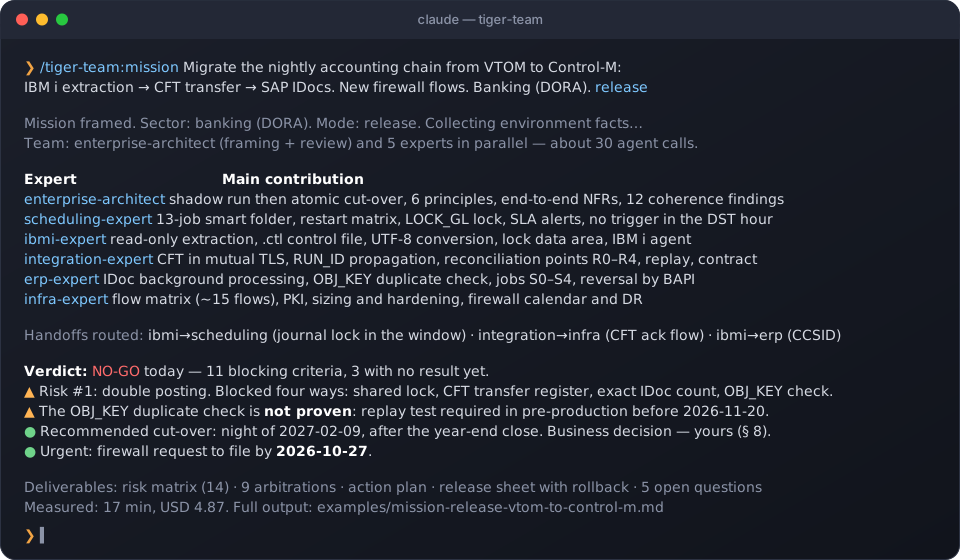
A tiger team is a group of senior specialists brought together to crack a hard problem. This plugin gives you nine of them. Ask one question and a project manager scopes it, an enterprise architect frames the target, the right experts work in parallel, trade their findings, and hand you a consolidated answer: risks, decisions, action plan and the deliverable you need.
/tiger-team:mission Migrate the nightly accounting chain from VTOM to Control-M:
IBM i extraction → CFT transfer → SAP IDocs. Banking context (DORA). release
17 minutes later: architect framing, five experts, a handoff round, a coherence review, a go/no-go verdict, a 9-decision arbitration log and a timed release sheet with rollback. Real run, fictitious data — read the full output.
🚀 Quick start
claude plugin marketplace add Crapule421/tiger-team
claude plugin install tiger-team@tiger-team
Then, inside Claude Code:
/tiger-team:mission <your topic> [scoping|review|incident|release|quick]
or call one expert directly, for example /tiger-team:sql-release-review ./release/V42__add_index.sql.
Other ways to install and run
-
From inside Claude Code:
/plugin marketplace add Crapule421/tiger-team, then/plugin install tiger-team@tiger-team. -
Update:
/plugin marketplace update tiger-team. -
Run a whole session as the project manager:
claude --agent tiger-team:project-manager. -
Call an expert in plain language ("ask the tiger-team dba-expert to…") or with
@. -
Offer the team to everyone on a project, in its
.claude/settings.json:{ "extraKnownMarketplaces": { "tiger-team": { "source": { "source": "github", "repo": "Crapule421/tiger-team" } } }, "enabledPlugins": { "tiger-team@tiger-team": true } }
Requires Claude Code (tested with 2.1.292). The confidentiality guard needs bash, which Claude Code already uses on Windows (Git Bash).
👥 The team
| Agent | Brings to the table | |
|---|---|---|
| 🎯 | project-manager | Team lead. Scoping, planning, RACI, RAID, governance, test strategy, cut-over, go/no-go, rollback, hypercare, arbitration between experts |
| 🏛️ | enterprise-architect | Design authority. TOGAF, ArchiMate, IS urbanisation, target architecture, ADRs, NFRs, cloud and sovereignty, coherence review |
| 🛡️ | devsecops-expert | CI/CD (GitLab CI, Jenkins, Azure DevOps, GitHub Actions), IaC (Terraform, Ansible), containers, Kubernetes/OpenShift, secrets, SAST/DAST/SCA/SBOM, hardening |
| 🗄️ | dba-expert | Oracle, PostgreSQL, SQL Server, Db2, MySQL: performance, HA/DR, backup, security, migrations, release scripts |
| ⏱️ | scheduling-expert | VTOM, Dollar Universe, Control-M: batch chains, calendars, dependencies, restart, scheduler migrations |
| 🔀 | integration-expert | REST/SOAP APIs, ESB/iPaaS, MFT (Axway CFT, Sterling), IBM MQ, Kafka, formats (ISO 20022, SEPA, EDI, HL7/FHIR), interface contracts |
| 🧾 | erp-expert | SAP, Oracle EBS/Fusion, Sage X3, Cegid, Dynamics 365: O2C, P2P, R2R, ERP interfaces, data migration |
| 🌐 | infra-expert | Network, firewalls, flow matrices, DNS, TLS/PKI, Linux (RHEL, Debian, SUSE), Windows Server (AD, GPO, IIS) |
| 🟢 | ibmi-expert | IBM i / AS400: RPG, CL, COBOL, Db2 for i, jobs, journaling, security, integration with the rest of the IS |
Every expert is a Claude Code subagent (tiger-team:<name>) with a preloaded knowledge base, the confidentiality rules of the regulated sectors, and the same answer format: Summary · Analysis · Recommendations · Risks · Handoffs · Open questions · Assumptions. They answer in your language.
They ask before they guess. Each expert knows which facts about your environment would change its answer (scheduler version and New Day time, database edition and HA topology, firewall change process, ERP release, IBM i PTF level…) and where to find them. In a conversation it asks you up to five precise questions, each with why it matters and how to obtain the answer; when it runs from a command it states explicit assumptions and lists the checks to run instead. What it says is labelled Fact (with its source), Inference or Assumption, and every product statement is version-qualified. Record your environment once with /tiger-team:discover: it writes docs/tiger-team/environment.md, which every expert reads before answering.
🤝 How they work together
flowchart TD
    U([You: /tiger-team:mission]) --> PM

    PM[🎯 project-manager<br/>scopes, picks the experts] --> EA[🏛️ enterprise-architect<br/>target, principles, NFRs]
    EA --> R1

    subgraph R1[Expert round — in parallel]
        direction LR
        E1[🛡️ devsecops] ~~~ E2[🗄️ dba] ~~~ E3[⏱️ scheduling] ~~~ E4[🔀 integration] ~~~ E5[🧾 erp] ~~~ E6[🌐 infra] ~~~ E7[🟢 ibmi]
    end

    R1 -->|"→ handoffs between experts"| H[Handoff round<br/>each point goes to its expert]
    H --> CR[🏛️ coherence review]
    CR --> OUT([Consolidated deliverable<br/>summary · risk matrix · decisions · action plan])
The Handoffs section is what makes nine agents behave like a team. The DBA flags a long-running lock, so the scheduling expert moves the batch window. The integration expert adds a CFT acknowledgment flow, so the infra expert adds it to the flow matrix. The lead routes every point, arbitrates conflicts (compliance > security > data integrity > availability > delay > cost) and writes the arbitration down.
| Mode | For | You get |
|---|---|---|
scoping | a new project or change | scoping note, RACI, RAID, experts to involve |
review | an existing design, chain, interface or plan | prioritized findings report |
incident | something broken in production | diagnosis, recovery plan, follow-up actions |
release | a go-live being prepared | release sheet, go/no-go criteria, rollback plan |
quick | a cross-domain question | one expert round, short consolidated answer |
Cost. A full mission is 20 to 40 agent calls: expect 10 to 20 minutes and a few dollars of API usage (measured: about 5 USD for the example above). A
quickmission with three experts measured about 3.5 USD; a direct command about 1 USD. Figures depend on your model and on the other plugins loaded in your session.
⚡ Commands
| Command | Expert | Produces |
|---|---|---|
/tiger-team:discover | 🎯 project-manager (interactive) | the environment sheet docs/tiger-team/environment.md, built from an interview about your organization's environment |
/tiger-team:scoping | 🎯 project-manager | scoping note, RACI, RAID, experts to involve |
/tiger-team:release-plan | 🎯 project-manager | release sheet, go/no-go criteria, rollback plan |
/tiger-team:adr | 🏛️ enterprise-architect | architecture decision record or target-architecture note |
/tiger-team:security-review | 🛡️ devsecops-expert | security review of a pipeline, IaC, Dockerfile, manifest or config |
/tiger-team:sql-release-review | 🗄️ dba-expert | review of a SQL release script, with rollback |
/tiger-team:batch-review | ⏱️ scheduling-expert | review of a batch chain |
/tiger-team:scheduler-convert | ⏱️ scheduling-expert | conversion between VTOM, Dollar Universe and Control-M |
/tiger-team:interface-contract | 🔀 integration-expert | interface specification |
/tiger-team:erp-interface-review | 🧾 erp-expert | analysis of an ERP inbound or outbound interface |
/tiger-team:flow-matrix | 🌐 infra-expert | network flow matrix and firewall requests |
/tiger-team:ibmi-review | 🟢 ibmi-expert | analysis of an RPG/CL/COBOL program, job or IBM i interface |
Each command takes a description or a file path. Except discover, a command runs in the expert's own context and never asks you questions: when something is missing, it states its assumptions and lists, under Open questions, the exact checks that would close them.
📚 What is inside
- 9 knowledge bases, one per expert, with detailed reference files loaded on demand (Control-M Automation API, Dollar Universe, VTOM, SAP IDoc/BAPI/OData, ISO 20022 and SEPA, HL7 and FHIR, Axway CFT, Terraform, PostgreSQL, Oracle, IBM i…). Every reference file ends with the official sources it was checked against. Where no public official source settles a point (a vendor's behaviour that varies by version, a law not yet promulgated), the text says verify against your version instead of guessing: you will meet that phrase, and it is deliberate.
- Real example outputs in
examples/: a full mission, a quick mission and a direct command, unedited, with their measured cost. - Sector compliance references: DORA, NIS2, EBA, ACPR, PCI DSS, AML/CFT and banking secrecy; HDS, GDPR article 9, PGSSI-S, INS and CI-SIS; IGI 1300, II 901, homologation and ANSSI qualifications. Informational, not legal advice.
- 9 deliverable templates: DAT, DEX, release sheet (fiche MEP), interface contract, flow matrix, RACI, RAID, UAT sign-off (PV de recette), environment sheet.
- Discovery protocol: what each expert must know about your environment, how to obtain it (commands, console paths, documents), and the factual discipline every answer follows.
- A confidentiality guard (below).
🔒 Confidentiality
Claude Code sends your prompts and the files it reads to a cloud API. Tiger Team knows the regulations of sensitive sectors, but it must never receive sensitive data:
| Sector | Never | The team can still help with |
|---|---|---|
| Defense | classified information (Secret, Très Secret), Diffusion Restreinte information — processed only on homologated systems (IGI 1300, II 901) | methods, templates, generic scripts, anonymized architectures |
| Healthcare | real patient data (HDS hosting rules, GDPR article 9) | pseudonymized or synthetic data, schemas, HL7/FHIR structure |
| Banking | customer data, secrets, production credentials | anonymized flows, formats, controls, reconciliation design |
Follow your organization's AI usage policy.
Built-in guard
The plugin ships a hook (plugins/tiger-team/hooks/confidentiality-guard.sh, bash only, no dependency) that blocks:
- reading, editing or searching secret files:
.env(but not.env.example),*.pem,*.key,*.p12,*.pfx,*.jks,*.keystore,*.kdbx,*.ppk,*.p8,id_rsa*,id_ed25519*,credentials.*,.netrc,.pgpass,.htpasswd; - reading a file that carries a French classification marking written in upper case, as on marked documents (Secret Défense, Très Secret, Diffusion Restreinte, Spécial France, Confidentiel Défense; accents optional; UTF-8 and Latin-1);
- Bash commands that target secret files;
- prompts that contain such a marking.
It is covered by 30 tests (tests/confidentiality-guard.test.sh) that run in CI. Limits: it cannot see inside binary formats (PDF, Office files); if the script itself fails, the call goes through (Claude Code 2.1.295+ supports "onFailure": "block"); and it is a safety net against mistakes, not a substitute for a security policy or a homologation.
Recommended settings for sensitive projects
Add deny rules to the project's .claude/settings.json (a plugin cannot set permissions for you):
{
  "permissions": {
    "deny": [
      "Read(**/.env)", "Read(**/.env.*)",
      "Read(**/*.pem)", "Read(**/*.key)", "Read(**/*.p12)", "Read(**/*.pfx)",
      "Read(**/*.jks)", "Read(**/*.kdbx)", "Read(**/id_rsa*)", "Read(**/id_ed25519*)",
      "WebFetch", "WebSearch"
    ]
  }
}
The Tiger Team agents already have no web access (WebFetch and WebSearch are disallowed), and only the DevSecOps, DBA and infra experts have Bash, for local read-only checks.
Persistent memory (memory: user in an agent's frontmatter) is off, because it could retain client or project names between sessions. Turn it on in a fork only if your context allows it.
Option: agent teams (experimental)
Claude Code's experimental agent teams let teammates message each other and share a task list. They can be based on Tiger Team agents. Enable them for one session only:
CLAUDE_CODE_EXPERIMENTAL_AGENT_TEAMS=1 claude
Then ask: "Create an agent team with tiger-team:integration-expert, tiger-team:scheduling-expert and tiger-team:infra-expert to …". Expect a much higher token cost, and note that skills are not preloaded into teammates. On Windows only the in-process display mode works. Keep the default orchestration (/tiger-team:mission) for everyday work.
🗺️ Roadmap and contributions wanted
The team is built by one integrator, from official documentation and field practice. It gets better with every practitioner who corrects a fact or adds a tool they run every day. Where help is most welcome:
| Area | Wanted | Why |
|---|---|---|
| Scheduling | Practitioners of VTOM and Dollar Universe to review scheduling-reference/references/vtom.md and dollar-universe.md; coverage of Broadcom AutoSys and IBM Workload Scheduler (IWS/TWS) | Their public documentation is thinner than Control-M's, so more facts are still flagged verify |
| IBM i | Review of ibmi-reference by RPG and operations people; IBM i scheduler agent specifics per tool | Legacy knowledge lives with practitioners, not online |
| ERP | Cegid and Sage X3 specifics; Oracle Fusion and Dynamics 365 integration patterns from real projects | Vendor docs cover the mechanisms, not the project traps |
| Healthcare | HL7 v2 / FHIR FR Core / INS flows from hospital integrators; HDS v2.1 once published | Interoperability specs move fast in France |
| Mainframe | A zos-expert (JCL, CICS, Db2 for z/OS, Control-M for z/OS) | Many banking batch chains still land there |
| Templates | DPIA (AIPD) skeleton, homologation dossier outline, interface test-plan template | Requested on regulated projects |
| Quality | An evaluation suite that replays the examples/ prompts and checks the output structure; cheaper expert runs (per-agent model option) | Keep behaviour stable across Claude Code releases and cut the cost of a mission |
| Languages | Prompts stay in English; a French-first variant of the README and templates would help non-English teams | — |
Open a fact correction when a command, parameter or legal reference is wrong, a feature request for a new expert or tool, or a bug report when an agent misbehaves. Fictitious data only, always.
🛠️ Customizing and contributing
Fork the repository and edit:
| What | Where |
|---|---|
| The experts: system prompt, tools, preloaded skills | plugins/tiger-team/agents/*.md |
| Their knowledge bases | plugins/tiger-team/skills/*-reference/ (SKILL.md + references/) |
| Your own deliverable templates | plugins/tiger-team/skills/deliverables/templates/ |
| The orchestration procedure | plugins/tiger-team/skills/mission/SKILL.md |
Test with claude --plugin-dir plugins/tiger-team, run bash tests/lint.sh and bash tests/confidentiality-guard.test.sh, then see CONTRIBUTING.md. Keep public forks generic: no employer conventions, server names, client names or real data.
⚠️ Disclaimer
Tiger Team is an assistant. Its output must be reviewed by qualified people before use in production. Regulatory content is informational, may be out of date and is not legal advice.
📄 License
🇫🇷 Tiger Team en français
Neuf experts seniors. Une commande. Ton projet d'intégration passé en revue sous tous les angles.
Une équipe d'agents experts pour les projets d'intégration technique et applicative, dans Claude Code, pensée pour les secteurs régulés : banque, santé, défense. Neuf experts travaillent ensemble : chef de projet, architecte d'entreprise, DevSecOps, DBA, ordonnancement (VTOM, Dollar Universe, Control-M), API et flux, ERP, réseau et systèmes, IBM i (AS400). Ils te répondent en français si tu leur écris en français.
Installation
claude plugin marketplace add Crapule421/tiger-team
claude plugin install tiger-team@tiger-team
Utilisation
- Toute l'équipe :
/tiger-team:mission <sujet> [scoping|review|incident|release|quick]. Le chef de projet cadre le sujet et choisit les experts utiles. Les experts travaillent en parallèle et s'échangent leurs points d'attention, puis l'architecte vérifie la cohérence de l'ensemble. Tu obtiens une synthèse, une matrice des risques, un plan d'action et le livrable : note de cadrage, rapport de revue, plan de reprise ou fiche MEP. Le modequickrépond à une question transverse en un seul tour, sans livrable. - Un seul expert : les 11 commandes du tableau ci-dessus, par exemple
/tiger-team:scheduler-convertpour convertir une chaîne VTOM en Control-M, ou/tiger-team:flow-matrixpour une matrice de flux. - Ton environnement, une fois pour toutes :
/tiger-team:discovert'interroge sur ton infrastructure (ordonnanceur et version, bases, middleware, ERP, réseau, IBM i, chaîne de livraison) et écritdocs/tiger-team/environment.md. Chaque expert le lit avant de répondre. Les experts demandent avant de supposer : en conversation, au plus cinq questions précises avec la raison et la façon d'obtenir la réponse ; en commande, des hypothèses explicites et la liste des vérifications à faire. Ce qu'ils affirment est étiqueté Fait avec sa source, Déduction ou Hypothèse. - Session pilotée par le chef de projet :
claude --agent tiger-team:project-manager.
Une mission complète représente 20 à 40 appels d'agents, soit 10 à 20 minutes et quelques dollars d'API. Pour une question qui ne concerne qu'un domaine, une commande directe coûte beaucoup moins.
Confidentialité
Claude Code envoie les prompts et les fichiers lus à une API dans le cloud. L'équipe connaît les réglementations sensibles, mais ne doit jamais recevoir de données sensibles :
- Défense : aucune information classifiée (Secret, Très Secret) ni Diffusion Restreinte. Ces informations ne se traitent que sur des systèmes homologués (IGI 1300, II 901).
- Santé : aucune donnée patient réelle. Travaille sur des jeux pseudonymisés ou synthétiques (HDS, RGPD art. 9).
- Banque : ni données clients, ni secrets, ni identifiants de production. Respecte la politique IA de ton entreprise.
Le hook fourni bloque la lecture des fichiers de secrets et des documents qui portent un marquage de classification, les commandes Bash qui visent ces fichiers, et les prompts qui contiennent un tel marquage. C'est un filet de sécurité contre les erreurs de manipulation : il ne remplace ni une politique de sécurité ni une homologation.
Avertissement
Tiger Team est un assistant : ses productions doivent être relues par des personnes qualifiées. Les contenus réglementaires sont informatifs et ne constituent pas un avis juridique.
// faq
What is tiger-team?
Senior expert agents for technical & application integration projects — Claude Code plugin. It is open-source on GitHub.
Is tiger-team free to use?
tiger-team is open-source under the MIT license, so it is free to use.
What category does tiger-team belong to?
tiger-team is listed under plugins in the Claudeers registry of Claude-compatible tools.
// embed badge

[](https://claudeers.com/tiger-team)
// retro hit counter

[](https://claudeers.com/tiger-team)
// reviews
// guestbook
// related in Claude Plugins
 🔓
A single CLAUDE.md file to improve Claude Code behavior, derived from Andrej Karpathy's observations on LLM coding pitfalls.
 🔓
Claude Code is an agentic coding tool that lives in your terminal, understands your codebase, and helps you code faster by executing routine tasks, explainin…
 🔓
"CLI-Anything: Making ALL Software Agent-Native" -- CLI-Hub: https://clianything.cc/
🔓financial-services — a Claude ecosystem project on GitHub.