
teamlore
Shared memory for your team's claude code so that you break things only once
Install with your AI
Paste into Claude Code, Cursor, or any agent — it reads the repo and wires the tool into your project.
Install and set up teamlore (npm project) into my current project.
Found on https://claudeers.com/teamlore
Repo: https://github.com/lak7/teamlore
Homepage/docs: https://www.teamlore.io
Detected install method: npm → npm install teamlore
Category: rag. Platforms: cli, api, web.
Read the repo's README for exact setup and env vars, then install it and wire it into my project.

Claudeers Health Verdict:
slowing; community-verified: false. Confirm the source before running anything.
npm install teamlore
git clone https://github.com/lak7/teamlore
// compatibility
| Platforms | cli, api, web |
|---|---|
| Operating systems | — |
| AI compatibility | claude |
| License | MIT |
| Pricing | open-source |
| Language | JavaScript |

Break things only once. Shared memory for your team's Claude Code — one dev's agent learns a lesson, every teammate's agent remembers it.
teamlore
teamlore is shared memory for your team's Claude Code. Agents distill
hard-won lessons into small, reviewable files in a .lore/ folder; every
teammate's agent recalls them automatically when they touch the relevant code.
No server. No accounts. No embeddings. The brain is a folder in git —
onboarding a teammate is git pull.
npx teamlore init
Why teamlore
Monday: Billy's Claude causes double refunds. She fixes it. Tuesday: your Claude opens the same file — and almost does it again. The lesson existed. It was trapped in her session history.
teamlore ends that. One agent distills the lesson into a small lore file. Every teammate's agent recalls it. When it stops a repeat, the terminal says so:
⚡ teamlore — your team already learned this.

   billy · 3 days ago · mistake · src/payments/**
   "Stripe webhook retries caused double refunds (#412).
    In-memory dedupe fails across pods. Use processed_events."

   break things only once.
teamlore is built for teams that want their agents to compound knowledge instead of repeating mistakes. It helps you:
- Capture lessons at the moment they're learned — corrections, surprising failures, decisions with a stated why
- Recall them exactly where they matter — path-scoped, never a full dump
- Keep humans in control — every memory is reviewed and merged like code
- See the whole picture — render the brain as a living scar map
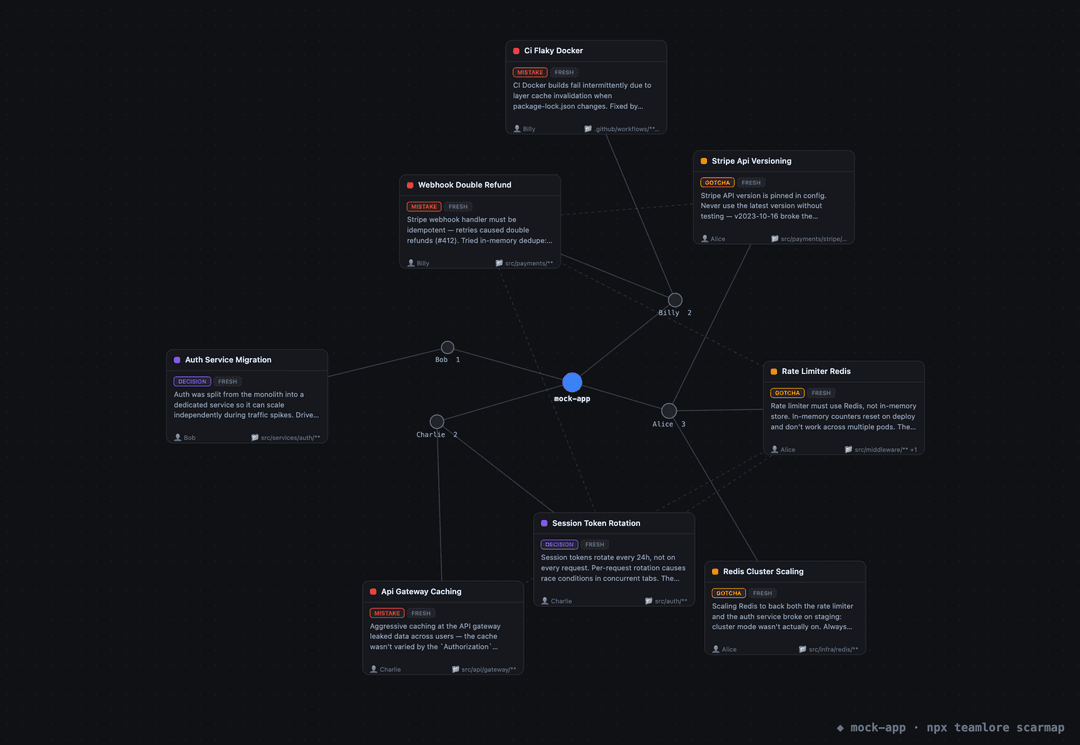
scarmap — see the scars move
npx teamlore scarmap
One command renders .lore/ as a living scar map — a force-directed
graph that settles in front of you, in your browser. Every node is a lesson,
sized by severity (mistake > gotcha > decision) and colored by decay
(fresh → stale). Every edge is a real relationship — overlapping paths,
shared commits, explicit links. No embeddings, no word-similarity guesses:
if two scars are connected, it's because the repo says so.
Click a scar for the full story. Flip to the tree view for risk density by directory. Export a watermarked PNG in one click and drop it in a standup, a README, or a tweet — the image is the pitch.
Offline, zero network calls, one self-contained HTML file. No server, no accounts, ever.
How it works
Distill. Your agent turns hard lessons into tiny lore files — when you correct it, when a command breaks unpredictably, or when a decision is made with a stated reason.
Recall. Teammates' agents load matching lore automatically. Path-scoped, ~800 tokens, max 5 entries. Never a full dump. Zero matches inject nothing — silence is a feature.
Review. Lore rides the PR. Humans merge. Nothing enters the brain unreviewed.
See. npx teamlore scarmap turns the brain into a living scar map —
where the danger zones are, what's fresh, what's gone stale.
Getting Started
Requirements
- Node ≥ 18 (already required to run
npx teamlore). - Claude Code with skills + hooks support.
- Hook scripts are plain Node (no bash/jq dependency). They run on macOS, Linux, and Windows.
Install
In the root of a git repo:
npx teamlore init
git add -A && git commit -m "Add teamlore"
Teammates get the brain on their next git pull. Claude Code picks
up the committed skill and hooks automatically.
init is idempotent. Safe to re-run. It never clobbers existing
hooks or settings.
Uninstall
npx teamlore remove
This deletes the skill and unwires the three hooks from .claude/settings.json
(leaving any other hooks and settings untouched). It keeps your .lore/
folder — it holds your team's real, committed memories. To delete everything
including the lore and .loreignore:
npx teamlore remove --purge
The lore contract
One lore. One file. ≤120 words. Reviewed like code.
---
paths: [src/payments/**]        # glob(s) that make this lore relevant
kind: mistake                   # mistake | gotcha | decision
by: Billy                       # git user who learned it
commit: abc123                  # short HEAD when learned (anchors staleness)
verify_by: 2026-10-01           # soft expiry (~+90 days)
---
Stripe webhook handler must be idempotent — retries caused double refunds
(#412). Tried in-memory dedupe: fails across pods. Use the processed_events
table instead.
- Filename
YYYY-MM-DD-slug.md. One memory per file. Merge conflicts stay rare. pathsscopes recall. Keep globs tight.
Lore is code — review it
Lore is proposed by an agent and merged by a human, in a PR, exactly like
code. Nothing enters the shared brain without review. That review is the trust and
security boundary. It's what stops a bad or poisoned instruction from becoming
something every teammate's agent obeys. The skill stages lore with git add and
never commits. The human always merges.
Our own brain
teamlore keeps its own .lore/. Every mistake Claude made building this
tool, as reviewable git history. Read it in the repo.
Telemetry
teamlore collects minimal anonymous CLI usage telemetry: command name, outcome, duration, package version, Node version, platform, architecture, and a random anonymous ID stored on your machine. It does not collect project content, prompts, file paths, repo names, git remotes, usernames, hostnames, environment variables, or stack traces.
Disable telemetry with either:
TEAMLORE_TELEMETRY_DISABLED=1 npx teamlore init
or:
DO_NOT_TRACK=1 npx teamlore init
Roadmap
v0.2 — the skill-and-folder release. Path-scoped grep recall, plus
teamlore scarmap — the living scar map of your team's lore. No server,
no embeddings. Planned fast-follows:
teamlore stale— surface lore past itsverify_bydateteamlore stats— the "dodges" receipts: how many repeats the brain prevented- Cross-agent adapters — built for Claude Code; Cursor & Codex next
License
This project is licensed under the MIT License — see the LICENSE file for details.
Break things only once.
// faq
What is teamlore?
Shared memory for your team's claude code so that you break things only once. It is open-source on GitHub.
Is teamlore free to use?
teamlore is open-source under the MIT license, so it is free to use.
What category does teamlore belong to?
teamlore is listed under rag in the Claudeers registry of Claude-compatible tools.
// embed badge

[](https://claudeers.com/teamlore)
// retro hit counter

[](https://claudeers.com/teamlore)
// reviews
// guestbook
// related in RAG & Knowledge
 🔓
🔓Persistent Context Across Sessions for Every Agent – Captures everything your agent does during sessions, compresses it with AI, and injects relevant contex…
 🔓
🔓✨ Light and Fast AI Assistant. Support: Web | iOS | MacOS | Android | Linux | Windows
 🔓
🔓Compress tool outputs, logs, files, and RAG chunks before they reach the LLM. 60-95% fewer tokens, same answers. Library, proxy, MCP server.
 🔓
🔓A light-weight and powerful meta-prompting, context engineering and spec-driven development system for Claude Code by TÂCHES.