
tau-job-research-skills
LinkedIn job search skills for AI chat: CV briefs, search plans and evidence-based shortlists. Codex guides, optional Apify MCP, and Claude Code setup notes.
Install with your AI
Paste into Claude Code, Cursor, or any agent — it reads the repo and wires the tool into your project.
Install and set up tau-job-research-skills (git-clone project) into my current project.
Found on https://claudeers.com/tau-job-research-skills
Repo: https://github.com/ArsenOria/tau-job-research-skills
Homepage/docs: https://get-tau.com
Detected install method: git-clone → git clone https://github.com/ArsenOria/tau-job-research-skills
Category: skills. Platforms: api, desktop, web, mobile.
Read the repo's README for exact setup and env vars, then install it and wire it into my project.

Claudeers Health Verdict:
unknown; community-verified: false. Confirm the source before running anything.
git clone https://github.com/ArsenOria/tau-job-research-skills
// compatibility
| Platforms | api, desktop, web, mobile |
|---|---|
| Operating systems | — |
| AI compatibility | claude |
| License | MIT |
| Pricing | open-source |
| Language | Python |
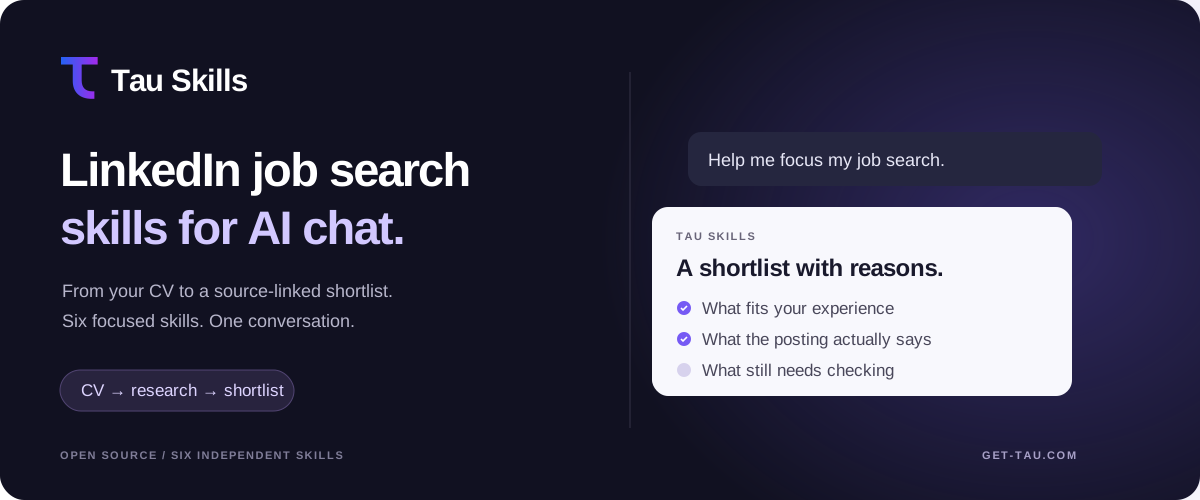
Tau Skills — LinkedIn Job Search Skills
Turn your CV and search preferences into an evidence-based job shortlist.
Install Skills · Try it in chat · Workflow · Scout MCP · Explore Tau
Tau Skills provides six open-source LinkedIn job search skills for an AI-assisted search: turn your CV into a focused brief, plan LinkedIn queries, research roles and compare the evidence in chat. Start with your preferences; finish with a shortlist that explains fit, gaps and unanswered questions.
The optional Tau Scout — LinkedIn Job Search MCP Server companion repository supplies a LinkedIn job search MCP server using your own Apify account. There is no Tau backend, Tau account or shared API key. A configured host assistant calls the tools and presents the results in chat; you do not run search commands or transfer reports between applications.
For a Codex job search skill workflow, use the Codex chat guide and the installation steps below. Looking for a LinkedIn job search skill for Claude? The Claude Code setup guide explains the local skill and optional Scout connection. Tau's recorded end-to-end chat validation is in Codex; the Claude Code route has not yet been validated end to end.
How LinkedIn job search works in chat
| 1. Focus the search | 2. Research the roles | 3. Review the evidence |
|---|---|---|
| Share your CV and constraints; build a job search brief. | Use Scout or the host assistant's available public-web tools. | Compare requirements, remote eligibility and unanswered questions. |
The result is an evidence-based job shortlist that you can refine in the same conversation. Skills cover the reasoning workflow; Scout supplies optional local search tools.
Skills
| Skill | Use it to |
|---|---|
job-search-brief | Turn a CV and preferences into a focused search brief |
linkedin-search-plan | Prepare job-title queries and LinkedIn searches |
job-research | Find and compare vacancies using Scout or the host's web tools |
fit-review | Compare the actual requirements with CV evidence |
company-brief | Research a company using the host's public-web tools |
shortlist-review | Refine and prioritize the saved shortlist in conversation |
Each skill folder installs independently. None requires the other five. Installation uses the host's skill mechanism; Scout needs a client that can launch local stdio MCP servers. We do not claim support for every chat application. See installation and the workflow.
Connect to Codex desktop
Skills provide instructions; Scout provides tools. Install both for the complete chat workflow.
- Download or check out this repository. In Finder/file manager, open your user folder's
.agents/skillsdirectory (create it if needed). - Copy the six individual folders inside
skills/into that directory. For example, the result must be~/.agents/skills/job-research/SKILL.mdwith itsreferences/beside it. Do not copy onlySKILL.md, or nest the entire repository under another skill folder. If a same-named skill already exists, review it before replacing it. - In Codex, ask to use
job-search-briefor select the skill. If it does not appear, restart Codex. See official skill setup. - Install the
tau-job-scoutpackage from the companion Tau Scout repository and add its local STDIO MCP connection. Its README has the full Codexconfig.tomlexample. You need the Scout executable's absolute path, not this repository's path. - Add your own Apify token to the Scout connection's
APIFY_TOKENenvironment setting. Obtain it at Apify Console → Settings → API & Integrations. Never paste it into a chat or commit it. Scout does not load a repository.envautomatically.
After the MCP server has been saved/restarted, send this free connection check:
Use job-research. Check whether Scout is connected and whether APIFY_TOKEN is configured, without showing its value. Do not start a search or make paid requests.
Expected: Scout's get_scout_status is called and reports capabilities plus a token-presence boolean. That boolean does not validate the token or balance with Apify. If the assistant cannot discover Scout, finish the MCP setup first; reading these skill files alone does not connect the server.
Next, try the synthetic demo. A real search can follow with an explicit result/spending cap. Step-by-step manual checkpoints keep setup, free demo and live search separate.
Try it in chat
Here is my CV. Find product analyst jobs in Berlin or remote in Germany from the past week. I can work in Germany without sponsorship. Show what fits and what you cannot verify.
Remove recruitment agencies and prioritize roles involving SQL and experiments. Keep jobs with unknown salary in a separate group.
Research the first company and explain why you would put this role ahead of the second.
The assistant uses the same conversation for follow-up questions and refinements. The demo conversation shows the complete offline flow with clearly synthetic companies. It makes no paid requests.
A live integration exercise also applied these skills to five real Scout results with a synthetic candidate, including description-level fit review and official-source company research. It does not establish automatic installation/discovery in all chat clients.
A subsequent native Codex output review used the installed skills and configured MCP server on ten observed jobs and three synthetic profiles. It includes the captured model answer and its quality limitations.
The Scout 0.2 native answer in Russian repeats those profiles with experience, seniority, remote-country constraints, normalized skills and employer/publisher separation. All user interaction remains in the AI chat.
Scout v0.3 additionally separates publication claims from collection time, distinguishes employer/publisher/recruiter/client identity and evaluates student-program relevance and education/placement requirements. Supply only evidenced student facts; unknown grades, study progress and placement permission remain unknown. Earlier output captures above remain historical; they do not establish current openings or v0.3 behavior.
Setup guides
- Codex job search skill: from CV to shortlist in chat — the host used in our recorded manual exercises.
- LinkedIn job search skill for Claude: Claude Code setup — instructions based on vendor documentation; Tau end-to-end validation is pending.
- Search positioning and competition evidence — dated Google observations, demand proxies and their limits.
Access and evidence
- Scout's Apify source uses a third-party Actor. Receiving a listing does not independently verify that it is still open, complete or correctly categorized.
- Dates, salary, remote eligibility and sponsorship may be unknown. Missing evidence stays unknown.
- Your CV is handled by the AI host under that host's data policy. Scout needs only a minimal structured profile for local matching. The search sent to Apify contains job-search parameters, not your CV or contacts.
- Connect your own
APIFY_TOKENthrough your client's protected secret or environment configuration, never by pasting it into chat. Live searches use your Apify balance and have disclosed caps. Scout has no hosted Tau proxy. - Skills and Scout do not log in to LinkedIn, apply, send messages, automate a browser or monitor in the background. LinkedIn's User Agreement restricts automated access and scraping; using an Apify Actor is not official LinkedIn permission.
Development
python3 -m venv .venv
.venv/bin/python -m pip install -r requirements-dev.txt
.venv/bin/python checks/validate.py
.venv/bin/python checks/package_skills.py
These are maintainer checks and packaging commands, not the user's job-search interface. Packaging writes one independently installable ZIP per skill to dist/. Behavioral evaluation scenarios live in checks/scenarios.md; structural checks cannot prove research quality.
MIT licensed. See LICENSE, CONTRIBUTING, the updated plan in Russian, the Scout tool-reference snapshot, and the implementation boundary. No live Apify call was required to build the skills.
// faq
What is tau-job-research-skills?
LinkedIn job search skills for AI chat: CV briefs, search plans and evidence-based shortlists. Codex guides, optional Apify MCP, and Claude Code setup notes.. It is open-source on GitHub.
Is tau-job-research-skills free to use?
tau-job-research-skills is open-source under the MIT license, so it is free to use.
What category does tau-job-research-skills belong to?
tau-job-research-skills is listed under skills in the Claudeers registry of Claude-compatible tools.
// embed badge

[](https://claudeers.com/tau-job-research-skills)
// retro hit counter

[](https://claudeers.com/tau-job-research-skills)
// reviews
// guestbook
// related in Claude Skills
 🔓
An agentic skills framework & software development methodology that works.
 🔓
 🔓
AI coding assistant skill (Claude Code, Codex, OpenCode, Cursor, Gemini CLI, and more). Turn any folder of code, SQL schemas, R scripts, shell scripts, docs,…
 🔓
💫 Toolkit to help you get started with Spec-Driven Development