
system-design-skills
A divide-and-conquer wiki of system-design skills for Claude Code — reason about scalable systems, don't memorize architectures.
Install with your AI
Paste into Claude Code, Cursor, or any agent — it reads the repo and wires the tool into your project.
Install and set up system-design-skills (claude-plugin project) into my current project.
Found on https://claudeers.com/system-design-skills
Repo: https://github.com/proyecto26/system-design-skills
Homepage/docs: https://proyecto26.com/system-design-skills/
Detected install method: claude-plugin → /plugin install system-design-skills@proyecto26/system-design-skills
Category: plugins. Platforms: cli, api, web.
Read the repo's README for exact setup and env vars, then install it and wire it into my project.

Claudeers Health Verdict:
slowing; community-verified: false. Confirm the source before running anything.
/plugin marketplace add proyecto26/system-design-skills
/plugin install system-design-skills@proyecto26/system-design-skills
git clone https://github.com/proyecto26/system-design-skills
// compatibility
| Platforms | cli, api, web |
|---|---|
| Operating systems | — |
| AI compatibility | claude |
| License | MIT |
| Pricing | open-source |
| Language | JavaScript |
system-design-skills
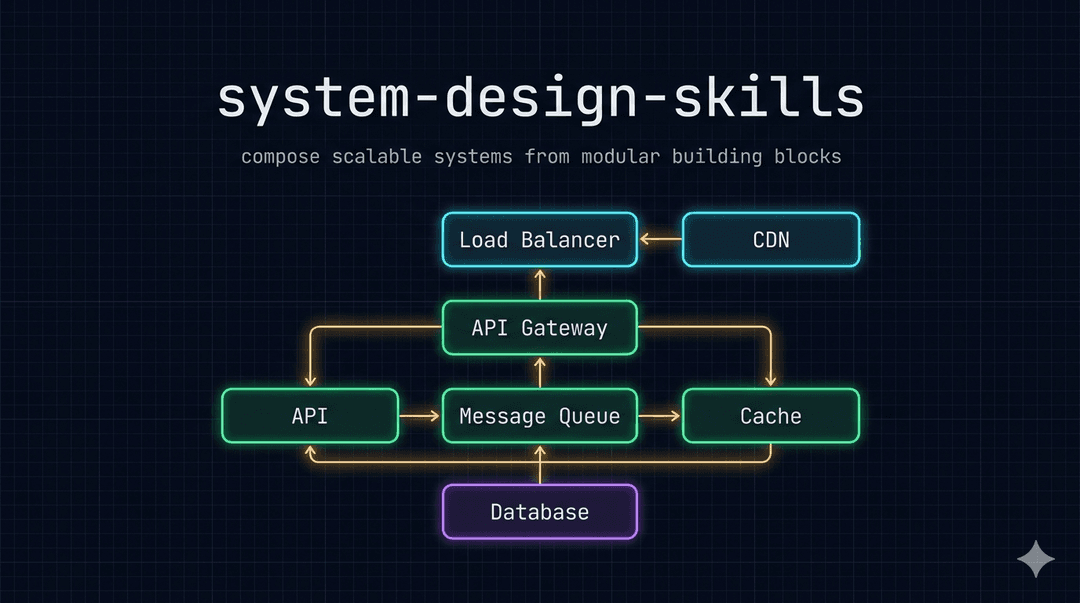
Design scalable systems the way strong engineers actually do — by reasoning, not by memorizing diagrams. A divide-and-conquer wiki of composable building-block skills for Claude Code: clarify requirements, size with numbers, compose the right components, justify every trade-off, and stress-test for failure — then score and persist the design. Works in Claude Code, and any agent that can run skills.
At a glance
flowchart TB
    U["🧑 "design X" · system-design interview"]
    U --> ENTRY["/design command  ·  system-design-orchestrator agent"]
    ENTRY --> LOOP

    subgraph LOOP["Reasoning loop — GUIDE-driven, iterative (reason, don't memorize)"]
      direction LR
      C["1· Clarify"] --> E["2· Estimate"] --> H["3· Design"] --> T["4· Trade-offs"] --> F["5· Failure modes"] --> I["6· Iterate"]
      I -.-> C
    end

    LOOP -->|"invoke the owning skill (Skill tool)"| BB

    subgraph BB["Building-block skills — bottom-up catalog · compose, justify every choice"]
      direction TB
      L0["L0 Frame  · requirements-scoping · back-of-the-envelope"]
      L1["L1 Edge   · dns · load-balancing · content-delivery"]
      L2["L2 Services · api-design · service-decomposition"]
      L3["L3 State  · data-storage · caching · blob-store · sequencer · sharded-counters · distributed-search"]
      L4["L4 Async  · messaging-streaming · task-scheduling"]
      L5["L5 Correctness · consistency-coordination"]
      L6["L6 Ops    · resilience-failure · observability · distributed-logging"]
      L7["L7 Growth · scaling-evolution"]
      L0 --- L1 --- L2 --- L3 --- L4 --- L5 --- L6 --- L7
    end

    BB -->|"each carries: options · trade-offs · stress · provider variants"| DIAG["architecture-diagram · self-contained HTML+SVG"]
    LOOP --> OUT["📄 Scored design doc → docs/design/  +  diagram"]
    DIAG --> OUT

    style U fill:#0b1220,stroke:#8aa8ff,color:#fff
    style ENTRY fill:#0b1220,stroke:#a78bfa,color:#fff
    style LOOP fill:#0b1220,stroke:#22d3ee,color:#fff
    style BB fill:#0b1220,stroke:#34d399,color:#fff
    style DIAG fill:#0b1220,stroke:#fbbf24,color:#fff
    style OUT fill:#0b1220,stroke:#4caf50,color:#fff
Most system-design material teaches you to memorize finished architectures. That is exactly the trap that makes strong engineers fail design discussions: the moment a constraint changes, a memorized diagram falls apart and there is no reasoning underneath to rebuild it. This plugin ships building blocks — one skill per part of a system, each a reusable recipe with explicit trade-offs, behavior under stress, the numbers that matter, and cloud-provider variants — that you compose to fit the problem in front of you.
Quick Start
Installation
Option 1: CLI Install (Recommended)
Use npx skills to install the skills directly:
npx skills add proyecto26/system-design-skills
This installs into your .claude/skills/ directory.
Option 2: Claude Code Plugin
# Add the marketplace
/plugin marketplace add proyecto26/system-design-skills

# Install the plugin (skills + the /design command + the orchestrator agent)
/plugin install system-design-skills
SSH errors? The marketplace clones via SSH. If you don't have SSH keys on GitHub, force HTTPS:
/plugin marketplace add https://github.com/proyecto26/system-design-skills.git
/plugin install system-design-skills
Option 3: Clone and Copy
git clone https://github.com/proyecto26/system-design-skills.git
cp -r system-design-skills/skills/* .claude/skills/
Option 4: Local / development
git clone https://github.com/proyecto26/system-design-skills.git
claude --plugin-dir ./system-design-skills
Option 5: Fork and Customize
Fork the repo, add your own building blocks or provider files (follow meta/SKILL-CONTRACT.md), and point your projects at your fork.
Your first design
No configuration, API keys, or runtime dependencies — just describe what you want:
"/design a URL shortener that handles billions of reads and 10k writes/sec"
Claude runs the full loop — clarifies scope, sizes it with back-of-the-envelope numbers, composes the building blocks, weighs trade-offs, stress-tests failure modes, scores the design, and writes it to docs/design/.
The three ways to use it
- Run the workflow.
/design <system>runs the whole process (or dispatches to thesystem-design-orchestratoragent). Best for full designs and interview practice — it scores the result against the GUIDE quality bar and persists the design doc. - Start a design conversationally. Trigger the system-design orchestrator skill ("design WhatsApp-scale messaging"); it runs the same loop and routes to the blocks.
Preparing for an interview?
docs/study-path.mdsequences the plugin into a learn → drill → self-test path (method, numbers, building-block syllabus, mistakes checklist, and the practice bank).
- Reason about one part. Trigger a building block directly ("what caching strategy here?", "SQL or NoSQL for this?", "how do I shard this table?") — the recipe, trade-offs, and provider variants for just that part.
Building blocks
22 skills: an orchestrator, a diagram engine, and 20 building blocks arranged bottom-up so each layer depends only on the ones beneath it.
| Layer | Blocks | What they decide |
|---|---|---|
| L0 Frame | requirements-scoping · back-of-the-envelope | what to build, how big |
| L1 Edge | dns · load-balancing · content-delivery | get traffic in, served close |
| L2 Services | api-design · service-decomposition | the interface boundary + how the system is split into services |
| L3 State | data-storage · caching · blob-store · sequencer · sharded-counters · distributed-search | store it, read it fast |
| L4 Async | messaging-streaming · task-scheduling | decouple, schedule, absorb spikes |
| L5 Correctness | consistency-coordination | CAP, ordering, consensus |
| L6 Ops | resilience-failure · observability · distributed-logging | degrade, see, survive |
| L7 Growth | scaling-evolution | what changes at 10×/100× |
| Render | architecture-diagram | draw any of the above |
Every block follows one contract (meta/SKILL-CONTRACT.md): When to reach for it · Clarify first · Options · Trade-offs (solves / worsens / when-to-change) · Behavior under stress · How to apply · Dos & Don'ts · Numbers that matter · Choosing a provider · Related blocks.
Usage examples
Just describe what you need — the right skill triggers automatically:
"/design a rate limiter for our API across 100 gateway nodes"
Runs the full loop and composes
resilience-failure(algorithm) +sharded-counters(hot-key counts) +api-design(429/Retry-After contract).
"SQL or NoSQL for a chat app, and how would I shard it?"
data-storage— the SQL/NoSQL trade-off table, key design, and sharding strategy with their failure modes.
"What caching strategy for a read-heavy feed? I'm worried about stampedes."
caching— read/write strategies, eviction, and the thundering-herd / hot-key mitigations.
"How many servers and how much storage for 100M DAU posting twice a day?"
back-of-the-envelope— QPS, storage, bandwidth, server count (runscripts/botec.pyfor an exact check).
"We lost a region — what breaks and how do we degrade?"
resilience-failure+consistency-coordination— SPOFs, failover, and the degradation story (stale beats error).
"Draw the architecture for what we just designed."
architecture-diagram— a self-contained dark-theme HTML+SVG diagram (with PNG/PDF export).
Provider modularity
Every building block defaults to a generic, vendor-neutral recipe. When a cloud is named, the skill reads references/providers/<provider>.md for the concrete managed-service mapping, quotas/limits, and provider-specific trade-offs (AWS · Azure · GCP, plus Temporal for durable execution). If no provider file exists for a request, the generic recipe is the answer — by design, never an invented service.
How it works
sequenceDiagram
    participant U as User
    participant C as Claude Code
    participant O as Orchestrator (agent/skill)
    participant B as Building-block skills
    participant D as architecture-diagram

    U->>C: "/design a URL shortener at scale"
    C->>O: Run the reasoning loop
    O->>B: requirements-scoping (clarify FR / NFR / scope)
    O->>B: back-of-the-envelope (peak QPS, storage, servers)
    Note over O,B: numbers force the architecture
    O->>B: api-design · data-storage · sequencer · caching
    B-->>O: options + trade-offs (solves / worsens / when-to-change)
    O->>B: resilience-failure (SPOF, degradation, recovery)
    U-->>O: curveball: "now 10× writes"
    O->>O: name the invalidated assumption, redesign the affected part
    O->>O: coverage sweep — media? IDs? SLOs? search?
    O->>D: render the stabilized design
    D-->>C: self-contained HTML+SVG
    O-->>C: scored design doc → docs/design/
    C-->>U: design + diagram + weakest-dimension call-out
The diagram engine is self-contained: one HTML file with inline SVG, a system monospace font (no web-font fetch), no Mermaid. The only external calls are two pinned, SRI-protected CDN scripts that power the optional PNG/PDF export — omit them and the diagram still renders.
Running the evals
A realistic eval harness measures whether the skills make Claude design better (not just differently). Everything lives in meta/evals/.
- Eval set —
meta/evals/evals.json: multi-turn exercises (URL shortener, rate limiter, news feed, observability pipeline, typeahead, WhatsApp) that each lead with different blocks. Scored on 6 GUIDE behaviors (clarify / quantify / trade-offs / failure / pivot / concrete-API) + a composition check. - Trigger evals —
meta/evals/trigger-evals.json: ~20 should / should-not routing queries. - Run a comparison (with-skill vs baseline, then a judge) — the method is in
meta/evals/README.md; run it with whatever orchestration you have. The first run (meta/evals/iteration-1/) scored with-skill 30/30 vs baseline 20/30 with composition confirmed real. - Deterministic check (the one objectively-scriptable surface):
python3 skills/back-of-the-envelope/scripts/test_botec.py # asserts calculator == golden fixture
See meta/evals/README.md for the full methodology (multi-turn delivery, broad coverage, variance, regression baselines).
Project structure
system-design-skills/
├── .claude-plugin/
│   ├── plugin.json                  # plugin manifest
│   └── marketplace.json             # marketplace metadata
├── agents/
│   └── system-design-orchestrator.md  # autonomous driver of the reasoning loop
├── commands/
│   └── design.md                    # /design <system> — runs the workflow
├── skills/
│   ├── system-design/               # ORCHESTRATOR — reasoning loop + routing + templates
│   ├── <20 building blocks>/        # SKILL.md + references/ (+ providers/ for component blocks)
│   └── architecture-diagram/        # DIAGRAM ENGINE — self-contained HTML+SVG
├── docs/                            # shared, in-repo references (not skills)
│   ├── GUIDE.md                     #   the ten failure modes (source of the method)
│   ├── study-path.md                #   interview-prep study path (links the pieces)
│   └── hero.png                     #   README banner
├── meta/                            # maintainer docs + eval set (not skills)
│   ├── SKILL-CONTRACT.md            #   the authoring contract every block follows
│   ├── PLAN.md                      #   creation plan + status
│   └── evals/                       #   realistic eval set + results (evals.json, iteration-1/)
├── LICENSE
└── README.md
For the method, read the
system-designskill'sreferences/(reasoning loop, failure modes, trade-off framework, building-blocks index). For the shared shape of every block, readmeta/SKILL-CONTRACT.md.
Known limitations
- Reasoning is subjective, not deterministic. These are judgment skills; only
back-of-the-envelopeships a scriptable calculator + golden fixture. The eval grades behaviors, not a single "right" answer. - Provider numbers drift. Managed-service quotas/limits change — provider files mark them "verify against current docs" and intentionally avoid being exhaustive service catalogs.
- Diagram export needs two CDN scripts. The diagram renders fully offline; the PNG/PDF export buttons load two pinned, SRI-protected scripts.
- No live state. The plugin has no runtime, server, or API keys — it's pure skills + one stdlib Python calculator.
Design principle
Do not memorize architectures; learn the forces that shape them.
There is no single correct design — success depends on the assumptions you make explicit. Treat every architecture as a hypothesis that holds until a constraint changes, and be ready to redraw it calmly when one does.
👍 Credits
Built on the shoulders of the best system-design resources:
- The System Design Primer — building blocks, CAP, and worked examples
- System Design Interview (Alex Xu / ByteByteGo) — the four-step process and back-of-the-envelope numbers
- Grokking Modern System Design — the bottom-up building-block catalog
- Designing Data-Intensive Applications (Martin Kleppmann) — data-systems fundamentals
docs/GUIDE.md— the ten system-design failure modes that shape the reasoning loop (condensed, runtime version embedded inskills/system-design/references/failure-modes.md)
🌟 Star History
💜 Sponsors
This project is free and open source. Sponsors help keep it maintained and growing.
Become a Sponsor | Sponsorship Program
🤝 Contribution
When contributing to this repository, please first discuss the change you wish to make via issue, email, or any other method with the owners of this repository before making a change. Any contributions you make are greatly appreciated ❤️.
See the contribution guide.
⚖️ License
This repository is available under the MIT License.
Happy vibe coding 💯
Made with ❤️ by Proyecto 26 — Changing the world with small contributions.
One hand can accomplish great things, but many can take you into space and beyond! 🌌
Together we do more, together we are more ❤️ 
// faq
What is system-design-skills?
A divide-and-conquer wiki of system-design skills for Claude Code — reason about scalable systems, don't memorize architectures.. It is open-source on GitHub.
Is system-design-skills free to use?
system-design-skills is open-source under the MIT license, so it is free to use.
What category does system-design-skills belong to?
system-design-skills is listed under plugins in the Claudeers registry of Claude-compatible tools.
// embed badge

[](https://claudeers.com/system-design-skills)
// retro hit counter

[](https://claudeers.com/system-design-skills)
// reviews
// guestbook
// related in Claude Plugins
 🔓
🔓A single CLAUDE.md file to improve Claude Code behavior, derived from Andrej Karpathy's observations on LLM coding pitfalls.
 🔓
🔓Claude Code is an agentic coding tool that lives in your terminal, understands your codebase, and helps you code faster by executing routine tasks, explainin…
 🔓
🔓"CLI-Anything: Making ALL Software Agent-Native" -- CLI-Hub: https://clianything.cc/
🔓financial-services — a Claude ecosystem project on GitHub.