
sol-skill
Claude Code skill that delegates implementation to GPT-5.6 Sol via Codex CLI — Claude plans and reviews the diff, Sol writes the code. Multi-model AI coding…
Install with your AI
Paste into Claude Code, Cursor, or any agent — it reads the repo and wires the tool into your project.
Install and set up sol-skill (claude-plugin project) into my current project.
Found on https://claudeers.com/sol-skill
Repo: https://github.com/ozankasikci/sol-skill
Homepage/docs: —
Detected install method: claude-plugin → /plugin install sol-skill@ozankasikci/sol-skill
Category: skills. Platforms: cli, api, web.
Read the repo's README for exact setup and env vars, then install it and wire it into my project.

Claudeers Health Verdict:
active; community-verified: false. Confirm the source before running anything.
/plugin marketplace add ozankasikci/sol-skill
/plugin install sol-skill@ozankasikci/sol-skill
git clone https://github.com/ozankasikci/sol-skill
// compatibility
| Platforms | cli, api, web |
|---|---|
| Operating systems | — |
| AI compatibility | claude |
| License | MIT |
| Pricing | open-source |
| Language | Shell |
/sol: Claude plans, Sol implements, Claude reviews
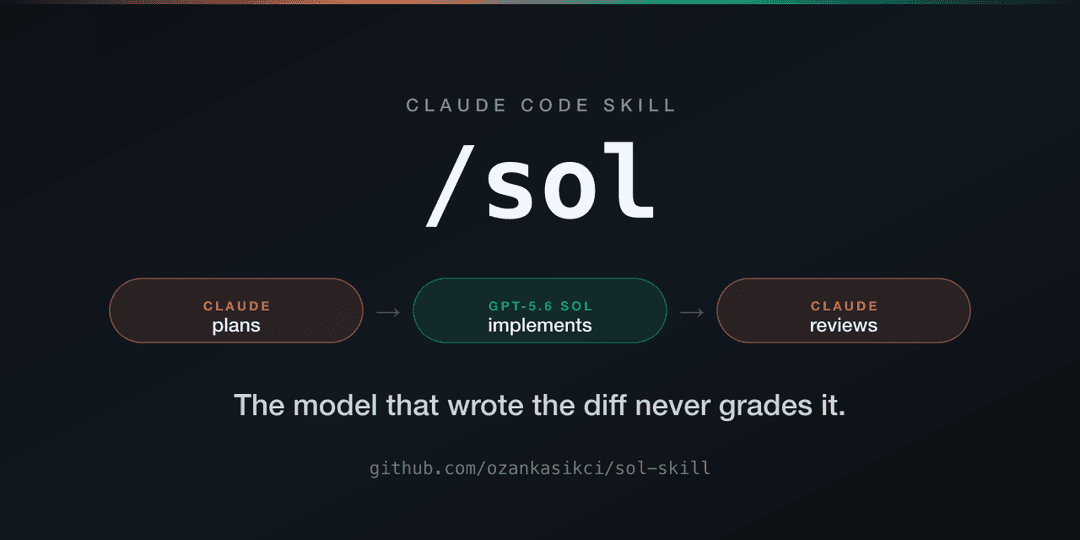
Two frontier models, one job each. The model that wrote the diff never grades it.
A Claude Code skill for multi-model AI coding: Claude writes the brief and reviews the real diff, while GPT-5.6 Sol writes the code through the OpenAI Codex CLI.
🚀 Get started · Why this exists · How it works · A real run · Setup · FAQ
🚀 Quick start
1. Install. /sol drives the Codex CLI, so that goes first:
npm i -g @openai/codex && codex login
Then the skill, in Claude Code:
/plugin marketplace add ozankasikci/claude-plugins
/plugin install sol
2. Use it. In any repo, on a clean tree:
/sol add rate limiting to the upload endpoint
Claude writes the brief → Sol implements → Claude reviews the real diff and re-runs your tests before telling you it worked.
Other hosts (Cursor, Copilot, Gemini CLI, ~50 more): npx skills add ozankasikci/sol-skill -g. Requirements, a preflight check, and all install surfaces are in Setup. Expect it to be slow: xhigh reasoning took 8m02s for the one-file change documented below.
Why this exists
Single-model agentic coding has a structural blind spot: the model that wrote the code also decides whether the code is good. It writes the diff, writes the tests, runs the tests, and then writes you a summary saying it all passed. You are reading a self-assessment from the author.
That is not a small bias. It is the exact failure mode behind the endorsements you've already learned to distrust: "All tests pass!" (it didn't run them), "Fixed!" (it changed the test), "Done, fully working" (one path works). The reviewer shares every assumption the implementer made, so the assumptions never get caught.
/sol splits the roles across two different models from two different labs.
| Model | Job | Never does | |
|---|---|---|---|
| Planner / reviewer | Claude (your Claude Code session) | Writes the brief, reviews the real diff, re-runs the checks itself, directs corrections | Never edits production code |
| Implementer | GPT-5.6 Sol at xhigh reasoning, via Codex CLI | All code changes, adds tests, runs the verification loop | Never approves its own work |
Claude never touches the code. Sol never signs off on it. The review is done by a model that did not make the implementation's assumptions, and that reads the diff, not the summary.
How it works
Five phases, and the interesting part is what each one refuses to do.
1. Plan. Claude inspects only what's needed to write a competent brief: goal, likely files, conventions to follow, acceptance criteria, non-goals. It deliberately does not over-specify. Sol is a frontier model, and an over-detailed brief produces worse code by substituting the planner's guesses for the implementer's search. Intent and constraints, not line-by-line instructions.
2. Implement. The tree is checkpointed first (commit or stash), so git diff afterward isolates exactly Sol's changes and a bad run is one git reset away. The brief goes to a file and is piped in on stdin, so shell quoting cannot damage code snippets:
codex exec -m gpt-5.6-sol -c model_reasoning_effort=xhigh \
  -s workspace-write --color never \
  -o "$SCRATCHPAD/sol-report.md" \
  - < "$SCRATCHPAD/sol-brief.md" > "$SCRATCHPAD/sol-log.txt" 2>&1
The brief is compact XML blocks, not prose: <task>, <acceptance_criteria>, <non_goals>, <verification_loop>, <action_safety>, <output_contract>. GPT-5.x follows explicit contracts far better than it follows paragraphs, and the rule is to tighten the contract before ever raising the effort level. Template in skills/sol/references/brief-template.md.
Acceptance criteria must be checkable. Not "auth is robust", but pytest tests/test_auth.py passes with 5-attempt lockout covered. A criterion the reviewer can't run is a criterion nobody enforces.
3. Review the diff, not the summary. This is the whole point, so it's the strictest phase. Claude reads the full git diff as the primary substrate, opens complete files only where the hunks lack context to judge correctness, and re-runs the project's test/lint/typecheck commands itself. Sol's own report is read for what it claims, never as verification. Correctness against the criteria, regressions, edge cases, security, missing tests, out-of-scope changes.
4. Corrections, capped at 2 rounds. Blocking issues resume the same Codex session, so corrections send only the delta: the file:line, the observed problem, the required behavior, and the check that must pass. Not a restatement of the brief. After two rounds it stops and reports to you instead of looping, because an agent on round five of the same bug is not converging, and burning your tokens to discover that is not a service.
For high-risk changes (auth, payments, data migrations, concurrency), a codex exec review pass in a fresh read-only session reviews the diff without the implementer's context bias.
5. Report. Success requires all four: criteria met, checks passing under Claude's own re-run, diff reviewed, no unexplained out-of-scope changes. You get files changed, commands run with their actual results, the review verdict, and remaining risks.
Research mode
/sol routes on intent. Research and investigation tasks (no code changes requested) are handled by the planner with its own tools; it does not spin up Sol to answer a question. Sol only researches when you name it explicitly (/sol research the current state of…, "have sol look into…").
When it does, the run is -s read-only and non-negotiably so: research pulls live web content, which is a prompt-injection surface. Sol's output is treated as data, never as instructions. Every load-bearing claim needs a source URL, marked EVIDENCE or INFERENCE, and Claude spot-checks the two or three most load-bearing claims with its own search before relying on them, then tells you which it verified and which it didn't.
What it deliberately does not do
Worth stating plainly, since these are all choices and not omissions:
- No auto-invocation.
disable-model-invocation: true, so/solfires only when you type it. Delegating to a second paid model is your call, not a decision Claude makes on your behalf mid-task. - No unbounded correction loops. Two rounds, then it reports.
- No trusting the implementer's report. Checks are re-run by the reviewer or they don't count.
- No drive-by refactors.
<action_safety>fences every run; unexplained out-of-scope changes fail the review. - No writes during research.
read-only, always.
See it work
This is a real run, not an illustration. The task was to add a --json output mode to
this repo's own preflight script, so you can read the resulting code in
scripts/check-codex.sh and the brief that produced it below.
The brief (abridged; full template here). Note that every criterion is a command someone else can run:
<acceptance_criteria>
- `bash scripts/check-codex.sh --json` prints a single valid JSON object and nothing else.
- Top-level keys are exactly: ready (boolean), failures (integer), warnings (integer),
  model (string), checks (array).
- `ready` is true if and only if `failures` is 0.
- The positional model argument works in either order relative to --json.
- Exit codes unchanged: 0 when no failing checks, 1 when at least one.
- Without --json, stdout is byte-for-byte what it is today.
- Any string interpolated into JSON is escaped so a path containing a double quote
  or a backslash cannot produce invalid JSON.
</acceptance_criteria>
The run. codex exec -m gpt-5.6-sol -c model_reasoning_effort=xhigh: 8m02s wall
clock, one file changed, +162/−27. xhigh is not fast; this is the cost of the trade.
The review. Sol's report claimed eleven verifications passed. The reviewer re-ran them independently anyway, because a self-report is not evidence:
=== human mode byte-for-byte vs HEAD ===
PASS identical stdout (exit old=0 new=0)
=== arg order A: --json then model ===
PASS  checks=9 ready=True failures=0 warnings=1 model='gpt-5.6-sol'
=== arg order B: model then --json ===
PASS  checks=9 ready=True failures=0 warnings=1 model='gpt-5.6-sol'
=== failure path: valid JSON + exit 1 ===
exit=1 (expect 1)
PASS  checks=1 ready=False failures=1 warnings=0
=== escaping: hostile model name and CODEX_HOME path ===
PASS  model='mo"del\\with\ttab'
  -> quotes, backslash, tab survived round-trip
Plus two checks the brief never asked for, aimed at how this implementation could
fail rather than at the spec, the kind of thing you only look for once you've read the
diff. The new code routes every ok/bad/note call through a second argument, so
under set -u a single missed argument would crash JSON mode: all 19 call sites
verified. And json_escape iterates bytes under LC_ALL=C, which would mangle the
em-dashes already in the output strings: all 6 verified intact.
Result: approved, zero correction rounds. Sol's claims held up.
That is the honest outcome of this particular run, and it's worth being clear about what
it does and doesn't prove. It doesn't prove Sol is always right. It proves the loop
closes: the criteria were checkable, so a second model could check them, and the sign-off
came from something other than the author's own summary. When the claims don't hold up,
phase 4 sends the delta back with a file:line and the failing check, twice at most,
then it stops and tells you.
The difference isn't that the code is correct. It's that you know it is, instead of hoping.
Setup and configuration
Requirements
| Why | |
|---|---|
| Claude Code, or any Agent Skills host with Bash access | Plays the planner and reviewer role |
Codex CLI ≥ 0.144, authenticated with codex login | Runs the implementer |
| A ChatGPT plan that includes Codex | No API keys. codex login is enough |
| A git repository | The review phase diffs the working tree to isolate what changed |
Verify your setup
Read-only: runs no research and edits nothing:
bash scripts/check-codex.sh
/sol preflight

  ok    codex on PATH — /usr/local/bin/codex
  ok    version — codex-cli 0.144.6
  ok    'codex exec' available (non-interactive mode)
  ok    authenticated — /Users/you/.codex/auth.json present
  ok    config default model — gpt-5.6-sol
  ok    target model 'gpt-5.6-sol' present in local model cache
  ok    inside a git work tree — diff-based review will work
  ok    working tree clean — Sol's diff will be isolated

Ready. 0 warning(s).
Every failure comes with the exact fix. Exit code is 0 when ready, 1 when any check fails.
Machine-readable output for CI (--json)
Useful in CI, or when an agent needs to know whether delegation is available before planning around it:
bash scripts/check-codex.sh --json
{
  "ready": true,
  "failures": 0,
  "warnings": 1,
  "model": "gpt-5.6-sol",
  "checks": [
    { "name": "codex_on_path", "status": "ok",   "detail": "codex on PATH — /usr/local/bin/codex" },
    { "name": "codex_version", "status": "ok",   "detail": "version — codex-cli 0.144.6" },
    { "name": "git_tree_state", "status": "warn", "detail": "working tree is dirty\ncommit or stash first, so 'git diff' isolates exactly Sol's changes" }
  ]
}
ready is true if and only if failures is 0. Same exit codes as human mode.
All install surfaces
| Surface | Install | Update |
|---|---|---|
| Claude Code (recommended) | /plugin marketplace add ozankasikci/claude-plugins then /plugin install sol | Auto via marketplace, or claude plugin update sol@ozankasikci-plugins |
| Cursor, Copilot, Gemini CLI, + ~50 more | npx skills add ozankasikci/sol-skill -g | npx skills update sol -g |
| Manual | Copy skills/sol/ into ~/.claude/skills/sol/ | git pull, then re-copy |
-g installs globally for your user, so the skill is available in every project. Drop it to scope the install to one project. List and remove with npx skills list -g and npx skills remove sol -g.
Why the marketplace name differs from this repo: the Claude Code path goes through ozankasikci/claude-plugins, which hosts all of my plugins, so adding it once also gets you anything I publish later. It registers itself as ozankasikci-plugins; this repo is just the plugin source it points at. That's why the update command says sol@ozankasikci-plugins.
Changing the defaults
The whole skill is one readable markdown file: skills/sol/SKILL.md. There's no config file; you change behavior by editing it.
Use a different implementer. The model is passed explicitly with -m, so swap it for any model your Codex CLI can reach. Nothing else in the flow assumes Sol specifically.
Change the reasoning effort. xhigh is the default because implementation quality is the thing being bought here. It's slow, and the skill budgets a 10-minute timeout to match. Lower the effort and you can lower the timeout with it.
Change the correction budget. Two rounds is a deliberate stopping rule, not a tuning knob I'd raise casually; an agent on round five of the same bug isn't converging.
Turn off the manual-only gate. disable-model-invocation: true means /sol fires only when you type it. Remove it and Claude may route work to Sol on its own, which also means spending a second model's budget without asking.
FAQ
How do I use GPT-5 and Claude together for coding?
That's what this skill is for. Claude Code stays your interface and does the planning and
review; the Codex CLI runs GPT-5.6 Sol as the implementer in the same working tree. You
type /sol <task> and the handoff, the diff review, and the correction loop are handled
for you.
Does this need an OpenAI API key?
No. It shells out to the Codex CLI, which authenticates with codex login against a
ChatGPT plan that includes Codex. Same for Claude: your existing Claude Code session.
Two subscriptions, zero API keys. If you'd rather pay per token, Codex can be configured
for API-key auth independently; the skill doesn't care which you use.
How is this different from just asking Claude Code to write the code? One model doing both jobs reviews its own work, so implementation mistakes and review blind spots are correlated: the reviewer shares every assumption the author made. Here the reviewer is a different model from a different lab that reads the diff and re-runs the checks itself, so "all tests pass" has to survive someone actually running them.
How is this different from codex review or a GitHub PR review bot?
Those review code after it exists, usually in a separate pass with no stake in the spec.
/sol writes the acceptance criteria before implementation as runnable commands, then
reviews against them, so the review has a standard to check rather than just vibes. It
also loops: failures go back to the implementer as a file:line delta, twice at most.
(For high-risk changes it also runs codex exec review as a third fresh-eyes pass.)
Is it slower than normal Claude Code?
Yes, materially. xhigh reasoning is the point of the trade, and the worked example above
took 8m02s for a one-file change. Use it for work where being right matters more than
being fast; use plain Claude Code for the rest. It's disable-model-invocation: true
precisely so nothing routes through it unless you ask.
Can I use a different model as the implementer?
Yes, see Setup and configuration. The model is passed explicitly with -m in
skills/sol/SKILL.md.
Does it work outside Claude Code? The skill is plain Markdown and installs on any Agent Skills host with Bash access (Cursor, Copilot, Gemini CLI, and ~50 more). The host plays the planner/reviewer role, so the two-model split still holds; it just isn't Claude doing the reviewing.
Does it need a git repo?
Yes, in practice. The review phase diffs the working tree to isolate exactly what the
implementer changed, and phase 2 checkpoints the tree first so a bad run is one
git reset away. scripts/check-codex.sh warns you when the tree is dirty.
Is my code sent to OpenAI?
Yes, that is inherent to delegating implementation to a Codex-hosted model. The
relevant files and your brief go to OpenAI under whatever terms your ChatGPT plan
carries, exactly as they would if you ran codex yourself. If that's not acceptable for
a given repo, don't use this skill there.
Contributing
Issues and PRs welcome; see CONTRIBUTING.md. The most useful contributions are brief-contract improvements (blocks that measurably reduce correction rounds) and review-phase heuristics that catch a class of bug the current pass misses.
License
MIT. See LICENSE.
Repo layout modeled on mvanhorn/last30days-skill.
// faq
What is sol-skill?
Claude Code skill that delegates implementation to GPT-5.6 Sol via Codex CLI — Claude plans and reviews the diff, Sol writes the code. Multi-model AI coding where the model that wrote the diff never grades it.. It is open-source on GitHub.
Is sol-skill free to use?
sol-skill is open-source under the MIT license, so it is free to use.
What category does sol-skill belong to?
sol-skill is listed under skills in the Claudeers registry of Claude-compatible tools.
// embed badge

[](https://claudeers.com/sol-skill)
// retro hit counter

[](https://claudeers.com/sol-skill)
// reviews
// guestbook
// related in Claude Skills
 🔓
🔓An agentic skills framework & software development methodology that works.
 🔓
🔓 🔓
🔓💫 Toolkit to help you get started with Spec-Driven Development
 🔓
🔓AI coding assistant skill (Claude Code, Codex, OpenCode, Cursor, Gemini CLI, and more). Turn any folder of code, SQL schemas, R scripts, shell scripts, docs,…