
shipproof
Evidence-first Codex, Claude plugin for bugs, security, and 10k-to-1M-user scale readiness.
Install with your AI
Paste into Claude Code, Cursor, or any agent — it reads the repo and wires the tool into your project.
Install and set up shipproof (claude-plugin project) into my current project.
Found on https://claudeers.com/shipproof
Repo: https://github.com/kingggg5/shipproof
Homepage/docs: —
Detected install method: claude-plugin → /plugin install shipproof@kingggg5/shipproof
Category: devops. Platforms: cli, api, web, mobile.
Read the repo's README for exact setup and env vars, then install it and wire it into my project.

Claudeers Health Verdict:
active; community-verified: false. Confirm the source before running anything.
/plugin marketplace add kingggg5/shipproof
/plugin install shipproof@kingggg5/shipproof
git clone https://github.com/kingggg5/shipproof
// compatibility
| Platforms | cli, api, web, mobile |
|---|---|
| Operating systems | — |
| AI compatibility | claude |
| License | MIT |
| Pricing | open-source |
| Language | Python |
ShipProof
Make AI-written code prove it is ready to ship.
Security · Correctness · Scale · Performance · Production readiness
Works with Codex, Claude Code, Cursor, Gemini, Grok, local terminals, pre-commit, and GitHub Actions.
ShipProof is a production gate for AI-assisted repositories. It scans code without executing it, checks measured CPU/RAM/latency budgets, models reviewed capacity assumptions, and gives coding agents focused engineering instructions. Results are available as terminal output, JSON, SARIF, pre-commit, GitHub Actions, or an optional read-only MCP adapter.
It does not promise "perfect," "unhackable," "maximum performance," or "one million users" from a static scan. It makes assumptions visible, verifies what can be verified, and preserves human authority for consequential actions and releases.
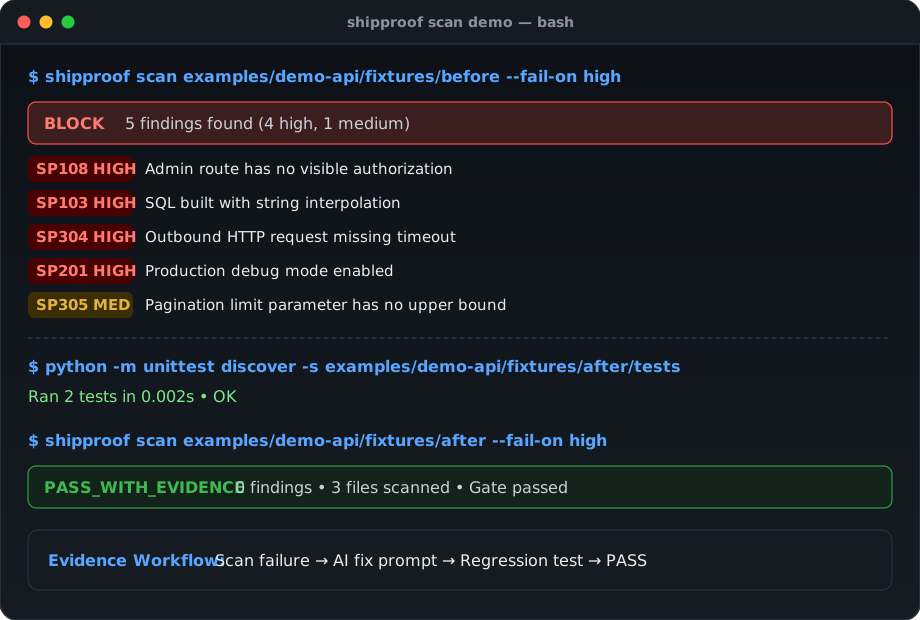
Understand it in 30 seconds
The checked-in demo API contains five real, intentionally vulnerable code paths: missing admin authorization, interpolated SQL, unbounded pagination, a missing outbound timeout, and production debug mode.
shipproof scan examples/demo-api/fixtures/before --fail-on high
# BLOCK · 5 findings

python -m unittest discover -s examples/demo-api/fixtures/after/tests -v
shipproof scan examples/demo-api/fixtures/after --fail-on high
# PASS_WITH_EVIDENCE · 0 findings
The test suite verifies the exact before/after contract. Additional Node.js, Python, secure, and performance fixtures guard against missed findings and obvious false positives.
Quickstart (Zero-Config)
Run directly in any repository without creating a configuration file first:
npx @kingggg5/shipproof check
Or install globally:
npm install --global github:kingggg5/shipproof
shipproof doctor .
shipproof init . --target both
shipproof check .
init adds repository-scoped skills to .agents/skills for Codex and .claude/skills for Claude Code. It skips existing skill directories unless you explicitly pass --force.
Node.js 20+ runs the front-door CLI. Python 3.10+ is needed for scan, check, budget, capacity, and the MCP tools. The core has no runtime npm or Python package dependencies.
Code-Review Terminal Output
ShipProof formats findings as actionable review cards with source context, confidence levels, why the risk matters, and recommended fixes:
  [BLOCK] ShipProof: BLOCK
  Scanned 24 files | 1 blocking issue | 0 suppressed
  HIGH: 1

  [HIGH] Sensitive route lacks visible authorization (SP108)
     src/routes/admin.py:42  |  confidence: LIKELY

     Evidence:
       40
       41   @app.post("/admin/users/{user_id}/ban")
       42 > def ban_user(user_id: str):
       43       return db.ban(user_id)

     Why: An admin or internal route has no visible authorization dependency.
     Fix: Require an explicit authorization dependency or verify application-wide control.
     Ref: CWE-862 | OWASP ASVS V4

  ----------------------------------------------------------------------

  -> Run `shipproof scan --fix-prompt` to generate AI-ready fix instructions
  -> Run `shipproof explain SP108` for attack scenarios and testing guidance
The Closed-Loop AI Workflow
ShipProof turns development into a verified feedback loop: AI writes code, ShipProof finds risks, AI fixes with explicit constraints, and ShipProof re-verifies.
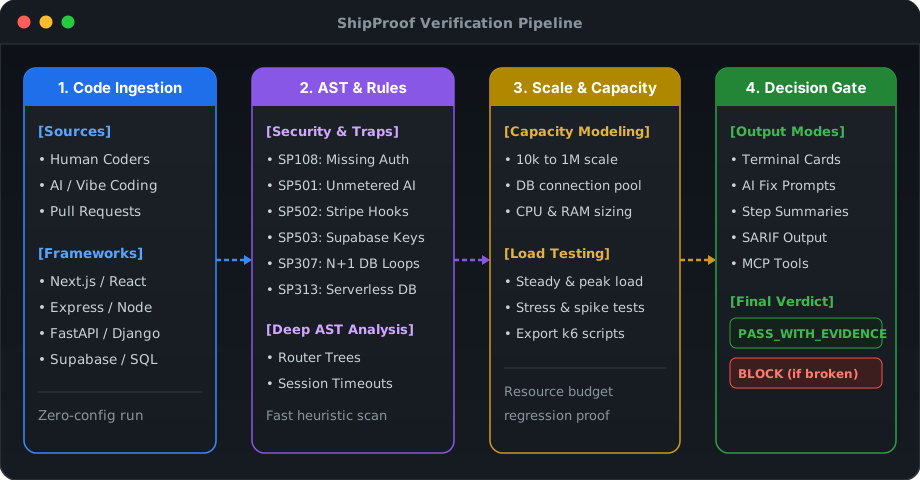
flowchart LR
    A["AI writes code"] --> B["ShipProof finds risks"]
    B --> C["shipproof scan --fix-prompt"]
    C --> D["AI fixes code + regression tests"]
    D --> E["ShipProof verifies evidence"]
Generate Prompts for AI Handoff
shipproof scan --fix-prompt
Outputs structured instructions with code context, constraints, and test requirements ready for Codex, Claude Code, Cursor, Gemini, Grok, or Copilot:
Fix SP108 in src/routes/admin.py (line 42).
Problem: An admin route has no visible authorization dependency.
Required fix: Add Depends(require_admin) to route dependencies.
Constraints:
- Do not change the public API contract
- Add a regression test verifying non-admin returns 403
- Reference: CWE-862, OWASP ASVS V4
Interactive Rule Explanations
Inspect why a rule exists, the threat scenario, common false positives, and how to write a regression test:
shipproof explain SP108
Framework-Aware Detection
ShipProof automatically detects project frameworks and runtimes across multiple ecosystems to apply domain-specific guardrails:
| Ecosystem / Framework | Detection Source | Target Production Checks |
|---|---|---|
| Next.js, Nuxt, SvelteKit, Remix, Astro | package.json (next, nuxt, @sveltejs/kit, @remix-run/*, astro) | Secrets in NEXT_PUBLIC_ (SP403), CSP header evaluation (SP408), Serverless DB connection leaks (SP313) |
| React, Vue, Angular, SolidJS | package.json (react, vue, @angular/core, solid-js) | Exposed service role keys (SP503), Credential logging in client bundles (SP204), Unsanitized SVG uploads (SP112) |
| Express, Fastify, NestJS, Koa, Hono, Elysia | package.json (express, fastify, @nestjs/core, koa, hono, elysia) | Missing security headers/helmet (SP401), Raw error object leaks (SP406), Insecure Stripe webhooks (SP502), Unmetered AI routes (SP501) |
| Prisma, Drizzle, TypeORM, Mongoose, Supabase | package.json (@prisma/client, drizzle-orm, typeorm, mongoose, @supabase/*) | Non-singleton DB clients in serverless (SP313), Supabase RLS bypass (SP503), Unbounded queries (SP302) |
| FastAPI, Starlette, Litestar, Sanic | pyproject.toml, requirements.txt | Unprotected admin routes (SP108), N+1 queries in loops (SP307), Unbounded pagination (SP305), Missing HTTP timeouts (SP304) |
| Django & Flask | pyproject.toml, requirements.txt | Hardcoded SECRET_KEY (SP404), Wildcard ALLOWED_HOSTS (SP405), String-interpolated SQL (SP103) |
| Go (Gin, Echo, Fiber, Chi) | go.mod | Insecure secret fallbacks (SP004), Outbound request timeouts (SP304), Unbounded concurrency (SP306) |
| Rust (Actix-web, Axum, Rocket) | Cargo.toml | TLS verification bypass (SP104), SSRF to metadata (SP109), Credential logging (SP204) |
| PHP (Laravel, Symfony) | composer.json | Dynamic code evaluation (SP101), SQL injection interpolation (SP103), Path traversal (SP110) |
| Ruby (Rails, Sinatra) | Gemfile | Secret key leakage (SP003), Unsafe deserialization (SP106), Debug mode enabled (SP201) |
| Java / Kotlin (Spring Boot, Quarkus, Micronaut) | pom.xml, build.gradle, build.gradle.kts | Hardcoded tokens (SP003), Insecure CORS with credentials (SP107), Path traversal (SP110) |
| Containers, Serverless & CI/CD | Dockerfile, compose.yaml, serverless.yml, .github/workflows | Floating container base tags (SP202), Unpinned GitHub Actions (SP203), Debug mode (SP201) |
Detection Rules Reference
| Rule ID | Severity | Category | Rule Title & Target Problem | Detection Method |
|---|---|---|---|---|
SP001 | CRITICAL | Security | Private key committed in source control | Regex |
SP002 | CRITICAL | Security | AWS access key committed (AKIA...) | Regex |
SP003 | HIGH | Security | Hardcoded credential-like secret or API token | Regex |
SP004 | HIGH | Security | Insecure secret fallback default (os.getenv("KEY", "default")) | Regex |
SP101 | HIGH | Security | Dynamic code execution (eval(), exec()) | AST / Regex |
SP102 | HIGH | Security | Command injection risk via shell execution (shell=True) | AST / Regex |
SP103 | HIGH | Security | Database query built with string interpolation (SQL Injection) | Python AST |
SP104 | HIGH | Security | Outbound TLS certificate verification explicitly disabled | AST / Regex |
SP105 | CRITICAL | Security | JWT signature verification disabled (algorithms=['none']) | Regex |
SP106 | HIGH | Security | Unsafe deserialization (pickle.loads, yaml.load) | AST / Regex |
SP107 | HIGH | Security | Credentialed wildcard CORS (Access-Control-Allow-Origin: *) | Regex |
SP108 | HIGH | Security | Sensitive/admin route lacks visible authorization dependency | Python AST |
SP109 | HIGH | Security | SSRF to cloud metadata (169.254.169.254) or localhost | AST / Regex |
SP110 | HIGH | Security | Path traversal vulnerability in filesystem operations | AST / Regex |
SP112 | MEDIUM | Security | Unsanitized SVG file upload accepted (Stored XSS risk) | Regex |
SP113 | CRITICAL | Security | PHP object injection via unserialize() | Regex |
SP114 | MEDIUM | Security | Catastrophic ReDoS exponential backtracking nested quantifier | Regex |
SP201 | HIGH | Security | Application debug mode enabled in production | Regex |
SP202 | MEDIUM | Supply Chain | Floating container base image tag without SHA256 digest | Regex |
SP203 | HIGH | Supply Chain | Unpinned GitHub Action referenced by mutable tag | Regex |
SP204 | MEDIUM | Security | Sensitive credential or authentication payload logging | Regex |
SP301 | HIGH | Scale | Redis KEYS * full keyspace scan blocking event loop | Regex |
SP302 | LOW | Scale | SQL SELECT * query without explicit LIMIT | Regex |
SP303 | HIGH | Reliability | Blocking time.sleep() inside async coroutine | Python AST |
SP304 | HIGH | Reliability | Outbound HTTP request without explicit timeout deadline | Python AST |
SP305 | MEDIUM | Scale | Pagination query parameter without request-boundary maximum | Python AST |
SP306 | MEDIUM | Scale | Unbounded concurrency over collections (Promise.all(items.map)) | Regex |
SP307 | HIGH | Scale | N+1 database query inside loop construct | Python AST |
SP313 | HIGH | Scale | Non-singleton database client in serverless route (new PrismaClient) | Regex |
SP314 | HIGH | Security | Committed SQLite database file (.sqlite, .db) in git repository | File Header |
SP315 | HIGH | Reliability | Go HTTP request missing response body close (defer resp.Body.Close()) | Regex |
SP316 | HIGH | Scale | Outbound HTTP network call inside database transaction boundary | Python AST |
SP317 | HIGH | Scale | Blocking synchronous call inside Python async def coroutine | Python AST |
SP401 | MEDIUM | Security | Express app missing security headers (helmet) | Regex |
SP403 | HIGH | Security | Secret in client-exposed NEXT_PUBLIC_ environment variable | Regex |
SP404 | CRITICAL | Security | Django SECRET_KEY hardcoded in settings file | Regex |
SP405 | HIGH | Security | Django ALLOWED_HOSTS wildcard (['*']) allowing cache poisoning | Regex |
SP406 | MEDIUM | Security | Express error handler leaking raw error object to clients | Regex |
SP501 | HIGH | Cost & Scale | Unmetered AI/LLM API route (OpenAI, Anthropic, Gemini) | Regex |
SP502 | CRITICAL | Security | Insecure Stripe payment webhook using parsed JSON body | Regex |
SP503 | CRITICAL | Security | Leaked Supabase service_role key bypassing Row Level Security | Regex |
False Positive Control
ShipProof prioritizes high precision over noisy alerts:
- Inline suppression: Add
# shipproof-ignore SP101or// shipproof-ignore SP101directly on the line or on the line immediately preceding it. - Confidence filtering: Run with
--min-confidence highto surface only confirmed, high-confidence issues. - Reviewed baselines: Record existing technical debt into
.shipproof-baseline.jsonusingshipproof scan --baseline-out .shipproof-baseline.json.
Add the GitHub Action
Add a deterministic gate to pull requests:
name: ShipProof
on: [pull_request]
permissions:
  contents: read
jobs:
  production-gate:
    runs-on: ubuntu-latest
    steps:
      - uses: actions/checkout@v4
      - uses: kingggg5/[email protected]
        with:
          fail-on: high
The action automatically writes a structured Markdown status card to the GitHub Step Summary. v0.5.1 is the public-beta contract. Pin ShipProof to the release commit SHA when immutable supply-chain references are required.
One Policy, One Command
Commit a bounded .shipproof.yml, then run every declared repository gate:
version: 1
scan:
  path: .
  exclude:
    - vendor/**
security:
  fail_on: high
performance:
  baseline: perf/baseline.json
  current: perf/current.json
  budget: perf/budget.json
capacity:
  config: capacity.json
shipproof check .
The dependency-free YAML subset rejects executable tags, anchors, duplicate keys, unknown fields, path traversal, and arbitrary commands. The full shape is documented by the policy schema.
Two Modes, One Workflow
| Skill | Use it for | Outcome |
|---|---|---|
engineer-production-systems | Design, implementation, refactoring, hardening, performance, data, AI/MCP, and authorized defensive systems work | Small, bounded, testable production code with explicit assumptions |
audit-production-readiness | Deep review, vulnerability triage, incidents, release gates, and 10k-to-1M-user planning | Independent Security, Correctness, Data & Privacy, Scale, Operability, and Supply Chain gates |
flowchart LR
    A["Requirements + workload"] --> B["Engineering contract"]
    B --> C["AI implements bounded code"]
    C --> D["Tests + scanners + benchmarks"]
    D --> E["CPU/RAM/latency budget gate"]
    E --> F["Production readiness audit"]
    F --> G{"Human release decision"}
    G -->|"blocking evidence"| H["Fix + regression test"]
    G -->|"missing evidence"| I["Targeted experiment"]
    G -->|"verified"| J["Release"]
What It Tells the AI to Do
- Read the real architecture and trace the affected path before changing code.
- Define authorization, tenancy, correctness, workload, latency, CPU, memory, and recovery constraints.
- Bound input, output, recursion, concurrency, fan-out, queues, caches, retries, timeouts, logs, and retained state.
- Prefer simple composition and narrow interfaces over speculative abstractions or premature microservices.
- Measure before and after with the same workload; report variance and tail behavior, not one fast run.
- Treat static and AI findings as leads until a path, reproducer, sanitizer failure, or focused test confirms them.
- Keep dangerous actions human-approved and never upload private code or run active tests without authorization.
Progressive references cover production architecture, full-stack boundaries, database invariants and migrations, AI/RAG/MCP security, software supply chains, operability and incident response, performance, low-level systems, and authorized defensive reverse engineering.
The ShipProof production engineering playbook is the owner-authored map across those disciplines: eight control planes, one decision doctrine, and a compact release record.
Systems Coverage
ShipProof routes high-risk code to a stricter evidence ladder:
| Target | Review focus | Recommended evidence when authorized |
|---|---|---|
| Kernel and drivers | User/kernel boundaries, lifetime/refcounts, copy-to/from-user, ioctl/netlink, locks/RCU, teardown races | KASAN, KMSAN, KCSAN, UBSAN, syzkaller, minimized reproducers |
| Browser engines | GC/refcount boundaries, parsers/codecs, JIT, IPC, sandbox/origin identity, re-entrancy | ASan, UBSan, MSan, coverage-guided fuzzing, regression corpora |
| Network protocols | Framing, integer/length checks, explicit state machines, negotiation, replay, fragmentation, amplification | Structure-aware fuzzing, protocol corpora/dictionaries, fault and sequence tests |
| Services and apps | Authn/authz, tenancy, transactions, retries, idempotency, timeouts, queues, dependency budgets | Unit/integration tests, SAST/SCA, load/soak tests, traces and resource profiles |
The bundled scanner stays deliberately conservative. Deep memory-safety and protocol findings need compiler instrumentation, sanitizers, fuzzers, and target-specific reasoning rather than misleading regex matches.
Codex and Claude Compatibility
Both hosts use the open SKILL.md structure, so ShipProof keeps one source of truth.
| Host | Skill metadata | Plugin manifest | Personal skill path |
|---|---|---|---|
| Codex | skills/*/SKILL.md + optional agents/openai.yaml | .codex-plugin/plugin.json | ~/.agents/skills or <repo>/.agents/skills |
| Claude Code | skills/*/SKILL.md | .claude-plugin/plugin.json | ~/.claude/skills |
Command Reference
shipproof check [path] [--config <file>]     Run every gate (works without config)
shipproof scan [path] [options]              Scan repository (--format terminal|json|sarif)
shipproof explain <rule-id>                  Explain a rule in detail (e.g. explain SP108)
shipproof doctor [path] [--json]             Inspect local runtime and integration health
shipproof init [path] [--target <host>]      Add project skills (.agents/.claude)
shipproof install [--target <host>]          Add personal skills for Codex/Claude
shipproof prompt <name|list>                 Print a focused production engineering prompt
shipproof budget [budget options]            Enforce CPU/RAM/latency regression budgets
shipproof capacity [capacity options]        Model capacity and export to k6 load tests
shipproof evidence [path] [options]          Run allowlisted TypeScript, Go, or Rust analyzers
shipproof mcp                                Start the read-only stdio MCP server
shipproof help                               Show command help
shipproof version                            Print current version
See docs/commands.md for full argument options and exit codes.
Install from a Clone
git clone https://github.com/kingggg5/shipproof.git
cd shipproof
npm install --global .
Then invoke the skill while building:
Use $engineer-production-systems to implement this feature with explicit security,
CPU, RAM, latency, and failure budgets.
Before release:
Use $audit-production-readiness to audit this repository for production.
Claude Code can also load the repository directly as a plugin during development:
claude --plugin-dir .
Plugin-installed Claude skills use the namespaced commands /shipproof:engineer-production-systems and /shipproof:audit-production-readiness.
Reproducible Resource Budgets
Benchmarks remain owned by your project. ShipProof evaluates numeric outputs to keep CI local, fast, and provider-independent.
perf-baseline.json:
{"metrics":{"p95_latency_ms":120,"cpu_ms":8.5,"rss_mb":180,"throughput_rps":850}}
perf-current.json has the same keys. Define reviewed limits in perf-budget.json:
{
  "metrics": {
    "p95_latency_ms": {"direction":"lower","max_regression_percent":10,"max":160},
    "cpu_ms": {"direction":"lower","max_regression_percent":8},
    "rss_mb": {"direction":"lower","max_regression_percent":5,"max":220},
    "throughput_rps": {"direction":"higher","max_regression_percent":5,"min":750}
  }
}
Run the gate:
shipproof budget \
  --baseline perf-baseline.json --current perf-current.json \
  --budget perf-budget.json --format markdown
Runnable sample files live in examples/performance.
Exit codes are 0 for pass, 1 for a measured budget failure, and 2 for missing or invalid evidence.
Audit and Capacity Tools
Fast local scan with Terminal, Markdown, JSON, or SARIF 2.1.0 output:
shipproof scan . --format sarif --output shipproof.sarif --fail-on high
Create a reviewed fingerprint baseline for accepted debt:
shipproof scan . --format json --baseline-out .shipproof-baseline.json --fail-on none
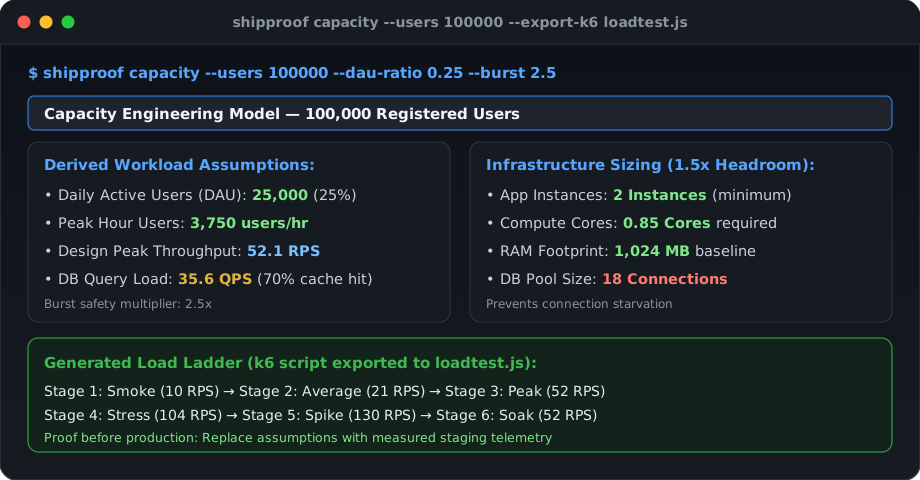
Turn one million registered users into a transparent workload hypothesis, including CPU and memory assumptions:
shipproof capacity \
  --users 1000000 --dau-ratio 0.25 --peak-hour-ratio 0.20 \
  --actions-per-session 12 --requests-per-action 2 --instance-rps 250 \
  --cpu-ms-per-request 5 --memory-mb-per-instance 512 --format markdown
Replace sample values with analytics and production-shaped benchmarks. Registered users are not concurrent users, and capacity arithmetic is not a load test.
Generate a deterministic k6 starting point from reviewed config:
shipproof capacity --config examples/capacity/shipproof.config.json \
  --export-k6 load-test.js --format json
BASE_URL=https://staging.example.test LOAD_TEST_TOKEN=replace-me k6 run load-test.js
The generated file contains no hostname or credential. Running it is a separate, authorized action; review the rate, routes, target environment, and thresholds first.
Local MCP and Language Evidence
Install optional MCP peers beside ShipProof, then point an MCP client at shipproof mcp:
npm install --save-dev github:kingggg5/shipproof @modelcontextprotocol/[email protected] [email protected]
npx shipproof mcp
Set SHIPPROOF_MCP_ROOT to the repository root when the client does not launch the server there. Paths are canonicalized, symlink escapes are denied, execution is bounded to 30 seconds and 2 MB, and no raw shell or file-reading tool is exposed.
Inspect available language-native evidence adapters before running one:
shipproof evidence . --list --format json
shipproof evidence . --adapter typescript --format json
shipproof evidence . --adapter go --format json
shipproof evidence . --adapter rust --allow-project-code --format json
Dependency downloads are disabled for Go and Rust adapters. TypeScript must exist in the repository. The Rust opt-in is deliberate because cargo clippy can execute project-controlled build.rs code.
Layer with Mature Tools
ShipProof routes the agent to tools already present in the environment and never silently installs them:
- CodeQL or Semgrep for source and data-flow analysis.
- OSV-Scanner or Trivy for dependencies, containers, IaC, secrets, licenses, and SBOM evidence.
- Gitleaks for current and historical secrets.
- SkillSpector for trust checks before installing third-party agent skills.
- OpenSSF Scorecard for repository and supply-chain posture.
- LLVM libFuzzer, OSS-Fuzz, or syzkaller for authorized target-specific fuzzing.
- Grafana k6 or the project's existing harness for SLO-driven load testing.
ShipProof Design and Research Trail
ShipProof is independently implemented. Its guidance is written as ShipProof decisions—each tied to an invariant, evidence, and a limitation—not as a collage of external checklists.
- Read the production playbook for the first-party operating model.
- Read the research notebook only when you need to trace which primary pages were opened, what question they answered, what ShipProof retained, and what it deliberately did not claim.
External links are concentrated in the notebook so the README and skill instructions remain ShipProof's own concise guidance. Community posts and repositories may suggest questions, but they are not accepted as proof and their code or prompts are not imported.
ShipProof deliberately avoids a single readiness score because one critical defect must not be averaged away by many clean files.
AWE TraceGate Engineering Loop and Roadmap
AWE TraceGate orchestrates the loop; ShipProof remains the reusable evidence engine. This keeps loop state, budgets, approvals, and user experience in AWE TraceGate while one ShipProof contract serves local CLI, pre-commit, GitHub Actions, generated k6 tests, and MCP clients.
Observe -> Contract -> Change -> Verify -> Audit -> Decide -> Learn
   ^                                                        |
   +--------------------- bounded next iteration -----------+
Run shipproof prompt loop to load the bounded workflow. See the delivery roadmap for what shipped in 0.4.0 and which acceptance evidence belongs before a stable 1.0 release.
Development
npm ci --ignore-scripts
python -m pip install -r requirements-dev.txt
npm run lint
npm run test
python -m compileall -q skills tests
python skills/audit-production-readiness/scripts/scan_repo.py . --fail-on high
npm pack --dry-run
The core runtime uses only Node and the Python standard library; Ruff is development-only. The optional MCP adapter uses the official MCP SDK and Zod as explicitly installed peers. CI tests Node 20/24 and Python 3.10/3.12, verifies package contents, and runs CodeQL for Python and JavaScript/TypeScript. Read CONTRIBUTING.md before adding a detector: each rule needs positive and negative tests, a mapping, remediation, and false-positive analysis.
The scoped npm manifest is ready for a future registry release. Until the owner configures npm trusted publishing, use the GitHub npm install shown above; this project does not claim an unpublished registry release. See docs/releasing.md.
License and Security
MIT. Report vulnerabilities privately according to SECURITY.md.
// faq
What is shipproof?
Evidence-first Codex, Claude plugin for bugs, security, and 10k-to-1M-user scale readiness.. It is open-source on GitHub.
Is shipproof free to use?
shipproof is open-source under the MIT license, so it is free to use.
What category does shipproof belong to?
shipproof is listed under devops in the Claudeers registry of Claude-compatible tools.
// embed badge

[](https://claudeers.com/shipproof)
// retro hit counter

[](https://claudeers.com/shipproof)
// reviews
// guestbook
// related in DevOps & CI/CD
 🔓
🔓⭐AI-driven public opinion & trend monitor with multi-platform aggregation, RSS, and smart alerts.🎯 告别信息过载,你的 AI 舆情监控助手与热点筛选工具!聚合多平台热点 + RSS 订阅,支持关键词精准筛选。AI…
 🔓
🔓Use Claude Code as the foundation for coding infrastructure, allowing you to decide how to interact with the model while enjoying updates from Anthropic.
 🔓
🔓Professional Antigravity Account Manager & Switcher. One-click seamless account switching for Antigravity Tools. Built with Tauri v2 + React (Rust).专业的 Antig…
 🔓
🔓Roadmap to becoming an ASP.NET Core developer in 2026