
sessionly
Lab-neutral, local-first ledger for Claude Code, Codex, Cursor and Grok sessions: what they did, what it cost, what survived.
Install with your AI
Paste into Claude Code, Cursor, or any agent — it reads the repo and wires the tool into your project.
Install and set up sessionly (git-clone project) into my current project.
Found on https://claudeers.com/sessionly
Repo: https://github.com/KIvanow/sessionly
Homepage/docs: https://sessionly.dev
Detected install method: git-clone → git clone https://github.com/KIvanow/sessionly
Category: devtools. Platforms: cli, api, web.
Read the repo's README for exact setup and env vars, then install it and wire it into my project.

Claudeers Health Verdict:
unknown; community-verified: false. Confirm the source before running anything.
git clone https://github.com/KIvanow/sessionly
// compatibility
| Platforms | cli, api, web |
|---|---|
| Operating systems | — |
| AI compatibility | claude |
| License | Apache-2.0 |
| Pricing | open-source |
| Language | TypeScript |
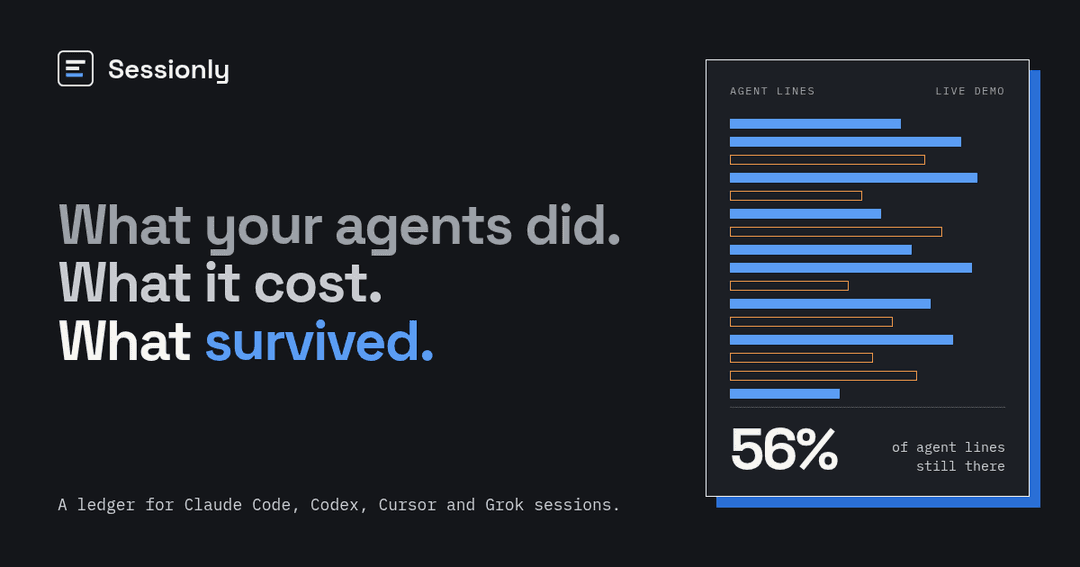
What your agents did. What it cost. What survived.
A lab-neutral, local-first ledger for Claude Code, Codex, Cursor and Grok sessions.
Try the live demo · Install · Docs · Website
https://github.com/user-attachments/assets/2ff085fc-7731-4bae-9d10-5ec33f0f5eea
Sessionly keeps a ledger of your Claude Code, Codex, Cursor and Grok sessions, on your own machine: which tools ran, which files changed and what it cost. Then it counts how many of the agent's lines are still in the file later, and still in the pull request after review.
You decide whether anything is shared. Nothing leaves your machine until you connect it to a server, and source code never does.
The live demo
The demo is Sessionly's own repository, built with the agents it measures. Sign in with Google or GitHub to open it; it is read-only. As of 22 Nov 2026:
| Agent | Sessions | Cost | Lines still there |
|---|---|---|---|
| Claude Code | 16 | $888.06 | 73% |
| Grok | 8 | $40.65 | 17% |
| Codex | 2 | no cost | 89% |
| Cursor | 1 | no cost | 100% |
| Total | 27 | $928.71 | 63% |
27 sessions, 37h 12m active, 688 files changed. 5 of the 27 costs are estimates, and 4 sessions have no cost figure: the Codex ones were imported before Sessionly estimated Codex costs from their tokens, and the Cursor session and one Grok session reported none. One repository and one developer over nine days: a record of this work, not a benchmark of the agents. The demo is brought up to date every day, so its figures have moved on since.
Why Sessionly
- Four agents, one record. Claude Code, Codex, Cursor and Grok, on a machine or in the cloud, mapped to the same tool names and the same session record. A row means the same thing whichever agent produced it.
- Survival, not volume. Lines written is easy to inflate. Sessionly counts how many of an agent's lines are still there later, and still in the pull request after review.
- Lab-neutral. Sessionly is not any agent maker's tool. It reads every agent's sessions the same way and says where one records less, so a comparison isn't scored by one of the players.
- A ledger, not marks in your repo. Nothing is written into your commits: no notes, no trailers. Pull requests are matched to sessions by hashes of the lines, on your server.
- Private by default. Capture, parsing and redaction happen locally. Uploads are opt-in, the default upload has no text from prompts, commands or files, and source code is never sent.
Install
Each release has a binary for Linux and macOS.
Unpack it and put sessionly on your PATH, or install it from crates.io with Rust 1.89 or
later:
cargo install sessionly
Then:
sessionly install     # adds the capture hooks for Claude Code, Codex, Cursor and Grok
sessionly status      # hooks installed? how many sessions captured?
sessionly import      # bring in sessions from before the hooks were installed
sessionly update moves to a newer release. More: Install.
Use
sessionly list                   # sessions, newest first, with filters and text search
sessionly summary                # totals per user, repo, model, tool or day
sessionly show <session>         # one session: cost, prompts, files changed, tools, subagents
$ sessionly list
ID        TOOL         STARTED (UTC)      ACTIVE      COST  FILES         LINES  REWRITTEN  REPO      PROMPT
2b02c8f5  Claude Code  2026-11-13 18:29      14s     $0.17      2        +24 -0        1/2  e2e2      Do these steps in order, one tool call each: 1. Write a …
6c6a61b0  Claude Code  2026-11-13 18:10      15s     $0.29      1         +1 -0        0/1  e2e2      Do these steps in order, one tool call each, and keep go…
More: Command line, the rewrite rate, and what is known of each agent's sessions.
How it works
A small local program does the work. A server is optional.
- Capture. A hook appends each agent event to a local file in 2–4 ms. It only observes: it can't block or change a session.
- Read. Tokens, models and cost come from the transcripts and session files the agents keep themselves.
- Normalize. Both become one record per session in a local SQLite ledger at
~/.sessionly: prompts, tool calls, files, subagents, cost. - Measure. On every sync, the lines each session added are counted again in the files as they are now.
- Upload. Only if you connect a server. Paths are made relative and the content level you chose is applied first.
Claude Code, Codex ──hooks───────┐
Cursor, Grok ──────their files───┼──▶ sessionly (local Rust binary) ──▶ ~/.sessionly/ledger.db
cloud agents ──────repo hooks────┘                 │
                                                   └── upload, if connected ──▶ Sessionly server ──▶ team dashboard
The ledger is derived data: delete it and sessionly sync --force rebuilds it.
Cloud agents
Claude Code's cloud sessions, Cursor's cloud agents and Codex's cloud tasks are captured through hooks the repository carries:
sessionly install --repo          # in the repository's root
git add .sessionly .claude/settings.json .cursor/hooks.json AGENTS.md
git commit -m "Capture cloud agent sessions"
More: Cloud sessions.
Pull requests
A GitHub Action reports each pull request to the server, which works out how much of it coding agents wrote, with which models, and how those lines fared in review. Both sides send hashes, never source code. More: Pull requests.
Team server
The server receives uploads and serves the team dashboard. Use the hosted one at app.sessionly.dev (free during early access), or run your own:
SESSIONLY_ADMIN_TOKEN=choose-a-long-secret docker compose up -d
sessionly connect http://127.0.0.1:8080
sessionly upload
Owners can export everything as JSONL or delete the organisation at any time. More: Server, Uploading, Data and privacy and the API reference.
Documentation
Everything is at docs.sessionly.dev, built from
docs-site/, where each page also reads well on GitHub:
Install ·
Command line ·
Commands ·
Agents ·
Cloud sessions ·
Data and privacy ·
Uploading ·
Server ·
Configuration ·
API ·
Pull requests ·
Editions
Editions and license
Everything outside ee/ is Apache-2.0 (LICENSE): the sessionly binary, the server
and the dashboard. It never needs a license key. ee/ (LICENSE-EE) holds the
Business and Enterprise features. More: Editions and license.
Contributing
Issues and pull requests are welcome. Contributions use DCO sign-off (git commit -s); see
CONTRIBUTING.md.
cargo test
cargo clippy --all-targets
pnpm typecheck && pnpm test   # the TypeScript side and the GitHub Action
scripts/dummy-session.sh      # runs a short real Claude Code session that exercises most hooks
The website (sessionly.dev) is the static pages in website/,
with no build step and one analytics script; python3 -m http.server -d website previews it. The docs are
the Jekyll site in docs-site/; its README says how to
preview them.
If Sessionly is useful to you, a ⭐ helps other people find it.
// faq
What is sessionly?
Lab-neutral, local-first ledger for Claude Code, Codex, Cursor and Grok sessions: what they did, what it cost, what survived.. It is open-source on GitHub.
Is sessionly free to use?
sessionly is open-source under the Apache-2.0 license, so it is free to use.
What category does sessionly belong to?
sessionly is listed under devtools in the Claudeers registry of Claude-compatible tools.
// embed badge

[](https://claudeers.com/sessionly)
// retro hit counter

[](https://claudeers.com/sessionly)
// reviews
// guestbook
// related in Developer Tools
 🔓
The agent harness performance optimization system. Skills, instincts, memory, security, and research-first development for Claude Code, Codex, Opencode, Curs…
 🔓
Makes your AI agent think like the laziest senior dev in the room. The best code is the code you never wrote.
 🔓
AI coding assistant skill (Claude Code, Codex, OpenCode, Cursor, Gemini CLI, and more). Turn any folder of code, SQL schemas, R scripts, shell scripts, docs,…
 🔓
Orca is the ADE for working with a fleet of parallel agents. Run any coding agent with your own subscription. Available on desktop and mobile.