
repo-structure-in-house
The repo structure for in-house marketers: give Claude Code your company's context before it writes. Folder layout, 11 context skills, a filled-in example.
Install with your AI
Paste into Claude Code, Cursor, or any agent — it reads the repo and wires the tool into your project.
Install and set up repo-structure-in-house (git-clone project) into my current project.
Found on https://claudeers.com/repo-structure-in-house
Repo: https://github.com/matteotitta/repo-structure-in-house
Homepage/docs: https://genesysgrowth.com
Detected install method: git-clone → git clone https://github.com/matteotitta/repo-structure-in-house
Category: rag. Platforms: web.
Read the repo's README for exact setup and env vars, then install it and wire it into my project.

Claudeers Health Verdict:
active; community-verified: false. Confirm the source before running anything.
git clone https://github.com/matteotitta/repo-structure-in-house
// compatibility
| Platforms | web |
|---|---|
| Operating systems | — |
| AI compatibility | claude |
| License | MIT |
| Pricing | open-source |
| Language | HTML |
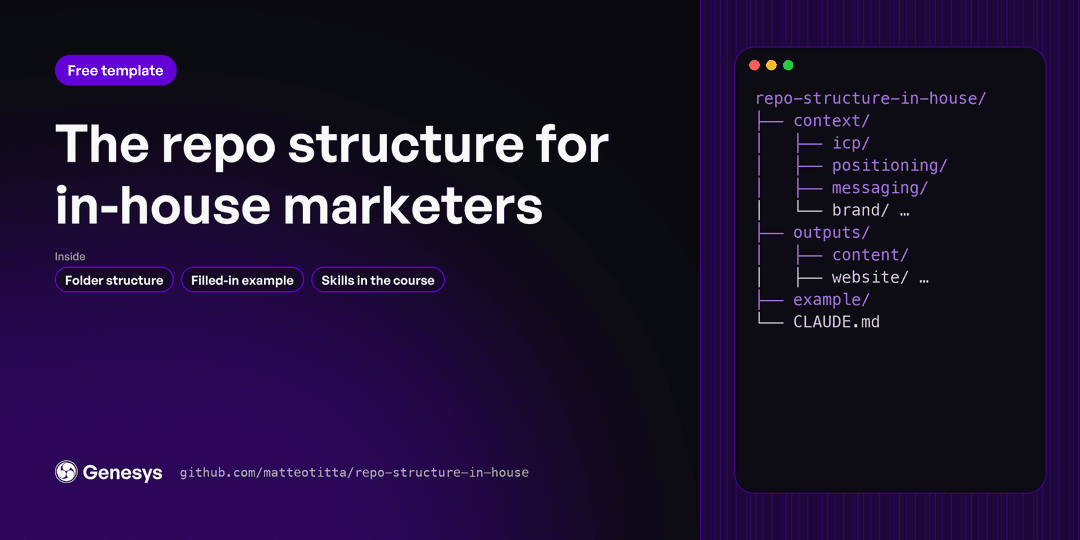
Repo structure for in-house marketers
The folder layout that gives Claude Code your company's context before it writes anything. Fork it, fill context/ with the 11 skills inside, and every draft after that starts from your ICP, your positioning and your voice. You stop re-explaining your product every session.
Agency or consultant with several clients? Use repo-structure-agency instead.
Start in three steps
- Create your copy. Click Use this template above, or run:
gh repo create my-marketing --template matteotitta/repo-structure-in-house --private --clone - Open it in Claude Code and read the example first:
example/pulse-analytics/is a made-up B2B SaaS company with every context file filled in. - Fill your context in this order. Each skill asks for what it needs and saves into the right folder:
/company-context → /icp-research → /competitor-research → /win-loss → /expert-pov → /tov-guidelines → /brand-kit → /positioning → /messaging → /funnel-strategy → /goals/win-lossneeds call transcripts and/expert-povneeds founder material. Skip either until you have them.
Web research works best with an Exa key in .env (copy env to .env). Without one, the skills fall back to plain web search.
What's inside
repo-structure-in-house/
├── context/          what Claude reads first: icp, competitors, positioning, messaging,
│                     brand, expert-pov, win-loss, goals, docs
├── outputs/          what you ship, by lane: content, website, seo-aeo, social,
│                     product-marketing, sales, paid, lifecycle, outbound
│                     (each lane runs research → strategy → execution)
├── workflows/        recipes that chain several skills
├── library/taste/    work you admire, for "in the style of"
├── example/          PulseAnalytics, filled in. Read it, then delete it
├── latest.md         what changed recently (Claude reads it at the start)
├── history.md        one line per meaningful change
└── .claude/
    ├── skills/       the 11 context skills, plus /level
    └── rules/        four short house rules
Every folder has a one-page CLAUDE.md that says what goes there and which skill fills it.
The idea: context/ is written once and kept current. outputs/ is where work happens. Because every skill reads context/ before it writes, a landing page, a launch plan and a LinkedIn post all come out sounding like the same company.
Add skills for each lane
The 11 skills here build your context. When you're ready to ship work, add the plugin for that lane. Each one reads the same context/ folder:
| Lane | Plugin |
|---|---|
| Product launches, stories, case studies | claude-marketing-launch |
| Website score, sitemap, wireframes, copy | claude-marketing-website |
| AI-answer and search visibility | claude-marketing-aeo |
| LinkedIn profile, posts, carousels | claude-marketing-linkedin |
| Content strategy, long-form, newsletter | claude-marketing-content |
Want to build your own skills? Start from gtm-skill-template.
What the full version adds
This is the free shape of the workspace students build in Marketing Engineering University. The course version adds:
- the full skill library, with the reference material and output templates these free skills leave out
- agents, commands and hooks that chain the skills and check their own work
- live sessions where you build the system on your own company
The free version is enough to get your context right. That's the step most teams skip.
Keep it alive
- Every file in
context/has one owner. - Re-run a context skill when something real changes: a new competitor, a pricing change, a new segment.
- Every 90 days, spend 30 minutes pruning. See
.claude/rules/quarterly-maintenance.md.
HOW-TO-OPERATE.md has seven habits for getting real work out of Claude Code.
Built by Matteo Tittarelli at Genesys Growth. MIT licensed: fork it, change it, use it with clients.
// faq
What is repo-structure-in-house?
The repo structure for in-house marketers: give Claude Code your company's context before it writes. Folder layout, 11 context skills, a filled-in example.. It is open-source on GitHub.
Is repo-structure-in-house free to use?
repo-structure-in-house is open-source under the MIT license, so it is free to use.
What category does repo-structure-in-house belong to?
repo-structure-in-house is listed under rag in the Claudeers registry of Claude-compatible tools.
// embed badge

[](https://claudeers.com/repo-structure-in-house)
// retro hit counter

[](https://claudeers.com/repo-structure-in-house)
// reviews
// guestbook
// related in RAG & Knowledge
 🔓
Persistent Context Across Sessions for Every Agent – Captures everything your agent does during sessions, compresses it with AI, and injects relevant contex…
 🔓
✨ Light and Fast AI Assistant. Support: Web | iOS | MacOS | Android | Linux | Windows
 🔓
Compress tool outputs, logs, files, and RAG chunks before they reach the LLM. 60-95% fewer tokens, same answers. Library, proxy, MCP server.
 🔓
A light-weight and powerful meta-prompting, context engineering and spec-driven development system for Claude Code by TÂCHES.