
pinwall
Self-hosted artifact server for AI agents: Claude Code, Cursor and Codex publish HTML pages over MCP, you review them with pinned comments, versions and shar…
Install with your AI
Paste into Claude Code, Cursor, or any agent — it reads the repo and wires the tool into your project.
Install and set up pinwall (git-clone project) into my current project.
Found on https://claudeers.com/pinwall
Repo: https://github.com/dungnguyenv/pinwall
Homepage/docs: —
Detected install method: git-clone → git clone https://github.com/dungnguyenv/pinwall
Category: mcp-servers. Platforms: api, desktop, web.
Read the repo's README for exact setup and env vars, then install it and wire it into my project.

Claudeers Health Verdict:
unknown; community-verified: false. Confirm the source before running anything.
git clone https://github.com/dungnguyenv/pinwall
// compatibility
| Platforms | api, desktop, web |
|---|---|
| Operating systems | — |
| AI compatibility | claude |
| License | Apache-2.0 |
| Pricing | open-source |
| Language | TypeScript |

Pinwall
The self-hosted review wall for the pages your AI agents build.
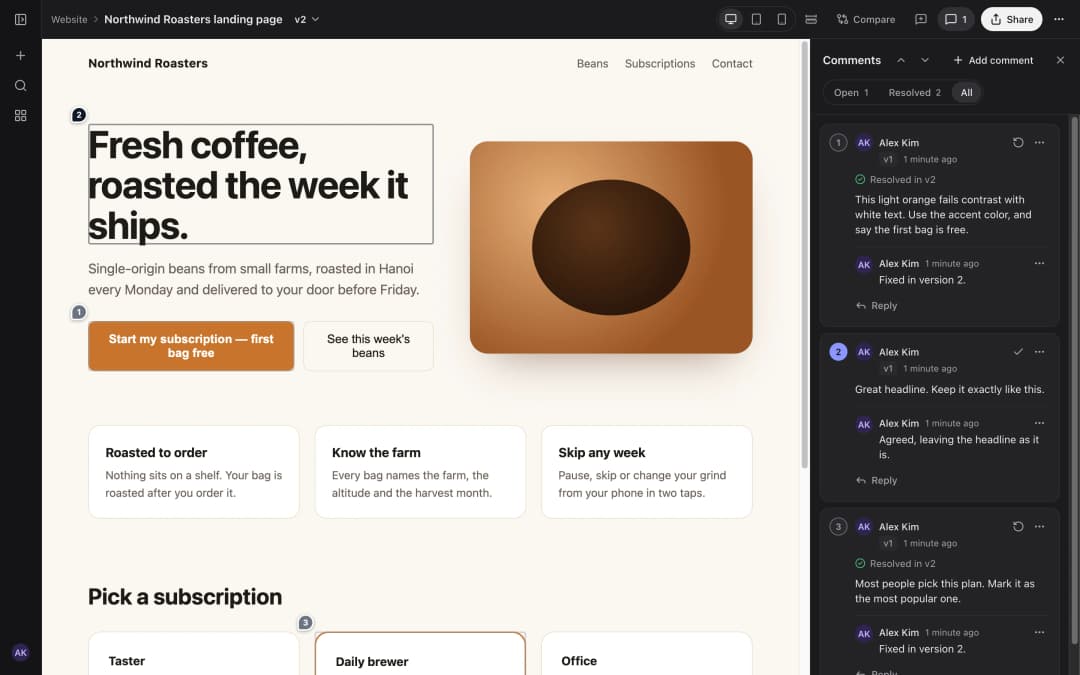
Claude Code, Cursor, Codex and any MCP client publish HTML pages, static sites and Markdown to Pinwall. You review every version in the browser, pin comments on the exact spot, and the agent reads them over MCP, fixes the page and publishes the next version.
Try it free on pinwall.ap.vn, or run your own with one docker run.
Try it · Quick start · Connect an agent · Features · Deploy · Docs · FAQ
Why Pinwall
Coding agents are good at making things you have to look at: a landing page, a dashboard, a report, a prototype, a design doc. Reviewing them is still clumsy. The page lives in one chat or one account, feedback goes back as screenshots and long messages, and nobody can tell which version a remark was about.
Pinwall gives that work one home that you host yourself:
- One place for every agent and every account. Any MCP client can publish, and the same artifact is there no matter which machine, account or tool made it.
- Feedback the agent can act on. Comments are pinned to an element, a text selection or a point on the page, and the agent reads them, with the page and version they belong to, over MCP.
- History you can trust. Every publish is a numbered version that never changes, and each comment stays tied to the version it was written on.
- Yours to run. One container, your database, your storage, your identity provider. No telemetry.
How it works
sequenceDiagram
    autonumber
    participant Agent as Agent (Claude Code, Cursor, Codex)
    participant Pinwall
    participant You
    Agent->>Pinwall: Publish a page or a site over MCP
    Pinwall-->>Agent: Review link for version 1
    Agent->>You: "Here is v1"
    You->>Pinwall: Pin comments on v1
    Agent->>Pinwall: Read the open comments
    Agent->>Pinwall: Publish v2, resolve what it fixed
    Pinwall-->>You: Your open review tab switches to v2
Features
Review
- 📌 Pinned comments on an element, a text selection or any point, with threads, replies and resolve/reopen. Comments follow their spot when the next version moves things around.
- 📱 Phone, tablet and desktop widths, or any width you type, without leaving the page.
- 🔀 Compare versions side by side, as an overlay, or file by file, with synced scrolling.
- ⚡ Live updates. An open review tab switches to the new version, and new comments appear as they are written.
- 📝 Markdown documents rendered as pages, next to HTML pages and multi-page static sites.
Agents
- 🤖 MCP server with built-in OAuth. Add one URL to Claude Code, Cursor or Codex and sign in in the browser. No token to copy, and access renews itself.
- 📦 Publish a file, a folder or an archive. An agent with a shell gets a one-time upload URL that expires within minutes, so no long-lived secret sits in its shell. An agent without one publishes text files inline.
- 🗂️ Projects with instructions that every agent follows when it publishes there.
- 🧩 A skill for Claude Code that teaches the publish, review and fix loop.
- 🔌 REST API described by an OpenAPI document, with API tokens for scripts and CI.
Sharing and access
- 🔗 Share links for people without an account, with an optional password, an expiry date and guest comments, showing the latest version or one fixed version.
- 🔐 Single sign-on through any OpenID Connect provider, with groups mapped to admin and member, and access re-checked against the provider. Recipes for Zitadel, Keycloak and Google.
- 👤 Owner account with a passkey or a password, for a single-person install or as a way in while the identity provider is down.
- 🏠 Personal spaces. One setting gives each person a space of their own, and in the app nobody sees another person's work, admins included. The default, one shared library for the team, stays as 1.0 had it. Spaces and members
- 🤝 Project members. An owner adds people by email as editors, who publish, or as viewers, who read and comment, and the project shows up under Shared with me for them.
- 🚦 Guard rails for an open instance. Admins approve who may share pages outside Pinwall, each person has quotas for storage, artifacts and files, and admins can look up a reported link, take it down or clear out an account without reading anyone's work. Running an open instance
Operations
- 🐳 One container, multi-arch (amd64 and arm64): SQLite and local disk to start, PostgreSQL and any S3-compatible storage to grow.
- ☸️ Helm chart for a hardened pod: non-root, read-only root filesystem, image pinned by digest.
- 🛡️ Untrusted pages stay apart from the app, in a sandbox on one domain or on a separate content domain.
- 💾 One-command backup and restore, also the way from SQLite to PostgreSQL and S3.
- 📈 Prometheus metrics, health checks and JSON logs.
- ✍️ Signed releases with cosign, plus SBOM and build provenance attestations.
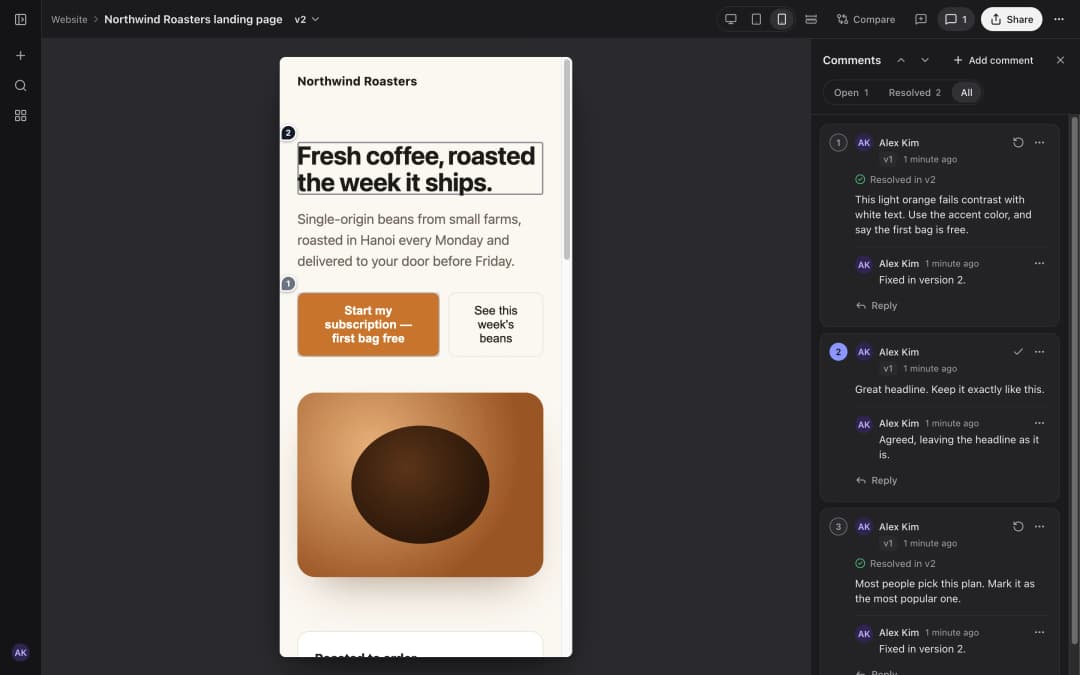 Review at phone width. Threads show the version they were resolved in. | 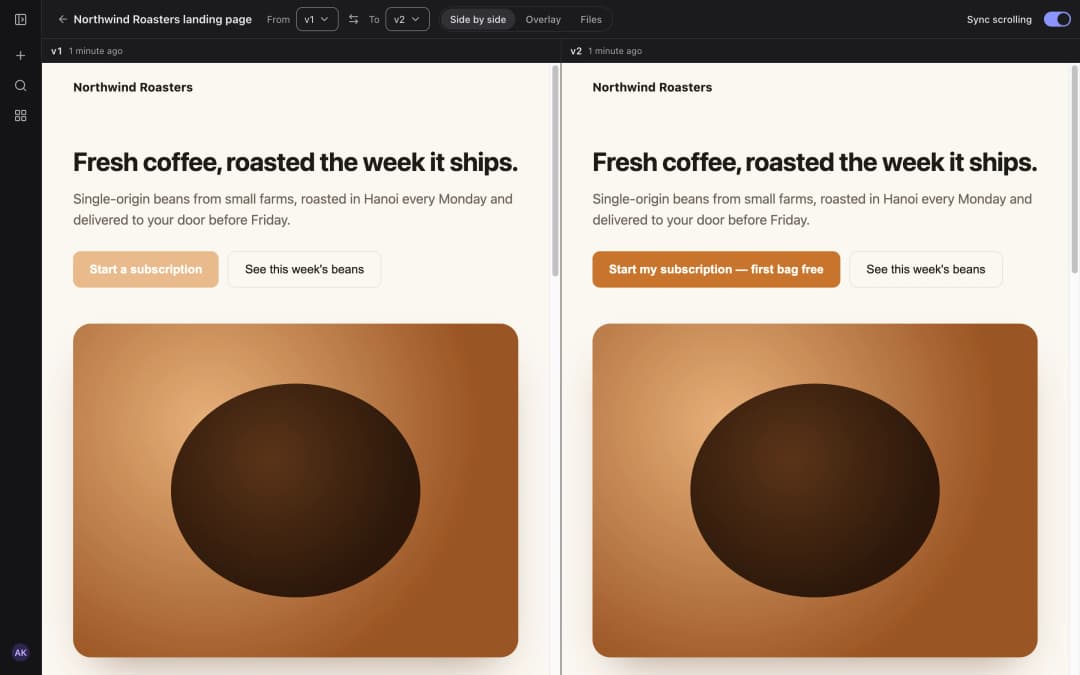 Compare versions side by side, as an overlay or file by file. |
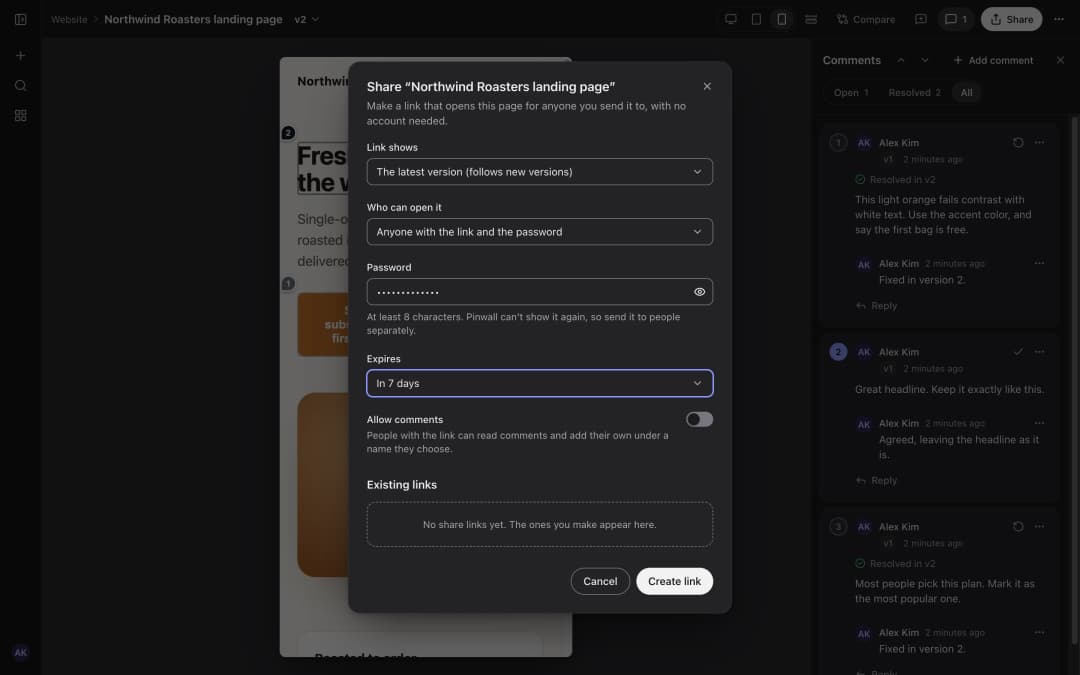 Share links with a password, an expiry and optional guest comments. | 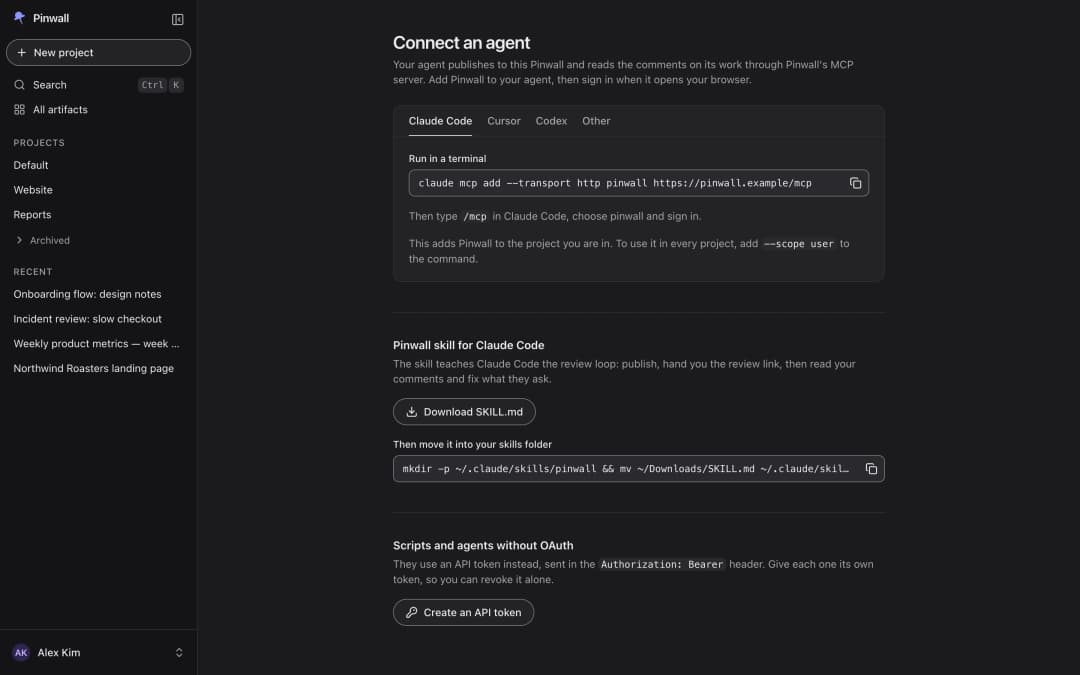 Connect an agent with one command, no token to paste. |
Try it on pinwall.ap.vn
pinwall.ap.vn is a public Pinwall that the maintainer runs on the latest release. Anyone with a Google account can sign up, and it is free.
Connect Claude Code:
claude mcp add --transport http --scope user pinwall https://pinwall.ap.vn/mcp
Then type /mcp, pick pinwall and sign in with Google. Your browser opens on Pinwall, you
approve the agent, and Claude Code keeps and renews its own access. Ask it to publish something, and
open the review link it gives you. Cursor, Codex and other clients use the same address, see
Connect an agent. The Claude Code skill
teaches your agent the publish, review and fix loop.
What to expect there:
- Your work is private. Only you see it, and the people you add to a project. Admins cannot open it. See Spaces, projects and members.
- Limits per person: currently 500 MB of storage, 200 artifacts, 50,000 files, and 50 MB for one upload. Settings → Usage shows where you stand.
- Sharing outside Pinwall needs approval. Reviewing, commenting and project members work right away. Share links and raw pages work once an admin has approved you: ask at the contact address in the privacy notice.
- Pages run apart from the app, each version on its own host under
*.artifacts.io.vn. - Best effort, from one person. There is no uptime guarantee, so keep a copy of anything that matters. Do not publish secrets or confidential material: as with any hosted service, the operator can technically reach the stored data. The privacy notice says what is kept and where.
- Leave at any time. Settings → Usage → Delete all my content removes everything you own.
For a team, your own data and your own sign-in, run Pinwall yourself.
Quick start
docker run -v pinwall:/data -p 8080:8080 ghcr.io/dungnguyenv/pinwall
Pinwall starts with SQLite and the uploaded files in the Docker volume pinwall, and prints a
one-time link that creates the owner account:
Pinwall setup: open http://localhost:8080/setup?token=… to create the owner account
Open it, choose a passkey or a password, and drag a file, a folder or an archive onto the page, or connect an agent.
Anywhere other than a trial on your own machine, set the address people use before you create the owner account, because links, cookies and passkeys are built from it:
docker run -v pinwall:/data -p 8080:8080 \
  -e PINWALL_PUBLIC_ORIGIN=https://pinwall.example \
  ghcr.io/dungnguyenv/pinwall
On Kubernetes:
helm install pinwall oci://ghcr.io/dungnguyenv/charts/pinwall --version 1.2.1 \
  --set publicOrigin=https://pinwall.example
The install guide covers running in the background, a read-only container, reverse proxies and Cloudflare Tunnel, and the chart.
Connect an agent
In Claude Code, with your own address in place of https://pinwall.example:
claude mcp add --transport http pinwall https://pinwall.example/mcp
Add --scope user after add to have Pinwall in every project. Then type /mcp, pick
pinwall and sign in. Your browser opens on Pinwall, you approve the
agent, and Claude Code keeps and renews its own access. Then ask it to publish something:
Build a pricing page for our coffee subscription and publish it to Pinwall.
Cursor, Codex and other MCP clients connect the same way, and clients without OAuth use an API token: see Connect an agent. The Connect an agent page inside Pinwall shows every snippet with your address filled in. Writing pages for Pinwall explains what a published page can and cannot do.
Deploy
| Where | How | Guide |
|---|---|---|
| One machine | docker run, SQLite and local disk | Install: Docker |
| Docker Compose | SQLite in a volume, or PostgreSQL with S3 storage | deploy/compose |
| Kubernetes | Helm chart from oci://ghcr.io/dungnguyenv/charts/pinwall | Chart reference |
| Behind a proxy or Cloudflare Tunnel | PINWALL_PUBLIC_ORIGIN and PINWALL_TRUST_PROXY | Install: proxies |
Content isolation
A page an agent writes is untrusted code, so Pinwall never runs it with the app's session. By
default (single-domain) pages are served under the app's own host inside a
Content-Security-Policy: sandbox, which needs nothing extra but is weaker than two separate sites.
With content-domain, every version gets a host of its own on a second domain that holds nothing
else, which is the strongest isolation and the one to choose for a team. See
Content isolation.
Documentation
| Guide | What it covers |
|---|---|
| Install and run | Docker, content isolation, reverse proxies and Cloudflare Tunnel, Kubernetes, metrics |
| Sign-in | The owner account, OpenID Connect, roles from groups or emails, Zitadel, Keycloak and Google, open sign-up |
| Spaces, projects and members | Your space, sharing a project, sharing outside Pinwall, storage limits, deleting your content |
| Running an open instance | Personal spaces, quotas, approval, abuse reports, the moderation log, moving work between people |
| Connect an agent | Claude Code, Cursor, Codex, other MCP clients, API tokens, the Claude Code skill |
| Writing pages for Pinwall | Entry pages, links, what a page can keep, Markdown, limits |
| Configuration | Every PINWALL_* setting with its default |
| Backup and restore | Backups, restores, moving from SQLite to PostgreSQL and S3 |
| Helm chart | Every chart value, secrets, upgrades |
| Security | The security model, verifying a release, reporting a vulnerability |
FAQ
Can I use Pinwall without hosting it?
Yes. pinwall.ap.vn is a free public instance: sign up with a Google
account and connect your agent to https://pinwall.ap.vn/mcp. It runs in personal mode with
quotas, so your work stays in a space of your own.
Which agents work with Pinwall? Any client that speaks the Model Context Protocol over Streamable HTTP. Claude Code, Cursor and Codex sign in with OAuth. Claude Desktop and other clients without a shell can publish text files inline, and scripts use the REST API with an API token.
Do I need a second domain? No. The default single-domain mode needs only the app's own address. A second domain with a wildcard certificate gives stronger isolation between the app and the pages, and is the better choice for a team.
Does Pinwall send data anywhere? No. There is no telemetry, and Pinwall only talks to the identity provider and the storage you configure.
Can people outside my team see a page? Only through a share link that you create, optionally with a password and an expiry. Everything else needs a signed-in account.
Can other people on my Pinwall see my work?
It depends on PINWALL_VISIBILITY. With team, the default, every member sees every project. With
personal, only you do, together with the people you add to a project and anyone you give a share
link to. See Spaces, projects and members.
Which mode fits a small team?
Usually team: everyone who signs in sees every project, so there is nobody to add. Keep sign-in
to your team with a member rule. Choose personal when strangers can sign in, or when people need
projects nobody else sees; owners then add people with Members.
Choosing a mode compares the two.
Can I let anyone with a Google account sign up?
Yes, in personal mode, where each person gets a space of their own and sees nothing of anyone
else's. Pair it with quotas, approval for sharing outside Pinwall and a separate content domain.
Running an open instance gives the settings and the order to switch them
in, and Spaces, projects and members tells the people who sign up what to expect.
Can an admin read my private pages?
No. In personal mode admins manage accounts, limits, approvals and reports, and they can delete
what an account owns, but the app does not let them open anyone's pages. The operator who runs the
server can read its database and storage, as with any self-hosted service. See
Who can see your work.
How do I work on a project with someone? Open the project, choose Members, and add them by the email they signed in to Pinwall with, as an editor, who can publish, or a viewer, who can read and comment. The project appears for them under Shared with me. See Project members.
Does upgrading from 1.0 change what people see?
No. PINWALL_VISIBILITY stays team, so every member sees every project and every member can
share, until the operator turns on personal mode. Quotas and approval for sharing are off by
default as well.
Can several Claude Code accounts or machines share one Pinwall?
Yes. That is a main reason it exists: every machine signed in to the same Pinwall account sees the
same artifacts, and in team mode every member does. In personal mode, accounts have spaces of
their own, so share a project between them with Members.
What does it run on? Node.js 24 with TypeScript, Hono and React, storing data in SQLite or PostgreSQL and files on local disk or S3-compatible storage. It runs as one instance per installation.
Contributing
Issues and pull requests are welcome. CONTRIBUTING.md explains how to set up the repository, run the checks and send a change. Please report vulnerabilities privately, as SECURITY.md describes.
License
Pinwall is licensed under the Apache License 2.0. The licenses of the third-party
packages that ship with it are in THIRD_PARTY_NOTICES, which is in the image at
/app/THIRD_PARTY_NOTICES and attached to every release.
// faq
What is pinwall?
Self-hosted artifact server for AI agents: Claude Code, Cursor and Codex publish HTML pages over MCP, you review them with pinned comments, versions and share links, and the agent reads your feedback and fixes them.. It is open-source on GitHub.
Is pinwall free to use?
pinwall is open-source under the Apache-2.0 license, so it is free to use.
What category does pinwall belong to?
pinwall is listed under mcp-servers in the Claudeers registry of Claude-compatible tools.
// embed badge

[](https://claudeers.com/pinwall)
// retro hit counter

[](https://claudeers.com/pinwall)
// reviews
// guestbook
// related in MCP Servers
 🔓
f.k.a. Awesome ChatGPT Prompts. Share, discover, and collect prompts from the community. Free and open source — self-host for your organization with complete…
 🔓
A cross-platform desktop All-in-One assistant for Claude Code, Codex, OpenCode, OpenClaw, Gemini CLI & Hermes Agent. Only official website: ccswitch.io
 🔓
🪨 why use many token when few token do trick — Claude Code skill that cuts 65% of tokens by talking like caveman
 🔓
An open-source AI agent that brings the power of Gemini directly into your terminal.