
orchvia
Run Claude Code and Codex agents as a team: long-lived sessions, a durable mailbox, human approval gates and per-task token accounting, scheduled by code rat…
Install with your AI
Paste into Claude Code, Cursor, or any agent — it reads the repo and wires the tool into your project.
Install and set up orchvia (git-clone project) into my current project.
Found on https://claudeers.com/orchvia
Repo: https://github.com/masonlee39/orchvia
Homepage/docs: —
Detected install method: git-clone → git clone https://github.com/masonlee39/orchvia
Category: mcp-servers. Platforms: cli.
Read the repo's README for exact setup and env vars, then install it and wire it into my project.

Claudeers Health Verdict:
active; community-verified: false. Confirm the source before running anything.
git clone https://github.com/masonlee39/orchvia
// compatibility
| Platforms | cli |
|---|---|
| Operating systems | — |
| AI compatibility | claude |
| License | MIT |
| Pricing | open-source |
| Language | TypeScript |
Orchvia
Orchvia runs Claude Code and Codex agents as a team from your own application: one local engine, with TypeScript and Python SDKs.
- Agents stay warm. Each agent is a long-lived session that keeps its history, so follow-up work reuses it instead of starting over, or forks it to try another direction.
- Nothing is lost or silently repeated. Tasks, messages, approvals and token usage are stored in SQLite before anything runs. After a crash, work whose outcome is unknown waits for you instead of being retried.
- You stay in charge. Your code and the limits you configure decide what runs next, not a manager model. A result counts as done only after a person or a check you registered accepts it.
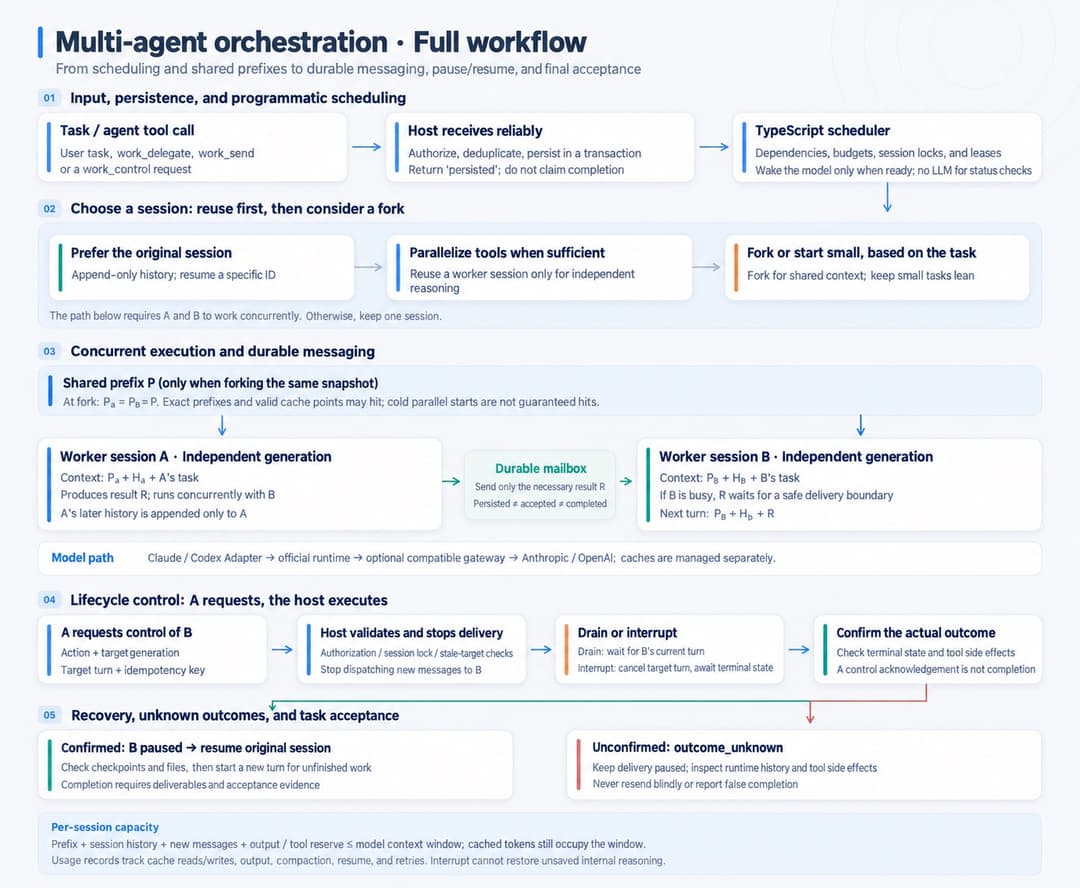
Quickstart
You need Node.js 22.18 or later, on macOS or Linux. Orchvia uses Node's built-in SQLite, which prints an experimental warning.
git clone https://github.com/masonlee39/orchvia.git
cd orchvia
npm ci --ignore-scripts
node examples/typescript/quickstart.ts
The example uses a fake runtime, so it needs no account and calls no model. It runs two tasks, accepts each result, and the second task reuses the first agent's session:
1. "Draft the release notes": completed, session <id>
2. "Tighten the draft you just wrote": completed, session <id>
The second task reused the first agent's session: true
With real Claude, the same two tasks run on one Claude Code session. You need Claude Code signed in (claude auth login); the example makes two small model calls:
node examples/typescript/quickstart-claude.ts
From Python, the same kind of task runs through a Node host that Python starts:
PYTHONPATH=python/src python3 examples/python/fake_roundtrip.py
To use Orchvia in your own project, install it from npm (Node.js 22.18 or later):
npm install @orchvia/sdk @orchvia/engine @orchvia/adapter-claude
Use @orchvia/adapter-codex for Codex and add @orchvia/cli for a separate host. The Python package orchvia is not on PyPI yet; until it is, build it from source. To let agents edit files, run Codex, or wire the engine into your application, follow the integration guide.
How it compares
Orchvia runs coding agents. It is not a framework for building agents out of model calls, and it can sit next to one.
| Orchvia | LLM agent frameworks1 | Claude Code subagents2 | Several sessions by hand | |
|---|---|---|---|---|
| An agent is | a Claude Code or Codex session that stays open across tasks | model calls and tools that your code defines | a helper with its own context window, inside one Claude Code session | a terminal window |
| The next step is chosen by | your code and the limits you configure | your graph or code, or a model: a manager LLM in CrewAI's hierarchical process, or handoffs that the model calls as tools in the OpenAI Agents SDK | the main Claude agent, when a task matches a subagent's description | you |
| Scope | many agents and tasks in one engine, with a durable mailbox between them | whatever your graph, crew or workflow defines | one session | sessions that do not know about each other |
What it does
- Sessions: open, reuse, fork, compact, pause, resume and stop agents; each keeps its native history.
- Scheduling: dependencies between tasks, queues for busy agents, limits on how many run at once, and no two writers on the same files.
- Messages and handoffs: a durable mailbox between agents; delegation and handoffs that your host approves.
- Acceptance: human review of each result, or verification commands you register.
- Accounting: token usage recorded per task, with cost estimates from prices you register.
- Recovery: after a crash, nothing is resent or marked done by guesswork; you settle unknown outcomes explicitly.
- Routing (optional): a judge you choose, a model or plain rules, proposes which agent takes a request; nothing is submitted without you.
Status
Orchvia is alpha software.
- Tested offline on macOS and Linux, with Node 22 and 24 and Python 3.11 and 3.14.
- The real Claude Code and Codex programs are tested in CI against a scripted local gateway, with no model calls.
- Not verified yet: runs with real models, operating-system sandbox enforcement, Windows, and speed or cost compared with other approaches. Measurements will be published with their raw data.
Status lists what each check covered, the specifications and their evidence.
Documentation
- Integration guide: wire the engine into your application, step by step.
- Reference: installation, the CLI, configuration and handling failures.
- Concepts: the terms these documents use, in plain words.
- Design: why the engine works the way it does.
- Status: what is verified, specifications and evidence.
- Python SDK and contributing.
License
MIT. Third-party SDKs and native runtimes keep their own licenses.
Footnotes
-
LangGraph, CrewAI processes, OpenAI Agents SDK handoffs and Microsoft Agent Framework, the successor to AutoGen. Checked on 2026-09-23. ↩
-
Claude Code subagents, checked on 2026-09-23. ↩
// faq
What is orchvia?
Run Claude Code and Codex agents as a team: long-lived sessions, a durable mailbox, human approval gates and per-task token accounting, scheduled by code rather than a manager LLM.. It is open-source on GitHub.
Is orchvia free to use?
orchvia is open-source under the MIT license, so it is free to use.
What category does orchvia belong to?
orchvia is listed under mcp-servers in the Claudeers registry of Claude-compatible tools.
// embed badge

[](https://claudeers.com/orchvia)
// retro hit counter

[](https://claudeers.com/orchvia)
// reviews
// guestbook
// related in MCP Servers
 🔓
🔓f.k.a. Awesome ChatGPT Prompts. Share, discover, and collect prompts from the community. Free and open source — self-host for your organization with complete…
 🔓
🔓A cross-platform desktop All-in-One assistant for Claude Code, Codex, OpenCode, OpenClaw, Gemini CLI & Hermes Agent. Only official website: ccswitch.io
 🔓
🔓🪨 why use many token when few token do trick — Claude Code skill that cuts 65% of tokens by talking like caveman
 🔓
🔓An open-source AI agent that brings the power of Gemini directly into your terminal.