
open-pencil
AI-native design editor. Open-source Figma alternative.
Install with your AI
Paste into Claude Code, Cursor, or any agent — it reads the repo and wires the tool into your project.
Install and set up open-pencil (git-clone project) into my current project.
Found on https://claudeers.com/open-pencil
Repo: https://github.com/open-pencil/open-pencil
Homepage/docs: https://openpencil.dev
Detected install method: git-clone → git clone https://github.com/open-pencil/open-pencil
Category: mcp-servers. Platforms: cli, api, desktop, web.
Read the repo's README for exact setup and env vars, then install it and wire it into my project.

Claudeers Health Verdict:
active; community-verified: false. Confirm the source before running anything.
git clone https://github.com/open-pencil/open-pencil
// compatibility
| Platforms | cli, api, desktop, web |
|---|---|
| Operating systems | — |
| AI compatibility | claude |
| License | MIT |
| Pricing | open-source |
| Language | TypeScript |
OpenPencil
Open-source design editor. Opens .fig and .pen design files, includes built-in AI, and ships as a programmable toolkit with a headless Vue SDK for building custom editors.
Status: Active development. Not ready for production use.
Note: There is another open-source project with the same name — OpenPencil by ZSeven-W, focused on AI-native design-to-code workflows. This project focuses on Figma-compatible visual design with real-time collaboration.
Try it online → · Download · Documentation · llms.txt
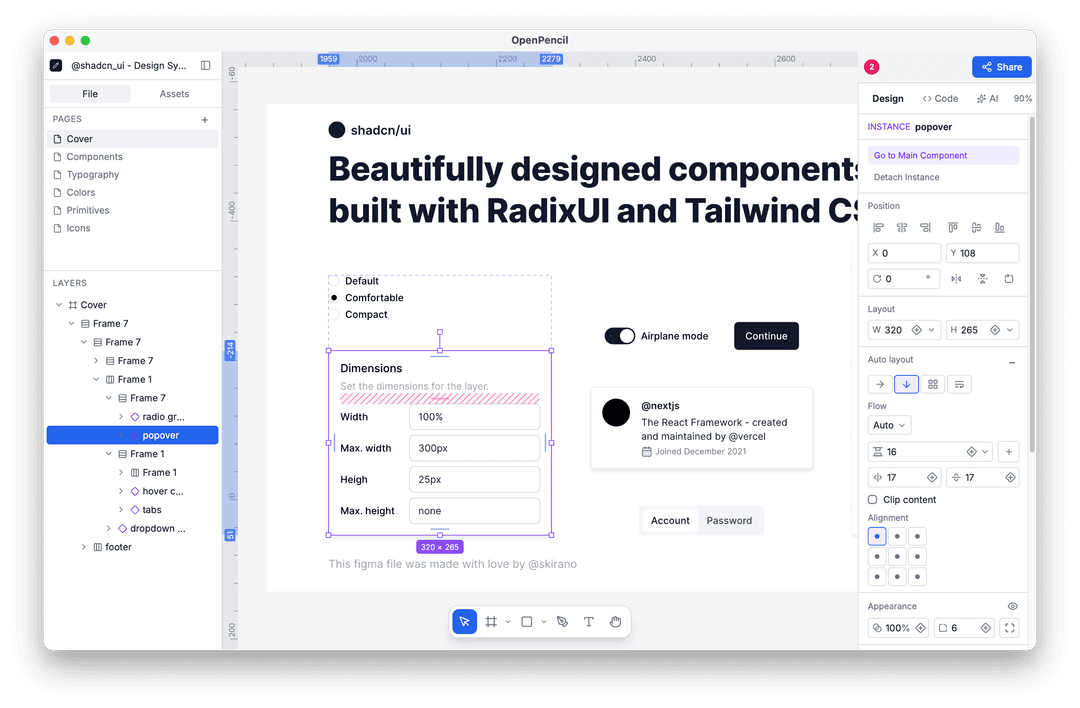
Installation
macOS (Homebrew):
brew install openpencil
Or download from the releases page, or use the web app — no install needed.
What it does
- Opens
.figand.penfiles — read and write native Figma files, open supported Pencil documents from the app or OS file browser, copy & paste nodes between apps - AI builds designs — describe what you want in chat, 90+ tools create and modify nodes. Connect OpenRouter, Anthropic, OpenAI, Google AI, Z.ai, MiniMax, or compatible endpoints
- Fully programmable — headless CLI, XPath queries, Figma Plugin API via
eval, MCP server for AI agents, and desktop agent integrations for Claude Code, Codex, and Gemini CLI - Lint, convert, and extract tokens — inspect documents, lint naming/layout/accessibility, convert between supported formats, analyze colors/typography/spacing/clusters, and extract design tokens
- Components and variants — create reusable components, group variants into component sets, insert local assets as instances, and switch variants from the inspector
- Design-to-code export — export selections as JSX/Tailwind, generate token outputs, and map designs into component-oriented code workflows
- Vue SDK for custom editors — headless components and composables for embedding OpenPencil into other apps or building workflow-specific editing surfaces. Read the SDK docs →
- Real-time collaboration — P2P via WebRTC, no server, no account. Cursors, presence, follow mode
- Auto layout & CSS Grid — flex and grid layout via Yoga WASM, with gap, padding, alignment, track sizing
- ~7 MB desktop app — Tauri v2 for macOS, Windows, Linux. Also runs in the browser as a PWA
CLI
npm install -g @open-pencil/cli
# or: bun add -g @open-pencil/cli
Inspect design files
Browse node trees, search by name or type, dig into properties — all without opening the editor:
openpencil tree design.fig
openpencil find design.pen --type TEXT
openpencil node design.fig --id 1:23
openpencil info design.fig
[0] [page] "Getting started" (0:46566)
  [0] [section] "" (0:46567)
    [0] [frame] "Body" (0:46568)
      [0] [frame] "Introduction" (0:46569)
        [0] [frame] "Introduction Card" (0:46570)
          [0] [frame] "Guidance" (0:46571)
Query with XPath
Use XPath selectors to find nodes by type, attributes, and structure:
openpencil query design.fig "//FRAME"                              # All frames
openpencil query design.fig "//FRAME[@width < 300]"                # Frames under 300px
openpencil query design.fig "//TEXT[contains(@name, 'Button')]"     # Text with 'Button' in name
openpencil query design.fig "//*[@cornerRadius > 0]"               # Rounded corners
openpencil query design.fig "//SECTION//TEXT"                       # Text inside sections
Export
Render to PNG, JPG, WEBP, SVG, .fig, or JSX — or export selections/pages as .fig and convert whole documents between supported formats:
openpencil export design.fig                           # PNG
openpencil export design.fig -f jpg -s 2 -q 90        # JPG at 2x, quality 90
openpencil export design.fig -f fig --page "Page 1"   # Export a page as .fig
openpencil export design.fig -f jsx --style tailwind   # Tailwind JSX
openpencil convert design.pen output.fig               # Convert between document formats
<div className="flex flex-col gap-4 p-6 bg-white rounded-xl">
  <p className="text-2xl font-bold text-[#1D1B20]">Card Title</p>
  <p className="text-sm text-[#49454F]">Description text</p>
</div>
Lint design files
Catch naming, layout, structure, and accessibility issues from the terminal:
openpencil lint design.fig
openpencil lint design.pen --preset strict
openpencil lint design.fig --rule color-contrast
openpencil lint design.fig --list-rules
Analyze and extract design tokens
Audit an entire design system from the terminal — find inconsistencies, extract the real palette, and spot components waiting to be extracted:
openpencil analyze colors design.fig
openpencil analyze typography design.fig
openpencil analyze spacing design.fig
openpencil analyze clusters design.fig
openpencil variables design.fig
#1d1b20  ██████████████████████████████ 17155×
#49454f  ██████████████████████████████ 9814×
#ffffff  ██████████████████████████████ 8620×
#6750a4  ██████████████████████████████ 3967×

3771× frame "container" (100% match)
     size: 40×40, structure: Frame > [Frame]

2982× instance "Checkboxes" (100% match)
     size: 48×48, structure: Instance > [Frame]
Script with Figma Plugin API
eval gives you the full Figma Plugin API. Modify the file, write it back:
openpencil eval design.fig -c "figma.currentPage.children.length"
openpencil eval design.fig -c "figma.currentPage.selection.forEach(n => n.opacity = 0.5)" -w
Control the running app
When the desktop app is running, omit the file argument — the CLI connects via RPC and operates on the live canvas. Useful for automation scripts, CI pipelines, or AI agents that need to interact with the editor:
openpencil tree                               # Inspect the live document
openpencil export -f png                      # Screenshot the current canvas
openpencil eval -c "figma.currentPage.name"   # Query the editor
All commands support --json for machine-readable output.
AI & MCP
Built-in chat
Press ⌘J to open the AI assistant. It has 100+ tools that can create shapes, set fills and strokes, manage auto-layout, work with components and variables, run boolean operations, analyze design tokens, and export assets. Bring your own API key for OpenRouter, Anthropic, OpenAI, Google AI, Z.ai, MiniMax, or compatible endpoints. No backend, no account.
Coding agents (desktop)
Use Claude Code, Codex, or Gemini CLI directly in the chat panel. The agent connects to the editor's MCP server and uses all 100+ design tools. Requires the desktop app and the agent CLI installed locally.
Setup (Claude Code):
- Install the ACP adapter:
npm install -g @agentclientprotocol/claude-agent-acp - Add MCP permission to
~/.claude/settings.json:{ "permissions": { "allow": ["mcp__open-pencil__*"] } } - Open the desktop app → CtrlJ → select Claude Code from the provider dropdown
MCP server
Connect Claude Code, Cursor, Windsurf, or any MCP client to inspect, modify, and export design documents headlessly. 100+ tools. Full docs →
Stdio (Claude Code, Cursor, Windsurf):
npm install -g @open-pencil/mcp
claude mcp add --scope user open-pencil -- openpencil-mcp
For other MCP clients:
{
  "mcpServers": {
    "open-pencil": {
      "command": "openpencil-mcp"
    }
  }
}
HTTP (scripts, CI):
openpencil-mcp-http # http://localhost:3100/mcp
File access: Set OPENPENCIL_MCP_ROOT to scope file operations (open_file, new_document, export path param) to a directory. Defaults to the current working directory.
AI agent skill
Teach your AI coding agent to use OpenPencil — inspect designs, export assets, analyze tokens, modify .fig files:
npx skills add open-pencil/skills@open-pencil
Works with Claude Code, Cursor, Windsurf, Codex, and any agent that supports skills.
For documentation-aware agents, the docs site publishes llms.txt, llms-full.txt, and per-page Markdown files generated from the VitePress docs.
Collaboration
Share a link to co-edit in real time. No server, no account — peers connect directly via WebRTC.
- Click the share button in the top-right panel
- Share the generated link (
app.openpencil.dev/share/<room-id>) - Collaborators see your cursor, selection, and edits in real time
- Click a peer's avatar to follow their viewport
Why
Figma is a closed platform that actively fights programmatic access. Their MCP server is read-only. figma-use added full read/write automation via CDP — then Figma 126 killed CDP. Your design files are in a proprietary binary format that only their software can fully read. Your workflows break when they decide to ship a point release.
OpenPencil is the alternative: open source (MIT), reads .fig files natively, every operation is scriptable, and your data never leaves your machine.
See the roadmap for product direction and current Figma compatibility gaps.
Contributing
Setup
bun install
bun run dev        # Dev server at localhost:1420
bun run tauri dev  # Desktop app (requires Rust)
Quality gates
| Command | Description |
|---|---|
bun run check | Lint + typecheck |
bun run test | E2E visual regression |
bun run test:unit | Unit tests |
bun run format | Code formatting |
Project structure
packages/
  core/           @open-pencil/core — engine (scene graph, renderer, layout, file formats, tools)
  vue/            @open-pencil/vue — headless Vue SDK
  cli/            @open-pencil/cli — headless CLI
  mcp/            @open-pencil/mcp — MCP server (stdio + HTTP)
  docs/           Documentation site (openpencil.dev)
src/              Vue app (components, composables, stores)
desktop/          Tauri v2 (Rust + config)
tests/            E2E (188 tests) + unit (764 tests)
Tech stack
| Layer | Tech |
|---|---|
| Rendering | Skia (CanvasKit WASM) |
| Layout | Yoga WASM (flex + grid via fork) |
| UI | Vue 3, Reka UI, Tailwind CSS 4 |
| File format | Kiwi binary + Zstd + ZIP |
| Collaboration | Trystero (WebRTC P2P) + Yjs (CRDT) |
| Desktop | Tauri v2 |
| AI/MCP | Multi-provider (Anthropic, OpenAI, Google AI, OpenRouter), MCP SDK, Hono |
Desktop builds
Requires Rust and platform-specific prerequisites (Tauri v2 guide).
bun run tauri build
Acknowledgments
Thanks to @sld0Ant (Anton Soldatov) for creating and maintaining the documentation site.
License
MIT
// faq
What is open-pencil?
AI-native design editor. Open-source Figma alternative.. It is open-source on GitHub.
Is open-pencil free to use?
open-pencil is open-source under the MIT license, so it is free to use.
What category does open-pencil belong to?
open-pencil is listed under devtools in the Claudeers registry of Claude-compatible tools.
// embed badge

[](https://claudeers.com/open-pencil)
// retro hit counter

[](https://claudeers.com/open-pencil)
// reviews
// guestbook
// related in MCP Servers
 🔓
🔓f.k.a. Awesome ChatGPT Prompts. Share, discover, and collect prompts from the community. Free and open source — self-host for your organization with complete…
 🔓
🔓A cross-platform desktop All-in-One assistant for Claude Code, Codex, OpenCode, OpenClaw, Gemini CLI & Hermes Agent. Only official website: ccswitch.io
 🔓
🔓🪨 why use many token when few token do trick — Claude Code skill that cuts 65% of tokens by talking like caveman
 🔓
🔓An open-source AI agent that brings the power of Gemini directly into your terminal.