
nanopi
Tiny Rust port of Pi — a ~4 MB statically-linked coding agent CLI for old/low-resource Linux boxes. OpenAI + Anthropic providers, streaming tool calls (read/…
Install with your AI
Paste into Claude Code, Cursor, or any agent — it reads the repo and wires the tool into your project.
Install and set up nanopi (release-binary project) into my current project.
Found on https://claudeers.com/nanopi
Repo: https://github.com/ChrisZhangJin/nanopi
Homepage/docs: —
Detected install method: release-binary → inspect the README
Category: skills. Platforms: cli, api.
Read the repo's README for exact setup and env vars, then install it and wire it into my project.

Claudeers Health Verdict:
active; community-verified: false. Confirm the source before running anything.
Grab the latest release asset from GitHub.
# download a build from https://github.com/ChrisZhangJin/nanopi/releases
git clone https://github.com/ChrisZhangJin/nanopi
// compatibility
| Platforms | cli, api |
|---|---|
| Operating systems | — |
| AI compatibility | claude |
| License | MIT |
| Pricing | open-source |
| Language | Rust |
nanopi
No Node. No Python. No node_modules.
A coding-agent CLI you can scp onto a box that has no runtime —
a single ~4 MB static Rust binary, ported from Pi.
Runs on Alpine, on CentOS 6, and anywhere npm install isn't an option.
English · 简体中文
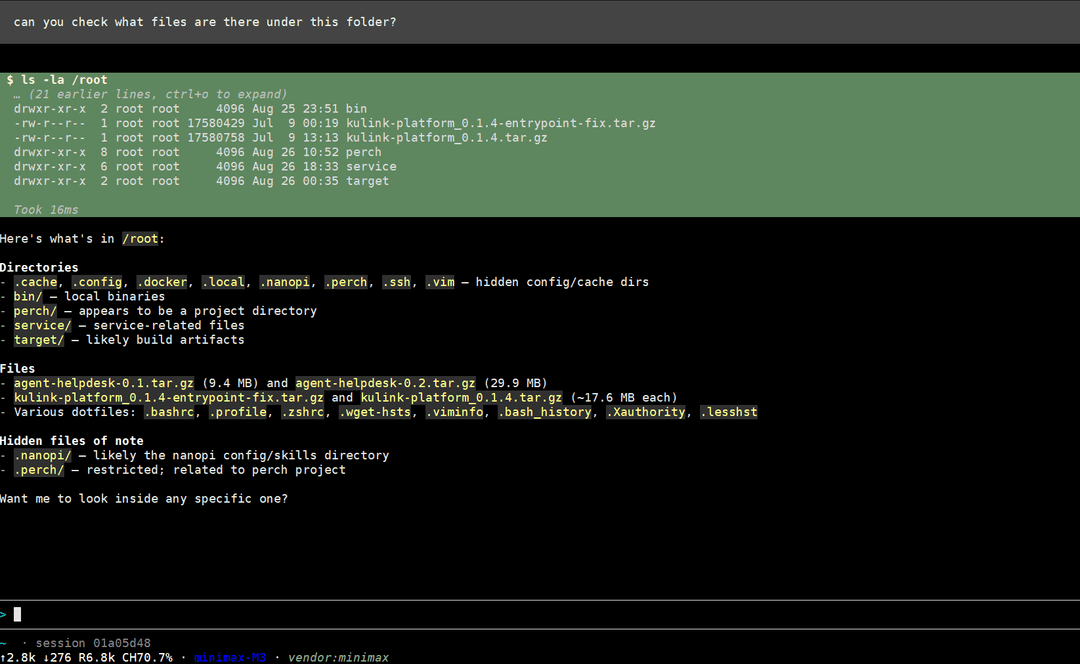
Why nanopi?
- 🚫 Zero runtime dependencies — no Node, no Python, no package manager.
Download one file,
chmod +x, run. - 🖥 Runs on ancient boxes — glibc 2.12+ (CentOS 6), or the fully static musl build on Alpine and anything else
- 🪶 ~4 MB static binary — musl + LTO + strip (the download is 1.6 MB, UPX-packed)
- 🧬 PI-parity — mirrors Pi's surface: JSONL sessions, hooks, skills,
-p,/fork,/resume - 🔌 Multi-provider — any OpenAI-compatible endpoint (DeepSeek, ollama, vLLM, …) plus native Anthropic
- 🛠 Streaming tool calls —
read/write/edit/bash, rendered live in a ratatui TUI - 🪝 Claude Code hooks —
PreToolUse/PostToolUse/UserPromptSubmitshell hooks - 🧠 Agent Skills — spec-compliant
SKILL.mddiscovery +/skill:nameexpansion
Background — why nanopi exists
Pi is a great coding agent, but its upstream chose not to support certain environments that real users need:
| Upstream issue | User request | Upstream status |
|---|---|---|
| pi#8591 | musl-linked builds for Alpine | not planned |
| pi#6546 | Avoid glibc version mismatch on older Linux | not planned |
| pi#6075 | Startup time is too slow | not planned |
Three separate people asked for musl builds, old-glibc compatibility and a lighter startup; upstream closed all three as not planned. That is a reasonable call for them — Pi targets modern machines — but it leaves the old-hardware case unserved. nanopi is a Rust rewrite for exactly that case:
- Static musl build — zero runtime deps, runs in Alpine containers
(see
release.ymlfor the CI matrix) - glibc 2.12+ (CentOS 6) — the dynamic build covers old servers; the musl build covers everything else
- ~4 MB — Rust + LTO +
opt-level = "z"+panic = abort+ strip; the published binary is UPX-packed down to 1.6 MB - Prebuilt for
linux-x86_64,linux-x86_64-musl,macos-aarch64andwindows-x86_64. Linux ARM is not prebuilt yet — build from source withcargo build --release --target aarch64-unknown-linux-musl.
Install
Prebuilt binaries
Grab a build from Releases:
# Adjust VERSION to the tag you want (e.g. v0.9.1)
VERSION=v0.9.1
curl -L -o nanopi \
  "https://github.com/ChrisZhangJin/nanopi/releases/download/${VERSION}/nanopi-${VERSION}-linux-x86_64-musl"
chmod +x nanopi
./nanopi --version
Per release, prebuilt binaries ship for:
nanopi-<ver>-linux-x86_64-musl— fully static Linux, works on anything (recommended)nanopi-<ver>-linux-x86_64— dynamic glibc Linux, slightly smallernanopi-<ver>-macos-aarch64— Apple Silicon (M1+)nanopi-<ver>-windows-x86_64.exe— Windows 10/11
macOS Intel isn't prebuilt (GitHub runner supply is scarce); build from source with cargo build --target x86_64-apple-darwin.
Build from source
# One-time host setup
curl --proto '=https' --tlsv1.2 -sSf https://sh.rustup.rs | sh -s -- -y --default-toolchain stable --profile minimal
source "$HOME/.cargo/env"
rustup target add x86_64-unknown-linux-musl
sudo apt install -y musl-tools build-essential   # Debian/Ubuntu

# Build
cargo build --release --target x86_64-unknown-linux-musl
./target/x86_64-unknown-linux-musl/release/nanopi --version
Quick start
export OPENAI_API_KEY=sk-...
export OPENAI_BASE_URL=https://api.deepseek.com/v1
export OPENAI_MODEL=deepseek-v4-flash

# Interactive TUI (default)
nanopi

# One-shot -p mode (Claude Code semantics)
nanopi -p "read /etc/hostname and tell me what you see"

# JSON output for scripting
nanopi -p --output json "say hi"

# Prompt piped on stdin
echo "explain this error" | nanopi -p

# Resume: last session / by id / fork
nanopi --continue
nanopi --session <id>
nanopi --fork <id>
CLI
| Flag | Default | Purpose |
|---|---|---|
--base-url | https://api.openai.com/v1 | OpenAI-compatible API root |
--model | (required) | Model id |
--api-key | $OPENAI_API_KEY | Bearer token |
-m, --message | (piped stdin) | User message; first positional arg also accepted. In -p mode, falls back to piped stdin |
-p, --print | false | Non-interactive mode |
--output | text | -p output: text | json |
--continue | false | Resume the most recent session |
--session <id> | — | Resume by session id |
--fork <id> | — | Fork an existing session |
--no-hooks | false | Disable all hooks |
-a, --approve | false | Trust project resources for this run |
-N, --distrust | false | Distrust project resources |
--skill <path> | — | Load a skill file/dir (repeatable) |
-S, --no-skills | false | Disable skill discovery |
-C, --no-context-files | false | Disable AGENTS.md / CLAUDE.md discovery |
--system-prompt <text|path> | — | Replace the built-in system prompt |
--append-system-prompt <text|path> | — | Append to the system prompt (repeatable) |
Skills
Nanopi implements the Agent Skills spec. Drop a SKILL.md into ~/.nanopi/skills/<name>/:
---
name: greet
description: Greet the user warmly. Use for hellos.
---
Say "hi, friend" — nothing else.
Invoke explicitly, or let the model discover it via the auto-appended <available_skills> block in the system prompt:
/skill:greet             # expands SKILL.md into the message
/skill:greet in french   # extra args are appended
Locations (earlier wins on name collisions):
- User:
~/.nanopi/skills/ - Project:
<cwd>/.nanopi/skills/(only when trusted via-aor persisted decision) - CLI:
--skill <path>(files or dirs; loads even with--no-skills)
Custom system prompt
--system-prompt <text|path> replaces the built-in identity/guidelines prompt; --append-system-prompt <text|path> (repeatable, values joined by a blank line) adds text after it. Both accept literal text OR a path to an existing file. Either flag suppresses the matching file discovery below entirely — no merge.
Without a flag, nanopi discovers:
<cwd>/.nanopi/SYSTEM.md(only when the project is trusted via-aor a persisted decision), then~/.nanopi/SYSTEM.md— for--system-prompt.<cwd>/.nanopi/APPEND_SYSTEM.md(same trust rule), then~/.nanopi/APPEND_SYSTEM.md— for--append-system-prompt.
Project beats global; the global file needs no trust gate (it's your own machine, not a cloned repo). Context files, skills, and the "Current working directory: …" line still apply on top of a custom prompt — only the identity/tools/guidelines section is replaced. Caveat: a replaced prompt drops the auto-generated "Available tools: …" line, and some models skip tool calls without it, so mention the tools you expect the model to use.
Hooks
Shell hooks fire around tool calls, matching Claude Code's PreToolUse / PostToolUse / UserPromptSubmit protocol. Configure in ~/.nanopi/settings.toml:
[[hooks.pre_tool_use]]
matcher = "^bash$"
command = "logger 'nanopi about to shell out'"
Keys are snake_case (pre_tool_use, not PreToolUse). Full protocol in docs/v0.5-research.md §6.
Versions
| Version | Status | Size | Notes |
|---|---|---|---|
| v0.10.0 | current | 1.6 MB | Custom system prompt (--system-prompt, SYSTEM.md); explicit api_kind beats the vendor sniff; readable tool failures in -p; UPX-packed release |
| v0.9.x | released | ~3.9 MB | First-run wizard, /settings + /keybindings, 8-vendor dispatch, retry envelope (0.9.2–0.9.3); v0.9.1 fixed the v0.9.0 tool loop |
| v0.9.0 | released | ~4.0 MB | Skills (PI-parity), --skill/--no-skills, folded TUI card, UserPromptSubmit hook |
| v0.8.x | released | ~3.9 MB | Full ratatui TUI, /fork, --continue/--session, hooks, JSONL sessions |
| v0.5.0 | released | ~3.0 MB | Tools (read/write/edit/bash), -p mode, JSON output, hooks |
| v0.1.0 | released | 2.4 MB | Single-file OpenAI streaming demo (kept as nanopi_v0_1 binary) |
Sizes are the published musl artifact. From v0.10.0 that artifact is
UPX-packed (make), so 1.6 MB is not comparable to the unpacked figures
above it — the same build is 4.4 MB before packing.
Roadmap
- v1.0 — full PI parity: themes, compaction, extension system
- Linux aarch64 not yet in the CI matrix (see
cargo build --release --target aarch64-unknown-linux-muslabove)
Cargo mirror (China)
Add to ~/.cargo/config.toml for faster crate downloads:
[source.crates-io]
replace-with = "rsproxy-sparse"

[source.rsproxy-sparse]
registry = "sparse+https://rsproxy.cn/index/"

[target.x86_64-unknown-linux-musl]
linker = "musl-gcc"
Design notes
- musl + LTO + panic=abort + strip → small static binary. rustls avoids the OpenSSL dep.
- Hand-written SSE parser — no
reqwest-eventsource, keeps the dep tree lean. - JSONL over JSON — append-only files survive crashes mid-write.
- Provider abstraction landed in v0.6; native Anthropic + any OpenAI-compatible endpoint.
See docs/v0.5-research.md and docs/PLAN.md for design + implementation notes.
Credits
- Pi — the upstream TypeScript agent nanopi ports.
- Claude Code — hook protocol,
-pmode, skills spec. - ratatui & crossterm — the TUI foundation.
License
MIT © Chris Zhang
// faq
What is nanopi?
Tiny Rust port of Pi — a ~4 MB statically-linked coding agent CLI for old/low-resource Linux boxes. OpenAI + Anthropic providers, streaming tool calls (read/write/edit/bash), JSONL sessions, ratatui TUI, Agent Skills, Claude Code-style hooks, -p print mode.. It is open-source on GitHub.
Is nanopi free to use?
nanopi is open-source under the MIT license, so it is free to use.
What category does nanopi belong to?
nanopi is listed under skills in the Claudeers registry of Claude-compatible tools.
// embed badge

[](https://claudeers.com/nanopi)
// retro hit counter

[](https://claudeers.com/nanopi)
// reviews
// guestbook
// related in Claude Skills
 🔓
🔓An agentic skills framework & software development methodology that works.
 🔓
🔓 🔓
🔓💫 Toolkit to help you get started with Spec-Driven Development
 🔓
🔓AI coding assistant skill (Claude Code, Codex, OpenCode, Cursor, Gemini CLI, and more). Turn any folder of code, SQL schemas, R scripts, shell scripts, docs,…