Paste into Claude Code, Cursor, or any agent — it reads the repo and wires the tool into your project.
Install and set up math-rsi (release-binary project) into my current project.
Found on https://claudeers.com/math-rsi
Repo: https://github.com/lisresearchgroup/math-rsi
Homepage/docs: https://lisresearchgroup.github.io/math-rsi/
Detected install method: release-binary → inspect the README
Category: mcp-servers. Platforms: api, web.
Read the repo's README for exact setup and env vars, then install it and wire it into my project.

Claudeers Health Verdict:
unknown; community-verified: false. Confirm the source before running anything.
// or install directly (release-binary)
Grab the latest release asset from GitHub.
# download a build from https://github.com/lisresearchgroup/math-rsi/releases
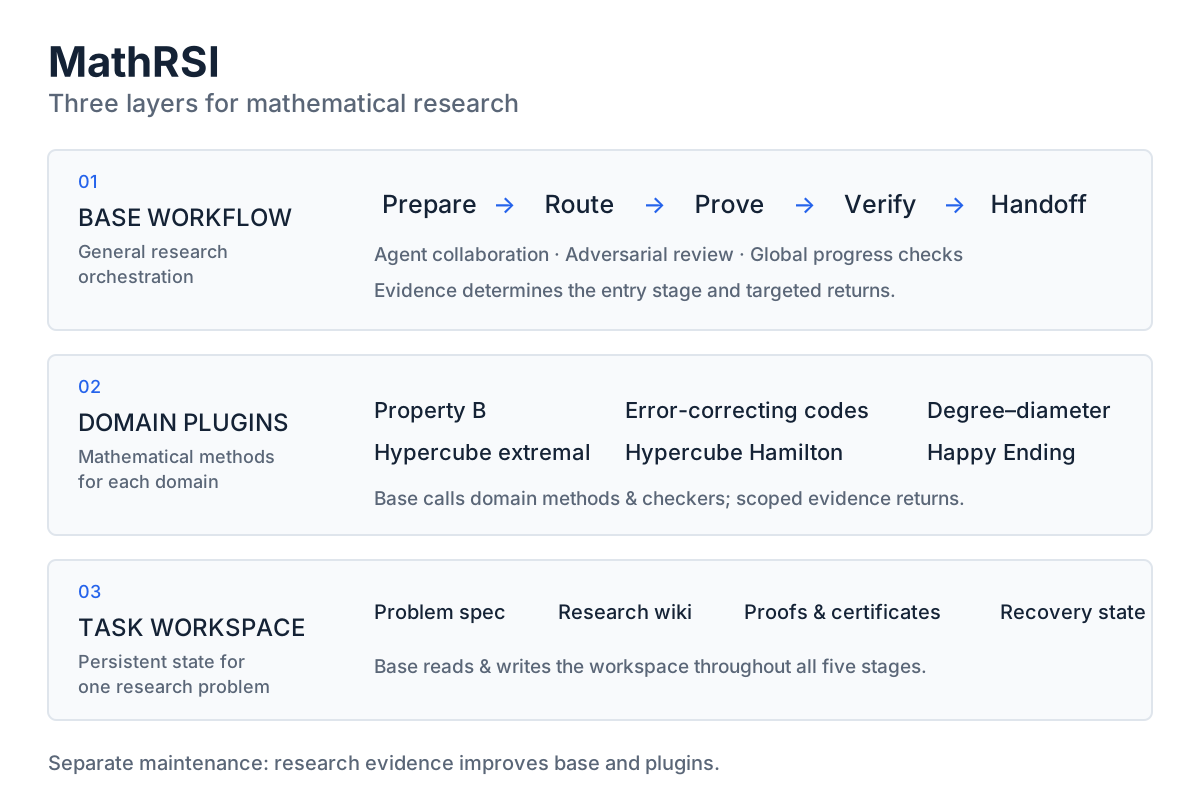
MathRSI pairs a shared base workflow with domain plugins and a per-problem research wiki, guiding Claude Code and Codex from literature survey and route selection through proof development, review, verification, and handoff. Validated results and diagnosed failures feed back to refine both the workflow and plugins.
1. 🚀 Quick Start
After completing setup, open this repository in Claude Code or Codex with access to your task directory. In Codex, replace /skill with $skill. Replace the example paths below with your own.
Start from a mathematical problem
/mathrsi-research Study edge-count lower bounds for k-uniform hypergraph two-coloring; work in ../my-problem/
Connects literature research, route exploration, proof work, verification and handoff, reusing the task wiki throughout. If you already have a problem statement, you can pass ../my-problem/problem.md instead.
Check a candidate proof or local lemma
/mathrsi-verify Check ../my-problem/proof.tex
Checks the proof or a specific obligation, repairs local omissions and identifies substantive mathematical gaps that need further proof work.
Resume an existing study (Codex example)
$mathrsi-research Continue the study in ../my-problem/
Reads the task's existing specification, wiki and resumption notes, then continues from the current evidence. In Claude Code, use /mathrsi-research.
Property B: bounds for $k=5,\ldots,12$ and exponentially growing additive gains for every $k\ge12$. Results & proof scope
Error-correcting codes: three gaps dating to 1985 closed; four exact values (one from literature) and one narrowed range. Results, methods & open case
Degree–diameter: our constructions reach 2,567 vertices at $(10,4)$, 37,632 at $(11,5)$, 42,433 at $(12,5)$ and 16,416 at $(16,4)$. Constructions, dated comparisons & scope
Erdős Problem 86: $Q_7$ at $304$ (304-edge construction verified; 304 upper bound as reported in the source package, not re-verified in this pass), $682\le\mathrm{ex}(Q_8,C_4)\le683$, and asymptotic density improved from $0.60318$ to $\le0.5912405943$ (T3) / $\le0.5912405942$ (T4). Results & verification scope
Ruskey–Savage: every $Q_6$ matching and every $Q_7$ matching with at least 56 edges (complete E16 across all $\mu\in{0,1,2,3,4}$) extends to a Hamilton cycle. Results, methods & open scope
Happy Ending & $N(m,r,s)$: replayed CNF+DRAT and native-trace integer duals give $N(8,6,6)\le 61$ and $N(9,8,8)\le 688, D_9\le 458$; combined with structural working proofs (independent review pending), they yield signotope $N(8,8,8)\le 318$ (planar $\mathrm{ES}(8)\le 319$ is Schroeder's bound) and working planar corollaries $\mathrm{ES}(7)\le 77$ and $\mathrm{ES}(9)\le 1148$ (vs. $1508$ / $1501^*$). Results & status
3. 🧩 Three Layers
Base (base/) supplies general research logic. Domain plugins (plugins/) supply specialized mathematics and checkers. Task workspaces hold each problem's specification, wiki, proofs, certificates and recovery state. Architecture & plugin contract · Editable source & GPT Image variant
4. 🔬 How Research Runs
The main mathrsi-research skill coordinates Prepare → Route → Prove → Verify → Handoff, entering from current evidence and reading each returned artifact. The task wiki is read, updated and reused throughout; scoped collaborators and cross-model reviewers support the work.
What you need
Start here
Formulate a new question and investigate the literature
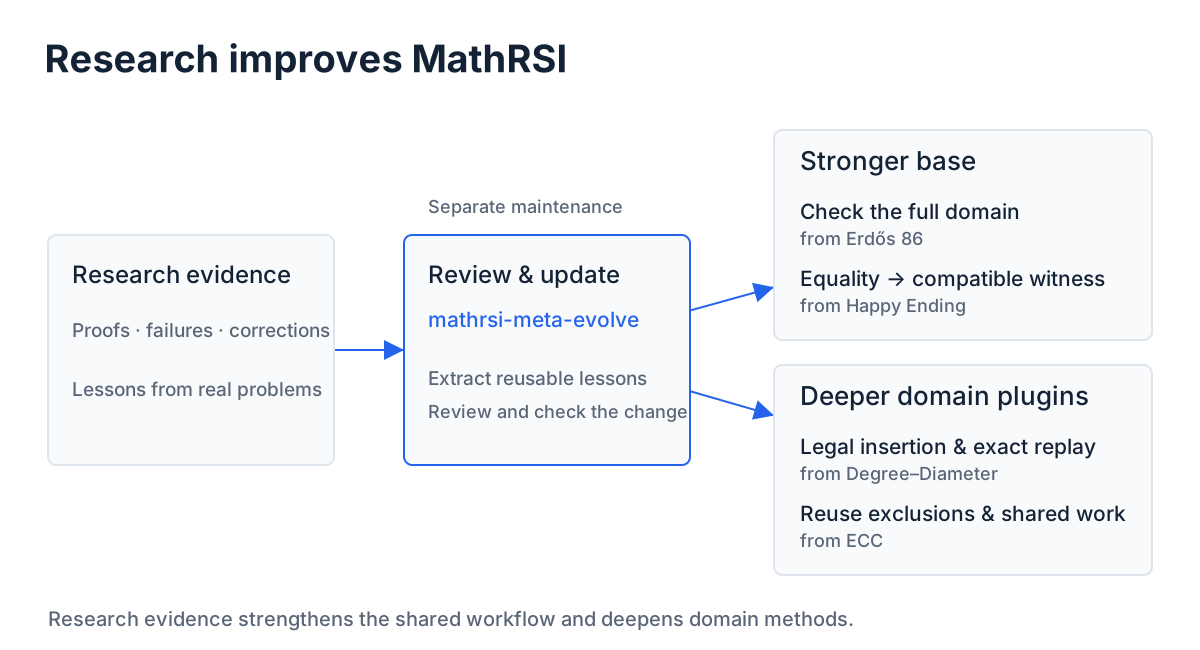
Two tracks evolve together: shared base behavior becomes stronger, while domain plugins expand and deepen. Separate mathrsi-meta-evolve maintenance turns research evidence into implemented changes.
v6 base: test candidate case splits on the hardest open branch before adopting them, and measure net-new coverage on the same input; run primal–dual coevolution that keeps the proof goal separate from the search target, rotates four normalized signed residual channels, and tests candidate cuts against the full graph archive; stop floating-point SDP/CP loops once gains fall to the rounding-repair residual.
Deeper domain plugins:hypercube-extremal adds asymptotic COP + $m=1024$ degree-potential bounds (T3 / T4), same-subgraph 3-measure pullbacks ($Q_8 \le 683$), $Q_7$ 304 constructions + source report, and the reusable cube_coevolve engine; hypercube-hamilton completes $Q_7$ E16 ($\ge 56$ edges across all $\mu=0..4$) with parameterized $Q_6$ $\Delta=2$ double bridges, $Q_6$ $A_8$, and $S_6$ large-face tables paired with symbolic small-face holes; happy-ending adds cross-platform checkers and curated archives for $m=7,8,9$ signotope capacities ($N(8,6,6)\le 61$ shared-label CEGAR, $N(9,8,8)\le 688$ & $D_9\le 458$ generative sparse integer duals, and relaxation-ceiling stopping; developed with Trellis + ARIS + v3, integrated in main maintenance; fixed v6 tag unchanged).
Inherited behavior: v5's controlled auxiliary choices, cross-representation theorem reuse and consuming returned results before dispatching new work, together with v4's equality-to-witness steps, global progress checks and ECC branch reuse.
v0: standalone Property B and ECC research tools prior to the shared harness (no Git tag).
v1: five solving stages, three-layer separation, adversarial route iteration and initial plugins.
v2: separate maintenance workflow, Degree–Diameter plugin, evidence transfer and shared coverage checks. Changes
v3: full-domain counterexample checks, marked-object transport, finite universal certificates and explicit Lean-premise checks; upgraded ECC and three new domains. Changes
v4: turning tight equalities into usable witnesses, plus Happy Ending and Degree–Diameter methods. Changes
v5: controlled auxiliary choices, theorem reuse across legal representations and finite-plan coverage; deeper Hamilton and DD D5 methods. Changes
v6: hardest-branch split probes, primal–dual coevolution and repair-residual stopping; deeper hypercube extremal and complete $Q_7$ E16 Hamilton methods. Changes
Built on ARIS and the research artifacts preserved in the plugins and cases. The bundled ARIS snapshot is c485faa59a68e51c6575dea67ca57abc7a6a2b9c. Provenance · Snapshot manifest · Bridge sources
Workflow and scripts are MIT licensed. Archived papers and third-party materials retain their original copyrights.
MathRSI - A self-improving agent harness for mathematical discovery and proof: shared 5-stage research loop, domain plugins, workspace memory & verifiable proofs(Lean 4, DRAT) for Claude Code and Codex.. It is open-source on GitHub.
Is math-rsi free to use?
math-rsi is open-source under the MIT license, so it is free to use.
What category does math-rsi belong to?
math-rsi is listed under mcp-servers in the Claudeers registry of Claude-compatible tools.
f.k.a. Awesome ChatGPT Prompts. Share, discover, and collect prompts from the community. Free and open source — self-host for your organization with complete…
// mcp-serversf/⟨HTML⟩★ 177,810◷ NOASSERTION[ claude ]
A cross-platform desktop All-in-One assistant for Claude Code, Codex, OpenCode, OpenClaw, Gemini CLI & Hermes Agent. Only official website: ccswitch.io
// mcp-serversfarion1231/⟨Rust⟩★ 155,814◷ MIT[ claude ]











 🔓
 🔓
 🔓
 🔓