
llmio
Unified LLM gateway with weighted load balancing, observability & cost tracking. 统一的 LLM 网关,提供权重负载均衡、可观测性与费用追踪。
Install with your AI
Paste into Claude Code, Cursor, or any agent — it reads the repo and wires the tool into your project.
Install and set up llmio (git-clone project) into my current project.
Found on https://claudeers.com/llmio
Repo: https://github.com/atopos31/llmio
Homepage/docs: —
Detected install method: git-clone → git clone https://github.com/atopos31/llmio
Category: devtools. Platforms: cli, api, web.
Read the repo's README for exact setup and env vars, then install it and wire it into my project.

Claudeers Health Verdict:
active; community-verified: false. Confirm the source before running anything.
git clone https://github.com/atopos31/llmio
// compatibility
| Platforms | cli, api, web |
|---|---|
| Operating systems | — |
| AI compatibility | claude |
| License | MIT |
| Pricing | open-source |
| Language | TypeScript |
LLMIO
English | 中文
LLMIO is a Go-based LLM load‑balancing gateway that provides a unified REST API, weighted scheduling, observability, and a modern admin UI for LLM clients (openclaw / claude code / codex / gemini cli / cherry studio / open webui). It helps you integrate OpenAI, Anthropic, Gemini, and other model capabilities in a single service.
QQ group: 1083599685
Architecture
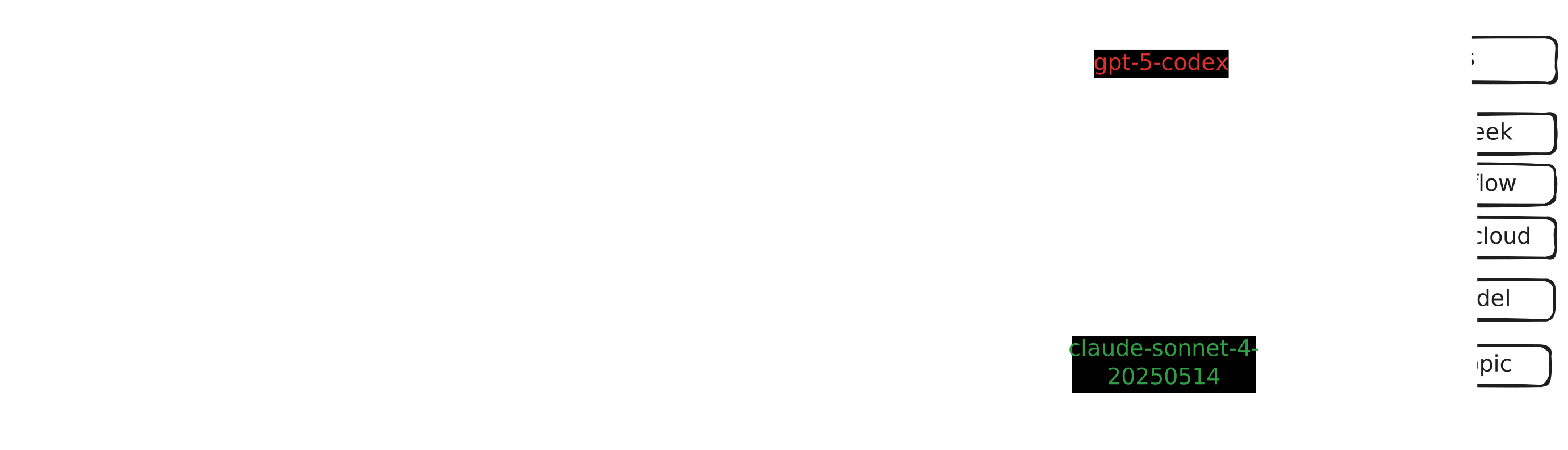
Features
- Unified API: Compatible with OpenAI Chat Completions, OpenAI Responses, Gemini Native, and Anthropic Messages. Supports both streaming and non‑streaming passthrough.
- Weighted scheduling:
balancers/provides two strategies (random by weight / priority by weight). You can route based on tool calling, structured output, and multimodal capability. - Admin Web UI: React + TypeScript + Tailwind + Vite console for providers, models, associations, logs, and metrics.
- Rate limiting & failure handling: Built‑in rate‑limit fallback and provider connectivity checks for fault isolation.
- Local persistence: Pure Go SQLite (
db/llmio.db) for config and request logs, ready to use out of the box. - Session tracking: Pass
session_idin any request body (works withextra_bodyin OpenAI SDK) to tag logs with a session identifier. Filter and search bysession_idin the admin UI or viaGET /api/logs?session_id=. - Observability: Every request is recorded with TraceID, latency breakdown (proxy / first-chunk / completion time), TPS, token usage (input / cached / output), and optional full IO logging. Per-request cost is calculated from configurable per-million-token prices (CNY / USD) and shown in the log detail view alongside provider and model metadata.
Deployment
Docker Compose (Recommended)
services:
  llmio:
    image: atopos31/llmio:latest
    ports:
      - 7070:7070
    volumes:
      - ./db:/app/db
    environment:
      - GIN_MODE=release
      - TOKEN=<YOUR_TOKEN>
      - TZ=Asia/Shanghai
docker compose up -d
Docker
docker run -d \
  --name llmio \
  -p 7070:7070 \
  -v $(pwd)/db:/app/db \
  -e GIN_MODE=release \
  -e TOKEN=<YOUR_TOKEN> \
  -e TZ=Asia/Shanghai \
  atopos31/llmio:latest
Local Run
Download the release package for your OS/arch from releases (version > 0.5.13). Example for linux amd64:
wget https://github.com/atopos31/llmio/releases/download/v0.5.13/llmio_0.5.13_linux_amd64.tar.gz
Extract:
tar -xzf ./llmio_0.5.13_linux_amd64.tar.gz
Start:
GIN_MODE=release TOKEN=<YOUR_TOKEN> ./llmio
The service will create ./db/llmio.db in the current directory as the SQLite persistence file.
Environment Variables
| Variable | Description | Default | Notes |
|---|---|---|---|
TOKEN | Console login and API auth for /openai /anthropic /gemini /v1 | None | Required for public access |
GIN_MODE | Gin runtime mode | debug | Use release in production |
LLMIO_SERVER_PORT | Server listen port | 7070 | Service listen port |
TZ | Timezone for logs and scheduling | Host default | Recommend explicit setting in containers (e.g. Asia/Shanghai) |
DB_VACUUM | Run SQLite VACUUM on startup | Disabled | Set to true to reclaim space |
Development
Clone:
git clone https://github.com/atopos31/llmio.git
cd llmio
Build frontend (pnpm required):
make webui
Run backend (Go >= 1.26.1):
TOKEN=<YOUR_TOKEN> make run
Web UI: http://localhost:7070/
API Endpoints
LLMIO provides a multi‑provider REST API with the following endpoints:
| Provider | Path | Method | Description | Auth |
|---|---|---|---|---|
| OpenAI | /openai/v1/models | GET | List available models | Bearer Token |
| OpenAI | /openai/v1/chat/completions | POST | Create chat completion | Bearer Token |
| OpenAI | /openai/v1/responses | POST | Create response | Bearer Token |
| Anthropic | /anthropic/v1/models | GET | List available models | x-api-key |
| Anthropic | /anthropic/v1/messages | POST | Create message | x-api-key |
| Anthropic | /anthropic/v1/messages/count_tokens | POST | Count tokens | x-api-key |
| Gemini | /gemini/v1beta/models | GET | List available models | x-goog-api-key |
| Gemini | /gemini/v1beta/models/{model}:generateContent | POST | Generate content | x-goog-api-key |
| Gemini | /gemini/v1beta/models/{model}:streamGenerateContent | POST | Stream content | x-goog-api-key |
| Generic | /v1/models | GET | List models (compat) | Bearer Token |
| Generic | /v1/chat/completions | POST | Create chat completion (compat) | Bearer Token |
| Generic | /v1/responses | POST | Create response (compat) | Bearer Token |
| Generic | /v1/messages | POST | Create message (compat) | x-api-key |
| Generic | /v1/messages/count_tokens | POST | Count tokens (compat) | x-api-key |
Authentication
LLMIO uses different auth headers depending on the endpoint:
1. OpenAI‑style endpoints (Bearer Token)
Applies to /openai/v1/* and OpenAI‑compatible endpoints under /v1/*.
curl -H "Authorization: Bearer YOUR_TOKEN" http://localhost:7070/openai/v1/models
2. Anthropic‑style endpoints (x-api-key)
Applies to /anthropic/v1/* and Anthropic‑compatible endpoints under /v1/*.
curl -H "x-api-key: YOUR_TOKEN" http://localhost:7070/anthropic/v1/messages
3. Gemini Native endpoints (x-goog-api-key)
Applies to /gemini/v1beta/* endpoints.
curl -H "x-goog-api-key: YOUR_TOKEN" http://localhost:7070/gemini/v1beta/models
For claude code or codex, use these environment variables:
export OPENAI_API_KEY=<YOUR_TOKEN>
export ANTHROPIC_API_KEY=<YOUR_TOKEN>
export GEMINI_API_KEY=<YOUR_TOKEN>
Note:
/v1/*paths are kept for compatibility. Prefer the provider‑specific routes.
Project Structure
.
├─ main.go              # HTTP server entry and routes
├─ handler/             # REST handlers
├─ service/             # Business logic and load‑balancing
├─ middleware/          # Auth, rate limit, streaming middleware
├─ providers/           # Provider adapters
├─ balancers/           # Weight and scheduling strategies
├─ models/              # GORM models and DB init
├─ common/              # Shared helpers
├─ webui/               # React + TypeScript admin UI
└─ docs/                # Ops & usage docs
Screenshots
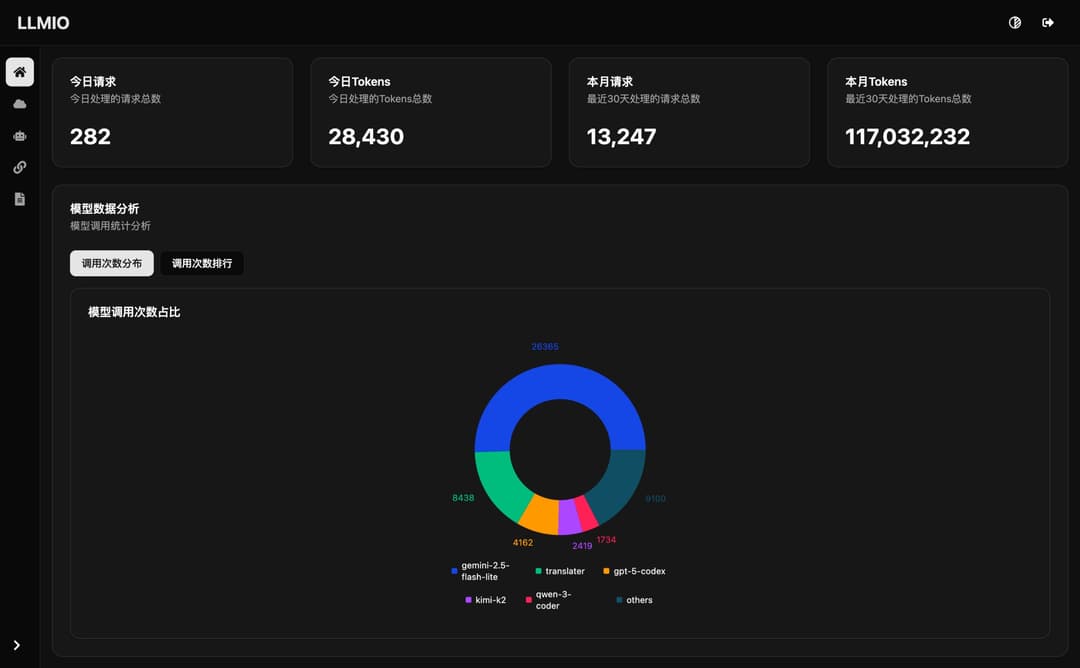 Dashboard — Overview of request volume, token usage and provider metrics | 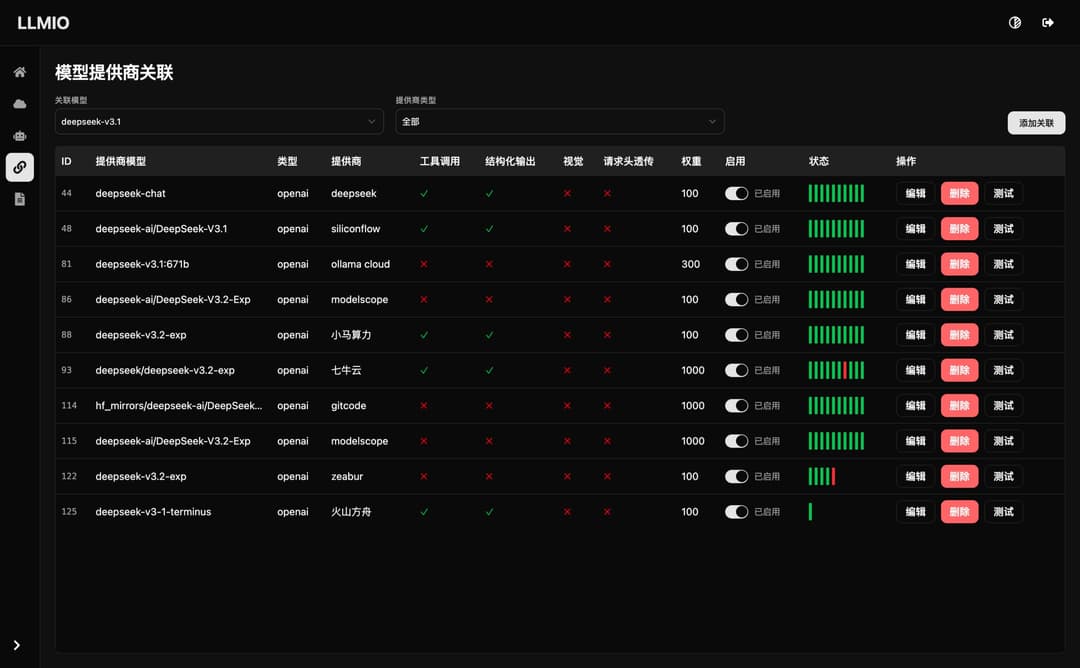 Model Associations — Configure multiple providers per model with weight, capability filters and per-token pricing |
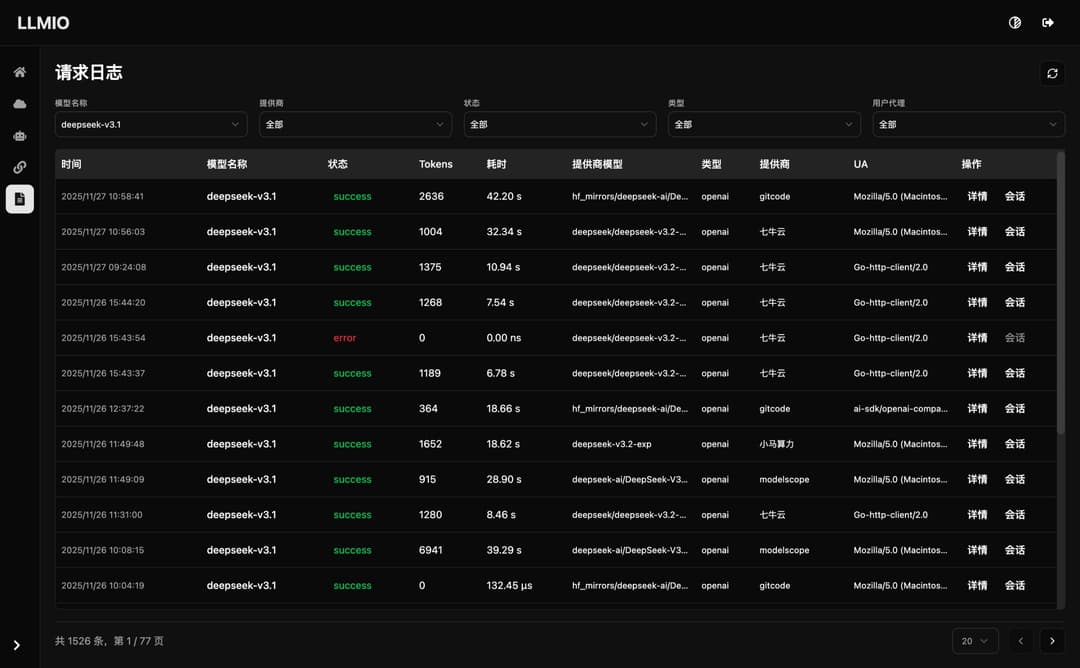 Request Logs — Multi-dimensional search and filtering by model, status, TraceID, Session ID and more | 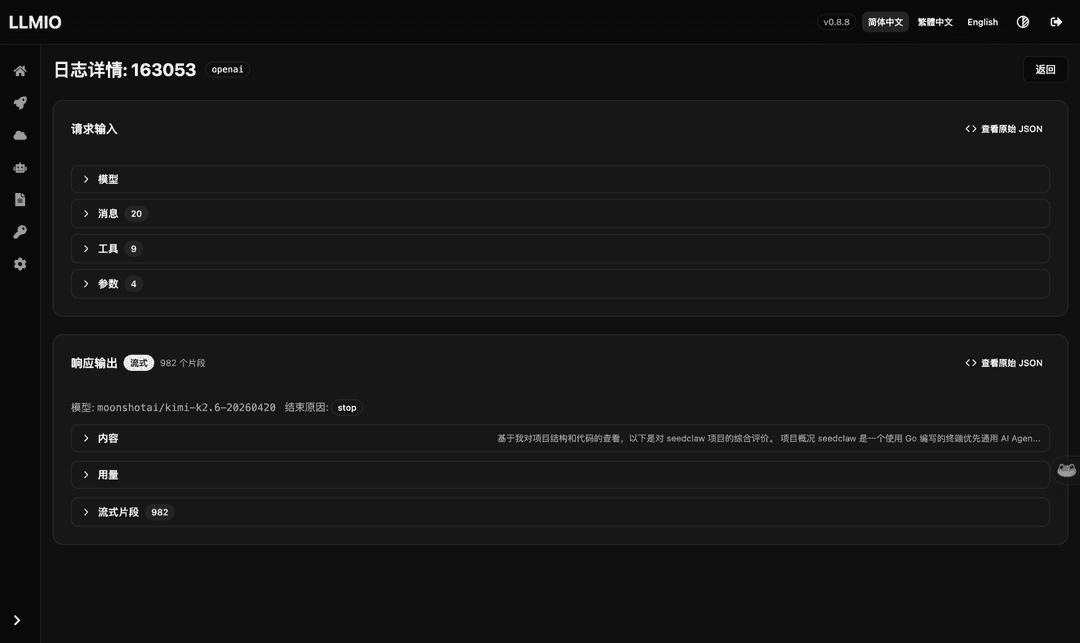 Session IO — Inspect full request / response, latency breakdown and per-token billing detail for any log entry |
License
This project is released under the MIT License.
Star History
// faq
What is llmio?
Unified LLM gateway with weighted load balancing, observability & cost tracking. 统一的 LLM 网关,提供权重负载均衡、可观测性与费用追踪。. It is open-source on GitHub.
Is llmio free to use?
llmio is open-source under the MIT license, so it is free to use.
What category does llmio belong to?
llmio is listed under devtools in the Claudeers registry of Claude-compatible tools.
// embed badge

[](https://claudeers.com/llmio)
// retro hit counter

[](https://claudeers.com/llmio)
// reviews
// guestbook
// related in Developer Tools
 🔓
🔓The agent harness performance optimization system. Skills, instincts, memory, security, and research-first development for Claude Code, Codex, Opencode, Curs…
 🔓
🔓Makes your AI agent think like the laziest senior dev in the room. The best code is the code you never wrote.
 🔓
🔓Use Garry Tan's exact Claude Code setup: 23 opinionated tools that serve as CEO, Designer, Eng Manager, Release Manager, Doc Engineer, and QA
 🔓
🔓AI coding assistant skill (Claude Code, Codex, OpenCode, Cursor, Gemini CLI, and more). Turn any folder of code, SQL schemas, R scripts, shell scripts, docs,…