
life-support
agentrouter.org / New API gateways don't forward event: ping, so Claude Code kills the stream after ~18s of silence and retries forever. This local proxy inj…
Install with your AI
This project is repository unavailable — not recommended for automated install, so we don't generate an auto-install prompt for it. Read the repo and decide for yourself.
// compatibility
| Platforms | cli, api, desktop, web |
|---|---|
| Operating systems | — |
| AI compatibility | claude |
| License | — |
| Pricing | open-source |
| Language | JavaScript |
English | Русский

This project is free and lives on XGATE subscriptions: own nodes, IP with no abuse history — gateways, APIs and sign-ups go through.
🤖 Telegram bot @xgateonline_bot · 🔑 Dashboard cabinet.xgate.online · promo code ABUSEHUB — 3 days free, then from 150 ₽/mo
life-support
Your gateway stops breathing. This breathes for it.
A local HTTP proxy between Claude Code and Anthropic-compatible gateways
(e.g. agentrouter.org / New API) that do not forward event: ping during
long thinking pauses. Claude Code's stream-idle watchdog (~18s without a single
byte — measured) then kills the stream and retries in an endless loop
("Waiting for API response · will retry in ...").
The proxy fixes this four ways:
- Ping injection — when the gateway is silent for longer than
IDLE_MS, the proxy sends the client a realevent: ping, the same event the upstream API emits during long pauses, so the client is built to accept it as a sign of life. A complete event may only be written at an event boundary: if the gateway stalled halfway through one, the proxy writes an SSE comment (: keepalive) instead — the only line that is legal inside an unfinished event, at the price of being a line the client is free to ignore. - Auto-retry — transient gateway errors (401/403/429/5xx, e.g.
"unauthorized client detected") are silently retried by the proxy with a
linear backoff (
RETRY_DELAY_MS, then twice that, and so on), so Claude Code never sees the error at all. When the gateway sendsretry-after, that wins over our own schedule (capped at 30s, so a gateway can't park a request). - Pre-commit — ping injection only works once the gateway has sent
response headers. If it hasn't within
PRE_COMMIT_MS, the proxy sends the SSE headers itself and starts injecting pings; retries continue behind them. Streaming requests go upstream withaccept-encoding: identity, because the proxy's own headers declare no compression and a gzipped upstream body would reach the client as garbage. - Hedging — after
HEDGE_MSof silence the proxy fires a duplicate request in parallel and forwards whichever attempt answers first, aborting the rest. The winner's real status and headers are passed through, so nothing is faked.
Request headers are relayed verbatim (gateways fingerprint the client via
user-agent, x-app, x-stainless-*, anthropic-version, anthropic-beta,
authorization); only Host is rewritten to the upstream host, plus
accept-encoding on streaming requests as described above.
The token is never logged.
A note on hedging
Duplicates are billed and they add load. On a gateway that is short of upstream
channels they make things worse, which is easy to measure: with
HEDGE_MS=5000 and MAX_ATTEMPTS=5 against agentrouter the duplicate rate hit
2.4 per request and response times grew from 8s to 15–30s. Backing off to
20s / 2 attempts brought them back to 6–9s. The defaults are deliberately
conservative — hedging here is a hang guard, not an accelerator.
Quick start
No npm dependencies, pure Node.js (built-in http/https/stream):
node proxy.js
node proxy.js selftest    # run the built-in checks and exit
node test-hedge.js        # hedging/pre-commit against a fake stalling gateway
On Windows you can also double-click proxy.bat (logs go to proxy.log).
Console panel
panel.bat opens a TUI against the running proxy: live counters, the remap
target and the hedge knobs, all without a restart. It reads GET /__state,
writes POST /__config, and starts the proxy itself (hidden) if the port is dead.
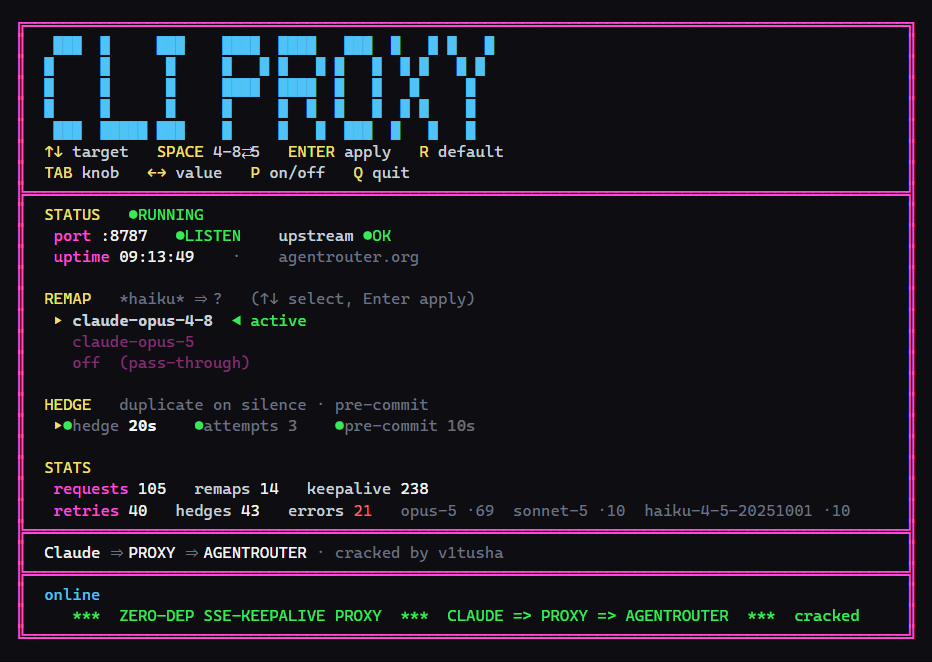
| Key | Action |
|---|---|
↑ ↓ ENTER | pick and apply the remap target |
SPACE | toggle claude-opus-4-8 ⇄ claude-opus-5 |
TAB ← → | pick a hedge knob and change it (applied immediately) |
R | back to the default target |
P | start / stop the proxy |
Q | quit — the proxy keeps running |
The knobs step through preset values rather than free arithmetic, so a slip
can't set hedgeMs to something that floods the gateway.
PowerShell 5.1 needs panel.ps1 stored as UTF-8 with BOM, otherwise the box
drawing and the arrows turn into mojibake. panel.ps1 -SelfTest checks the knob
steps and the frame invariant (every row is exactly the frame width, so a long
line can never wrap and make the frame scroll); -Once renders a single frame
and exits. PANEL_COLS / PANEL_ROWS render at a size other than your window's.
Model remap
Claude Code calls claude-haiku-4-5-* for background tasks. If your token has
no access to that model, the gateway answers 403 该令牌无权访问模型 and the
session stalls. The proxy rewrites any model name containing HAIKU_MATCH to
HAIKU_MODEL and fixes content-length. HAIKU_MODEL=off disables it.
The retry classifier also knows the permanent New API errors in Chinese (无权 / 过期 / 余额 / 额度 / 不存在 / 封禁 …) and does not waste attempts on them.
Point Claude Code at it
Edit ~/.claude/settings.json (Windows: C:\Users\<you>\.claude\settings.json):
{
  "env": {
    "ANTHROPIC_BASE_URL": "http://127.0.0.1:8787",
    "ANTHROPIC_AUTH_TOKEN": "sk-...",
    "ANTHROPIC_MODEL": "claude-opus-4-8"
  }
}
Change only ANTHROPIC_BASE_URL to http://127.0.0.1:8787;
keep ANTHROPIC_AUTH_TOKEN and ANTHROPIC_MODEL as they were.
Fully restart Claude Code.
The desktop Claude Code app reads the same settings.json, so the fix applies
there too. The Claude Desktop chat app uses its own gateway setting in the UI —
point it at http://127.0.0.1:8787 if you want to route it through the proxy.
Note that restarting the proxy kills the client's pooled keep-alive sockets, so
the first request in every open window fails once with ECONNRESET
("check your network"). Press Esc and send again. That is why the settings that
matter are runtime-patchable — see below.
Runtime config
| Endpoint | |
|---|---|
GET /__state | config, upstream and counters as JSON |
POST /__config | patch remapModel, remapMatch, hedgeMs, maxAttempts, preCommitMs |
Patched values are clamped to sane ranges and persisted to config.json, which
takes precedence over the environment on the next start.
Both endpoints refuse any request that carries an Origin header. They mutate
live config, and /__config parses a body of any content-type, which makes it a
CORS "simple request" — without that check, any page open in your browser could
POST to 127.0.0.1:8787 and flip your remap or set hedgeMs to a flood. The
panel and curl send no Origin, so they are unaffected.
curl -X POST http://127.0.0.1:8787/__config \
  -H 'content-type: application/json' -d '{"hedgeMs":20000,"maxAttempts":2}'
Environment configuration
| Variable | Default | Description |
|---|---|---|
PORT | 8787 | Proxy listen port |
UPSTREAM | https://agentrouter.org | Gateway URL |
IDLE_MS | 5000 | Gateway silence threshold before a ping is injected |
UPSTREAM_TIMEOUT_MS | 90000 | How long to wait for response headers before aborting an attempt (0 = forever) |
PRE_COMMIT_MS | 10000 | Silence before the proxy sends the SSE headers itself (0 disables) |
HEDGE_MS | 20000 | Silence before a parallel duplicate is fired (0 disables) |
MAX_ATTEMPTS | 2 | Total attempts per request — hedges and retries share this budget |
RETRY_DELAY_MS | 1500 | Base delay before a retry after a transient error; grows per attempt, and retry-after from the gateway overrides it |
HAIKU_MODEL | claude-opus-4-8 | Target of the model remap (off disables) |
HAIKU_MATCH | haiku | Substring in the model name that triggers the remap |
CONFIG_FILE | config.json | Runtime config file written by the panel |
LOG_FILE | (empty) | Path to a log file (stderr is also mirrored there) |
Example:
PORT=9000 UPSTREAM=https://other-gateway.example IDLE_MS=3000 node proxy.js
Reading the log
>> POST /v1/messages start                             request received
model remap claude-haiku-4-5-x -> claude-opus-5        remap applied
attempt #1 bounced 500: ...无可用渠道...               transient error, attempt dropped
hedge: 20016ms of silence, firing duplicate #2         silence, duplicate fired
duplicates aborted: 1                                  winner found, losers aborted
POST /v1/messages -> 200 (SSE) 21967ms                 upstream responded
pre-commit SSE (gateway silent for 10016ms)            headers sent by the proxy
POST /v1/messages ping #2                              event: ping injected
keepalive mid-event #3                                 comment: gateway stalled mid-event
stream closed normally: 12446b +2 keepalive in 13840ms   stream finished
CLIENT CLOSED the connection at 0b after 17833ms       client gave up before the first byte
GATEWAY TRUNCATED the stream at 4096b after 45000ms    upstream truncated the stream
all 2 attempts missed: ...                             every attempt failed, 502 to the client
client error: ECONNRESET                               connection-level failure
count_tokens -> 404 is normal — many gateways don't implement that endpoint.
The last three lines are the ones worth watching: they are the only cases where the client actually sees a failure.
License
MIT
// faq
What is life-support?
agentrouter.org / New API gateways don't forward event: ping, so Claude Code kills the stream after ~18s of silence and retries forever. This local proxy injects the pings, retries transient errors, pre-commits SSE headers and hedges stalled requests — plus a terminal panel. One file, zero deps.. It is open-source on GitHub.
Is life-support free to use?
life-support is open-source, so it is free to use.
What category does life-support belong to?
life-support is listed under devtools in the Claudeers registry of Claude-compatible tools.
// embed badge

[](https://claudeers.com/life-support)
// retro hit counter

[](https://claudeers.com/life-support)
// reviews
// guestbook
// related in Developer Tools
 🔓
🔓The agent harness performance optimization system. Skills, instincts, memory, security, and research-first development for Claude Code, Codex, Opencode, Curs…
 🔓
🔓Makes your AI agent think like the laziest senior dev in the room. The best code is the code you never wrote.
 🔓
🔓Use Garry Tan's exact Claude Code setup: 23 opinionated tools that serve as CEO, Designer, Eng Manager, Release Manager, Doc Engineer, and QA
 🔓
🔓AI coding assistant skill (Claude Code, Codex, OpenCode, Cursor, Gemini CLI, and more). Turn any folder of code, SQL schemas, R scripts, shell scripts, docs,…