
jusTokenMax
Token-reduction toolkit for Claude Code, OpenCode & other coding harnesses.
Install with your AI
Paste into Claude Code, Cursor, or any agent — it reads the repo and wires the tool into your project.
Install and set up jusTokenMax (claude-plugin project) into my current project.
Found on https://claudeers.com/justokenmax
Repo: https://github.com/Kalmantic/jusTokenMax
Homepage/docs: —
Detected install method: claude-plugin → /plugin install justokenmax@Kalmantic/jusTokenMax
Category: mcp-servers. Platforms: cli, api, web.
Read the repo's README for exact setup and env vars, then install it and wire it into my project.

Claudeers Health Verdict:
slowing; community-verified: false. Confirm the source before running anything.
/plugin marketplace add Kalmantic/jusTokenMax
/plugin install justokenmax@Kalmantic/jusTokenMax
git clone https://github.com/Kalmantic/jusTokenMax
// compatibility
| Platforms | cli, api, web |
|---|---|
| Operating systems | — |
| AI compatibility | claude |
| License | NOASSERTION |
| Pricing | open-source |
| Language | Python |
jusTokenMax
Keep your coding agent under a token (and cost) budget. jusTokenMax shrinks every expensive thing before it reaches the model's context — attachments, logs, JSON, notebooks, CSVs, diffs, and the files you read — so the same work costs a fraction of the tokens.
Built by Kashi (linkedin) and Rajan (linkedin), founders of Kalmantic — jusCode.co. MIT licensed. Contributors: Arbaz (linkedin), CTO of LineupX.
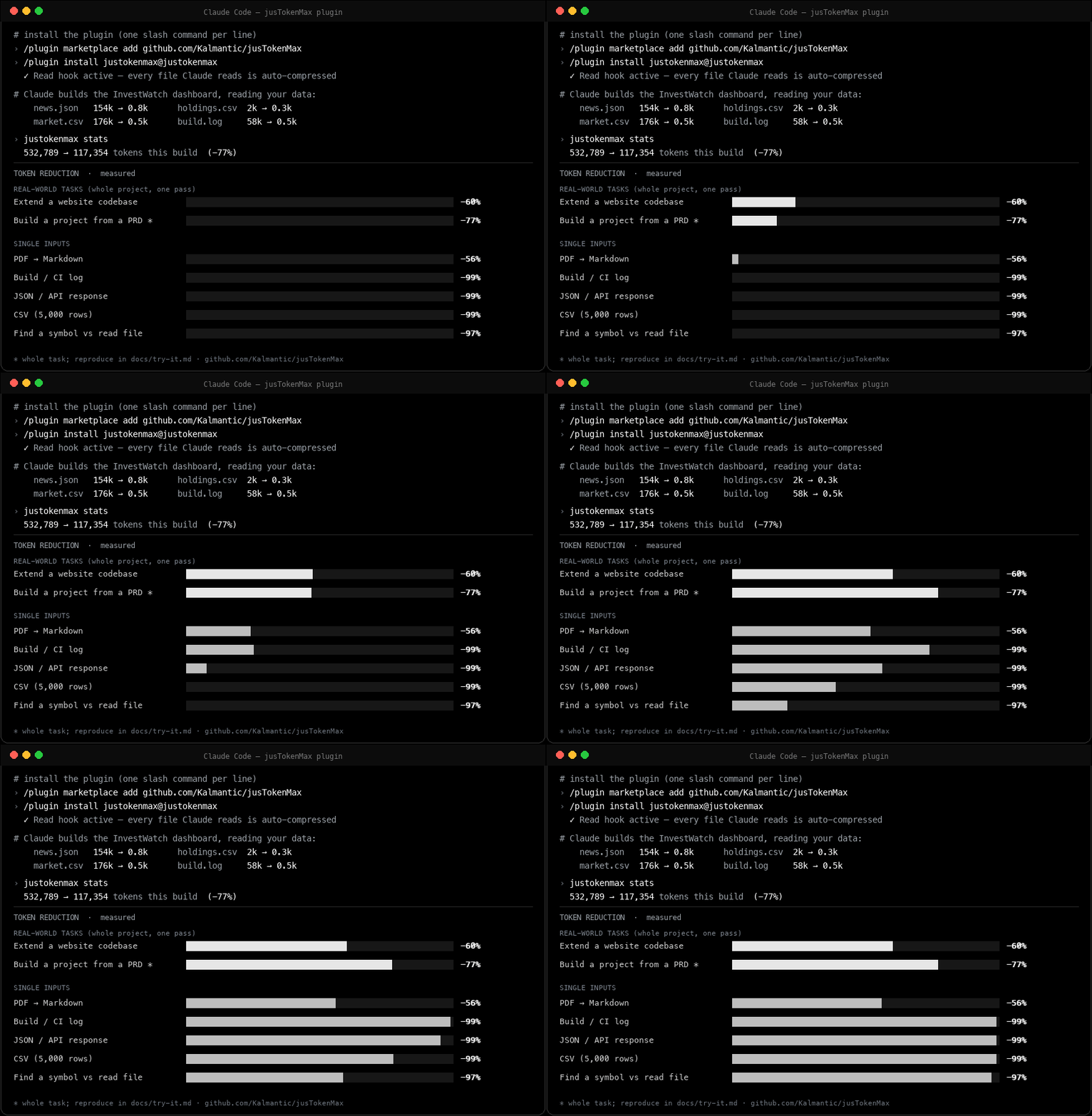
TokenMax under a budget
Coding-agent bills are driven by input tokens — the PDFs, logs, API responses, diffs, and source files that pile into the context window. jusTokenMax caps that: it intercepts each heavy input and replaces it with a faithful, far cheaper equivalent, before it costs you a token.
- Compress everything that bloats context — PDFs → Markdown, images downscaled, logs/JSON/notebooks/CSVs/diffs digested, whole-file reads replaced by symbol lookups. Typical reductions 56%–99% (measured, below).
- Stay under a budget — point it at the things you feed your agent and the
per-task token cost drops by roughly the same amounts; pair with
terseoutput andchat-branchto also cap what the agent writes and re-reads. - Reversible & safe — every original is cached by content hash
(
justokenmax retrievebrings it back); secrets and base64 blobs are masked on the way through. - Works where you work — automatic in Claude Code (a
Readhook swaps heavy files for cheap artifacts in place), and available to any MCP agent (Codex CLI, OpenCode, Cursor, …) plus a plainjustokenmaxCLI. - Zero dependencies, fully auditable — deterministic heuristics, no trained model, no network. Every transform is readable Python.
| What you feed it | Typical reduction |
|---|---|
| PDF spec / paper | −56% (real PDFs) |
| Verbose build/CI log | −99% |
| Large JSON / API response | −99% |
| Jupyter notebook | −99% |
| CSV (thousands of rows) | −99% |
| Git diff (lockfile churn) | lockfile → 1 line |
| Finding a symbol vs reading the file | −97% |
Quickstart — try it
Fastest path, inside Claude Code (run these one at a time — one slash command per prompt):
/plugin marketplace add https://github.com/Kalmantic/jusTokenMax.git/plugin install justokenmax@justokenmax/reload-plugins
Now reading PDFs / logs / JSON / CSV / notebooks / diffs is compressed
automatically. (The hook calls the justokenmax CLI — see Install
to add it; or just have Node and it auto-provisions.) Prefer the CLI or another
agent? justokenmax install registers it for Codex / OpenCode / Cursor too.
👉 Full 5-minute hands-on with a real dev task and on/off measurement:
docs/try-it.md.
In a real development loop — one pass through a small website project's inputs (8 source modules, a 10k-line
package-lock.json, a 5,000-row CSV, a noisy build log): 259,819 → 103,745 tokens (−60%), measured with a real tokenizer — and it compounds as the agent re-reads files while editing. Reproduce it step by step indocs/try-it.md.
Built for casual users and enterprise — from day one
The same tool serves a solo developer and a regulated enterprise, by design — not as an afterthought:
- Casual users get a one-command setup (
justokenmax install) and then it just works, automatically: free, MIT, no account, no signup, sensible defaults. Your agent simply gets cheaper. - Enterprise gets a tool that's safe to adopt: zero third-party services and no network calls — nothing leaves the machine, so it runs air-gapped and sidesteps data-egress / residency review; deterministic and fully auditable (readable Python, no black-box model) for security sign-off; built-in secret redaction (API keys/tokens masked before they ever reach context, logs, or the cache); an owner-only (0700) local cache; reversible (originals retained); open-MCP-standard integration that drops into an approved toolchain; and MIT licensing for legal clearance.
That's why it's deliberately zero-dependency and deterministic from the first commit — the properties enterprises require are the same ones that keep it small and trustworthy for everyone.
Comparison
Inspired by headroom / caveman / codegraph, built independently. ✅ has it · ⚠️ partial · ❌ no.
| Capability | jusTokenMax | headroom | caveman | codegraph |
|---|---|---|---|---|
| PDF → Markdown (drop page-image channel) | ✅ | ❌ | ❌ | ❌ |
| Image / log / JSON compression | ✅ | ✅ | ❌ | ❌ |
| Notebook (.ipynb) compression | ✅ | ❌ | ❌ | ❌ |
| CSV / tabular sampling | ✅ | ❌ | ❌ | ❌ |
| Git-diff compression | ✅ | ❌ | ❌ | ❌ |
| Delta / incremental re-reads | ✅ | ❌ | ❌ | ❌ |
| Secret + base64-blob redaction | ✅ | ❌ | ❌ | ❌ |
| Code symbol index + outline | ✅ | ❌ | ❌ | ✅ |
| Output-token reduction (terse) | ✅ | ✅ | ✅ | ❌ |
| Chat branching → subagent + digest | ✅ | ⚠️ | ❌ | ❌ |
| Reversible + retrieve original | ✅ | ✅ | ❌ | ❌ |
| Transparent in-place Read rewrite | ✅ | ❌ | ❌ | ⚠️ |
| Content sniffer / auto-route | ✅ | ✅ | ❌ | ❌ |
| MCP server + one-command install | ✅ | ⚠️ | ⚠️ | ⚠️ |
| MCP compression proxy (any server) | ✅ | ✅ | ❌ | ❌ |
| Per-lever on/off config | ✅ | ⚠️ | ⚠️ | ❌ |
| HTTP proxy / wrap / middleware | ❌ | ✅ | ❌ | ❌ |
| Trained compression model | ❌ | ✅ | ❌ | ❌ |
| Cross-agent shared memory | ❌ | ✅ | ❌ | ❌ |
| Zero-dependency / auditable | ✅ | ❌ | ✅ | ⚠️ |
| Single unified plugin (all levers) | ✅ | ⚠️ | ❌ | ❌ |
What's distinct to jusTokenMax: a Claude-Code-native transparent rewrite
(updatedInput, no proxy), a queryable code symbol index + file outline, PDF
→ Markdown that eliminates the per-page image channel, chat-branching as a
first-class command, and fully transparent zero-dependency heuristics. What
headroom still has that we don't: a trained model, an HTTP proxy mode, and a
cross-agent shared-memory store.
Install
The canonical install is the Python package; it provides the justokenmax CLI.
From this repo (works today — Python 3.9+):
git clone https://github.com/Kalmantic/jusTokenMax && cd jusTokenMax
pip install pypdf Pillow            # required codecs
pip install pdfplumber              # optional: better PDF table extraction
pip install ./python                # installs the `justokenmax` CLI
justokenmax --version
From PyPI (once published): pip install justokenmax.
npm (optional thin shim — runs python -m justokenmax, so it still needs the
Python package above): npm install -g @kalmantic/justokenmax.
As a Claude Code plugin — from inside Claude Code, run these one at a time (one slash command per prompt — don't paste all three together):
/plugin marketplace add https://github.com/Kalmantic/jusTokenMax.git/plugin install justokenmax@justokenmax/reload-plugins
The Read hook then optimizes PDFs / images / logs / JSON / notebooks / CSV /
diffs automatically, and the commands, skills, and MCP server become available.
The hook calls the justokenmax CLI, so install the Python package (above) or
have Node (it auto-provisions via npx/uv).
To uninstall the plugin (one at a time):
/plugin uninstall justokenmax@justokenmax/plugin marketplace remove justokenmax/reload-plugins
One-command setup for any agent (seamless and reversible — idempotent, never clobbers your other servers, removes cleanly):
justokenmax install              # auto-detect Codex / OpenCode / Cursor / Claude and register the MCP server
justokenmax install codex        # or target one agent
justokenmax install --dry-run    # preview the change first
justokenmax uninstall            # remove it again, just as cleanly
This writes the MCP-server entry into each agent's own config (~/.codex/ config.toml, ~/.config/opencode/opencode.json, ~/.cursor/mcp.json, project
.mcp.json). The registered command is npx, which works for anyone with
Node — even with no Python installed:
# Codex: ~/.codex/config.toml
[mcp_servers.justokenmax]
command = "npx"
args = ["-y", "@kalmantic/justokenmax", "mcp"]
Node but no Python? The npx launcher auto-provisions a runtime: if no
Python is on PATH it falls back to uvx justokenmax (uv
fetches an ephemeral Python + the package), and bootstraps uv itself if
needed. So a Claude Code user with only Node gets the full MCP toolset with zero
manual setup. (If you do have Python, command = "python3", args = ["-m", "justokenmax.mcp_server"] works too and skips Node entirely.)
OpenCode also has a transparent read-compression plugin (mirrors the Claude
Code hook) — see integrations/opencode/.
The levers
| Module | Reduces | How | Measured |
|---|---|---|---|
| Attachments | PDFs & images you read | PDF → page-delimited Markdown (drops the per-page image channel); images downscaled ≤1568px + recompressed | −56% on real PDFs |
| Logs | verbose build/test/CI output | strip ANSI, collapse repeats (×N), fold stack traces, keep errors/warnings + head/tail | −99% |
| JSON / tool output | big structured payloads | sample long arrays, truncate long strings, cap depth, minify whitespace; large uniform object arrays collapse to one inferred schema ([N × {id:int, name:str, …}]) | −99% |
| Lockfiles | package-lock.json, yarn.lock, pnpm-lock.yaml, poetry.lock, Cargo.lock, Gemfile.lock | collapse to a name@version table; drop integrity hashes + resolved URLs | −99% |
| Minified assets | .min.js / .min.css & single-line packed blobs | stub to one line (<minified asset, N bytes — retrieve for source>) | −99% |
| Notebooks | .ipynb files | drop base64 image outputs, truncate cell outputs, keep code + markdown | −99% |
| CSV / tabular | large tables | header + inferred column types + sample rows + row count | −99% |
| Git diffs | lockfile/generated churn | keep code hunks, collapse lockfile/generated/minified file diffs to one line | lockfile → 1 line |
| Delta reads | re-reading the same file | return only the diff since the last read, not the whole file | −96% |
| Redaction | secrets & blobs in text | mask API keys/tokens/passwords, elide base64/data-URIs (tokens + safety) | safety + tokens |
| Code index + outline | reading whole files to find code | symbol map (file:line + signature) + file outlines so you read only the relevant range | −97% to locate a symbol |
| Terse output | tokens the agent writes | output-style steering: lead with answer, fragments, no filler — facts kept exact | output-side |
| Chat branching | sub-tasks that bloat the thread | offload heavy work to an isolated subagent context, merge back only a digest | workflow skill |
| Cache alignment | recompute on long sessions | keep the prompt prefix stable so the provider KV cache keeps hitting | guidance |
All compression is reversible — originals are cached by content hash and
justokenmax retrieve <artifact> hands the full version back — and tracked in a
lifetime ledger (justokenmax stats). A content sniffer routes generic files
(.txt/.out/no-extension) to the right compressor automatically.
How each lever works
Attachments. A PDF is billed as text + a rendered page-image (~1,500 tokens/page after the API clamps a page to ≤1.15MP). jusTokenMax extracts the text to clean Markdown and drops the image channel — you keep the words, stop paying for the picture, and gain something searchable and quotable. Images are downscaled to the model's resolution ceiling and recompressed.
Why text, not image parsing? Almost every spec, design doc, README, and test
document an agent reads is born digital with a real text layer — and text is
~10× cheaper than a page-image, plus searchable, quotable, and diffable. So
text-first extraction is the right default; the only case it can't serve is a
scanned/image-only PDF (no text layer), which is exactly where OCR comes in
(on the roadmap). And if you'd rather it never touch PDFs, justokenmax config disable pdf.
Logs. Build/test/CI output is mostly noise: ANSI codes, progress spam, the
same line hundreds of times, 50-frame stack traces. jusTokenMax digests it —
strips colour, collapses repeated lines into (×N), folds long traces to
first+last frame, and always keeps error/warning lines plus the head and tail.
Code index + outline. Reading entire files to find one function is the
biggest avoidable input cost. jusTokenMax parses the repo (Python via ast,
JS/TS/Java via brace-aware scanners, others via regex) into a symbol map, so
justokenmax query parse_config returns file:line + a full signature, and
justokenmax outline <file> returns a file's shape with no bodies.
Chat branching. Every file read stays in context for the rest of the session. Branching runs a self-contained sub-task in a subagent whose context is discarded afterward, returning only a compact digest.
Results
Measured by benchmarks/benchmark.py. Text is counted
with a real tokenizer (tiktoken / cl100k); the PDF "before" uses the page-image
model at a conservative ~1,500 tokens/page. Full detail (regenerable) in
benchmarks/RESULTS.md.
PDF → Markdown (real public PDFs)
| Document | Pages | Before | After | Reduction |
|---|---|---|---|---|
| Attention Is All You Need (arXiv 1706.03762) | 15 | 37,074 | 14,574 | −60% |
| IRS Form W-9 | 6 | 18,305 | 9,305 | −49% |
| Total | 21 | 55,379 | 23,879 | −56% |
Logs / JSON / Notebook / CSV / delta
| Input | Tokens before | Tokens after | Reduction |
|---|---|---|---|
| build log (4,345 → 21 lines) | 107,668 | 396 | −99% |
| API response (2,000-row payload) | 168,023 | 374 | −99% |
| notebook, 20 cells w/ image outputs | 401,170 | 610 | −99% |
| CSV, 5,000 rows | 57,340 | 237 | −99% |
| delta re-read, 1 edit in 600 lines | 2,407 | 88 | −96% |
Code index — locating a symbol vs reading the file, over 21 lookups in jusTokenMax's own source: 16,691 → 486 tokens (−97%). Images — 3000×2000 → 1568×1045, 186 KB → 107 KB (−42% bytes).
A real development loop — one pass through a small website project's inputs
(reproduce with the scaffold in docs/try-it.md):
| Input the agent reads | Tokens before | After | Reduction |
|---|---|---|---|
| 8 source modules (read whole → outline) | 872 | 520 | −40% |
package-lock.json | 126,426 | 102,414 | −18% |
products.csv (5,000 rows) | 82,506 | 290 | −99% |
build.log | 50,015 | 521 | −98% |
| Total (one pass) | 259,819 | 103,745 | −60% |
(The source-module saving is small here only because the demo modules are tiny; on real files it's much larger — and every re-read during editing is near-free via delta.)
A build-from-scratch project — hand your agent a PRD for a news-indexed
investment tracker and it ingests a news-feed JSON, holdings + market-history
CSVs, a lockfile, and build logs: 532,789 → 117,354 tokens (−77%) on the data
it reads (the PRD itself is untouched). Full worked example — a real
PRD, a scaffold.sh, and a built
reference app (examples/investment-tracker/app/,
vanilla HTML/CSS/JS, no build step) you can run.
Reproduce the benchmarks: python benchmarks/benchmark.py --fetch; reproduce the
dev loops: docs/try-it.md and the example above.
Use
justokenmax optimize report.pdf shot.png build.log api.json data.csv nb.ipynb  # by type
justokenmax logs ci-output.log                      # compress a verbose log
justokenmax json response.json                      # compress a JSON payload
justokenmax delta src/app.py                        # only what changed since last read
justokenmax redact secrets.txt                      # mask secrets + elide blobs
justokenmax index && justokenmax query parse_config # build index, find a symbol
justokenmax retrieve <artifact>                     # get the original back (reversible)
justokenmax stats                                   # lifetime token savings
justokenmax sessions                                # per-session savings (effectiveness over time)
justokenmax install / uninstall [agent]             # register/remove the MCP server for any agent
justokenmax config disable csv                      # turn a lever off (your project, your way)
justokenmax proxy -- npx -y some-mcp-server         # compress ANY other MCP server's output
New here? docs/try-it.md is a 5-minute, copy-paste
walkthrough that shows the savings with a lever on vs off.
Configure — optimize your way
Every lever is on by default; turn any of them off when a project needs the raw file:
justokenmax config                    # show what's on/off
justokenmax config disable pdf        # persist: skip PDFs from now on
justokenmax config enable pdf         # back on
JUSTOKENMAX_DISABLE=pdf,image justokenmax optimize x.pdf   # one-off, via env
Kinds: pdf image log json notebook csv diff redact. A disabled kind is skipped
by optimize() and left untouched by the Read hook.
Plugin surface
- Hook:
PreToolUse(Read)transparently rewrites aReadof a PDF / image /.log/ JSON /.ipynb/ CSV / diff to the cheap artifact viaupdatedInput. It never blocks a Read — any failure falls through untouched. - MCP server:
.mcp.jsonlaunches a stdlib stdio server exposingjustokenmax_optimize,_compress_json,_compress_log,_compress_diff,_query,_outline,_delta,_redact,_retrieve,_stats— so any MCP-capable agent can call it. - Commands:
/justokenmax:optimize|logs|json|diff|index|query|outline|delta|redact|retrieve|terse|branch|compress-memory|learn|stats. - Skills:
attachments,code-index,chat-branch,terse-output,cache-align.
Limits & honesty
- No OCR. Scanned / image-only PDFs have no text layer → empty Markdown; jusTokenMax detects no saving and passes the original through.
- PDF per-page tokens are a conservative model, not a billed number.
- Image token savings are base64-pipeline only (native vision downscales regardless); the always-real image win is bytes.
- The code index is a snapshot, not live — re-run
justokenmax indexafter big changes.
Safety
Hooks run on untrusted files, so the converters are bounded: PDFs capped at 2,000 pages / ~5M chars of output, Pillow's decompression-bomb guard kept active, no shell execution, output paths are content-hash names, and the Read hook fails open. Secrets and base64 blobs are masked inside every text digest.
Test
cd python && pip install -e . pytest pdfplumber
pytest -q      # pdf, image, log, json, notebook, csv, diff, delta, redact, code-index, outline, optimize, cli, hook, mcp
Results — measured savings
All numbers are measured (text via a real tokenizer, tiktoken cl100k) and
reproducible — nothing here is hand-waved.
Real-world tasks first — whole-project, one pass; reproduce step by step in the linked docs:
| Scenario | Before | After | Reduction |
|---|---|---|---|
| Extend an existing website codebase | 259,819 | 103,745 | −60% |
| Build a project from a PRD — InvestWatch (data inputs) | 532,789 | 117,354 | −77% |
The InvestWatch example ships a runnable reference app
(examples/investment-tracker/app/).
Both numbers are one pass — in a real session they compound as the agent
re-reads files (near-free via delta).
Single inputs — reproduce with python benchmarks/benchmark.py --fetch:
| Input | Reduction |
|---|---|
| PDF → Markdown (real public PDFs) | −56% |
| Verbose build / CI log | −99% |
| Large JSON / API response | −99% |
| Jupyter notebook | −99% |
| CSV (5,000 rows) | −99% |
| Locate a symbol vs read the whole file | −97% |
| Image | −42% bytes |
Support this project
jusTokenMax is free and MIT-licensed. If it keeps your agent under budget, please consider sponsoring on GitHub — it funds OCR, more languages, and the roadmap. Thank you 🙏
Roadmap
OCR for scanned PDFs, DOCX/PPTX/HTML inputs, even deeper multi-language parsing, a
diff-mode lockfile path, a learn loop that mines sessions for durable
corrections, and PyPI/npm publishing. (Cross-agent install/uninstall, the
OpenCode plugin, and the MCP compression proxy are done.) PRs welcome.
// faq
What is jusTokenMax?
Token-reduction toolkit for Claude Code, OpenCode & other coding harnesses.. It is open-source on GitHub.
Is jusTokenMax free to use?
jusTokenMax is open-source under the NOASSERTION license, so it is free to use.
What category does jusTokenMax belong to?
jusTokenMax is listed under data in the Claudeers registry of Claude-compatible tools.
// embed badge

[](https://claudeers.com/justokenmax)
// retro hit counter

[](https://claudeers.com/justokenmax)
// reviews
// guestbook
// related in MCP Servers
 🔓
🔓f.k.a. Awesome ChatGPT Prompts. Share, discover, and collect prompts from the community. Free and open source — self-host for your organization with complete…
 🔓
🔓A cross-platform desktop All-in-One assistant for Claude Code, Codex, OpenCode, OpenClaw, Gemini CLI & Hermes Agent. Only official website: ccswitch.io
 🔓
🔓🪨 why use many token when few token do trick — Claude Code skill that cuts 65% of tokens by talking like caveman
 🔓
🔓An open-source AI agent that brings the power of Gemini directly into your terminal.