
hoprig
Install it on a fresh PC or Linux server and it sets up everything else for coding with Claude Code, managed from one dashboard: sessions that carry on under…
Install with your AI
Paste into Claude Code, Cursor, or any agent — it reads the repo and wires the tool into your project.
Install and set up hoprig (npm project) into my current project.
Found on https://claudeers.com/hoprig
Repo: https://github.com/allswebtech/hoprig
Homepage/docs: —
Detected install method: npm → npm install hoprig
Category: devtools. Platforms: cli, api, desktop, web, mobile.
Read the repo's README for exact setup and env vars, then install it and wire it into my project.

Claudeers Health Verdict:
unknown; community-verified: false. Confirm the source before running anything.
npm install hoprig
git clone https://github.com/allswebtech/hoprig
// compatibility
| Platforms | cli, api, desktop, web, mobile |
|---|---|
| Operating systems | — |
| AI compatibility | claude |
| License | Apache-2.0 |
| Pricing | open-source |
| Language | JavaScript |

Hoprig
One command, and a computer is ready to code with AI.
Your rules, skills and memory come along to every machine, and every session is on one page, also on your phone.
Free · runs on your own computers · for Claude Code and OpenCode · hoprig.com
curl -fsSL https://raw.githubusercontent.com/allswebtech/hoprig/main/install.sh | sh
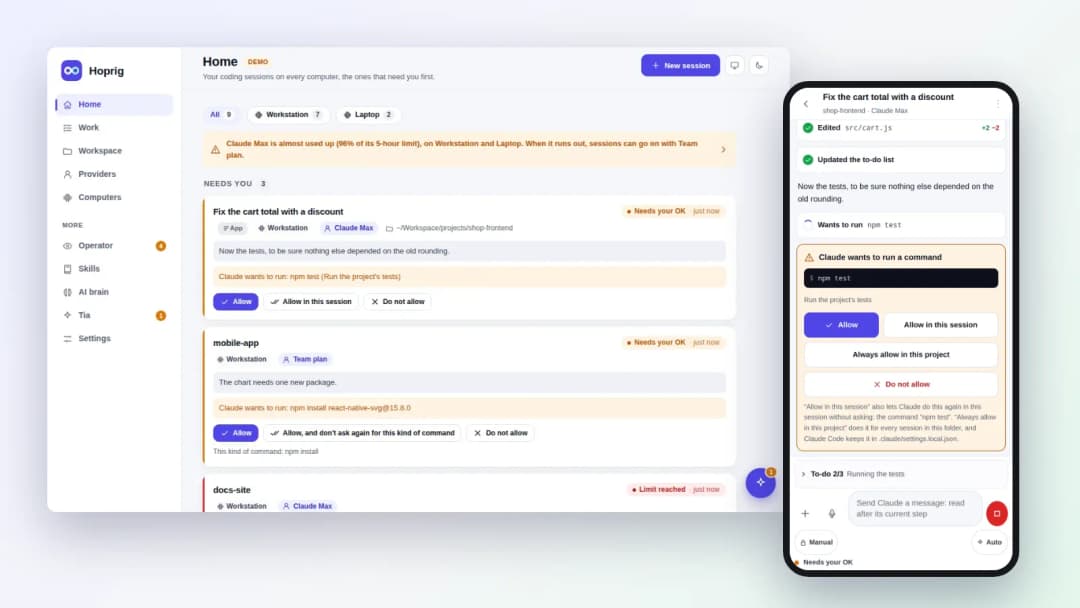
What it does
- A chat is the way to code. One tap on a project opens a chat with its coding tool: Claude Code, or OpenCode as a second one. Replies as they are written, each change as a diff, Allow and Deny buttons, the to-do list, agents and background tasks. The real terminal is one tap away and keeps the conversation.
- One AI brain for both tools. The same working rules, skills and memory, kept in one git repository and linked into each coding tool.
- Sessions carry on at a usage limit. Subscriptions, API keys and gateways are all "providers". A session belongs to its folder, not to a provider: one tap moves it to another provider, or Auto mode does it for you.
- A code editor in the page: VS Code's editor core with Explorer, Search and Source Control.
- A desktop in the browser: windows for a computer's terminal, files, editor, processes, services and logs.
- From anywhere: one switch, Settings → Public link, makes the dashboard reachable from the internet, with no server of your own.
- Several computers in one place: home PC, office PC, servers. Computers behind a router connect out by themselves.
- Tia, an assistant that does the work through the dashboard's own routes. What she asks to install, update, restart or power off on your computer, or to end a process there, comes to you as a card first, at every level. So does what costs money, except where you choose otherwise. Within a daily limit for paid use you set in Settings → Tia (none at first), she may write to sessions on providers billed by use unless her level is Ask me, and at Hands off also start or move her sessions there. At Hands off, the Operator's limit rule or Tia decides, once you turn them on, may also move a session at a usage limit onto a provider billed by use, only within that limit, and each move counts against it. At Hands off, the short call of Tia decides and a look into what nobody can explain may also run on such a provider when every provider you allowed her is billed by use (Auto mode counts as billed by use here when its order holds such a provider), only within that limit too, and each counts against it. The Operator's rules, once you turn them on, restart a gateway or the public link that does not answer and end a test's left-over processes by themselves. Tia decides may make the same restarts, type one fixed line of Hoprig's into a stuck session to nudge it, and end a stuck session only in a project where you ticked Tia may end a stuck session in this project on the project's page (docs/OPERATOR.md). Typing into a session that runs on a provider billed by use, the nudge too, is money: Tia decides does it only at Hands off and within that limit, and it counts against it. Off until you turn her on.
- Improve Tia (Settings → Tia): Hoprig tries rewordings of Tia's skills, tool descriptions and instructions, measures each with her tests, and shows you only the ones that do measurably better. Nothing changes until you accept one, and every change has Undo. It starts only by your press and counts against your daily limit for paid use; a weekly round is off until you switch it on.
- Hands-off lets Hoprig answer some of a coding tool's questions by itself while you are away — the option the tool marked as recommended, or your note for the project — so a session does not wait for you, while still holding, as your card, anything that is yours alone: a push to the main branch, a release, a pull request, admin rights, a delete outside the folder, and the rest. Off until you turn it on, per project or per session.
- Work: your tasks, and its Today tab that lists what is due this week, what waits for your yes, and the
sessions that need an OK or reached a usage limit. The list is one file in a git repository of your workspace (the AI
brain by default); Save commits only that file, brings another computer's changes in task by task, and either
reaches the server or leaves your change in the file; a save that was interrupted is finished the next time.
Do it on a task starts a coding session with the task as its brief; on a git project it works on a branch of
its own (
work/<task>) in its own copy of the project, so your folder is not changed. What it did (its answer, commits and changed files) comes back onto the task for Accept or Send back; Accept leaves the branch for Go live, and nothing is merged or pushed. Plans hold a goal, milestones and dated tasks with what waits for what, on a timeline; Plan with AI has a session research a goal and propose a plan, and nothing is written before you accept it. Auto, a switch per project on Work → Team (off at first), lets Tia start that project's ready tasks by herself, one at a time, each one in Activity and stopped by End. Another program adds a task with a Work token (made in Settings → Work, shown once, good for Work only) and hears its result through a signed webhook; such a task starts only when you start it. Missions (off at first, on Work → Team) let Tia do a goal with roles: a developer, tester or ops session may run only the project's tests, its build and its scripts, each in a box with no network. docs/WORK.md - Operator: one page with what stopped or is about to, from everything Hoprig watches (a session at its limit, an OK that waits, a disk 85% full, a run that stopped), with one recommended step for each; nothing happens until you tap it, unless you switched on one of Tia's rules, Tia decides or Tia looks into what nobody can explain (all are off at first; docs/OPERATOR.md).
- Updates of Hoprig, the coding tools and the helper for the public link (cloudflared) on one page, Manual by default.
- A computer ready for coding: git, Node.js, Python, the GitHub CLI, your projects and skills that fit them, installed by one guided run. What is already there is left alone.
Linux and macOS today.
On Windows (natively, without WSL) the main paths were used by hand on one Windows 11 computer: setup, doctor, the
computer setup with winget, projects, the background service and the dashboard with sessions and a chat. That first
run needed ways round (a new project needed a global git identity, programs winget installed stayed "missing", the
Python kit gave no Python, installing the service again left the old dashboard serving); this version has fixes for
them that were not yet tried there. The tests do not pass on Windows yet, and install.ps1 itself was not tried.
Much else was not tried there (see "Where it runs"). Not affiliated with Anthropic or with OpenCode's makers;
"Claude" and "Claude Code" are Anthropic's.
Who it is for
Three things together: it sets up the computer; it keeps one workspace that comes back from git on any computer, with an AI memory per project; and a session goes on with another provider or account when one reaches its limit. Each case below has its own page with the steps, what you need and what it does not do.
What you get, each answered on the page and section it links to:
- Can the AI write the code for me?: Yes, in a chat: you say what you want in plain words, and you see each change and allow it before it is made.
- How do I keep an AI-built project in order from day one?: Every project gets the same folder from the first day: the rules for the AI, its memory, the docs and the code, all in git.
- Who sets up my computer for coding with AI?: Hoprig does: one line installs it, and its setup installs and checks what is missing, after asking you once.
- Can I code on several computers?: Yes: each computer set up the same way from one recipe, and all of them on one page of the dashboard.
- Can I code on my own computer from my phone?: Yes: the dashboard opens in your phone's browser, with a chat per project and the real terminal, and no server of anyone else's.
- Can AI-built code be ready for real use?: Hoprig adds working rules that make the coding tool prove its work, and suggests reviewed skills for security, performance and tests.
- Does it come with skills and tools?: Yes: skills that fit what your project is made of, each with a scan of its risky lines before you add it, and a skill that sets up a new project from your brief.
- What happens when my project grows large?: It stays in order: each part has one place, every repository is in one map, and plans are kept in Work. The AI's work still needs your review.
- Does the AI brain learn?: There is one memory per project and one main brain, in git. Once you turn it on, it drafts skills from work you corrected or kept, at most three a week, and installs none without you.
- Is it easy, safe and fast?: The set-up is done for you, the working rules keep secrets out of the code, and skills for security and speed are suggested. It does not measure load for you.
- Can I move my work to another computer?: Yes: your AI brain lists every repository, so another computer gets the same projects, rules and memory.
- Does everything come back from git?: Yes: install Hoprig, sign in to git, and your AI brain, its map and your projects come back where they were.
- Do my computers stay in step?: Yes: the same rules, skills and memory through git, every repository brought up to date, and every computer's sessions on one page.
- Can I run an AI team under one assistant?: In part, today: Tia takes a goal, and sessions with six roles (developer, tester, reviewer, researcher, writer, ops) do its tasks, each checked before it comes back to you.
- Coming: one dashboard for a whole business?: Coming, not built yet: roles beyond code such as sales, posts sent only after your approval, and one dashboard for a whole business.
The cases:
- I am not a developer. How do I start building with AI on my own computer?: The set-up is the wall. Hoprig installs and checks everything, then you build in a chat.
- My AI-built project became a mess after a few weeks. How do I keep it in order?: A structure from day one: a project's own rules and memory, one AI brain, skills and checks.
- How do I code on my own PC from my phone with Claude Code?: The dashboard from anywhere, no server: a chat per project, the OKs and the real terminal.
- How do I use Claude Code on two computers with the same skills, rules and memory?: Home PC, office PC, laptop: the same projects, rules, skills and memory through git, every session on one page.
- How do I get my whole AI coding setup back on a new, formatted or lost computer?: Install, sign in to git, and everything comes back where it was.
- I hit the Claude Code usage limit in the middle of my work. How do I keep going?: The same session goes on with another provider or account, by one tap or by itself.
- How do I use Claude Code from my phone with an API key or a gateway?: Where the coding tool's own remote features stop working, the dashboard still does.
- How do I keep many client projects apart when I code with AI?: One folder, one set of rules and one provider per client project; fetch it when work starts, put it away after.
- How do I turn a spare PC or a small server into an always-on coding machine?: Your always-on coding machine: sessions keep running, and you reach them from any browser.
- How do I set up every machine the same way for AI coding?: Every machine set up the same, from one recipe and one AI brain, all on one page.
- How do I let AI coding work go on while I sleep?: Tasks in a queue, schedules and Auto mode, and the results waiting in the chats in the morning.
- How do I make AI-built code ready for real use, not just "it runs"?: Working rules, checked skills and proof before "done", for code that has to hold up.
- How do I plan a piece of work with AI and let sessions do it?: Write the goal, let a session propose milestones and tasks, accept what you keep, then have sessions do the tasks.
- How do I tell an AI assistant what to do, by voice or text, and approve just one step?: Say or type what you want; Tia shows one card with the task, the brief, the provider and the model, and starts nothing before your yes.
- How do I start a new project with Claude Code from a written brief?: Write the brief once; the AI fits the work to the project, asks you once, writes the documents, then builds with proof.
- How do I put a new server to work from my dashboard?: Add it by SSH from the Computers page, let the page install Hoprig there, then set it up and start sessions on it.
- How do I review and comment on Claude Code's changes before they go on?: The changed files beside the chat, comments on any line sent as one message, rewind, branch and your own checks.
- How do I see on one page what needs me?: One page lists what needs you, most urgent first, with one button for the recommended step; while Tia's switches are off, nothing happens until you tap.
- Can I run an AI team under one assistant?: Give Tia a goal; sessions with roles (developer, tester, reviewer and more) do its tasks, each checked before it comes back to you. Roles beyond code are coming.
Install
curl -fsSL https://raw.githubusercontent.com/allswebtech/hoprig/main/install.sh | sh
The line fetches Hoprig's installer from GitHub and runs it on your computer.
It installs what is missing (Node.js 24.13.1 or newer when it is missing or older, and on Linux the build tools, with sudo),
after asking once, then Hoprig itself from the main branch of this repository, then runs hoprig setup. Setup asks
before it installs Claude Code, sets up the rest step by step, and ends with a QR code (on a server: how to reach it
from your own computer): scan it and your phone is signed in to the dashboard. Until everything is set up, Home
shows a Get started checklist.
On a server with only a root login, the installer does not set Hoprig up under root (Claude Code refuses bypass
permissions mode for root): it lists its steps and asks once, Make the user hoprig and set Hoprig up there?, then
sets Hoprig up as that user. An older Hoprig that already runs as root moves with hoprig move-to-user, which needs
the network (docs/INSTALL.md).

Just want to look? hoprig demo opens the dashboard with sample data: no coding tool and no account needed.
On Windows, the PowerShell line and what was tried there are in docs/INSTALL.md (the line
above does not run in PowerShell). Everything else: docs/INSTALL.md.
Check a computer at any time on its Health tab (Computers → the computer → Health), where a problem that
one press can fix has a Fix button (or, in a terminal, hoprig doctor). Where the dashboard runs as a background
service, Restart the dashboard there restarts it; its sheet first says what happens to that computer's sessions
(kept by tmux (a program that keeps terminals running when the dashboard stops), they go on; in the built-in
terminals they end, and come back only if "Reopen sessions after a restart" is on). Only your own page restarts it, never Tia or a token. The command is hoprig, or hop for short.
Code in a chat
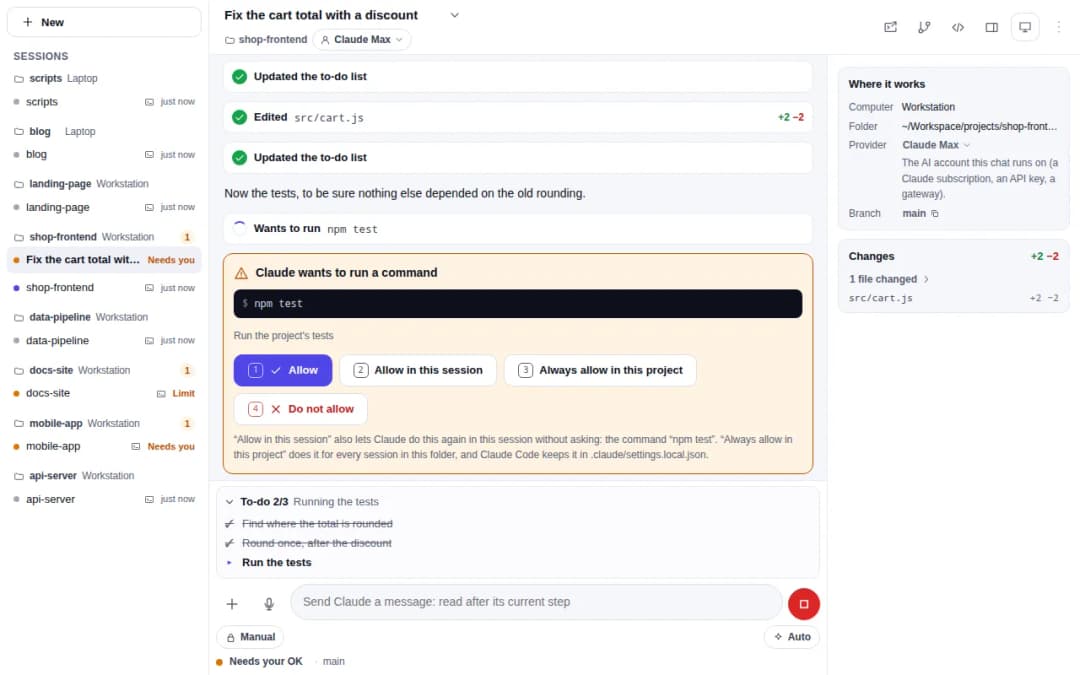
New session on Home (or a project's New session) opens with one line that says what will be used: the
computer (on Home, when several are linked), the App or a terminal, and the coding tool. Change on that line
unfolds those choices: the computer (on Home), App (a chat, like the Claude Code app) or Terminal, and the
coding tool. Below
it you pick the project the session starts in. The App takes the
provider, mode, model and effort of the last session there (the first time: Settings → New-session defaults).
Every model choice lists the chosen provider's own models: a gateway's or an API key's own list (asked when the
choice opens, kept ten minutes), or the models Claude Code offers a subscription. When no list can be had, it says
why, offers opus, sonnet and haiku, and takes an exact model name; a saved model the list leaves out is kept and marked.
From a terminal on that computer, hop chat [folder] prints the chat's address and opens it in the browser.
- What you see: the reply as it is written, thinking, each tool call on one line with its diff, the to-do list, subagents as a tree under the call that started them, background tasks with their progress.
- What you control: the permission mode, the model, the effort and ultracode are chips over the message box
and change without a restart. A message typed while it works is queued, and can be taken back. Stop ends
the turn; background tasks go on until you stop them.
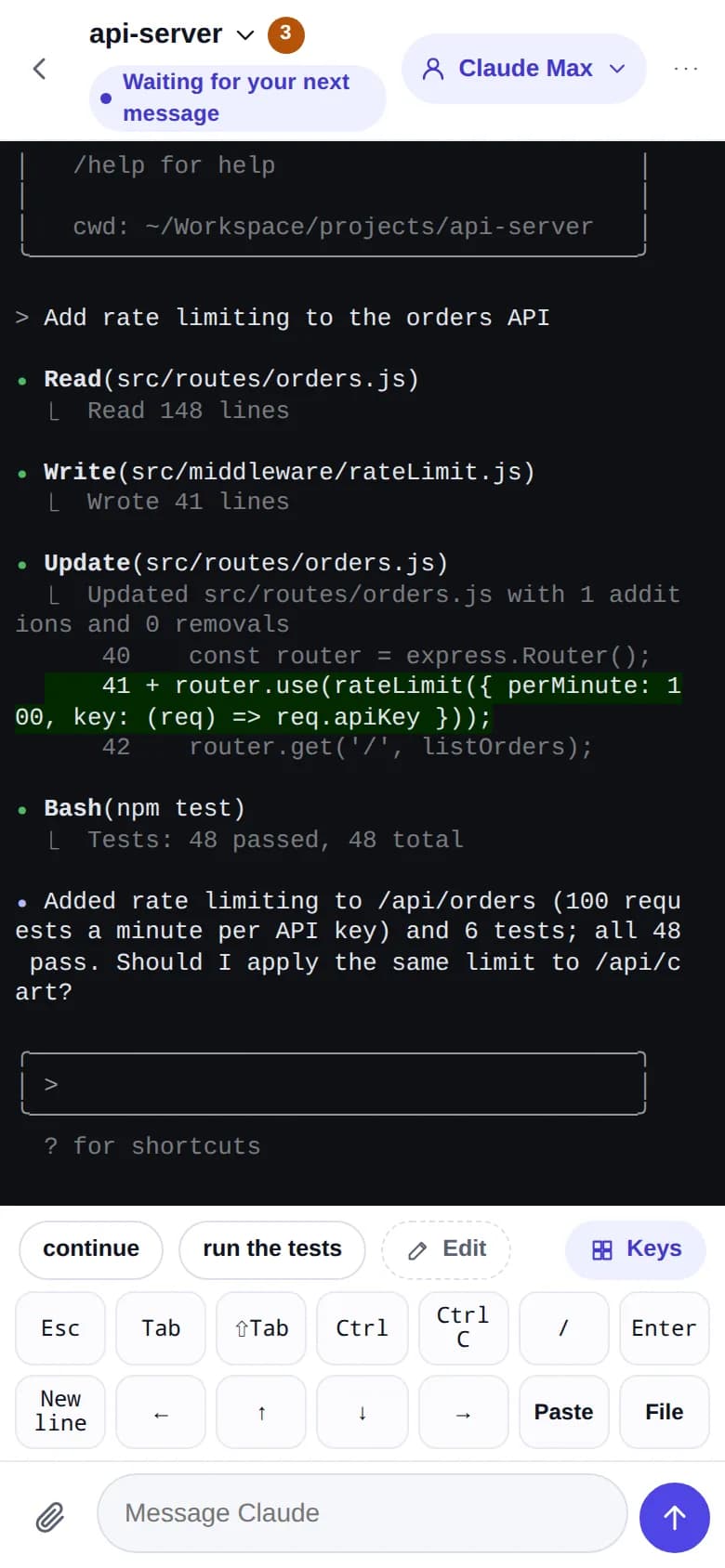
/lists the commands and skills by name, as Claude Code's menu (/compacttakes focus text,/helplists them,/configopens Settings,/clearopens a new session in the folder and keeps this one),@the folder's files; a picture can be pasted or dropped in.!before a line runs it as a shell command in the session's folder, as you would type it in the built-in terminal: your shell, the dashboard's environment without its secrets, at most 5 minutes (its output shows as it comes; Stop or Esc ends it; a program it starts in the background keeps running as long as the dashboard does, unless its output goes elsewhere:npm run dev > dev.log 2>&1 &); nothing goes to the coding tool until you send your next message, which carries the command and the end of its output as your own text. Through the public link it is behind the same sign-in as the rest of the dashboard (which can open a terminal anyway). The status line says what runs now, the branch, the context used and the plan's limits where the provider reports them. On a wide screen the session rail beside the chat shows the environment, the folder's changes, the context and the background tasks (Hide session rail in the title bar). - As in the Claude Code desktop app: the modes are Manual, Accept edits, Plan, Auto and Bypass permissions
(Bypass only once Allow bypass permissions mode is on in Settings → New-session defaults, which asks
first; the desktop app has the same switch under Settings > Code; off, a terminal session started in bypass
starts again without it after a move or a restart, and Settings counts the ones still running; New-session defaults names the modes with
the same words; a dashboard that already used bypass keeps it on after the update and says so once on Home); the caret
beside the title opens the session menu (Transcript view Normal, Thinking or Verbose, Open in,
Archive, Copy branch name, Branch: a new session on a copy of the conversation, which you switch into,
as Claude Code's
/branch;/fork [prompt]makes the copy and keeps you here;/model sonnet,/effort high,/branch nameand/clear namework as typed); the title bar has Open in Terminal, Changes and Files, and its ⋮ menu Background tasks once there are some. From 900 px wide the session list sits at the left: + New, the sessions of every computer grouped by folder (or by state or computer: Group and sort on its heading, where Archived lists this computer's archived App sessions to continue one), what needs you marked; a right-click on a row has Open in new window and, for an App session, Archive and Delete (the desktop app's Split view has no counterpart here); a phone keeps Back to Home. Ctrl+Shift+] and Ctrl+Shift+[ open the next and the previous session of that list. Keyboard shortcuts (Ctrl+/, or?outside the message box) lists every key of the App, and under "Kept by the browser" the desktop app's keys a page never gets (Ctrl+N, Ctrl+W, Ctrl+Tab) with where the App has them. - A question an MCP server asks you (an MCP server is a program that gives the coding tool more tools) shows as a card in the chat, as Claude Code's own questions do: the server's name, its words as plain text in a box of their own, its fields (or the one web address it asks you to open), Send and Decline. Only you answer it: no permission mode, Hands-off or Tia does, and Home and notifications say only "An MCP server asks you a question".
- A session's name is Claude Code's own name for the conversation, in the session list, the title bar, the
tab, Home, notifications and a terminal session's card: its first words until Claude Code writes its title, then
that title. The person's newest rename wins, wherever it was typed (Rename here, a click on the title, or
/renamein Claude Code); a title Claude Code generates never wins over a rename. A rename made here is kept by Hoprig, also after a restart. Started from the App, Claude Code makes no title by itself, so after a session's first reply the App asks it for one: one small request to the session's own provider. Name sessions with a short title in Settings → New-session defaults turns that off (then a session keeps its first words as its name). - Delete (the last entry of the session menu, of a row's menu, and a button on each ended conversation of
Earlier conversations) moves the conversation to Hoprig's trash: the toast has Undo, Trash in the list's
menu has Put back, and after 30 days it is removed with its transcript. Select to delete in the same menu
picks several at once. Only Claude Code's own files of that conversation move (its
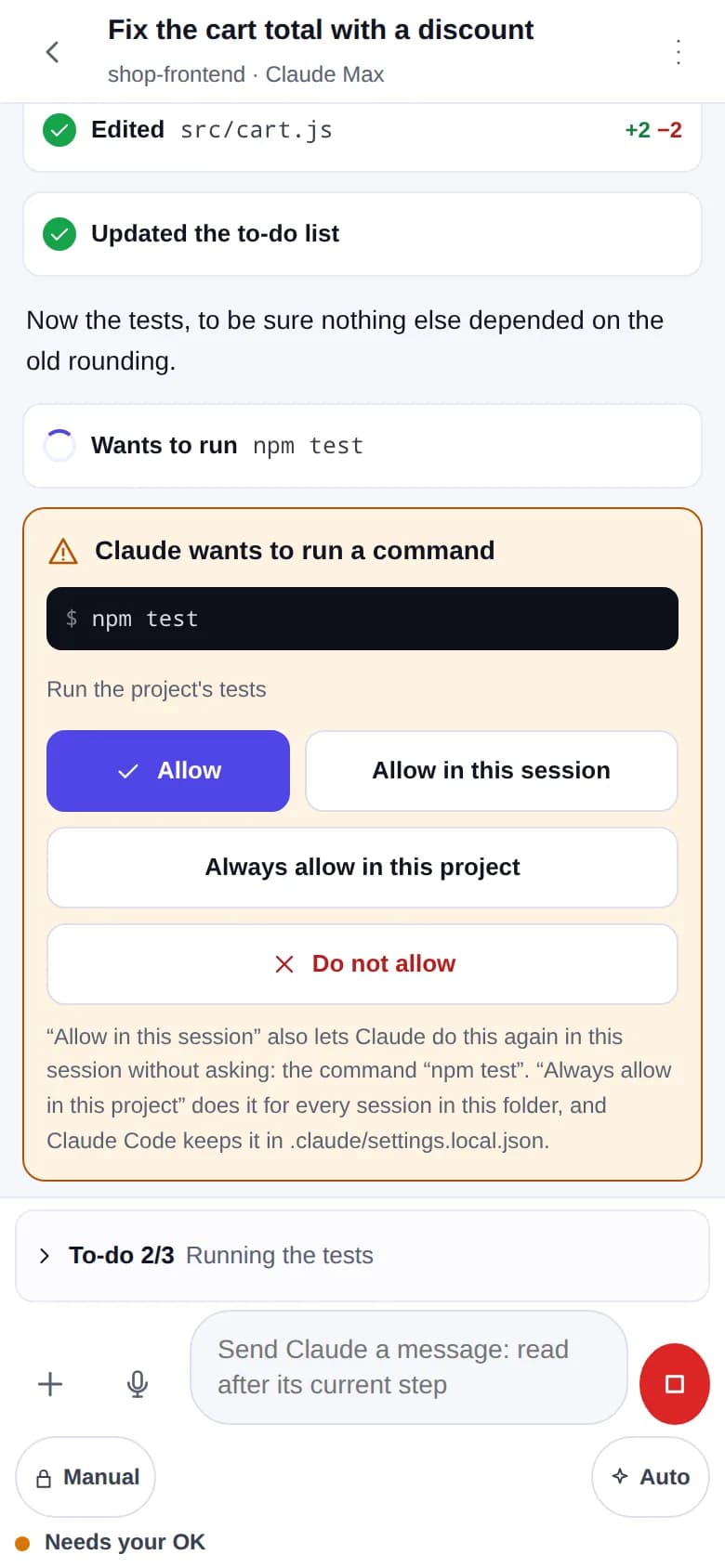
.jsonland its folder of the same id); a session that is working, waits for an OK or runs in a terminal is not deleted, and the page says why. Changes (or the rail's Changes card) opens the diff pane: the folder's files, unified or side by side; a + by a line opens a comment box, Enter queues the comment, Cmd/Ctrl+Enter sends them all as one message. Each of your messages has Rewind to here: Restore code and conversation, Restore conversation, Restore code or Never mind, as Claude Code's rewind (its Summarize choices are not offered: the coding tool's stream has no request for them). Dollars per turn show only in Verbose and only for a provider billed by use. - Its OKs: Allow, Allow in this session (stops the asking for that kind of call for the rest of this session;
nothing is written to a settings file), Always allow in this project (the same rule, which Claude Code itself
keeps in the project's
.claude/settings.local.json) and Do not allow, in the chat; its card on Home has the first, second and last. In the mode Bypass permissions Claude Code asks nothing except before some deletes; Hoprig answers for it only when the delete is plainly inside the session's folder. A question to you, a plan to approve, what your own settings insist on and any other delete Claude Code stops for still come to you, and a "deny" rule of your settings stays denied in every mode. - One place at a time: Open in → Terminal in the session menu takes the conversation to a real
terminal, and Open as chat in a terminal session's menu brings it back. A conversation runs in one process
only: a chat, a terminal session, or
hoptyped by hand in any terminal of that computer. The second one is refused in one sentence that says where the conversation runs and what to do; in a chat, Continue here stops that terminal and goes on in the chat. Files in the title bar opens the editor; the diff pane's editor button opens its Changes view.

Lead model: one model plans, others do the parts (Claude Code)
Lead model (off by default; in the new-session sheet, Plan with AI, Settings → New-session defaults and Settings → Tia) makes the model you chose the lead: it plans the task and hands each part to a helper by its kind of work. Running and recording (tests, builds, searches, logs, mechanical edits) goes to the provider's fastest model at low effort, writing and reviewing code to its strong model, an unknown cause, a design decision or the last check to its strongest at high effort. The models are picked from the chosen provider's own list, never another provider's; a tier it lacks falls to the next it has, and one line under the switch says which models it will use before anything starts. The helpers are Claude Code's own (given at the start), so no other process runs them, and a helper's model and effort are its kind's: a call in which the lead names another model or effort runs without it (a hook takes it out). It pays on work with parts that can be done apart; on a small task it costs more (three to six times the tokens in our tests), and the line under the switch says so. Who did what in the chat's side rail (and in the chat's ⋮ menu at any width) shows each part with its model and its tokens (new, written and read from the cache, apart), and one total per tier, read from Claude Code's own records; a Work run that had helpers shows the same under it, in a task's runs and in Activity, and a plan shows its tasks' runs per tier. A Lead chip under the message box says whether Lead is on. With the switch off a session starts exactly as before. Another coding tool shows the switch off. A terminal session shows the switch off: Hoprig cannot see what each part of a terminal session costs, so it cannot show or count its money in the daily limit for paid use as it does in the App.
Use other providers (shown while Lead model is on, off by default) lets the lead also hand a part to another provider you tick (the list, right under the switch, shows each one's coding tools, whether it is billed by use and its limit). A part is a session of its own on that provider in the same folder, which you can open from Home; it runs on its kind's model of that provider's list, in the lead's own permission mode (never in bypass unless "Allow bypass permissions mode" is on, and the line under the switch names the mode), and its answer returns to the lead as data. Hoprig checks every part itself: only a ticked provider (where Tia leads, only one she is allowed), none at its limit (skipped, and said in the chat), and never more at once than "runs by themselves at once", which Work's runs count too. A part on a provider billed by use starts only where you allowed pay-per-use for work that goes on by itself, or after a card in the lead's chat that names the provider and the part: No, or no answer, and the lead does that part itself. Where Tia leads, a part on a provider billed by use starts by itself only at Hands off and only within the daily limit for paid use (Settings → Tia); with no limit set, or not enough of it left today, it is that card. Parts that run at once share what is left of that limit; each holds its share while it runs. A part that starts by your yes on that card is counted in what Settings → Tia shows for today, but is never checked against the limit: it counts $0.50 until its chat reports what its turn cost, and when that turn ends without a reported cost, the $0.50 stays counted until the day ends. When the dashboard stopped while a part ran, Hoprig did not see the part end and could not measure what it cost, so the rest of its budget stays counted until the day ends. After the restart, Settings → Tia says it is counted for a part whose end Hoprig did not see, not for a part that runs now. A later start of a part (after it stopped for being idle, or after a restart) with no limit set any more, or no room left in it, starts nothing and holds nothing; when you send it a message, its chat says that Claude Code could not start, and why. No key or address is ever in what a model is given; a chat's part token and its file go when the chat ends. The switches and the ticks are kept with the chat, the plan and Tia's settings; a choice made for one session wins over the default.
Two coding tools: Claude Code and OpenCode
Claude Code can do everything here. OpenCode is the second coding tool: a chat or a terminal session, the
providers that fit it, the shared AI brain and updates. Turn it on in Settings → Coding tools: Install
puts it into Hoprig's own tools folder at the version this Hoprig is tested with (never globally), and its own
self-update and its makers' free cloud models are switched off. New session then offers it next to Claude
Code and keeps the one you chose last; a project's own New session chooses the coding tool that project used
last. In a terminal: hop opencode [provider].
OpenCode runs only on a provider that speaks its API: an API key or a gateway, never a Claude subscription (a subscription's sign-in is for Claude Code only, always). Auto mode, plan usage and Tia's own thinking are Claude Code's only.

One brain for both
hop workspace link (or Link on the AI brain page) makes every coding tool that is on read the same
global rules, skills and memory from your AI brain, a git repository of your own:
| Rules | Skills | Memory | |
|---|---|---|---|
| Claude Code | ~/.claude/CLAUDE.md → the brain | ~/.claude/skills → the brain | its home memory → the brain |
| OpenCode | its global AGENTS.md → the brain's rules file | ~/.agents/skills → the brain | none of its own: the shared rules tell it where each project's memory is |
Nothing is overwritten: a file or folder that is already there is merged into the brain and kept as a dated backup. Details: docs/WORKSPACE.md.
Hit a usage limit? Continue the same session on another provider

A provider is a small file of settings (a profile): a Claude subscription, an API key or a gateway. Claude Code keeps a session as a file named after its folder, and takes its provider from the environment it starts in, so the same conversation can be continued under any provider.
hop                 # choose a provider, then start Claude Code
hop add             # add a provider: a Claude subscription, an API key, or a gateway
hop work -c         # continue this folder's last session on the provider "work"
At a limit, a chat or a session says so and offers the other providers: one tap and the same conversation goes on
there (a chat's provider chip, or Move to another provider in a session's menu, does the same at any time).
When a session in a terminal stops at a limit or an error, Hoprig asks whether to continue on another provider;
one you end yourself (/exit, Ctrl+D) just ends, with one line on how to continue it later.
A provider that uses Claude Code's own sign-in can also go on with another Claude account of yours, as /login
does: Sign in with another Claude account, on the limit card, on Home and on Providers. You sign in in the
browser (from a phone: a link and a code); until that is complete the account of now stays. The provider's own
page shows who is signed in and has Sign out. A new account has its own limits, so the provider's limit mark
goes when the account changes. See Is this allowed?

Another gateway
A gateway is a program on your computer that offers other AI providers (OpenAI, Gemini, OpenRouter, a local
model…) through Claude's API, so Claude Code can use them. Hoprig ships one as an add-on, TRouteAI:
hop addons setup trouteai installs it, starts it and makes its provider, and Providers → Add provider → Other
providers does the same on the page. Any other gateway can be added as a definition of your own:
hop gateways                   # the gateways Hoprig knows, and yours
hop gateways add relay --title Relay --port 20100 --bin /opt/relay/bin/relay --args "--listen=127.0.0.1:PORT"
hop addons setup relay         # start it and make its provider
hop gateways confirm relay     # after you updated its program: run it as it is now
hop gateways remove relay
A definition has a short name (lower-case letters, digits and -), a title, a port (1024 to 65535, free when it is
added), either the program (its full path, or a name found on PATH) or the npm package Hoprig installs and updates it
with, the arguments that tell it the port (PORT stands for the port; only letters, digits and . _ = : , @ / + -),
and the path of its own page if it has one. It is kept in config.json under gateways → defined, and checked
again whenever it is read.
A program is pinned when you add it: a name is looked up on PATH then and a link is followed, and what is kept is the
file itself with a fingerprint (sha256) of it. The file and its folders must be ones only you (or the system) can
change, outside the workspace. On a Mac, Homebrew lets every admin user of the computer change its folders, so a
program installed with brew is refused: copy it to a folder only you can change (such as ~/bin) and add it from
there. Hoprig runs exactly that file; once it changes (an update of the program too), it does
not start it until you confirm it again: hop gateways confirm relay shows the file as it is now with its fingerprint
and asks as add does, or Confirm the new program on its row in Settings → Add-ons. The definition, its sharing
and the keys of other computers stay as they were. Hoprig also keeps the program as you typed it (a name on PATH, or a
link): when an update moves it (a new version in a new folder, the link moved there), confirm looks that up again and
shows the file it leads to now beside the one you confirmed. A gateway added before Hoprig kept that is named again with
hop gateways confirm relay --program <path>. hop gateways and the page say when a program changed. The program of an npm package is the one npm installed globally for that
package; a copy of that name earlier on PATH (a project's node_modules/.bin) is not run.
It is a program Hoprig will run, as your user, whenever you start it or a session on its provider needs it.
So you add it yourself: hop gateways add shows the exact program and arguments and asks in your terminal for the
dashboard's password (y/N while there is none; it refuses without a terminal and in a shell that a coding tool or the
dashboard started), and Settings → Add-ons → Add a gateway shows them and asks the same on the page. The
assistant's tools cannot add one. Nothing of it goes through a shell. This guards against a mistake and against a
coding tool trying it in passing, not against a program of your user that sets out to: such a program can edit
config.json itself, as it can any of your files.
On another computer, its page's Health → Gateways starts, stops and runs a gateway as a service there (see
docs/COMPUTERS.md).
Once added it is an add-on like the shipped one (hop addons start | stop relay); with more than one gateway,
Other providers first asks which one.
Auto mode (Claude Code)
hop auto order sub api      # your subscription first, then an API key
hop auto on                 # off at first: an API key costs money
hop auto                    # start a session in Auto mode
In the dashboard: Providers, then under When a provider reaches its limit choose Carry on with the next provider and put the providers in order. A chat or a session on the provider "Auto" then talks to a small router on your own computer: your subscription answers as long as it can, and the moment it reaches its limit the same request is answered by the next provider, with no error on screen and nothing to type. When the subscription is free again, requests go back to it.

Good to know:
- The first request after a move re-reads the whole conversation on the new provider. On an API key that is paid
at full price;
/compactfirst keeps it small. - When the next provider in the order is another subscription, Claude Code is restarted as that subscription (a few seconds) instead. See Is this allowed?
- Claude Code's own Remote Control does not work through a router or with an API key; the Hoprig dashboard is the remote for those sessions.
The code editor

Open code on a project, a repository, a chat's Files button or a session's menu opens the folder in VS Code's editor core (Monaco), inside the page and behind its sign-in, also for another computer's folders. Explorer (new, rename, delete), Search in files and Source Control (the changes side by side, stage, unstage, discard, commit, the log); N changes on a project goes straight there. VS Code's keys work: Ctrl+S, Ctrl+P, the command palette (Ctrl+Shift+P, F1), Ctrl+Shift+F and Ctrl+Shift+H (replace across files, with a preview), Ctrl+G, Ctrl+B, Ctrl+` (a terminal in the opened folder), and the code editor's own. A browser tab keeps Ctrl+W, Ctrl+N, Ctrl+T, Ctrl+Shift+T, Ctrl+Tab and Ctrl+PageDown/PageUp for itself: there the editor uses VS Code for the Web's keys (Ctrl+Shift+Alt+N closes a tab, Ctrl+Alt+N makes a file) or a Ctrl+K chord (Ctrl+K Shift+T reopens a closed tab), shown beside each command in the palette and in Keyboard shortcuts (Ctrl+K Ctrl+S); installed as an app, VS Code's own keys work too. A tab's menu (right click or long press) closes others, to the right or the saved ones, copies its path and pins it. A save never overwrites a file that changed on disk without asking; a replace across files skips such a file and names it. On a phone one pane shows at a time, with Plain text editing where the code editor cannot be typed into. Font Size, Tab Size and Word Wrap are in Settings → Editor; the colours follow the page.
The desktop

On a wide screen, the Desktop mode button at the top right of every page (or Open desktop on a computer's page) opens that computer as a desktop in the browser: windows that move, resize, snap to halves and quarters (also Alt+Shift with an arrow), minimise and maximise, a right-click menu, and the layout kept per computer. Its apps are the computer's own: Sessions, Terminal, Files (move, copy, a trash folder, upload, download, archives), Editor, Task manager (processes, performance, disks, network), Services (start, stop, restart with the administrator password) and Logs. Settings → Appearance and terminal chooses the style: Taskbar (the default) or Dock, and the desktop's keys: Alt+Shift (the default), Ctrl+Alt or Off, held with an arrow to snap, maximise and restore, M to minimise, W to close and ` (the key above Tab) to go to the next window in the order last used. Alt+Tab belongs to your computer; here it is Alt+Shift+` (on a Mac the keys are written Option+Shift and Cmd+Tab is the computer's; GNOME keeps Alt+Shift+` and Ctrl+Alt with an arrow for itself, and Settings says so there). In the code editor the arrows with these keys stay with what you type, and on a Mac every one of these keys does in a text box; the title bar's menu has every act. Dashboard at the top right goes back. On a small screen the desktop is a grid of the same apps, each opening as a page.
From anywhere: the public link

Settings → Public link (or hop public on) makes this dashboard reachable from anywhere through a Cloudflare
tunnel: no server of your own and nothing opened on your router. It is off until you turn it on, and it is one
switch with two kinds, never both at once:
- Temporary: a new
https://….trycloudflare.comaddress each time it starts; nothing to set up. - Custom: your own address that stays the same, on a domain in a free Cloudflare account (set up once on the page).
The helper for the public link (cloudflared) installs itself the first time. Turning the link on needs a strong dashboard password (the page
asks for one in place), and a visitor sees only the sign-in page. A link that was on comes back after a restart
(a Temporary one with a new address, which the page shows and sends to your notifications).
hop public on --temporary | --custom, hop public off, hop public status.
Several computers in one place

| Your situation | What to do |
|---|---|
| One computer, phone on the same Wi-Fi | hoprig setup, scan the QR |
| Two or more computers on one network | On one of them: Computers → Add a computer, then pick how it is reached. No server |
| Computers at home, a server on the internet | hoprig setup --hub on the server; hoprig join https://your-server <code> on each computer |
| Computers at home, no server, you are elsewhere | the public link on the main one; on the others: Computers → Link to my main Hoprig (how). With Temporary, the link ends when its address changes, so computers that should stay linked need Custom or a server |
| Servers only | one is the main computer; add the others by their SSH name |
Every other computer keeps one connection out to the main one, so nothing has to be opened on a router. A main computer is small: about 80 MB of memory, measured with 20 computers and 20 open terminals. Guides: docs/COMPUTERS.md, docs/HUB.md.
One gateway for every computer. Providers → Gateways on your computers lists every gateway (such as TRouteAI) on every linked computer. Use here makes it a provider of this computer in one step. A gateway can be shared through its computer's dashboard: the other computer gets a key of its own, the gateway keeps its own key and stays on 127.0.0.1, and a key a linked computer made ends when that computer's token is revoked.

A fresh computer, ready for coding

hop pc status                 # what this computer has, what is missing, what needs attention
hop pc setup                  # install what is missing: one confirmation, then it does it
hop project new shop          # a new project, or:
hop project new shop --brief brief.md --start   # one an AI session sets up from your brief, or:
hop project clone acme/shop   # an existing one, with all its code repositories and its AI memory
hop skills suggest            # skills that fit this project; you read each one before it is added
In the dashboard: Computers, open the computer, Setup. Everything there runs in the page: Set up this
computer, a check's Fix, a recipe, the commit name, the GitHub sign-in (with a one-time code) and Claude
Code's own sign-in. When a step needs the administrator password, the page asks for it once; it goes to sudo
only, is never saved, and is masked in the output.
On Health, each problem has its press under it: Fix where Hoprig can do it, a link to the page that does it, or Sign in for Claude Code. A step that needs administrator rights and that no Fix does says why ("It needs administrator rights, so the computer asks for your password, which only you type."), shows the one line, and Open a terminal with this line opens a new terminal session with the line typed: you press Enter yourself, and
// faq
What is hoprig?
Install it on a fresh PC or Linux server and it sets up everything else for coding with Claude Code, managed from one dashboard: sessions that carry on under another provider at a usage limit, coding from anywhere including a phone, and several computers in one place.. It is open-source on GitHub.
Is hoprig free to use?
hoprig is open-source under the Apache-2.0 license, so it is free to use.
What category does hoprig belong to?
hoprig is listed under devtools in the Claudeers registry of Claude-compatible tools.
// embed badge

[](https://claudeers.com/hoprig)
// retro hit counter

[](https://claudeers.com/hoprig)
// reviews
// guestbook
// related in Developer Tools
 🔓
The agent harness performance optimization system. Skills, instincts, memory, security, and research-first development for Claude Code, Codex, Opencode, Curs…
 🔓
Makes your AI agent think like the laziest senior dev in the room. The best code is the code you never wrote.
 🔓
AI coding assistant skill (Claude Code, Codex, OpenCode, Cursor, Gemini CLI, and more). Turn any folder of code, SQL schemas, R scripts, shell scripts, docs,…
 🔓
Orca is the ADE for working with a fleet of parallel agents. Run any coding agent with your own subscription. Available on desktop and mobile.