
harness-books
📚 Two books on harness engineering — the design philosophies behind Claude Code & Codex: constraints, query loops, context governance, multi-agent verificat…
Install with your AI
Paste into Claude Code, Cursor, or any agent — it reads the repo and wires the tool into your project.
⚠ Unverified source (community-unclaimed, low activity) — reveal the prompt
⚠ Unverified source (community-unclaimed, low activity). Inspect the repo before letting your agent install it.

Install and set up harness-books (git-clone project) into my current project.
Found on https://claudeers.com/harness-books
Repo: https://github.com/wquguru/harness-books
Homepage/docs: http://harness-books.agentway.dev/
Detected install method: git-clone → git clone https://github.com/wquguru/harness-books
Category: rag. Platforms: cli.
Read the repo's README for exact setup and env vars, then install it and wire it into my project.

Claudeers Health Verdict:
dormant; community-verified: false. Confirm the source before running anything.
git clone https://github.com/wquguru/harness-books
// compatibility
| Platforms | cli |
|---|---|
| Operating systems | — |
| AI compatibility | claude |
| License | — |
| Pricing | open-source |
| Language | Python |
Harness Books
Two books on harness engineering. They pursue the same engineering question: once a code-writing model is placed inside terminals, repositories, permission systems, and team workflows, what keeps the overall system bounded, continuous, and accountable for consequences?
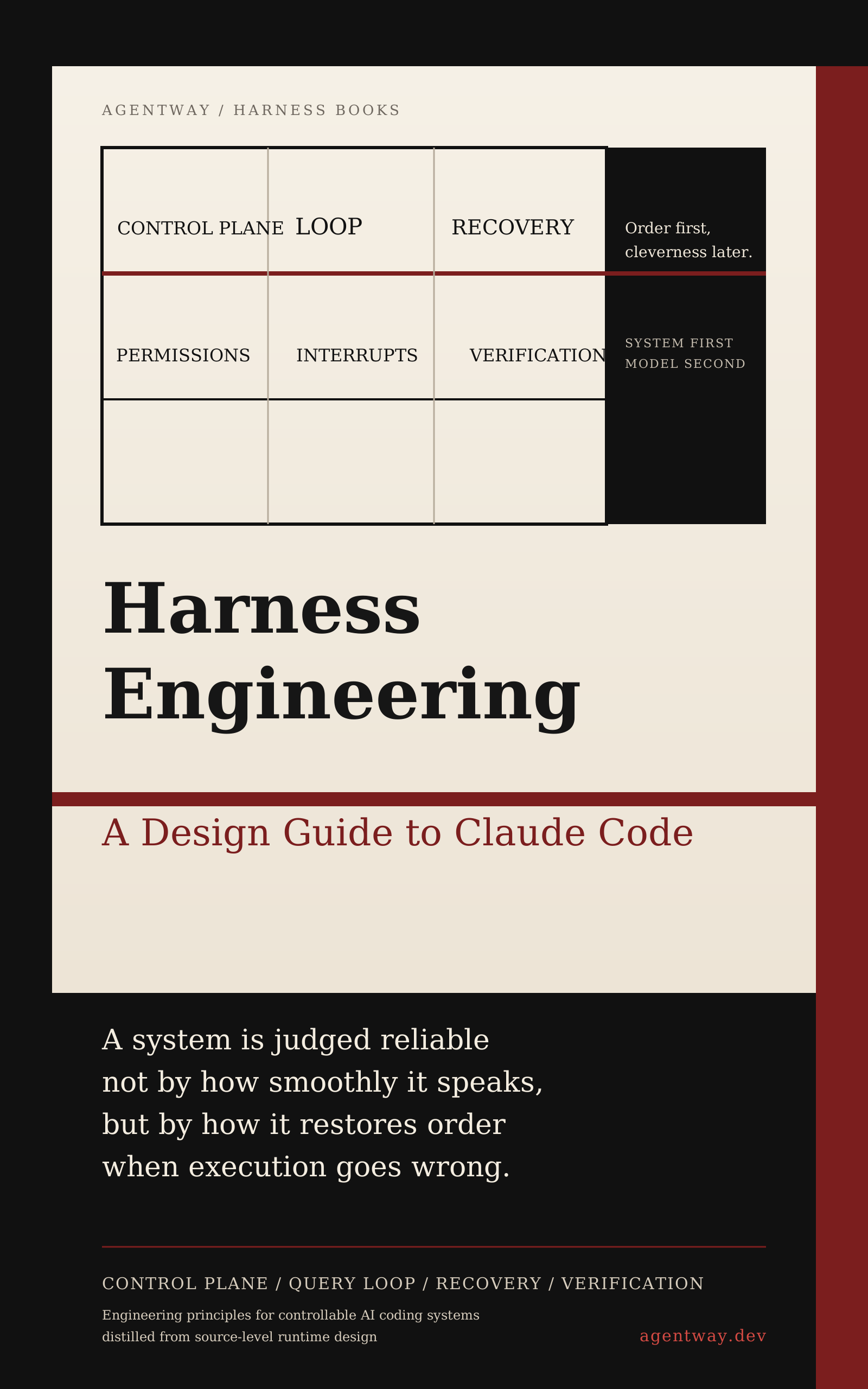
Harness Engineering: A Design Guide to Claude Code Read online · Download PDF |
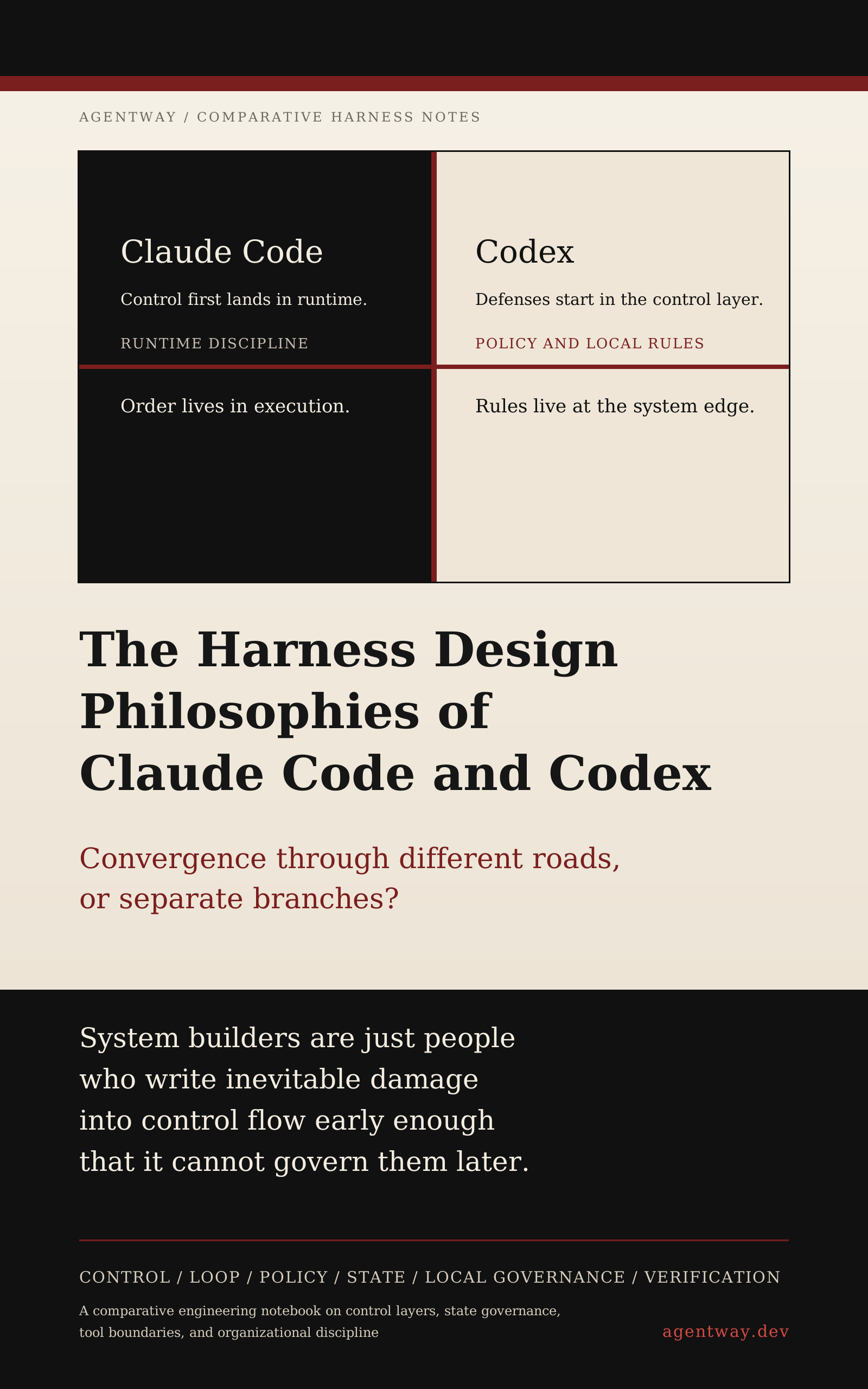
The Harness Design Philosophies of Claude Code and Codex Read online · Download PDF |
These books are not meant to walk line by line through the source code. They focus on how a harness organizes constraints and execution, and how an inherently unstable model can be folded into a sustainable engineering order. Prompt layering, query loops, permission decisions, context governance, failure recovery, multi-agent verification, local rules, and team institutions together form the organ system of a harness. The real danger is not that a model occasionally says something wrong, but that the system has no structure for handling consequences.
Core Claims
- Harness engineering is about how constraint structures organize execution.
- Once a code-writing model enters a real engineering environment, the main problem is no longer answer quality but behavioral consequences.
- Prompts, tools, permissions, state, recovery, verification, and institutions are not accessories around the system. They are organs in the same control structure.
- When comparing agent systems, the key question is not the feature checklist but where order is actually placed.
- If a team cannot turn individual experience into reusable rules, it will struggle to turn an agent into a stable system.
What The Two Books Focus On
Book 1: A Design Guide to Claude Code
The first book uses Claude Code as the observation target and concentrates on runtime structure. Its concern is why a system eventually has to grow components such as a control plane, query loop, tool permissions, context governance, recovery paths, multi-agent verification, and team rules.
Start with Book 1 if these are the questions you care about:
- Why harness engineering is not just prompt engineering at a larger scale
- Why prompts are fundamentally part of the control plane rather than a chat box
- Why model mistakes should be treated as a runtime norm rather than an exceptional event
- Why multi-agent work and verification should not be blended into one vague mechanism
- How a team can solidify personal experience into reusable engineering institutions
Book 2: Comparing Claude Code and Codex
The second book places Claude Code and Codex side by side and asks where each harness places order. One path starts from runtime discipline; the other starts from a more structured control layer. Both systems can work, but they distribute authority differently.
Start with Book 2 if you care more about system choice, architectural judgment, or what to learn when building your own harness:
- What the biggest control-plane divergence is between Claude Code and Codex
- How to align the roles of query loops, threads, rollouts, and state
- What governance roles are played by permissions, sandboxes, and policy languages
- How skills, hooks, and local rules encode organizational habits into the system
- If you want to build your own harness, who to learn from first and which layer to study first
Suggested Reading Paths
- Want the full frame first: read Book 1, then Book 2.
- Already familiar with coding-agent tools and want the architectural split directly: start with Book 2.
- Only want the conclusions: read Book 1 Chapter 9 plus Book 2 Chapter 7.
Full Table of Contents
Book 1 — Harness Engineering: A Design Guide to Claude Code
- Introduction
- Preface: Harness, Terminals, and Engineering Constraints
- Chapter 1 Why Harness Engineering Matters
- Chapter 2 Prompt Is Not Personality, Prompt Is the Control Plane
- Chapter 3 Query Loop: The Heartbeat of an Agent System
- Chapter 4 Tools, Permissions, and Interrupts: Why Agents Cannot Touch the World Directly
- Chapter 5 Context Governance: Memory, CLAUDE.md, and Compact as a Budgeting Regime
- Chapter 6 Errors and Recovery: An Agent System That Keeps Working After Failure
- Chapter 7 Multi-Agent Work and Verification: Managing Instability Through Division of Labor
- Chapter 8 Team Adoption: Turning a Smart Tool into a Reusable Institution
- Chapter 9 Ten Principles of Harness Engineering
- Appendix A Checklists: Turning Principles into Executable Constraints
- Appendix B Diagrams: Drawing the Runtime Skeleton
- Appendix C Source Map: Which Files Ground Each Chapter
Book 2 — The Harness Design Philosophies of Claude Code and Codex
- Introduction
- Reading Map: How to Understand Book 1 and This Comparative Book Together
- Preface: Two Harnesses, Not Accessories on the Same Horse
- Chapter 1: Why We Compare Claude Code and Codex
- Chapter 2: Two Control Planes: Prompt Assembly and Instruction Fragments
- Chapter 3: Where the Heartbeat Lives: Query Loop Compared with Thread, Rollout, and State
- Chapter 4: Tools, Sandboxes, and Policy Languages: Who Stops the Model from Moving Too Fast
- Chapter 5: Skills, Hooks, and Local Rules: How a System Learns Local Discipline
- Chapter 6: Delegation, Verification, and Persistent State: Who Prevents a System from Grading Itself
- Chapter 7: Convergence Through Different Roads, or Separate Branches
- Chapter 8: If You Are Building Your Own Harness, What to Study First
- Appendix A: Source Map That Underpins the Comparison
- Appendix B: Checklist to Determine Where Your Harness Sits
Want To Keep Practicing? Try AgentWay

| AgentWay is a related but separate practice platform. Harness Books explains control structures, engineering judgments, and architectural divergences. AgentWay is where these ideas continue into training paths, drills, project exercises, and agent PoCs. |
Local Build
Build the two locale-aware Honkit sites and then assemble the unified Pages site:
python3 tools/book-kit/build_honkit.py book1-claude-code
python3 tools/book-kit/build_honkit.py book1-claude-code --locale en
python3 tools/book-kit/build_honkit.py book2-comparing
python3 tools/book-kit/build_honkit.py book2-comparing --locale en
python3 tools/book-kit/build_pages_site.py
Final output is written to dist/.
Keywords: Harness Engineering, Claude Code guide, Claude Code vs Codex, AI coding agent, control plane, query loop, agent recovery, agent verification, local governance, approval policy
// faq
What is harness-books?
📚 Two books on harness engineering — the design philosophies behind Claude Code & Codex: constraints, query loops, context governance, multi-agent verification. harness-books.agentway.dev. It is open-source on GitHub.
Is harness-books free to use?
harness-books is open-source, so it is free to use.
What category does harness-books belong to?
harness-books is listed under rag in the Claudeers registry of Claude-compatible tools.
// embed badge

[](https://claudeers.com/harness-books)
// retro hit counter

[](https://claudeers.com/harness-books)
// reviews
// guestbook
// related in RAG & Knowledge
 🔓
🔓Persistent Context Across Sessions for Every Agent – Captures everything your agent does during sessions, compresses it with AI, and injects relevant contex…
 🔓
🔓✨ Light and Fast AI Assistant. Support: Web | iOS | MacOS | Android | Linux | Windows
 🔓
🔓Compress tool outputs, logs, files, and RAG chunks before they reach the LLM. 60-95% fewer tokens, same answers. Library, proxy, MCP server.
 🔓
🔓A light-weight and powerful meta-prompting, context engineering and spec-driven development system for Claude Code by TÂCHES.
// built by
1 of its contributors also build on official projects — claude-code, claude-cookbooks, claude-plugins-official
→ see how harness-books connects across the ecosystem