
glyph-kit
Product-design figures as text: research, flows, wireframes, plans and motion in four shades and a few lines. A skill for Claude Code and Codex.
Install with your AI
Paste into Claude Code, Cursor, or any agent — it reads the repo and wires the tool into your project.
Install and set up glyph-kit (claude-plugin project) into my current project.
Found on https://claudeers.com/glyph-kit
Repo: https://github.com/alextraykov/glyph-kit
Homepage/docs: https://traykov.cc/glyph-kit
Detected install method: claude-plugin → /plugin install glyph-kit@alextraykov/glyph-kit
Category: plugins. Platforms: cli, web.
Read the repo's README for exact setup and env vars, then install it and wire it into my project.

Claudeers Health Verdict:
active; community-verified: false. Confirm the source before running anything.
/plugin marketplace add alextraykov/glyph-kit
/plugin install glyph-kit@alextraykov/glyph-kit
git clone https://github.com/alextraykov/glyph-kit
// compatibility
| Platforms | cli, web |
|---|---|
| Operating systems | — |
| AI compatibility | claude |
| License | MIT |
| Pricing | open-source |
| Language | HTML |

Glyph kit
Get the point across clearly, cheaply, in an aesthetic that doesn't date.
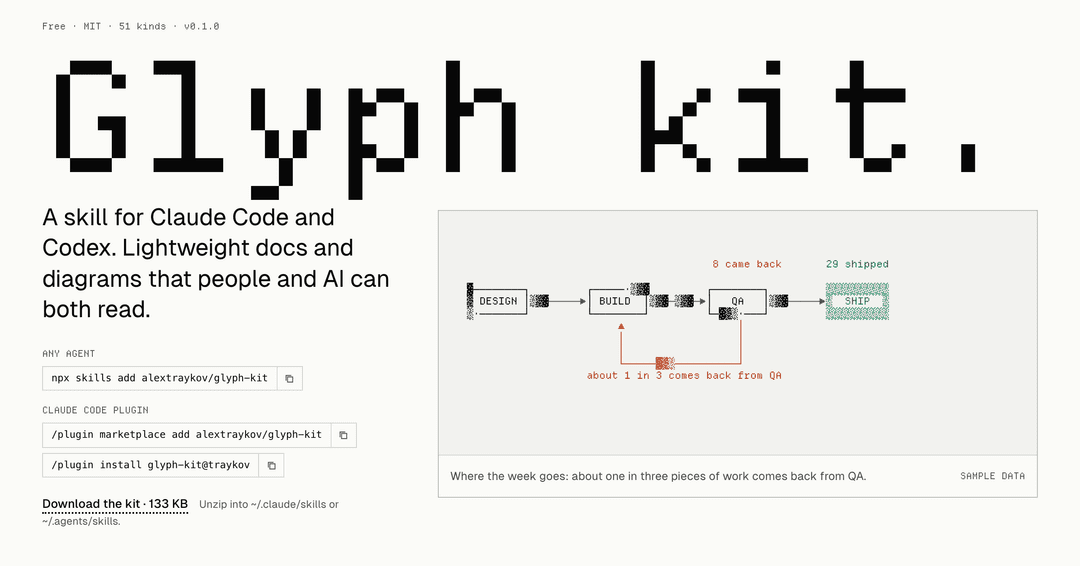
A skill for Claude Code and Codex that draws product-design work in four shades and a few lines: research results, funnels and tests, flows, roadmaps, wireframes, design-system docs, handoff checklists, motion specs and moving diagrams. The agent writes a small spec, and code draws the figure, so the bars always match their numbers. The same spec becomes Markdown for a PR, a deck you present, a report as a PDF, an SVG for a slide, or a prototype built with your design system.
┌─────────────────┐
│   open export   │
└────────┬────────┘
         │
         ▼
┌┄┄┄┄┄┄┄┄┄┄┄┄┄┄┄┄┄┐           ┌─────────────────┐
┆    has data?    ├─── no ───►│   empty state   │
└┄┄┄┄┄┄┄┄┬┄┄┄┄┄┄┄┄┘           │  → import data  │
         │ yes                └─────────────────┘
         ▼
╔═════════════════╗
║    download     ║
╚═════════════════╝
Try it in the browser
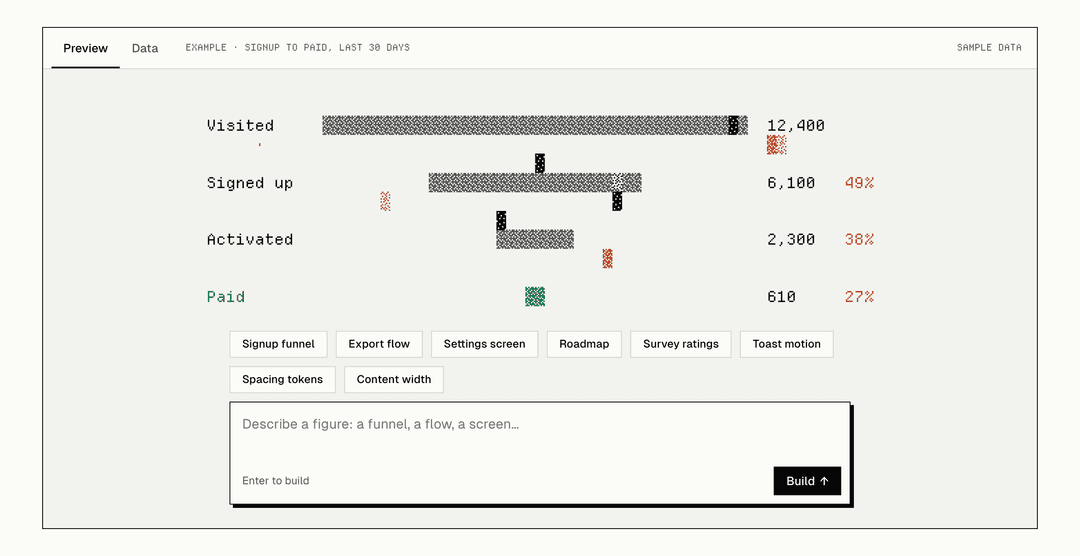
Describe a figure on glyph-kit.traykov.cc and the builder draws it live, with nothing to install.
Install
Any agent (Claude Code, Codex, Cursor and others):
npx skills add alextraykov/glyph-kit
Claude Code, as a plugin that updates:
/plugin marketplace add alextraykov/glyph-kit
/plugin install glyph-kit@traykov
By hand: download the zip from the latest release and unzip it into ~/.claude/skills/ (Claude Code) or ~/.agents/skills/ (Codex).
Font, recommended: Departure Mono, free under the SIL Open Font License. It draws every block and box character at exactly one cell, so figures line up. Any monospace font that covers ░▒▓█ and box drawing works; the kit doesn't require it.
Then ask for what you need, the way you'd ask a colleague: "chart these usability results for the PR", "a wireframe for the notification settings", "a motion spec for the toast, including reduced motion".
What it draws
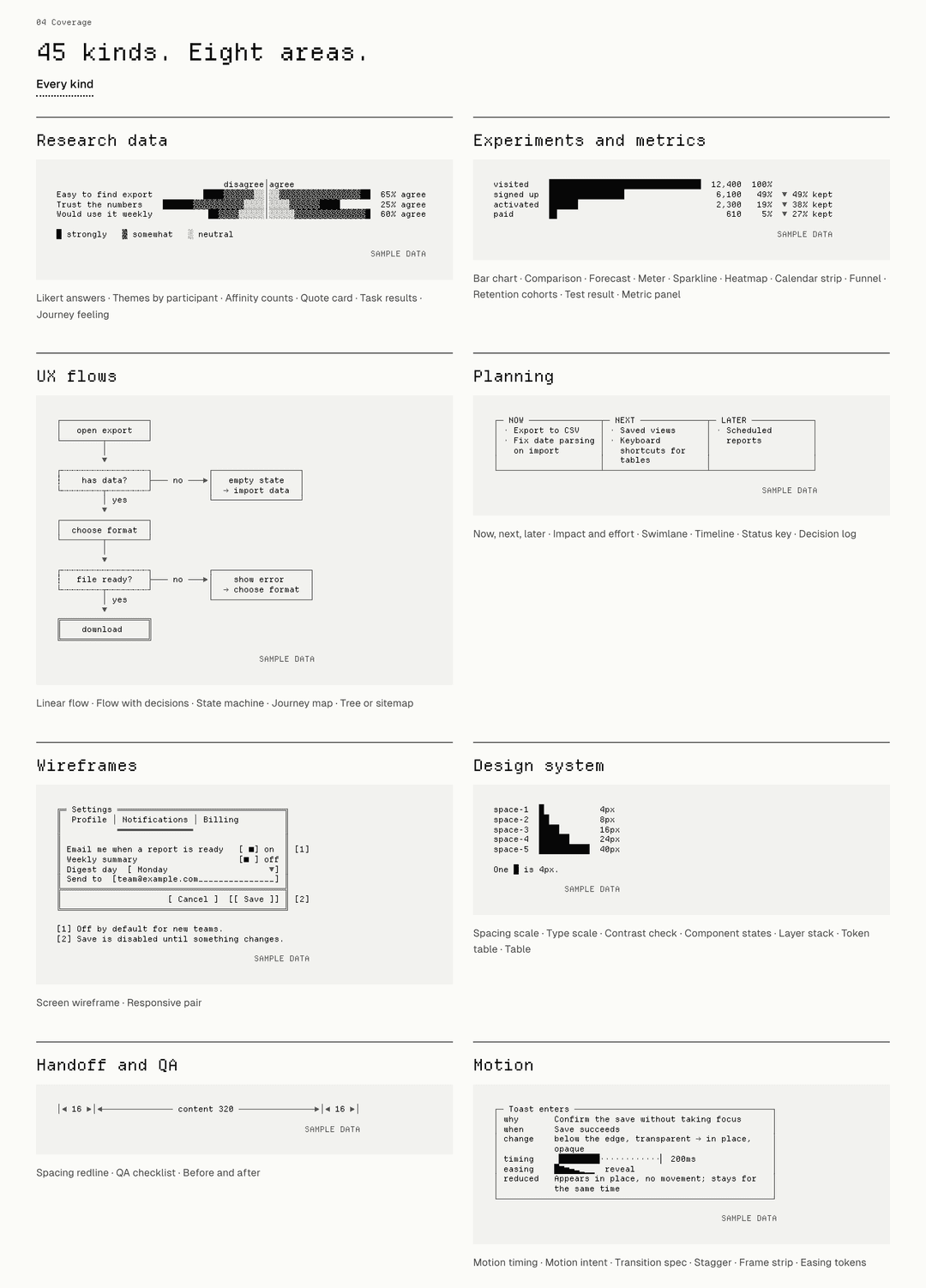
| Area | Types |
|---|---|
| Research data | Likert answers, themes by participant, affinity counts, quote card, task results, journey feeling |
| Experiments and metrics | Funnel, retention cohorts, test result, metric panel, bar chart, comparison, forecast, meter, sparkline, heatmap, calendar strip |
| UX flows | Flow with decisions, linear flow, state machine, journey map, tree or sitemap |
| Planning | Now/next/later, impact and effort, swimlane, timeline, status key, decision log |
| Wireframes | Screen, responsive pair |
| Design system | Spacing scale, type scale, contrast check, component states, layer stack, token table, table |
| Handoff and QA | Spacing redline, QA checklist, before and after |
| Motion | Motion timing, motion intent, transition spec, stagger, frame strip, easing tokens |
| Processes | Rework loops, queues, rollouts, loading sequences, state machines |
| Moving diagrams | Rework loop, funnel, state machine, work queue, staged rollout, loading sequence |
See every one at traykov.cc/glyph-kit.
Why text
- Cheap to make. A figure takes microseconds to draw and is a few hundred bytes, about 65× smaller than a screenshot of it.
- Exact. Code draws from the numbers, so a bar can't disagree with its value, and the same spec always gives the same figure.
- Works anywhere text does. PRs, tickets, READMEs, Slack, terminals, a model's context, print.
- A baseline, not a dead end. Agree the structure in text, then raise the same spec to a prototype, a deck, a report or production code.
What's measured and what isn't: benefits. Text tokens aren't measured yet, and the kit says so.
Guardrails
- No source, no numbers. A figure with numbers needs a source.
- Made-up data is stamped SAMPLE DATA in every format.
- Data from your files:
"data": "@results.csv". - Each type refuses data that can't be true, in plain words.
- Pass specs, not drawings, between agents;
--compactfor plain ASCII when a drawing must go into a model's context.
Without an agent
Node 18 or later, nothing to install:
node skills/glyph-kit/scripts/glyph-kit.mjs types
node skills/glyph-kit/scripts/glyph-kit.mjs render skills/glyph-kit/examples/product/settings.spec.json --to markdown
node skills/glyph-kit/scripts/glyph-kit.mjs export skills/glyph-kit/examples/reports/motion-audit.json --to pdf
Contributing
Issues and ideas are welcome. Run node --test tests/*.test.mjs before a pull request. The kit has no dependencies and keeps it that way.
License
MIT. Made by Alexander Traykov. The story behind it: Four characters.
// faq
What is glyph-kit?
Product-design figures as text: research, flows, wireframes, plans and motion in four shades and a few lines. A skill for Claude Code and Codex.. It is open-source on GitHub.
Is glyph-kit free to use?
glyph-kit is open-source under the MIT license, so it is free to use.
What category does glyph-kit belong to?
glyph-kit is listed under plugins in the Claudeers registry of Claude-compatible tools.
// embed badge

[](https://claudeers.com/glyph-kit)
// retro hit counter

[](https://claudeers.com/glyph-kit)
// reviews
// guestbook
// related in Claude Plugins
 🔓
A single CLAUDE.md file to improve Claude Code behavior, derived from Andrej Karpathy's observations on LLM coding pitfalls.
 🔓
Claude Code is an agentic coding tool that lives in your terminal, understands your codebase, and helps you code faster by executing routine tasks, explainin…
 🔓
"CLI-Anything: Making ALL Software Agent-Native" -- CLI-Hub: https://clianything.cc/
🔓financial-services — a Claude ecosystem project on GitHub.