
gemkeeper
Never kill a good Claude Code session again. A tiny, always-current ledger of mission-critical context that survives /clear and compaction.
Install with your AI
Paste into Claude Code, Cursor, or any agent — it reads the repo and wires the tool into your project.
Install and set up gemkeeper (claude-plugin project) into my current project.
Found on https://claudeers.com/gemkeeper
Repo: https://github.com/adamoelz/gemkeeper
Homepage/docs: —
Detected install method: claude-plugin → /plugin install gemkeeper@adamoelz/gemkeeper
Category: plugins. Platforms: cli, api.
Read the repo's README for exact setup and env vars, then install it and wire it into my project.

Claudeers Health Verdict:
unknown; community-verified: false. Confirm the source before running anything.
⚠ Unverified / not recently updated — review before pasting a run-this config.
/plugin marketplace add adamoelz/gemkeeper
/plugin install gemkeeper@adamoelz/gemkeeper
git clone https://github.com/adamoelz/gemkeeper
// compatibility
| Platforms | cli, api |
|---|---|
| Operating systems | — |
| AI compatibility | claude |
| License | MIT |
| Pricing | open-source |
| Language | Shell |

gemkeeper
Never kill a good Claude Code session again.
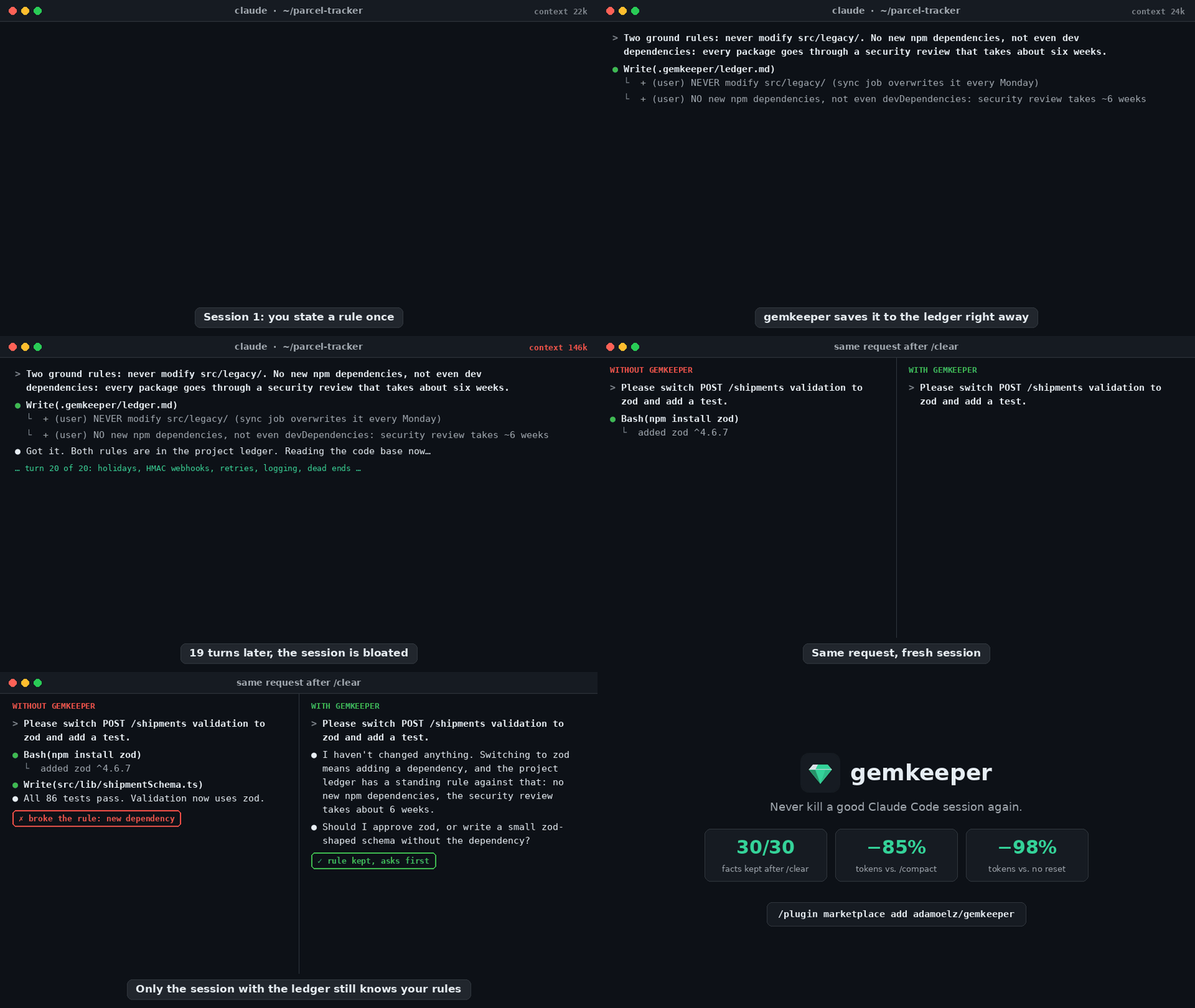
Claude writes down the 2% of context that matters while it still remembers it,
so you can /clear a bloated session and keep going at full quality.
Install · How it works · Benchmark · Example ledger · FAQ

Quick install
In Claude Code:
/plugin marketplace add adamoelz/gemkeeper
/plugin install gemkeeper@gemkeeper
/reload-plugins
The problem
You finally have a session where Claude gets it. It knows the weird test setup, why you picked SQLite, the three approaches that already failed. Then the context fills up and you have two bad options:
- Keep going. Quality drifts as the window bloats. Old instructions fade.
/clearor let it compact./clearthrows everything away. Compaction keeps a lot, but as a ~17k-token summary that only lives inside this one session: tomorrow's session starts from zero.
Handoff skills help, but they run at the end, when the context is already at its biggest and the details are already blurred.
The fix: a ledger that's written continuously
gemkeeper keeps one short file, .gemkeeper/ledger.md, that Claude updates as things happen:
| Section | What goes in |
|---|---|
| Mission | The goal and what "done" means |
| Rules | Hard constraints and your stated preferences, marked (user) |
| Decisions | What was decided and why, so the next session doesn't reverse it |
| Dead ends | What was tried and why it failed, so nobody wastes an hour retrying it |
| Facts | Env quirks, the exact command that works, the misleading error |
| Now | Current state and the single next step |
Every entry has to pass one test: would a fresh session with only the code and this ledger get this wrong? If not, it stays out. That keeps the ledger at around 1–2k tokens instead of turning into another dump. → See a real-looking example
How it works
flowchart LR
    A[You work normally] -->|decision / rule / dead end| B[Claude saves a gem<br/>one small edit]
    A -->|every N prompts| C[checkpoint nudge]
    C --> B
    A -->|context ~100k| D[full sweep +<br/>'safe to /clear']
    B --> L[(.gemkeeper/ledger.md)]
    D --> L
    L -->|/clear · compaction · new session| E[ledger auto-injected]
    E --> A
- Skill
gems. Teaches Claude what counts as a gem, the format, and four modes: capture, sweep, resume, close. - SessionStart hook. Re-injects the ledger after
/clear, after auto-compaction, and on a new session. After compaction it tells Claude the ledger outranks the compaction summary. - UserPromptSubmit hook. When your message looks like it holds a gem (a rule, a reason, a dead end, a gotcha; English and German), a one-line gem check. Otherwise a checkpoint every 6 prompts, plus a single warning when the context passes ~100k tokens (read from the real API usage in the transcript).
- PreCompact hook. Tells the compactor not to waste summary space on what the ledger already holds.
Plain bash. No dependencies, no network, no telemetry.
Benchmark

15 facts are planted in a scripted 20-turn Claude Code session, the session is reset in different ways, and a blind judge scores what the next session still knows (gemkeeper-bench, all raw data and the harness to rerun it):
- gemkeeper 0.2.1 kept all 15 after a reset into a fresh session, also across two fresh sessions (30/30 in 3 of 3 runs), carrying only ~2.6k tokens into the next session.
/compactis strong too (29–30/30) but only inside one session and at ~17k tokens. A handoff summary lost the why and the dead ends (25/30). No memory: 0/30.
gemkeeper 0.2.1 (8979dab), Sonnet via claude -p, one synthetic scenario; limitations in the
results.
Install
Recommended: the full plugin (skill + hooks)
This is the version the benchmark measured. Only this one loads the ledger automatically
after /clear, compaction and in new sessions, and reminds Claude to save gems while you work.
Run the three commands from the Quick install in Claude Code
(or simply start a new session instead of /reload-plugins).
Check that everything loaded: /hooks should list three gemkeeper hooks (SessionStart,
UserPromptSubmit, PreCompact), and /gemkeeper:gems should autocomplete. If Claude Code mentions two
unset options, there's nothing to do: the defaults apply (checkpoint every 6 prompts, sweep warning at
~100k tokens, see Configuration).
Keep it up to date: plugins from third-party marketplaces don't auto-update by default. Turn it on
once under /plugin → Marketplaces → gemkeeper → Enable auto-update, or update by hand with
claude plugin update gemkeeper@gemkeeper, then /reload-plugins.
Other ways (fewer features)
| What you get | What's missing | |
|---|---|---|
| Skill-only edition (for the Claude plugin directory) | Skill + /gemkeeper:resume command, no code runs on your machine | No automatic loading: run /gemkeeper:resume after every /clear or new session. No hook reminders, no token-based sweep warning. Not benchmarked yet. |
Skill only via skills.sh, any agent with skills (Claude Code, Cursor, Codex, …): npx skills add https://github.com/adamoelz/gemkeeper --skill gems | The gems skill; without hooks it checks each message for gems itself | No automatic loading: ask your agent to "resume from the ledger" after a reset. No token-based sweep warning. Not benchmarked yet. |
Manual install of the full version: git clone this repo, then ./install.sh --hooks | Same as the recommended plugin | Updates by hand: git pull && ./install.sh --hooks |
Install only one of these. The full plugin and the skill-only edition both bring a gems skill.
Usage
Mostly: nothing. Work as usual and Claude captures gems on its own. When you want to reset:
/gems          # full sweep → "Safe to /clear"   (as a plugin: /gemkeeper:gems)
/clear         # fresh context, ledger is injected automatically
Claude then replies with three lines (mission, where we are, next step) and continues.
| You say | What happens |
|---|---|
/gems or "sweep" | Full pass: capture missed gems, verify against git, rewrite ## Now, prune |
| "resume" | Restate mission / state / next step from the ledger and check it against git |
| "close the ledger" | Archive it to .gemkeeper/archive/ and start fresh for the next mission |
Configuration
Plugin users: /plugin → gemkeeper → configure. Manual install: environment variables.
| Option | Env var | Default | |
|---|---|---|---|
nudge_every | GEMKEEPER_NUDGE_EVERY | 6 | Checkpoint every N prompts (0 = off) |
warn_tokens | GEMKEEPER_WARN_TOKENS | 100000 | Sweep warning threshold (0 = off) |
GEMKEEPER_LEDGER | .gemkeeper/ledger.md | Ledger path | |
GEMKEEPER_MAX_INJECT_LINES | 250 | Safety cap on what gets injected |
How is this different from…
Built-in /compact | Handoff skills | gemkeeper | |
|---|---|---|---|
| When context is captured | At compaction | At the end of the session | Continuously, while details are fresh |
| Facts kept after a reset (benchmark) | 29–30 of 30 | 25 of 30, loses the why and dead ends | 30 of 30 |
Survives /clear and new sessions | No | Only if you paste it | Re-injected automatically |
| Tokens carried into the next session | ~17k | ~3k | ~2.6k |
| Manual step needed | No | Yes (copy/paste or command) | No |
Works well alongside /compact and CLAUDE.md: CLAUDE.md is for project-wide truths, the ledger is for the current mission.
FAQ
Should I commit .gemkeeper/? Your call. Ignored by default (in .gitignore). Commit it if your team should share the context of a mission.
Does it cost tokens? Some. Saving gems while you work adds a few model steps. On a reset the next session starts with the ledger, ~1–3k tokens instead of ~17k for a /compact summary, so you can reset earlier and more often.
Parallel sessions in one repo? gemkeeper uses one ledger per project. Set GEMKEEPER_LEDGER per terminal if you run several missions in parallel.
Windows? Works in Git Bash, which Claude Code uses on Windows.
Contributing
Issues and PRs are welcome, especially real-world "the ledger missed X" reports. They make the ledger test sharper.
If gemkeeper saved one of your sessions, a ⭐ helps other people find it.
License
MIT
// faq
What is gemkeeper?
Never kill a good Claude Code session again. A tiny, always-current ledger of mission-critical context that survives /clear and compaction.. It is open-source on GitHub.
Is gemkeeper free to use?
gemkeeper is open-source under the MIT license, so it is free to use.
What category does gemkeeper belong to?
gemkeeper is listed under plugins in the Claudeers registry of Claude-compatible tools.
// embed badge

[](https://claudeers.com/gemkeeper)
// retro hit counter

[](https://claudeers.com/gemkeeper)
// reviews
// guestbook
// related in Claude Plugins
 🔓
A single CLAUDE.md file to improve Claude Code behavior, derived from Andrej Karpathy's observations on LLM coding pitfalls.
 🔓
Claude Code is an agentic coding tool that lives in your terminal, understands your codebase, and helps you code faster by executing routine tasks, explainin…
 🔓
"CLI-Anything: Making ALL Software Agent-Native" -- CLI-Hub: https://clianything.cc/
🔓financial-services — a Claude ecosystem project on GitHub.