
FuguNano
Open & nano reimplementation of Sakana Fugu. A repo-native, multi-agent coding loop powered by 9+ LLMs (isolated via Claude Code) and an independent Codex re…
Install with your AI
Paste into Claude Code, Cursor, or any agent — it reads the repo and wires the tool into your project.
Install and set up FuguNano (git-clone project) into my current project.
Found on https://claudeers.com/fugunano
Repo: https://github.com/BicaMindLabs/FuguNano
Homepage/docs: https://github.com/LeoLin990405/FuguNano#readme
Detected install method: git-clone → git clone https://github.com/BicaMindLabs/FuguNano
Category: devtools. Platforms: cli, api.
Read the repo's README for exact setup and env vars, then install it and wire it into my project.

Claudeers Health Verdict:
slowing; community-verified: false. Confirm the source before running anything.
git clone https://github.com/BicaMindLabs/FuguNano
// compatibility
| Platforms | cli, api |
|---|---|
| Operating systems | — |
| AI compatibility | claude |
| License | Apache-2.0 |
| Pricing | open-source |
| Language | TypeScript |
FuguNano
Open & light-weight reimplementation of Sakana Fugu
Evidence-gated Evo Engineering for multi-agent software work
Quick Start | How It Works | Commands | Workflow | Self-Harness | Parity
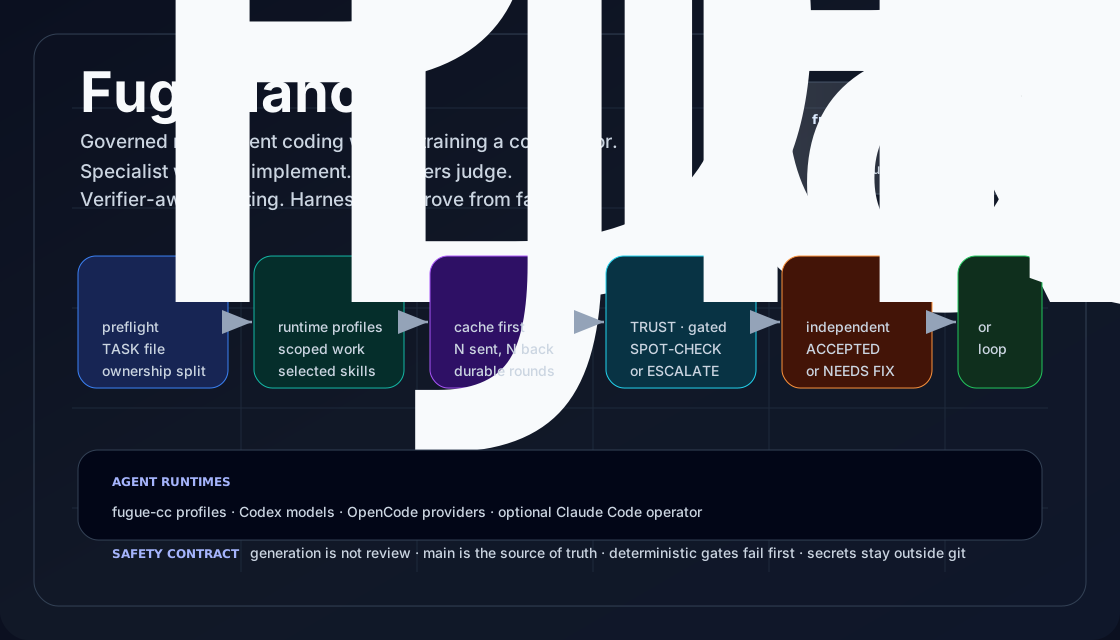
FuguNano is a small, training-free control plane for multi-agent coding. It does not train a conductor — it makes the agents you already have work as one auditable loop: plan, dispatch, gather, review, repair, learn, and improve the harness itself. Every step is backed by deterministic evidence, not model prose.
Why FuguNano
| Problem | FuguNano answer |
|---|---|
| Frontier models or hardware are hard to rely on | Coordinate many available models instead of betting on one path. |
| Multi-agent outputs are easy to lose | Every dispatch can write artifacts; every round has a join barrier. |
| Reviews become prose | Review, incident, recovery, guard, and handoff packets are typed. |
| Agent loops spin forever | The repair loop is bounded, stateful, and reviewer-gated. |
| Prompt/runtime safety is invisible | Guard packets and action certificates create local evidence. |
| Improvements disappear after one run | Experience memory and the evolution loop feed lessons back in. |
How It Works
One short pipeline, gated at every hop by the packets below:
flowchart LR
  A["TASK"] --> B["Plan"]
  B --> C["Guard prompt"]
  C --> D["Dispatch agents"]
  D --> E["Cache + join barrier"]
  E --> F["Integrate worktrees"]
  F --> G["Independent review"]
  G -->|ACCEPTED| H["Ship + learn"]
  G -->|NEEDS FIX| I["Review/incident/recovery packets"]
  I --> J["Bounded repair loop"]
  J --> G
  H --> K["Self-Harness"]
  K --> B
The day-to-day path is intentionally short:
fuguectl preflight --harness lite
fuguectl preflight --harness codex
fuguectl preflight --harness opencode --target opencode/deepseek-v4-flash-free
fuguectl preflight --harness agy
fuguectl preflight --harness fugue-cc

fuguectl task new "implement feature"
fuguectl plan "implement feature" --harness lite --models a,b --out /tmp/fugunano-plan --timeout-ms 120000 --allow-partial --codex-clean --harness-arg x --codex-arg x --opencode-arg x --agy-arg x --task TASK.md
fuguectl guard prompt /tmp/prompt.md --source-ref TASK.md
fuguectl dispatch cc-deepseek --template impl --task TASK.md --task-type backend
fuguectl cache barrier 1
fuguectl integrate --work /path/to/project --agents "cc-deepseek cc-kimi"
fuguectl review packet /tmp/review.txt --json
fuguectl incident packet /tmp/failure.log --json
fuguectl incident recovery /tmp/failure.log --json
fuguectl loop record --verdict NEEDS_FIX --round 1
fuguectl loop decide
fuguectl smoke --harness all --codex-clean --timeout-ms 120000 --task TASK.md --out-dir /tmp/fugunano-smoke writes summary.json with
status/passed/failed/exitCode.
fuguectl plan ... writes <out>/summary.json with
status/exitCode/allowPartial/succeeded/available/failed, so planning
can be inspected without reading model chat.
Quick Start
Requirements: macOS or Linux, Node.js >= 18.18, git, tmux, and whichever
model credentials you choose to use. Codex is recommended for independent
review.
git clone https://github.com/BicaMindLabs/FuguNano fugunano
cd fugunano

/path/to/fugunano/orchestration/fuguectl/fuguectl help quickstart
/path/to/fugunano/orchestration/fuguectl/fuguectl init --dry-run
make doctor
make install
make verify
make ci-clean
Real keys stay outside the repository:
mkdir -p ~/.config
$EDITOR ~/.config/cc-model-secrets.env
For the optional fugue-cc worktree fleet:
cp orchestration/fugue-cc/provider.config.example /path/to/project/.fugue-cc/provider.config
cd /path/to/project
fugue-cc

/path/to/fugunano/orchestration/fuguectl/fuguectl preflight --harness fugue-cc
/path/to/fugunano/orchestration/fuguectl/fuguectl fleet status
Install the operator skill:
make install-skill
~/.claude/skills/fugunano/fuguectl selftest
The skill is convenient for Claude Code, but the workflow is runtime-neutral.
Codex, OpenCode, Antigravity, and future agents use the same agent profiles.
Frontend/UI work may be sent through agy --prompt "..."; review should remain
independent.
Evidence Packets
The loop does not run on prose — it runs on typed packets. Each one is deterministic TypeScript that gates a hop in the pipeline above and becomes fuel for the evolution loop below.
| Packet | Command | Purpose |
|---|---|---|
| Task handoff | fuguectl task handoff | Give the next agent the contract and recent evidence. |
| Task digest | fuguectl task digest | Fit long TASK context into a bounded prompt card. |
| Review packet | fuguectl review packet | Turn reviewer prose into findings and checks. |
| Incident packet | fuguectl incident packet | Label failed traces with cause, layer, and evidence. |
| Incident recovery packet | fuguectl incident recovery | Emit containment, repair, validation, and learning. |
| Runtime guard packet | fuguectl guard prompt | Block risky prompts before runtime dispatch. |
| Action certificate | fuguectl dispatch --certificate | Record proof for a runtime action. |
Agent Runtime Contract
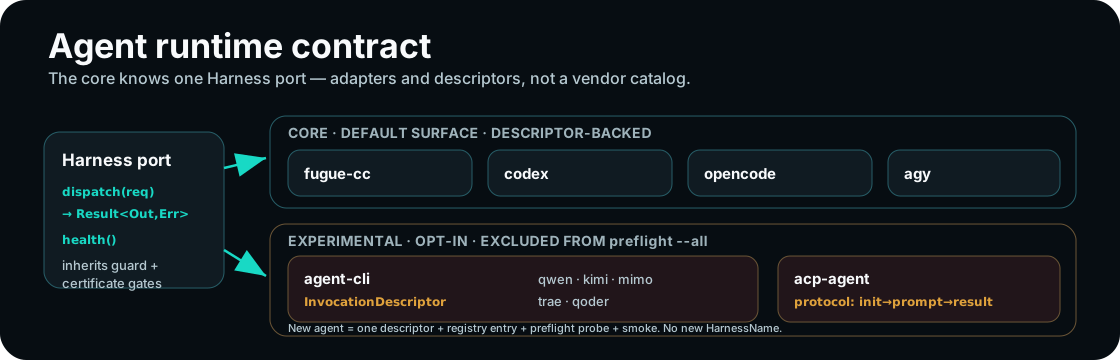
The core only knows one Harness port (dispatch(req) → Result, health()), so
adding an agent never touches orchestration. Four core harnesses
(fugue-cc|codex|opencode|agy) stay in the default surface; experimental
runtimes are opt-in and excluded from preflight --all.
| Tier | Runtime | How it plugs in |
|---|---|---|
| Core | fugue-cc · codex · opencode · agy | descriptor-backed adapters in the default surface |
| Experimental | agent-cli (qwen-code · kimi-code · mimo-code · trae · qoder) | one InvocationDescriptor per agent in the registry — no new HarnessName |
| Experimental | acp-agent | a protocol adapter (initialize → prompt → result), deliberately not a descriptor |
A new agent is a registry entry plus a preflight probe and a smoke test, not a core change. Every harness satisfies the same port, so it inherits the guard and certificate gates for free.
Evidence-gated Evolution
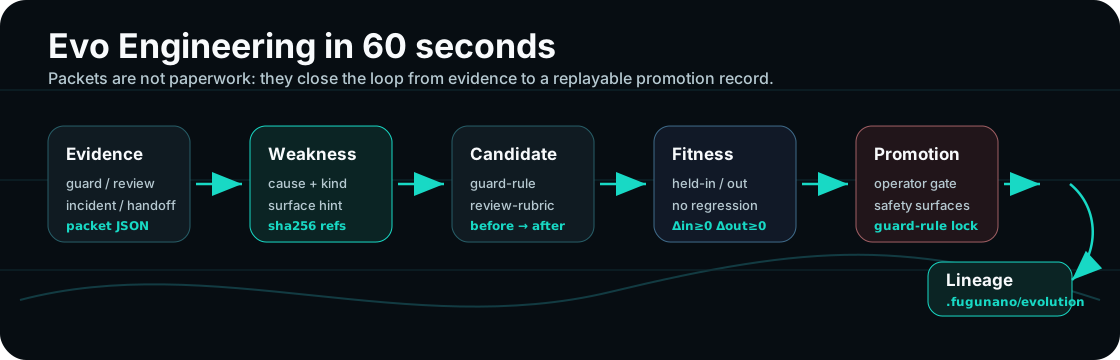
FuguNano treats runtime evidence as the start of an engineering loop, not the
end of a report. Packets become weakness signals; candidate edits to engineering
surfaces are scored on fixed held-in/held-out cases; only non-regressing changes
are promoted and written to auditable lineage. Safety surfaces such as
guard-rule always require operator promotion — the agent can never quietly
relax its own guardrails.
Dogfood fixture: .fugunano/evolution/evo-guard-rule-tighten-gh-release-certificate.json records a real guard-rule promotion for a missing action-certificate check.
Self-Harness is the first backend of this loop — it evolves the harness config surfaces (system prompt, memory, skills, …):
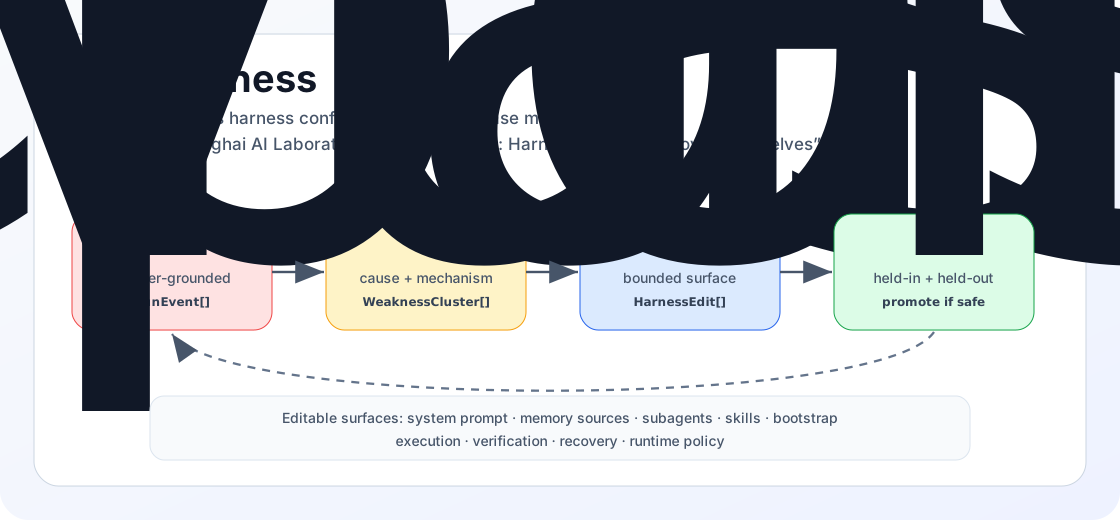
It mines verifier-grounded failures, proposes bounded edits, and promotes only non-regressing changes. Read the operator guide in docs/SELF_HARNESS.md.
Command Surface
orchestration/fuguectl/fuguectl is the production entry point: 28 subcommands,
29 test suites, and 410 wrapper assertions.
| Area | Commands |
|---|---|
| Setup | fuguectl doctor, fuguectl init --dry-run|--write, fuguectl version, fuguectl preflight --harness fugue-cc|codex|opencode|agy|lite|all, fuguectl smoke, fuguectl fleet status|up|down |
| Planning | fuguectl task new|log|done|handoff|digest, fuguectl template <name>, fuguectl plan "<goal>" [--harness h|lite] [--models a,b] [--out dir] [--timeout-ms n] [--allow-partial] [--codex-clean] [--harness-arg x] [--codex-arg x] [--opencode-arg x] [--agy-arg x] [--task f], fuguectl goal template|show|check |
| Routing | fuguectl allocate <type>, fuguectl workspace list|show|model|context, fuguectl agents template|validate|list|resolve, fuguectl skills index|list|match|show|inject|validate|forge |
| Dispatch | fuguectl guard prompt <file|->, fuguectl dispatch <target> [--certificate <file>], fuguectl cache init|put|fail|barrier|collect|resume |
| Review + repair | fuguectl integrate --work <repo>, fuguectl review packet <file|->, fuguectl incident packet|recovery <file|->, fuguectl loop init|record|decide|status, fuguectl run set|round|status|next|clear, fuguectl summary <round> |
| Memory + evolution | fuguectl experience add|audit|eval|learn|list|policy|promote|recall|show, fuguectl evolve mine|validate|promote|history, fuguectl self-harness template|run, fuguectl runtime check|adapt, fuguectl selftest |
Fugu, OpenFugu, FuguNano
| System | Coordination layer | Best for |
|---|---|---|
| Sakana Fugu | Learned conductor behind an API | Managed multi-model synthesis. |
| OpenFugu | Open training and serving stack | Rebuilding and studying the conductor route. |
| FuguNano | Repo-native engineering loop | Training-free orchestration, review, and repair. |
FuguNano is the lightest open entry point on this road: start with policies, ports, review gates, evidence packets, and harness improvement before deciding whether a learned conductor is worth the cost.
Docs Map
| Need | File |
|---|---|
| Agent profiles and runtimes | docs/AGENT_RUNTIME.md |
| Full workflow | docs/WORKFLOW.md |
| Architecture and ports/adapters | docs/ARCHITECTURE.md |
| Self-Harness guide | docs/SELF_HARNESS.md |
| Parity and references | docs/PARITY.md |
| Integration notes | docs/INTEGRATIONS.md |
| Agent-facing contract | AGENTS.md |
Development
npm run scan
npm run lint:launchers
npm run check:docs
npm run test:fuguectl
cd engine && npm run check && npm run build
npm run ci
The engine is strict TypeScript with ports and adapters. The repo keeps shell
usage as thin launchers; new durable behavior should live in engine/.
Acknowledgements
FuguNano builds on ideas from Sakana AI Fugu, OpenFugu, Shanghai AI Lab Self-Harness, Codex/Claude/OpenCode runtime tooling, and recent work on agent review, provenance, incident response, memory, and prompt safety. See NOTICE and docs/PARITY.md for the reference list.
Security
Do not commit real keys. Put local secrets in ~/.config/cc-model-secrets.env.
Report vulnerabilities privately.
License
Apache-2.0. See LICENSE.
// faq
What is FuguNano?
Open & nano reimplementation of Sakana Fugu. A repo-native, multi-agent coding loop powered by 9+ LLMs (isolated via Claude Code) and an independent Codex reviewer. Lightweight, bounded, and self-improving (Self-Harness)—no coordinator training required.. It is open-source on GitHub.
Is FuguNano free to use?
FuguNano is open-source under the Apache-2.0 license, so it is free to use.
What category does FuguNano belong to?
FuguNano is listed under devtools in the Claudeers registry of Claude-compatible tools.
// embed badge

[](https://claudeers.com/fugunano)
// retro hit counter

[](https://claudeers.com/fugunano)
// reviews
// guestbook
// related in Developer Tools
 🔓
🔓The agent harness performance optimization system. Skills, instincts, memory, security, and research-first development for Claude Code, Codex, Opencode, Curs…
 🔓
🔓Makes your AI agent think like the laziest senior dev in the room. The best code is the code you never wrote.
 🔓
🔓Use Garry Tan's exact Claude Code setup: 23 opinionated tools that serve as CEO, Designer, Eng Manager, Release Manager, Doc Engineer, and QA
 🔓
🔓AI coding assistant skill (Claude Code, Codex, OpenCode, Cursor, Gemini CLI, and more). Turn any folder of code, SQL schemas, R scripts, shell scripts, docs,…