
ForgeDock
GitHub as a knowledge graph for AI agents. Autonomous dev pipeline for Claude Code - investigate, build, review, merge. Issue in, PR out.
Install with your AI
Paste into Claude Code, Cursor, or any agent — it reads the repo and wires the tool into your project.
Install and set up ForgeDock (claude-plugin project) into my current project.
Found on https://claudeers.com/forgedock
Repo: https://github.com/RapierCraftStudios/ForgeDock
Homepage/docs: http://ForgeDock.io/
Detected install method: claude-plugin → /plugin install forgedock@RapierCraftStudios/ForgeDock
Category: automation. Platforms: cli, api, web, mobile.
Read the repo's README for exact setup and env vars, then install it and wire it into my project.

Claudeers Health Verdict:
slowing; community-verified: false. Confirm the source before running anything.
/plugin marketplace add RapierCraftStudios/ForgeDock
/plugin install forgedock@RapierCraftStudios/ForgeDock
git clone https://github.com/RapierCraftStudios/ForgeDock
// compatibility
| Platforms | cli, api, web, mobile |
|---|---|
| Operating systems | — |
| AI compatibility | claude |
| License | AGPL-3.0 |
| Pricing | open-source |
| Language | JavaScript |
ForgeDock
Autonomous software development for Claude Code.
ForgeDock turns every bug found, every fix shipped, and every review finding into structured context that makes the next agent smarter. It catches integration bugs that code review can't see — missing route registrations, env vars present in CI but absent in deploy, Docker permission mismatches, sibling code paths left unfixed. Every finding feeds back as a prevention rule for future builds. After thousands of issues on production codebases, the system catches bugs before they reach a testing branch.
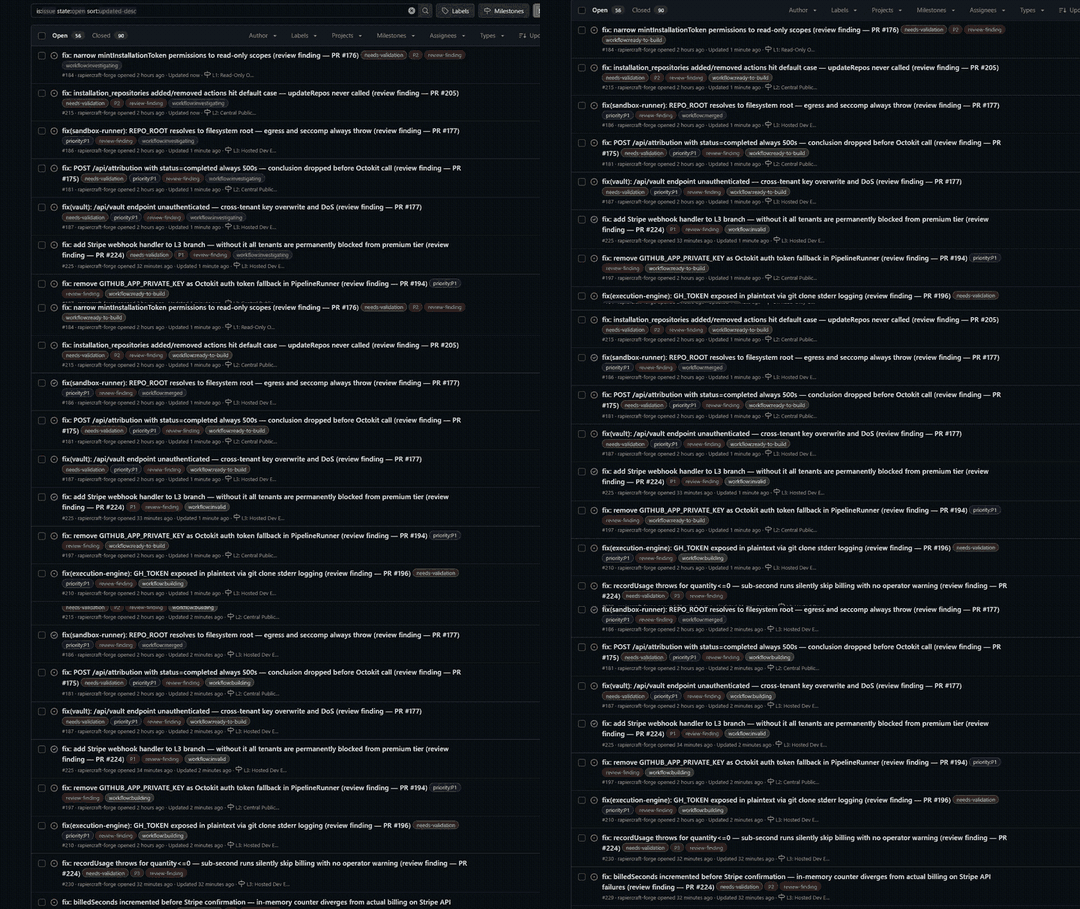
15+ issues orchestrated in parallel — investigated, built, reviewed, and shipped autonomously.
Why ForgeDock
AI coding agents forget everything between sessions. They re-investigate the same bugs, miss context from past PRs, and make mistakes that were already caught and fixed last week. There's no institutional memory.
ForgeDock fixes this by using GitHub itself as the memory layer. Every pipeline stage writes structured FORGE: annotations to issues and PRs. Every downstream agent reads them. When a new session starts — even after Claude's context resets — the agent queries GitHub and picks up exactly where the last one left off.
How Is This Different
ForgeDock is not another AI coding agent. It's a set of prompt-engineered command specs (.md files) that run inside Claude Code. No new runtime, no separate process, no vendor lock-in beyond what you already use.
| ForgeDock | Plain Claude Code | Cursor / Windsurf | Devin / Sweep | |
|---|---|---|---|---|
| Memory across sessions | Structured annotations on GitHub | CLAUDE.md + manual notes | Per-project context | Proprietary cloud state |
| Autonomous pipeline | Full lifecycle: investigate → merge | Manual, step by step | Autocomplete + chat | Autonomous but opaque |
| Review quality | 9 domain-specialist agents | You review everything | Basic suggestions | Varies |
| Infrastructure needed | None — just npx forgedock | None | IDE-specific | Cloud service |
| Codebase visibility | Everything stays on GitHub | Local | Local + cloud sync | Cloud-only |
What You Get
| Capability | How it works |
|---|---|
| Full-lifecycle automation | /work-on #42 — investigates the issue, architects a fix, builds it, runs quality gates, opens a PR, and reviews it. You click merge. |
| Persistent agent memory | Structured FORGE: annotations on GitHub issues/PRs survive context resets and session boundaries. Agents never start blind. |
| 9 specialist review agents | Security, billing, database, concurrency, auth, frontend, API, performance, infrastructure — every PR gets domain-expert review. |
| Cross-issue knowledge graph | Agent fixing issue #43 reads the investigation from #42 and applies the known pattern — no re-investigation. |
| Self-improving pipeline | Review agents learn from past findings — recurring patterns automatically become new quality gate checks. |
| Parallel orchestration | /orchestrate decomposes milestones into waves and runs /work-on on each in parallel. |
Cost note: ForgeDock itself is free and open-source. It orchestrates Claude Code sessions, so you pay your normal Anthropic API usage. A typical
/work-onrun on a straightforward bug uses roughly the same tokens as a 15–20 minute manual Claude Code session.
See a real pipeline run
Here's what a real run looks like on issue #619 — a performance bug where command specs were burning ~200K tokens in context:
FORGE:INVESTIGATOR  →  CONFIRMED. All 27 command spec files (848KB) load into
                        context at session start via symlinks. ~200K tokens wasted.

FORGE:CONTRACT      →  Replace symlink-based install with stub-file pattern.
                        Installer parses frontmatter, writes minimal stubs.

FORGE:CONTEXT       →  Issue #577: install() had overly broad catch{} — fixed to
                        check err.code === 'ENOENT'. Issue #587: Windows writes
                        regular files, not symlinks — keep both paths working.

FORGE:ARCHITECT     →  3 new functions in bin/forgedock.mjs: parseFrontmatter(),
                        generateStubContent(), updated install() flow.

FORGE:BUILDER       →  Branch feat/stub-install-pattern-619, 1 file changed.

FORGE:REVIEW        →  Auto-merged to staging.

FORGE:TRAJECTORY    →  Full audit trail recorded.
The context phase surfaced two historical bugs (#577, #587) in the same module — preventing the builder from repeating known mistakes. View the full issue →
Install
Requirements: Node.js 18+, Claude Code, GitHub CLI (gh), yq (YAML parser used by pipeline commands to read forge.yaml), and Playwright MCP (browser automation for /qa-sweep and visual testing commands)
Playwright MCP is a guaranteed ForgeDock dependency for browser automation commands. Register it in Claude Code after installing ForgeDock:
claude mcp add playwright npx @playwright/mcp@latestVerify with
npx forgedock doctor— Check 9 confirms Playwright MCP is registered.
# Install pipeline commands
npx forgedock

# Generate config for your repo
npx forgedock init
This symlinks 25+ pipeline commands into ~/.claude/commands/ and generates a forge.yaml config in your project root. That's it — open Claude Code and run /work-on #42.
Other install methods & commands
Claude Code Plugin Marketplace (v2.1.143+):
/plugin marketplace add RapierCraftStudios/ForgeDock
/plugin install forgedock@forgedock
CLI commands:
npx forgedock update       # Pull latest commands
npx forgedock uninstall    # Remove all ForgeDock commands from ~/.claude/commands/
npx forgedock help         # Show all available commands
AI-powered setup (inside Claude Code):
/forgedock-init # Guided config walkthrough — scans your repo, queries GitHub, auto-fills forge.yaml
Global Command Namespace
ForgeDock owns the global ~/.claude/commands/ namespace. When npx forgedock runs, it symlinks all pipeline commands there and writes a .symlink-source sentinel file so other installers can detect the owner:
~/.claude/commands/
  .symlink-source       ← sentinel: "ForgeDock owns this namespace"
  work-on.md            → /path/to/forgedock/commands/work-on.md
  review-pr.md          → /path/to/forgedock/commands/review-pr.md
  ...
Project-specific commands should install to the project-local .claude/commands/ directory instead:
your-project/
  .claude/
    commands/
      my-custom-command.md   ← project-local — Claude Code merges these in
Claude Code merges global (~/.claude/commands/) and project-local (.claude/commands/) automatically. Project-local commands win on name collisions.
If another tool runs its own install script that targets ~/.claude/commands/, it will silently repoint ForgeDock's symlinks to its own source path — breaking all ForgeDock commands globally. The .symlink-source sentinel is a machine-readable warning to other installers; ForgeDock also emits a per-command warning during npx forgedock install when it detects a collision.
How It Works
Issue → Investigate → Architect → Build → Quality Gate → Review → Merge
              ↓            ↓         ↓          ↓            ↓
        writes to     reads from  reads from  reads from   writes to
         GitHub        GitHub      GitHub      GitHub       GitHub
Each stage writes a structured annotation (<!-- FORGE:INVESTIGATOR -->, <!-- FORGE:CONTRACT -->, etc.) to the GitHub issue or PR. Each downstream stage reads what came before. The gh CLI is the query interface.
| Stage | What it does |
|---|---|
| Investigate | Traces root cause via git blame, related issues/PRs. Writes verdict, affected files, severity. |
| Context | Surfaces historical bugs and known pitfalls from the same module. Institutional memory. |
| Architect | Produces ordered implementation plan with exact file/function/line targets. |
| Build | Writes code, creates branch, makes commits. Follows the architect's plan. |
| Quality Gate | 14+ domain-specific checks (security, auth, DB, concurrency, etc.) |
| Review | 9 specialist agents review the PR diff with confidence-rated findings. |
| Close | Records full audit trail as FORGE:TRAJECTORY. |
Labels track workflow state (workflow:investigating, workflow:building, workflow:in-review, workflow:merged). The pipeline resumes from whatever state GitHub says it's in — restart-safe by design.
Commands
| Command | What it does |
|---|---|
/work-on #N | Full issue lifecycle: investigate → build → review → merge |
/issue | Create a pipeline-ready GitHub issue |
/orchestrate | Parallel execution across a milestone's issues |
/review-pr | PR review with 9 domain-specialist agents |
/quality-gate | Pre-commit checks across 14+ domains |
/milestone | Plan and ship milestones |
/deploy-info | Staging vs main diff with risk assessment |
/review-pr-staging | Staging-to-main review gate |
/rollback | Automated revert PR for production incidents |
/incident-response | P0 coordination: hotfix, timeline, postmortem |
/autopilot | Autonomous improvement: recon → triage → fix |
/pipeline-health | Self-analysis and prompt tuning |
/security-audit | 4-phase security posture audit |
/qa-sweep | Full platform QA via browser automation |
/analytics | Pull metrics from GSC, Clarity, Umami, Stripe |
/cleanup | Sweep stale issues, branches, worktrees |
Uninstall
npx forgedock uninstall
Removes all ForgeDock command symlinks from ~/.claude/commands/. Your forge.yaml config and any FORGE: annotations on GitHub issues/PRs are left untouched.
Documentation
- Getting Started in 5 Minutes — install, configure, first pipeline run
- How the Knowledge Graph Works — FORGE annotations, context relay, compaction resilience
- ForgeDock vs. Manual Workflows — structured pipelines vs. ad-hoc prompting
- FORGE Annotation Protocol — open standard spec for AI context passing
- Command Reference — all 25+ commands with usage and examples
Star History
Contributing
PRs welcome. Every change goes through a PR, tested against 3+ scenarios, using conventional commits (fix(command):, feat(command):, refactor(command):).
License
ForgeDock uses a dual-licensing model:
-
AGPL-3.0 — free to use, modify, and distribute for open-source and personal use. If you modify ForgeDock and offer it as a service (including over a network), you must open-source your modifications under AGPL-3.0.
-
Commercial License — for organizations that need to use ForgeDock in proprietary workflows or products without AGPL-3.0 copyleft obligations. Contact RapierCraft Studios to obtain a commercial license.
The open-source core remains free under AGPL-3.0. The commercial license is an exception for customers who cannot meet the copyleft requirements.
Built by RapierCraft Studios
// faq
What is ForgeDock?
GitHub as a knowledge graph for AI agents. Autonomous dev pipeline for Claude Code - investigate, build, review, merge. Issue in, PR out.. It is open-source on GitHub.
Is ForgeDock free to use?
ForgeDock is open-source under the AGPL-3.0 license, so it is free to use.
What category does ForgeDock belong to?
ForgeDock is listed under automation in the Claudeers registry of Claude-compatible tools.
// embed badge

[](https://claudeers.com/forgedock)
// retro hit counter

[](https://claudeers.com/forgedock)
// reviews
// guestbook
// related in Automation & Workflows
 🔓
🔓 🔓
🔓The API to search, scrape, and interact with the web at scale. 🔥
 🔓
🔓🌐 Make websites accessible for AI agents. Automate tasks online with ease.
 🔓
🔓Taste-Skill - gives your AI good taste. stops the AI from generating boring, generic slop