
fable-mode
Run Claude Fable 5 on Opus 4.8 in Claude Code. The Mythos-class model pulled by export controls — brought back as a native agentic distillation (FABLE_CODE.m…
Install with your AI
Paste into Claude Code, Cursor, or any agent — it reads the repo and wires the tool into your project.
Install and set up fable-mode (git-clone project) into my current project.
Found on https://claudeers.com/fable-mode-2
Repo: https://github.com/HalalifyMusic/fable-mode
Homepage/docs: —
Detected install method: git-clone → git clone https://github.com/HalalifyMusic/fable-mode
Category: skills. Platforms: cli, api, web.
Read the repo's README for exact setup and env vars, then install it and wire it into my project.

Claudeers Health Verdict:
active; community-verified: false. Confirm the source before running anything.
git clone https://github.com/HalalifyMusic/fable-mode
// compatibility
| Platforms | cli, api, web |
|---|---|
| Operating systems | — |
| AI compatibility | claude |
| License | NOASSERTION |
| Pricing | open-source |
| Language | Python |
fable-mode
Run Claude Fable 5 on Opus 4.8. The Mythos-class model the U.S. government pulled after three days — brought back as a system prompt.
One clone, one install: a native distillation of how Fable 5 actually operates inside Claude Code + a measured execution playbook + verification hooks + design and agent skills — wired into Claude Code. (The leaked consumer prompt lives on in reference/, but it's no longer what gets loaded — see below for why.)
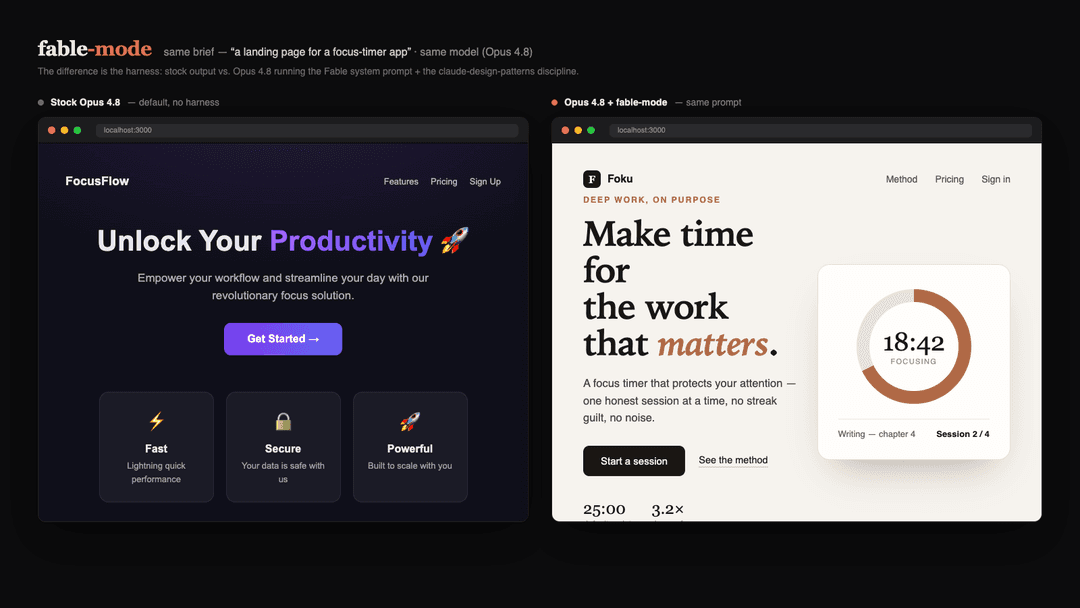 Same brief, same model. Left: stock Opus 4.8. Right: Opus 4.8 in fable-mode.
Why this exists
Claude Fable 5 shipped on June 9, 2026 as Anthropic's first Mythos-class model — and was suspended on June 12 under a U.S. export-control directive. You can't call the model right now.
But when its system prompt leaked, people noticed: a lot of what made Fable feel different — its taste, its directness, its tool-use instincts — lived in the prompt, not only the weights. Run that prompt on Opus 4.8 and the output changes character. The community calls it Fable 5 Lite.
There was a catch, though: the leaked prompt is Fable's consumer chat prompt. It governs claude.ai — artifacts, web-search etiquette, copyright limits, a Linux VM at /mnt — and almost none of that exists in Claude Code. Appending it to a terminal session spends ~42k tokens teaching the model rules for an environment it isn't in, some of which conflict outright with the Claude Code harness. Fable-in-Claude-Code runs on a different prompt entirely: outcome-first communication, autonomous-turn discipline, evidence-before-state-change, irreversibility-scaled reasoning.
So v2 replaces the leaked prompt with FABLE_CODE.md — an original distillation of that agentic layer, written against the real Claude Code Fable harness — plus the part no prompt can give you: measured discipline and verification, enforced by hooks.
Quickstart
One installer, every OS — it's Python (already required by the hooks), so the same command works on Windows, macOS, and Linux:
git clone https://github.com/HalalifyMusic/fable-mode
cd fable-mode
python install.py        # Windows  (use python3 on macOS / Linux)
Then reload your shell and launch:
fable # Opus 4.8 + FABLE_CODE.md + ultracode
Prefer a native one-liner? ./install.sh (macOS / Linux) and .\install.ps1 (Windows) just locate Python and run install.py for you.
Reload after install: source ~/.zshrc (or ~/.bashrc) on Unix; . $PROFILE in PowerShell on Windows.
Requirements: Python on PATH (
python --version) for the hooks, and Claude Code installed for thefablelauncher. On Windows, if.\install.ps1is blocked by execution policy, runpython install.pydirectly (no policy needed).
The installer copies everything into ~/.claude, adds the fable launcher (to your shell rc on Unix, to your PowerShell $PROFILE on Windows), and merges your settings (with a backup) — writing the absolute interpreter and hook paths so the hooks fire on every platform. Idempotent: safe to re-run. Needs Python ≥ 3.9 (the hooks are stdlib-only — no pip installs). No model switch, no API key — it runs on the Opus 4.8 you already have.
Uninstall
python uninstall.py # Windows (python3 on macOS / Linux; or ./uninstall.sh, .\uninstall.ps1)
Removes the bundled files from ~/.claude, strips the fable launcher line, and drops the two Fable hooks from settings.json (writing a fresh backup). It's surgical — your own skills, unrelated hooks, and alwaysThinkingEnabled are left untouched.
What's in the bundle
FABLE_CODE.md— the core. An original distillation of Fable 5's actual Claude Code operating layer: the final-message contract, outcome-first summaries, act-don't-ask autonomy, the report-vs-fix distinction, evidence-before-state-change, irreversibility-scaled reasoning, and the voice rules that genuinely transfer from the consumer prompt. This is what the launcher appends and the trigger hook injects.FABLE_PLAYBOOK.md— the measured layer. Fable-5 vs Opus-4-8 tool traces turned into rules: reasoning density (70% vs 47%), verify-after-edit, parallelism — plus an evidence-ledger grounding protocol. Original work, corrected in v2 against the harness itself (see the Fix 2 measurement caveat).reference/fable-system-consumer.md— the leaked Fable 5 consumer prompt, kept for reference and provenance only. Never installed, never injected.- Hooks —
fable-trigger.pyis a dual-event hook (SessionStart + UserPromptSubmit) that injectsFABLE_CODE.mdrules once per session (always on, sized under Claude Code's 10k-char hook-output cap) and directs the model to read the full playbook onxhigh/max/ultracodeeffort, the phrase "use fable", or when a prompt looks like a real engineering task (auto-activation heuristic; opt out withFABLE_AUTO=0).test-after-edit.pyruns your project's tests after each edit and reports the result back — the one habit no model keeps on willpower. fable doctor— one command that verifies the whole install/activation chain: files present, hooks registered, interpreter paths, Claude CLI version, a live-fire injection test, and transcript evidence of past activations. Run it any time something seems off./fableskill — explicit mid-session activation: reads the playbook + behavior layer and adopts both, no launcher required./groundskill +grounding-verifieragent — a self-terminating grounding loop and a cold verifier that assumes every claim is wrong until the live code proves it.- Skills —
fable(activation),claude-design-patterns(web-UI engineering),webapp-testing,mcp-builder,skill-creator,explore-data. fablelauncher — pins--model claude-opus-4-8, appendsFABLE_CODE.md, setsxhigheffort, and declares the mode viaFABLE_MODE=1so the playbook injects at session start on every Claude Code version (fable.zshfor Unix shells,fable.ps1for PowerShell).fable --ultraadds ultracode multi-agent orchestration;fable doctorverifies the install.
Pairs with loop-harness-system
loop-harness-system is the execution-discipline layer to this repo's behavior layer: contract-first building, fresh-context evaluation, crash-resumable 3-file state. When it's installed (~/.claude/docs/LOOP-HARNESS.md exists), fable-trigger.py adds a one-line bridge to every session pointing the model at it — fable-mode governs how each role thinks and writes, the harness governs how work is structured and judged.
The honest ceiling
This gives you Fable's disposition, not its raw capability. Reasoning depth, vision, long-horizon autonomy, and design intuition are weights-bound — only partly reachable by instruction. What transfers well: voice, formatting, grounding and verification, design patterns, effort configuration. On verification, parallelism, and communication it actually beats Fable, because those are enforced by hooks instead of left to intention.
About the bundled pieces
- The leaked Fable 5 consumer prompt (
reference/fable-system-consumer.md) is Anthropic's IP. It is already mirrored across high-star public repos; it's kept here for reference and provenance only — it is never installed or injected. Not ours to license, removable on request. webapp-testing,mcp-builder,skill-creatorare from anthropics/skills (Apache-2.0);explore-datais from anthropics/knowledge-work-plugins (Apache-2.0).
Credits
Made by HalalifyMusic — compiled from community sources (leaked prompts, public Anthropic skills) and original measurement and tooling work. Activation reliability improvements (fable doctor, dual-event SessionStart hooks, auto-activation heuristic, test-hook trust gate, skill preservation) adapted from @denfry's PR #3.
Contributing
Issues and PRs welcome — see CONTRIBUTING.md for dev setup and conventions, SECURITY.md for the security model (the hooks run code on your machine), and CHANGELOG.md for the running history.
License
MIT on the original code (see LICENSE). The bundled Fable system prompt and the Anthropic skills carry their own terms.
// faq
What is fable-mode?
Run Claude Fable 5 on Opus 4.8 in Claude Code. The Mythos-class model pulled by export controls — brought back as a native agentic distillation (FABLE_CODE.md), measured playbook, verification hooks, and design/MCP/test skills. "Fable 5 Lite," done right.. It is open-source on GitHub.
Is fable-mode free to use?
fable-mode is open-source under the NOASSERTION license, so it is free to use.
What category does fable-mode belong to?
fable-mode is listed under skills in the Claudeers registry of Claude-compatible tools.
// embed badge

[](https://claudeers.com/fable-mode-2)
// retro hit counter

[](https://claudeers.com/fable-mode-2)
// reviews
// guestbook
// related in Claude Skills
 🔓
🔓An agentic skills framework & software development methodology that works.
 🔓
🔓 🔓
🔓💫 Toolkit to help you get started with Spec-Driven Development
 🔓
🔓AI coding assistant skill (Claude Code, Codex, OpenCode, Cursor, Gemini CLI, and more). Turn any folder of code, SQL schemas, R scripts, shell scripts, docs,…