
exterminator
Claude Code + Codex skill that fixes bugs at the root cause, then hunts down every sibling of the same bug. Includes an eval lab.
Install with your AI
Paste into Claude Code, Cursor, or any agent — it reads the repo and wires the tool into your project.
Install and set up exterminator (claude-plugin project) into my current project.
Found on https://claudeers.com/exterminator
Repo: https://github.com/spider12223/exterminator
Homepage/docs: —
Detected install method: claude-plugin → /plugin install exterminator@spider12223/exterminator
Category: skills. Platforms: cli.
Read the repo's README for exact setup and env vars, then install it and wire it into my project.

Claudeers Health Verdict:
unknown; community-verified: false. Confirm the source before running anything.
⚠ Unverified / not recently updated — review before pasting a run-this config.
/plugin marketplace add spider12223/exterminator
/plugin install exterminator@spider12223/exterminator
git clone https://github.com/spider12223/exterminator
// compatibility
| Platforms | cli |
|---|---|
| Operating systems | — |
| AI compatibility | claude |
| License | MIT |
| Pricing | open-source |
| Language | Python |
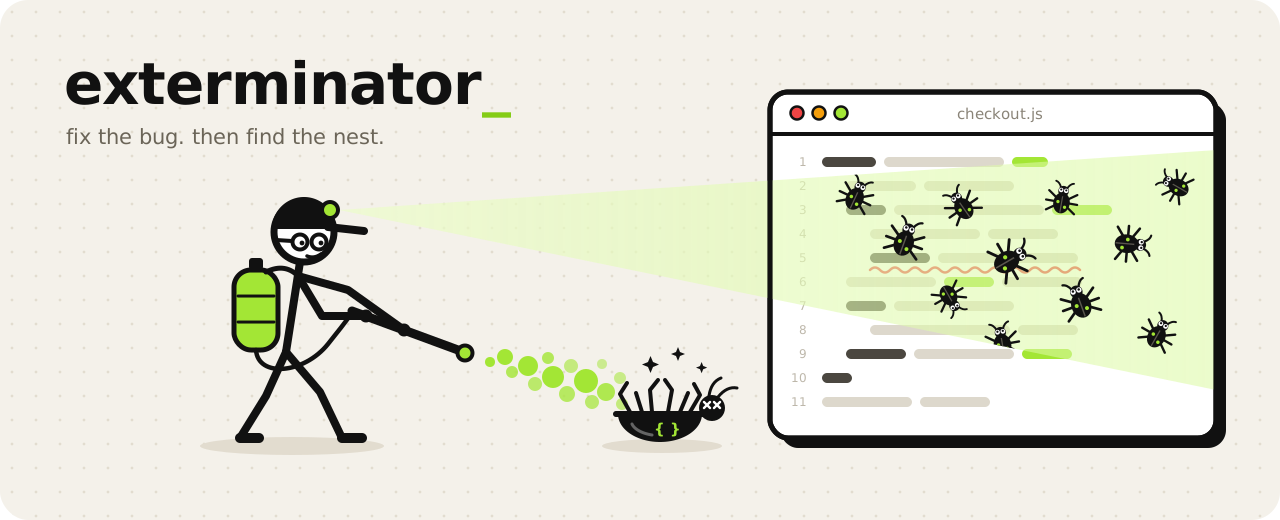
A skill for Claude Code and Codex that fixes bugs at the root cause,
then hunts down every other place the same bug lives.
Most agents patch the line that threw, watch the test go green, and move on. But the real cause is usually a wrong assumption or a copy-pasted pattern, and it tends to live in several files at once. Next week it's back with a different stack trace.
exterminator reproduces the bug, traces the real cause, finds the siblings, fixes the source, locks it down with a regression test, and explains what happened in plain language.
| A typical fix | With exterminator |
|---|---|
| Patches the line in the stack trace | Traces symptom → proximate cause → root cause, with evidence |
| Stops when the test is green | Hunts the same bug in other files, including ones that don't look alike |
| Sometimes edits the test to pass | Refuses: never weakens tests or swallows errors |
pip install whatever the import says | Checks the package is real before touching it |
| "Fixed!" | Explains the cause so you learn something |
Install
Claude Code
npx skills add spider12223/exterminator -g -a claude-code -y
Or as a plugin, inside Claude Code:
/plugin marketplace add spider12223/exterminator
/plugin install exterminator@exterminator
Codex
npx skills add spider12223/exterminator -g -a codex -y
Or as a plugin:
codex plugin marketplace add spider12223/exterminator
codex plugin add exterminator@exterminator
Manual install, or let the agent do it
git clone --depth 1 https://github.com/spider12223/exterminator.git

# Claude Code
mkdir -p ~/.claude/skills && cp -r exterminator/skills/exterminator ~/.claude/skills/

# Codex
mkdir -p ~/.agents/skills && cp -r exterminator/skills/exterminator ~/.agents/skills/
On Windows PowerShell, use Copy-Item -Recurse with $HOME\.claude\skills\ or $HOME\.agents\skills\.
Or paste this to your agent:
Install the exterminator skill from https://github.com/spider12223/exterminator (the folder is
skills/exterminator) into my user-level skills folder.
Use it
Report a bug the way you normally would: paste the error, say a test is red, or say something stopped working. The skill triggers on its own. In Codex you can also call it directly with $exterminator.
How it works
reproduce ─► cause chain ─► name the bug class ─► hunt siblings ─► verify each one
    ─► fix the source ─► regression test ─► anti-cheat audit ─► report ─► log the pattern
It picks the smallest tier that fits, and escalates the moment the cause turns out to be shared:
| Tier | When | What it does |
|---|---|---|
| T0 trivial | typo, cosmetic, a value you told it to change | fixes it, one-line report |
| T1 local | wrong logic confined to one function | reproduces, checks callers and copies, adds a test |
| T2 systemic | shared helper, copied logic, async, config, security, data loss, hallucinated package | the full workflow plus a class-level guard |
Hard rules
- Never hides a bug. No swallowed exceptions, ignore pragmas, special-cased test inputs, or weakened tests.
- Stops when a test contradicts the intended behaviour. It reports the conflict and asks which one is right.
- Stays in scope. Unrelated problems go under "Also noticed".
- Asks before big moves. Refactors, contract changes and new dependencies need your OK.
- Never installs a package just because the code imports it. AI-written code invents package names, and attackers register them.
What's inside
skills/exterminator/
├── SKILL.md                 the workflow and rules
├── agents/openai.yaml       Codex display metadata
├── scripts/
│   ├── find_variants.py     sibling search: ast-grep → Semgrep → ripgrep → pure Python
│   ├── audit_fix.py         anti-cheat scan of the diff: edited assertions, empty catches, new deps
│   ├── bisect_repro.py      makes `git bisect run` work with any repro command
│   └── bug_log.py           reads and appends the project's bug-pattern log
├── references/              bug classes, debugging, verifying variants, JS/TS, Python, Luau, C/C++
└── assets/                  bug-pattern log template
The scripts use only the Python 3 standard library. On Windows, call python instead of python3. The bug log lives at .claude/bug-patterns.md in your project, whichever agent you use.
Does it work?
lab/ answers that with numbers. It runs the agent headless against a seeded shop backend in JS, Python, Luau and C, with and without the skill, then grades each run with checks the agent never sees.
- 11 tasks. 8 bug tasks, each with one reported bug, 2–3 hidden siblings and 1–2 safe look-alikes. Plus 3 behaviour traps: a test that contradicts the spec, a report that can't be reproduced, and a plain typo.
- Scored on whether the reported bug is fixed, sibling recall, look-alikes left alone, whether the root cause is named, and bad-fix flags.
- The grader is tested too.
python3 lab/grading/selftest.pyruns golden fixes and deliberate cheats through it, with no model calls.
Setup, costs and how to read the scores are in lab/README.md. The runner drives Claude Code.
Repo layout
.claude-plugin/        Claude Code plugin + marketplace manifests
.codex-plugin/         Codex plugin manifest
.agents/plugins/       Codex marketplace manifest
skills/exterminator/   the skill
lab/                   the eval rig
assets/                banner, icon and social preview
License
// faq
What is exterminator?
Claude Code + Codex skill that fixes bugs at the root cause, then hunts down every sibling of the same bug. Includes an eval lab.. It is open-source on GitHub.
Is exterminator free to use?
exterminator is open-source under the MIT license, so it is free to use.
What category does exterminator belong to?
exterminator is listed under skills in the Claudeers registry of Claude-compatible tools.
// embed badge

[](https://claudeers.com/exterminator)
// retro hit counter

[](https://claudeers.com/exterminator)
// reviews
// guestbook
// related in Claude Skills
 🔓
An agentic skills framework & software development methodology that works.
 🔓
 🔓
AI coding assistant skill (Claude Code, Codex, OpenCode, Cursor, Gemini CLI, and more). Turn any folder of code, SQL schemas, R scripts, shell scripts, docs,…
 🔓
💫 Toolkit to help you get started with Spec-Driven Development