
evotrace
Turn every Claude Code and Codex session into reusable training, evaluation, and verification assets.
Install with your AI
Paste into Claude Code, Cursor, or any agent — it reads the repo and wires the tool into your project.
Install and set up evotrace (git-clone project) into my current project.
Found on https://claudeers.com/evotrace
Repo: https://github.com/jinzijian/evotrace
Homepage/docs: —
Detected install method: git-clone → git clone https://github.com/jinzijian/evotrace
Category: automation. Platforms: cli, api.
Read the repo's README for exact setup and env vars, then install it and wire it into my project.

Claudeers Health Verdict:
active; community-verified: false. Confirm the source before running anything.
git clone https://github.com/jinzijian/evotrace
// compatibility
| Platforms | cli, api |
|---|---|
| Operating systems | — |
| AI compatibility | claude |
| License | Apache-2.0 |
| Pricing | open-source |
| Language | Python |
EvoTrace
Turn every Claude Code and Codex session into reusable training, evaluation, and verification assets.
Quickstart · What you get · How it works · Security · 中文
Your agent sessions are not disposable chat logs. They are compounding data assets.
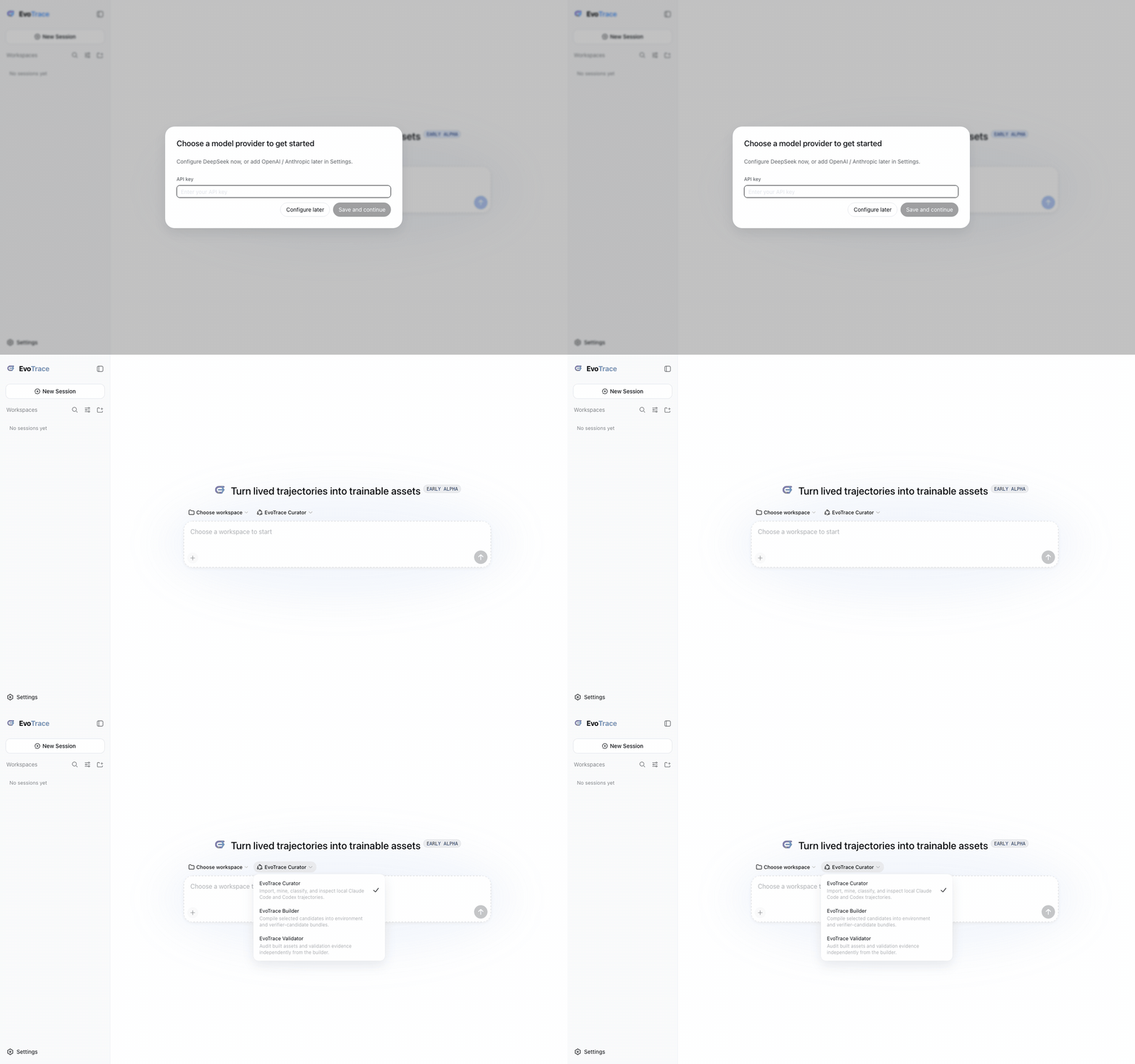
Illustrative output. EvoTrace reports the counts found in your own local history. Static preview.
⚡ Quickstart
macOS, Linux, or WSL
curl -LsSf https://raw.githubusercontent.com/jinzijian/evotrace/main/install.sh | sh
Windows PowerShell
irm https://raw.githubusercontent.com/jinzijian/evotrace/main/install.ps1 | iex
Then run one command:
evotrace init
EvoTrace discovers existing Claude Code and Codex sessions, indexes them locally, and mines useful candidates. The installer only installs the CLI—it does not read session data. You can inspect the Unix installer or the PowerShell installer before running it.
Already use uv?
uv tool install git+https://github.com/jinzijian/evotrace.git
evotrace init
Prerequisites: Git plus uv, pipx, or Python 3.9+. Docker is only needed when running sandboxed execution.
et is the short command; the older CLI names remain compatibility aliases.
What you get
| Asset layer | Recovered or produced | Can power |
|---|---|---|
| Preference and correction data | human edits, rejected/chosen pairs, successful recoveries | DPO, SFT, QA, preference learning |
| Executable tasks | task intent, repository base, environment evidence | agent evals, regression benchmarks, RL environments |
| Verifiers and rewards | test commands, execution results, behavioral checks | execution rewards, rollout scoring and filtering |
| Validated trajectories | rollouts after replay and verifier checks | high-quality, verifier-grounded SFT and RL training data |
These are composable asset layers, not separate silos. The same executable task and verifier can benchmark an agent, generate new rollouts, score their outcomes, and feed the verified trajectories back into training. Quality comes from executable outcomes and preserved provenance—not from treating every raw transcript as training data.
[!NOTE] Product direction: EvoTrace starts local-first. A future opt-in data marketplace will let users publish or license reviewed assets, and fine-tuning integrations will train on datasets users explicitly select. Nothing is shared by default.
EvoTrace works with the agents developers already use. No proxy, hosted agent, or new editor is required. The V0.3 curator is deterministic and auditable: it does not call an LLM or upload session data.
[!WARNING] EvoTrace is an early alpha. Mining labels and generated verifiers are evidence, not proof of task quality or semantic correctness. Inspect every eval before relying on it or sharing it.
How it works
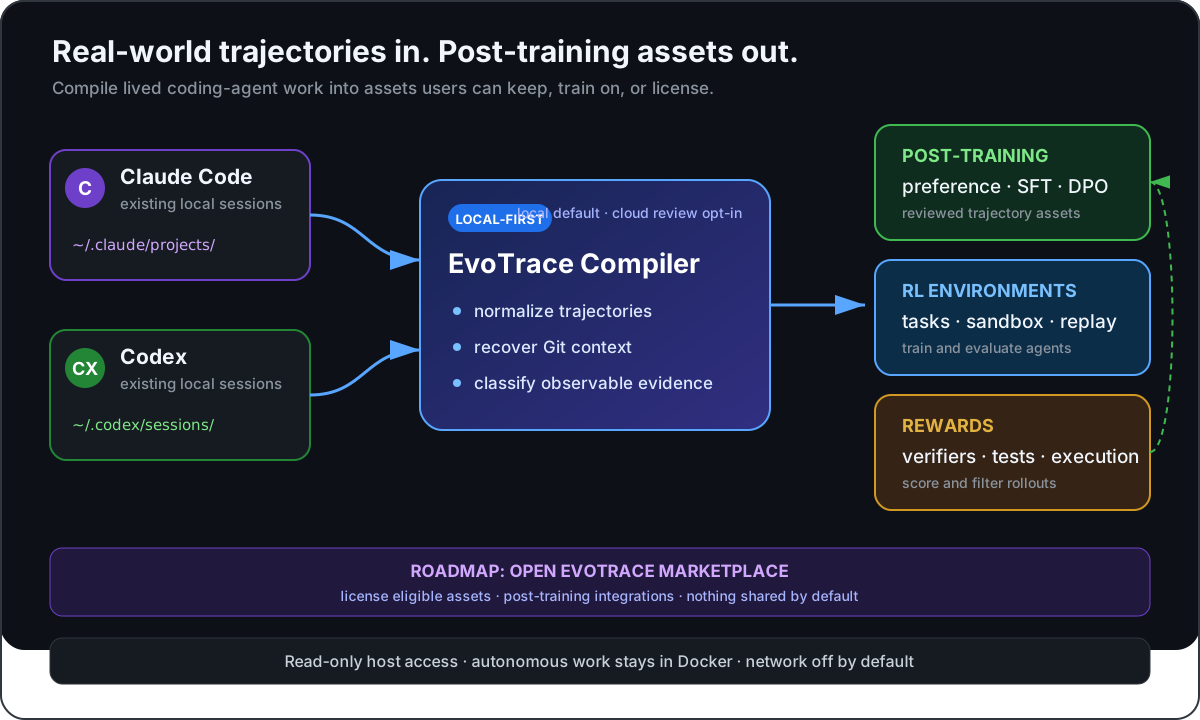
The host-side pipeline is local-first. Autonomous work is restricted to an ephemeral Docker workspace.
Relationship to RepoLaunch
Microsoft RepoLaunch is a primary technical inspiration for EvoTrace's executable-environment layer. RepoLaunch demonstrates that an agent can turn a repository and base commit into a Docker environment with reproducible build commands, test commands, test-output parsing, and per-test execution— infrastructure that can support both SWE benchmarking and agentic SFT/RL. See the RepoLaunch paper.
EvoTrace starts one layer earlier: before a curated task dataset exists, it mines lived Claude Code and Codex work to identify which tasks, corrections, recoveries, and execution signals are worth turning into learning assets.
| RepoLaunch | EvoTrace | |
|---|---|---|
| Starting point | repository, base commit, language and task dataset | local agent sessions plus repository evidence |
| Primary job | discover dependencies, build, tests and test parser | recover valuable tasks, preferences, trajectories and provenance |
| Output | Docker image, rebuild/test commands and structured test status | preference data and task/environment/verifier bundles |
| Reuse | SWE benchmarks and agentic SFT/RL | evals, rewards, verified RL data, and future marketplace/fine-tuning |
The planned integration seam is an optional RepoLaunch-compatible environment backend for candidates whose build and test environment cannot be recovered conservatively. EvoTrace remains responsible for history import, task selection, trajectory curation, provenance, privacy, and user-controlled distribution. No RepoLaunch code is vendored in the current release.
Core workflow
evotrace init — import and mine in one command
evotrace init
evotrace init --source codex --last 50
Use init on day one. It combines automatic discovery, incremental import, and local mining into a single
onboarding command. The commands below expose each stage when you want more control.
evotrace import — index history you already have
# Discover both sources and index all available sessions.
evotrace import

# Limit or select a source.
evotrace import codex
evotrace import claude --last 20

# Import exact files.
evotrace import codex ~/.codex/sessions/2026/08/19/rollout-*.jsonl
evotrace import codex ~/.codex/history.jsonl
evotrace import claude ~/.claude/projects/my-project/session.jsonl
The importer honors $CODEX_HOME and $CLAUDE_CONFIG_DIR. For Codex it recognizes rich session JSONL files and
the lighter prompt history separately, keeping the richer copy when both identify the same session. Claude Code
documents plaintext session transcripts under ~/.claude/projects/ and a default 30-day cleanup window;
installing EvoTrace early preserves a normalized local index before old transcripts disappear. See the
Claude Code session docs,
Claude Code data-path docs,
Codex configuration reference, and
Codex CLI resume reference.
Imports are incremental: unchanged source files are skipped using size and modification-time fingerprints. Use
--refresh to force re-indexing. Raw history files are read in place, never copied into the EvoTrace store.
evotrace mine — find valuable experience
evotrace mine
evotrace mine --source codex --min-score 4
evotrace mine --json
V0.3 scores only observable signals: non-trivial task text, code-edit calls, verification commands, failed then
successful checks, human corrections after agent work, and repository reconstruction confidence. Every candidate
contains its score, labels, signals, and human-readable evidence in ~/.evotrace/candidates/.
preference_candidate: a likely rejected/chosen or correction pair for DPO, preference, QA, or SFT curation.execution_verifiable: code changes plus recovered verification and a reconstructable repository base.recovery_trajectory: a failure or correction followed by subsequent repair work.
This deliberately avoids model-judged labels in the first release. A model curator can later sit behind the same schema without weakening provenance.
evotrace build — compile executable eval assets
# Build the highest-ranked execution-verifiable candidates.
evotrace build --limit 10

# Build one session and optionally add trusted verifier commands.
evotrace build SESSION_ID \
  --verify "python -m pytest tests/integration -q" \
  --verify "python -m ruff check src"
A history transcript is not a complete environment. The builder combines session evidence with the local Git repository: it uses a commit captured by the session when available, otherwise tries a time-aligned Git commit, and records reconstruction confidence instead of pretending the result is exact. It then emits:
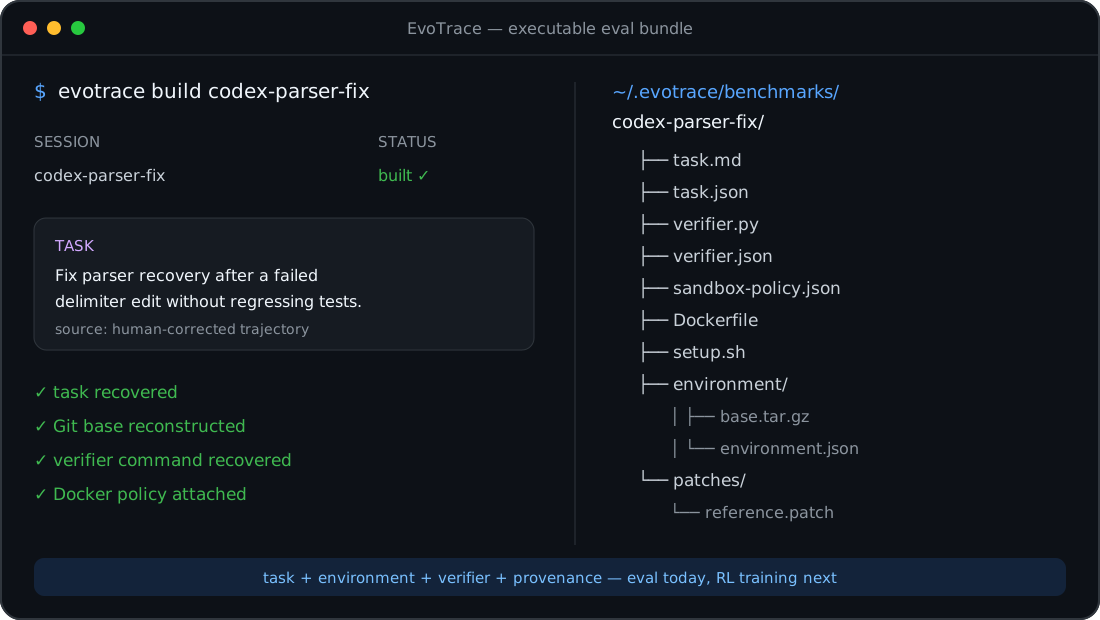
Example build output. Every recovered task and verifier retains inspectable provenance.
benchmark-id/
├── task.md
├── task.json
├── task.yaml
├── verifier.py
├── verifier.json
├── sandbox-policy.json
├── setup.sh
├── Dockerfile
├── environment/
│   ├── base.tar.gz
│   ├── environment.json
│   └── untracked-initial.tar.gz
└── patches/
    ├── initial.patch
    └── reference.patch
Verifier provenance is always visible: explicit user command, trajectory-recovered command, repository convention, or a warning that no behavioral verifier was found.
Day two and beyond
Keep the local index current without placing EvoTrace in front of either agent:
evotrace watch                 # poll every five minutes and re-run mining
evotrace watch --interval 60
evotrace watch --once          # useful in cron or a nightly job
The watcher reads changed history files only. It does not modify Claude Code, Codex, or source repositories.
Security model
Container-only agent boundary
The host-side importer and builder may read session files and Git objects, but they never give an autonomous agent
a writable host checkout. Each bundle contains an explicit sandbox-policy.json and a non-root Dockerfile. The
contract is:
- source enters as an archive copied into the image, not as a writable bind mount;
- no Docker socket, privileged mode, host PID namespace, or host credentials;
- runtime network is off by default, Linux capabilities are dropped, and new privileges are blocked;
- the agent may freely edit or delete its ephemeral
/workspacecopy; - host output is promoted only into a new, unique run directory after validation;
- internal systems are exposed only through explicit read-only adapters or deterministic mocks—never production write credentials.
For this reason V0.3 rejects legacy benchmark --agent host execution. The safe container orchestrator is the next
runtime milestone; today evotrace build produces its complete, inspectable input. Existing candidate checkouts can still
be scored explicitly with evotrace benchmark ... --candidate NAME=PATH.
Read the full sandbox contract and security model.
Storage and privacy
The default store is ~/.evotrace/; override it with $EVOTRACE_HOME or --home. If an existing
~/.scaleverifier/ store is present and the new path does not yet exist, EvoTrace reuses it automatically.
- No account, hosted LLM, API key, telemetry endpoint, payment flow, or data upload is required.
- Normalized text receives best-effort secret redaction.
- Git-ignored files, common
.envfiles, and private-key suffixes are excluded from untracked snapshots. - A compiled bundle contains source code and may still contain tracked secrets. Treat it as private until reviewed.
Current scope
Implemented in V0.3:
- one-command
evotrace initonboarding and macOS/Linux/WSL/Windows installers; - full and incremental Claude Code / Codex history discovery;
- rich-session versus prompt-history precedence;
- normalized, redacted local trajectories;
- auditable preference, execution, correction, recovery, and low-value mining;
- Git-time reconstruction confidence;
- task, environment, Dockerfile, and verifier bundle generation;
- explicit container-only policy with non-root images and no host-agent fallback;
- replay, verifier execution, and existing-candidate scoring from V0.1.
Next milestones:
- a sandboxed curator/builder agent that can generate mocks and improve verifier coverage;
- an optional RepoLaunch-compatible backend for cross-language build, test, and parser discovery;
- automatic verifier validation and reward-hacking checks;
- opt-in read-only internal-service adapters and record/replay mocks;
- export adapters for DPO, preference, QA, SFT, RL rollouts, execution rewards, and executable evals;
- an opt-in data marketplace with review, redaction, provenance, and licensing controls;
- fine-tuning service integrations for explicitly selected, validated datasets;
- deduplication, difficulty estimation, and benchmark registries.
See docs/design.md and docs/schema.md for the data model.
Community and development
Ask questions, share aggregate results, and propose new history adapters in GitHub Discussions. Report reproducible problems through GitHub Issues. Never post raw trajectories or unreviewed bundles.
git clone https://github.com/jinzijian/evotrace.git
cd evotrace
uv sync
uv run python -m unittest discover -s tests -v
uvx ruff check src tests
See CONTRIBUTING.md for adapter requirements and the pull-request checklist.
License
Apache License 2.0.
// faq
What is evotrace?
Turn every Claude Code and Codex session into reusable training, evaluation, and verification assets.. It is open-source on GitHub.
Is evotrace free to use?
evotrace is open-source under the Apache-2.0 license, so it is free to use.
What category does evotrace belong to?
evotrace is listed under automation in the Claudeers registry of Claude-compatible tools.
// embed badge

[](https://claudeers.com/evotrace)
// retro hit counter

[](https://claudeers.com/evotrace)
// reviews
// guestbook
// related in Automation & Workflows
 🔓
🔓 🔓
🔓The API to search, scrape, and interact with the web at scale. 🔥
 🔓
🔓🌐 Make websites accessible for AI agents. Automate tasks online with ease.
 🔓
🔓Taste-Skill - gives your AI good taste. stops the AI from generating boring, generic slop