
effortmining
Benchmark-calibrated per-subagent reasoning effort for Claude Code. Classify the subtask, dispatch the cheapest tier a blind grader still accepts. Pilot-prov…
Install with your AI
Paste into Claude Code, Cursor, or any agent — it reads the repo and wires the tool into your project.
Install and set up effortmining (claude-plugin project) into my current project.
Found on https://claudeers.com/effortmining
Repo: https://github.com/nagisanzenin/effortmining
Homepage/docs: —
Detected install method: claude-plugin → /plugin install effortmining@nagisanzenin/effortmining
Category: plugins. Platforms: cli, api.
Read the repo's README for exact setup and env vars, then install it and wire it into my project.

Claudeers Health Verdict:
slowing; community-verified: false. Confirm the source before running anything.
/plugin marketplace add nagisanzenin/effortmining
/plugin install effortmining@nagisanzenin/effortmining
git clone https://github.com/nagisanzenin/effortmining
// compatibility
| Platforms | cli, api |
|---|---|
| Operating systems | — |
| AI compatibility | claude |
| License | MIT |
| Pricing | open-source |
| Language | Python |
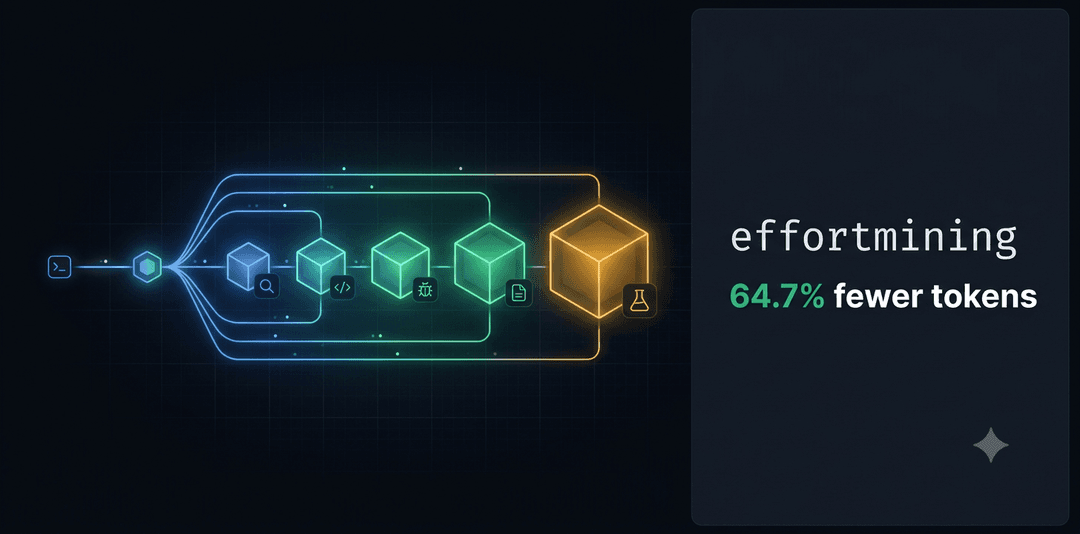
effortmining
Spend the reasoning each subtask deserves — no more, no less.
Claude Code makes every helper agent think as hard as your whole session. Most helpers don't need to. effortmining right-sizes reasoning effort per subagent and cuts output-token spend ~64.7% with no drop in quality — measured, not vibes.
Install
claude plugin marketplace add nagisanzenin/effortmining
claude plugin install effortmining@effortmining
Requires Python 3 (stdlib only). Start a new session — that's it. It works from the first delegation, nothing to configure.
The problem, in one picture
Claude Code has a "how hard should I think" dial (low → max). When it spawns a subagent, that subagent inherits your session's setting — there's no way to set effort per spawn. So every helper runs at the same effort, whether it's grepping a file or debugging a crash. And effort costs tokens.
  SESSION EFFORT: max        (no per-spawn setting — every helper inherits it)

  grep a file ......... max     <- overkill
  reformat a list ..... max     <- overkill
  read a diff ......... max     <- overkill
  run the tests ....... max     <- overkill
  debug a crash ....... max     <- the only job that actually needed it
What effortmining does
It classifies each subtask, looks up the cheapest effort tier proven sufficient for that kind of work, and dispatches a worker pinned at that tier.
  effortmining right-sizes each job:

  grep a file ......... low
  reformat a list ..... low
  read a diff ......... low
  run the tests ....... low
  debug a crash ....... high

  four cheap jobs go cheap, the hard one keeps its effort.
  => 64.7% fewer output tokens, same pass rate.
Measured (~450 pre-registered runs on claude-opus-4-8): calibrated dispatch used 64.7% fewer output tokens (95% CI [60.8, 67.8]) than effort inheritance, at an identical pass rate. max never beat xhigh anywhere. Two pre-registered tests failed and are published below, not buried.
Why the savings are real
Thinking harder genuinely burns more tokens — but past a point it buys nothing. Median output tokens per tier, across the same tasks, with every tier reaching the quality ceiling:
  low    101  ██
  high   158  ███
  xhigh  295  ██████
  max    696  ██████████████   <- 7x low, and it never won a single task
max doesn't get things wrong — it just costs 7x for the same answer. That gap, multiplied across every subagent your session spawns, is the waste effortmining removes.
Using it — three modes
-
Ambient (default): install and forget. A SessionStart hook injects a one-line dispatch policy, and from then on Claude picks the right-effort worker on its own. On a new session you'll see:
[effortmining] calibration table 6 cells, fitted 2026-07-07 · /effortmine to dispatch calibrated
[effortmining] ambient dispatch policy: ... T1-mechanical->miner-low · T3-moderate-reasoning->miner-high ...
Watch the task line when Claude delegates — you'll see
miner-lowdoing grunt work instead of a full-effort agent. Your explicit effort requests always override the table. -
Precise: hand a multi-part job to the orchestrator and watch it decompose:
/effortmine (1) extract the domains from these emails into a sorted list: [email protected], [email protected], [email protected]
(2) this function should return the second-largest unique number but breaks on some inputs — find and fix:
def second_largest(xs): s = sorted(set(xs)); return s[-2]
It classifies (1) as mechanical →
miner-low, (2) as diagnosis →miner-high, dispatches both, and tells you why. -
Measured:
/effort-bench— re-run the benchmark on your own account, or refit the table for a different model withpython3 bench/effort.py calibrate. The whole pipeline is deterministic and resumable.
How it works (the whole trick)
1. Five workers, one line apart. Claude Code's Agent tool has no per-spawn effort parameter — you can override a subagent's model, not its effort (verified against the CLI binary and docs, see docs/research/). The only place effort can be set is an agent's definition file. So effortmining ships five workers that are byte-identical except one frontmatter line:
  agents/  — pick a tier by picking a file:

  miner-low.md     ->  effort: low
  miner-medium.md  ->  effort: medium
  miner-high.md    ->  effort: high
  miner-xhigh.md   ->  effort: xhigh
  miner-max.md     ->  effort: max
That indirection is the entire mechanism. No hidden API.
2. A measured cheat-sheet. calibration.json maps task classes to the cheapest tier that passed a benchmark at that class's quality ceiling. It ships fitted from real runs, carries its own provenance (model, run counts, date), and — where its fitting tasks proved too easy — carries machine-readable warnings that route genuinely hard work up to xhigh.
3. A self-correcting loop. A SessionStart hook injects the table as policy; a fail-open PostToolUse hook logs every dispatch locally; effort.py calibrate refits the table from graded receipts under guarded rules (min-sample gates, single-step moves, clamps). Refit the table and the injected policy updates itself.
 request → classify (T1..T4, R, C) → calibration.json → miner-<tier> → result
                                          ↑                    │
                             guarded refit ← graded benchmark receipts
What the data says
Headline (pre-registered, could have failed) — HELD: a class-calibrated effort policy used 64.7% fewer output tokens (95% CI [60.8, 67.8]) than the status-quo inheritance policy (every subagent at
xhigh), at equal aggregate pass rate (1.000 vs 1.000), and was un-dominated against uniform-highand uniform-lowtoo.
The shipped 6-class table and the evidence behind each row:
| class | the work | evidence (pass rate) | dispatches to |
|---|---|---|---|
| T1-mechanical | extraction, reformatting | 9/9 at low | miner-low |
| T2-simple-transform | small well-specified transforms | 9/9 at low | miner-low |
| T3-moderate-reasoning | diagnosis, logic, tracing | 6/9 at low → 9/9 at high | miner-high |
| T4-hard-reasoning | adversarial multi-step | 9/9 at low † | miner-low † |
| R-research | cross-document synthesis | 18/18 at low isolated † | miner-low † |
| C-coding | implement/fix vs hidden tests | 16/18 at low → 18/18 at medium (refit) | miner-medium |
† ships with a fit-blindness warning: these fitting tasks saturated (too easy for Opus 4.8), so the ambient policy routes genuinely hard instances in these classes to miner-xhigh instead. That caveat is measured, not decorative — see finding 3.
Three findings worth your time:
- Cost climbs even when quality doesn't. Median output tokens per tier:
low101 →high158 →xhigh295 →max696.maxnever improved a single pass rate overxhigh— it saturates, it doesn't regress. - Genuinely tier-demanding tasks exist but are rare and specific. A diagnosis class (T3), a formal-invariant coding task (breaks
low, fixed by the refit moving C-coding tomedium), and one research question that onlyxhighreliably solves — and only when embedded in a bigger job (difficulty turned out to be contextual: the same question passes atlowin isolation). - Low effort doesn't just skim — it fabricates. In the composite test's one persistent failure, the model at
lowinvented a plausible ticket ID that appears nowhere in its documents. This is why the warnings and thexhighroute exist.
Two pre-registered composite tests returned no-win verdicts and are published as such — the full chronological record (pilot → v2 → refit, including both failures and what they taught) is in docs/BENCHMARK-STORY.md; machine-generated reports in bench/RESULTS.md and bench/RESULTS-v2.md.
Honest claims
- The knob is Anthropic's, shipped. Per-subagent
effort:frontmatter exists; effortmining invents no capability — it operates the knob from measurements. - Auto-calibration is an open, recurring request — Claude Code #43083 (open), #37783, #25669; OpenAI Codex #8649; OpenCode #21483. Only model is configurable per spawn today; effort is not.
- The closest research is Ares (arXiv 2603.07915) — per-step effort routing, unshipped. effortmining differs in granularity (per subagent role), method (offline pre-registered A/B), and the fact that you can install it.
- The economics are real: multi-agent systems use ~15x chat tokens and token spend explains ~80% of performance variance (Anthropic's own engineering data). A handful of recurring subagent roles carries most of the waste.
Caveats, honestly
n = 3 reps per cell (confidence is labeled low by design; intervals are wide); one model (claude-opus-4-8 — re-fit per model, it's one command); self-contained tasks that may be easier than your real work — the misclassification checks flag exactly where that's true; auto and ultracode are out of scope by construction (auto = the model default = the high column; ultracode is an orchestration mode that sends xhigh, not an API effort level).
Repo map
effortmining/
├── .claude-plugin/            # manifest + marketplace entry
├── agents/                    # miner-low..max (byte-identical except effort:) + blind effort-grader
├── skills/                    # effortmine (calibrated dispatch) · effort-bench (harness driver)
├── hooks/                     # SessionStart policy injection · fail-open dispatch logger
├── bench/                     # effort.py (stdlib harness) · tasks/ + tasks-v2/ · state/calibration.json · RESULTS*.md
└── docs/                      # architecture · BENCHMARK-STORY · research/ (mechanism, literature, methodology)
More from the same workshop
Five Claude Code plugins from the same workshop. Most share one habit: let a deterministic core decide, and never let the producer of work grade it.
- engram — evidence-based learning engine: first-principles curricula, generation-first tutoring, blind-graded free recall, FSRS-scheduled memory. This repo's blind grader and guarded refit are engram patterns, transposed.
- idiolect — human-voice writing engine: 60+ measured voices plus a deterministic AI-tell scanner and a blind auditor, so text reads like a person, not a model.
- production-grade — turns "build me X" into a gated multi-agent pipeline (architecture → tests → security → CI/CD) with a receipt for every phase. effortmining was built with it — the receipts are in this repo.
- less — a minimal comms protocol for Claude: a per-turn hook makes replies answer-first, pick-list-driven, and calm, without touching the work.
Pattern provenance: docs/research/03-pattern-mining.md.
License
MIT.
// faq
What is effortmining?
Benchmark-calibrated per-subagent reasoning effort for Claude Code. Classify the subtask, dispatch the cheapest tier a blind grader still accepts. Pilot-proven: -64.7% tokens vs effort inheritance at equal quality.. It is open-source on GitHub.
Is effortmining free to use?
effortmining is open-source under the MIT license, so it is free to use.
What category does effortmining belong to?
effortmining is listed under plugins in the Claudeers registry of Claude-compatible tools.
// embed badge

[](https://claudeers.com/effortmining)
// retro hit counter

[](https://claudeers.com/effortmining)
// reviews
// guestbook
// related in Claude Plugins
 🔓
🔓A single CLAUDE.md file to improve Claude Code behavior, derived from Andrej Karpathy's observations on LLM coding pitfalls.
 🔓
🔓Claude Code is an agentic coding tool that lives in your terminal, understands your codebase, and helps you code faster by executing routine tasks, explainin…
 🔓
🔓"CLI-Anything: Making ALL Software Agent-Native" -- CLI-Hub: https://clianything.cc/
🔓financial-services — a Claude ecosystem project on GitHub.