
effort-pilot
The right reasoning effort for every Claude Code turn, set for you: high for plans and for a push or deploy, medium for building, low for questions. Switch m…
Install with your AI
Paste into Claude Code, Cursor, or any agent — it reads the repo and wires the tool into your project.
Install and set up effort-pilot (git-clone project) into my current project.
Found on https://claudeers.com/effort-pilot
Repo: https://github.com/vadympetryshyn/effort-pilot
Homepage/docs: —
Detected install method: git-clone → git clone https://github.com/vadympetryshyn/effort-pilot
Category: plugins. Platforms: cli, api.
Read the repo's README for exact setup and env vars, then install it and wire it into my project.

Claudeers Health Verdict:
unknown; community-verified: false. Confirm the source before running anything.
git clone https://github.com/vadympetryshyn/effort-pilot
// compatibility
| Platforms | cli, api |
|---|---|
| Operating systems | — |
| AI compatibility | claude |
| License | MIT |
| Pricing | open-source |
| Language | TypeScript |
What is Effort Pilot?
The right reasoning effort for every turn in  Claude Code, set for you.
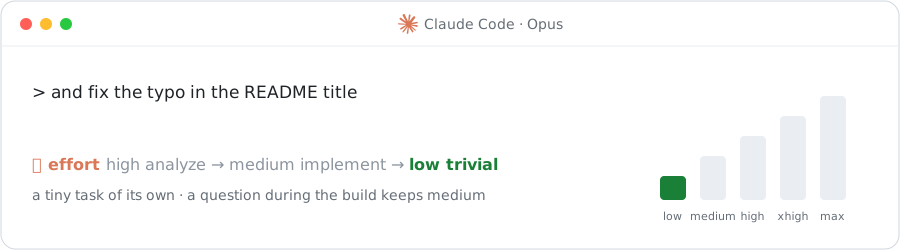
Effort Pilot switches the reasoning effort for every turn, automatically: plans get high, building gets medium, questions and trivial tasks get low, and an order that can't be taken back — a push, a merge, a deploy — gets high. Deep thinking goes where it counts, and a quick question no longer waits on it. Want another model or level? Just say it, typed or dictated: "plan this on Fable 5.2 at high, then build on Opus at medium".
What you get
Compared with leaving effort on high all the time, on the author's own turns:
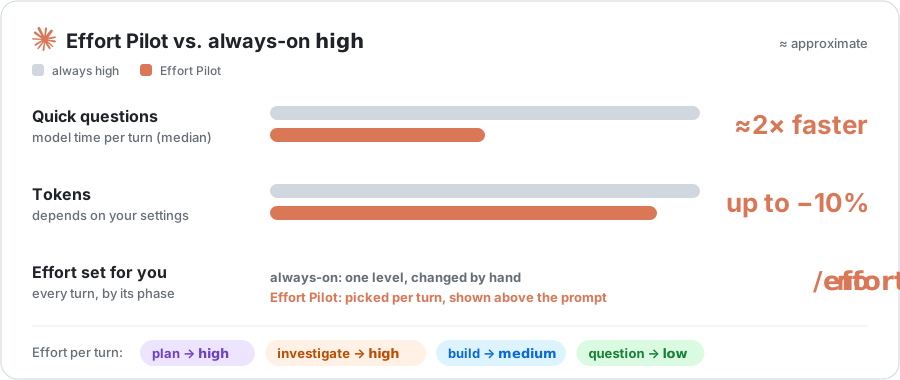
- Quick answers, up to twice as fast. A question or a chat turn runs at
low: its median model time is about half that athigh(−50%, 90% range −13% … −69%). - Plans lose nothing. Plans and plan mode run at
high, the same depth as always-onhigh; setplanEfforttoxhighormaxfor more. - Up to 10% fewer tokens. Every turn that drops from
hightomediumorlowthinks less, so it spends fewer tokens. How much you save depends on your settings: the more levels you set belowhigh, the more you save. - Nothing to switch. You never type
/effort; the line above the prompt shows what it picked and why. - Switch models and effort by saying it. In plain words, typed or dictated, in any language: "switch me to Sonnet at medium", "back to Opus", "plan it on Fable, then implement on Sonnet at high". No
/model, no/effort; a model named for a subagent or in code switches nothing.
≈ From the author's own sessions with /effort-pilot report. Token savings vary with your settings and your work. Not proven yet: fewer turns that fall short. Every setup differs: measure yours.
Install
In Claude Code:
/plugin marketplace add vadympetryshyn/effort-pilot
/plugin install effort-pilot@effort-pilot
/reload-plugins
Or from your terminal, in one line (then start a new session):
claude plugin install effort-pilot --marketplace vadympetryshyn/effort-pilot
It is on as soon as it loads: from your next message, the line above the prompt shows ⏵ effort with the effort it
picked and why. Nothing to configure — every setting has a default (the terminal install still says its options are
"not yet set": Claude Code counts any option you have not saved yourself, and the defaults apply). Works on Opus and Fable (Sonnet and Haiku are left to you). Needs a recent
Claude Code (tested on 2.1.325).
Where it stands aside. On the newer models (Opus 5 and 5.5, Fable 5.1) with an Anthropic login, effort is set per message, and a switch costs no prompt cache. Elsewhere effort is one setting of the whole request, and every switch would rewrite the conversation's prompt cache: on Claude 4.x and older, Fable 5, sessions on Bedrock, Vertex, Foundry or a gateway, and an effort set as a number. There Effort Pilot leaves your own effort alone (no classifier call either), and the band says so. On a model it does not know, it watches the cache: if a switch is seen to rewrite it, it stands aside on that model for the rest of the session.
Update: claude plugin marketplace update effort-pilot && claude plugin update effort-pilot@effort-pilot, then
restart. Pause: /effort-pilot off. Remove: /plugin uninstall effort-pilot@effort-pilot.
How it works
Before each turn a small, fast model (Haiku, ≈ $0.0004 a turn) reads your message and picks the effort:
| You… | Phase | Effort |
|---|---|---|
| ask for a plan, or use plan mode | plan | high |
| ask a hard question, investigate a bug | analyze | high |
| ask to build or fix something | implement / fix | medium (high when hard) |
| approve a plan | implement | medium — the thinking went into the plan |
| ask to commit, run a command or the tests | implement | medium |
| ask to push, merge, deploy or delete | implement | high — it can't be taken back |
| ask a quick question, or a question about a plan or an analysis | chat / trivial | low |
| ask a question or make a remark during a build | chat | the build's (medium) — the agent goes on building |
A band above the prompt shows the effort now, how it got there and why. Follow-ups that push the work on keep its effort (a word to go on, like "done" or "continue", too). During a build, a question, a remark or a side question keeps the build's effort, since the agent answers it in the middle of that work and goes on building; only a new task (a tiny one of its own goes at low) moves off it. A plain question about a plan or an analysis (what was found, where it stands) runs at low — the answer is already there — and a side question doesn't drag the work down. A skill or prompt command you type (/create-plan …) is read like any message, and with nothing after it by what the command says it does; built-in commands (/clear, /model) are left alone. Asked for a plan and its build in one message ("plan it, then implement")? Once the agent loads a skill that carries the plan out, the build goes at the build effort, as an approved plan does.
Features
- 🗣️ Just say it. "do this on max", "medium is enough", "plan it, then build on high" — in any language, typed or dictated.
ultrathinkruns that work atxhigh, as Claude Code does (withCLAUDE_CODE_DISABLE_ULTRATHINKset, the word asks for nothing). "back to auto" hands it back. Name a model the same way: "switch me to Sonnet at medium", "back to Opus", "plan it on Fable, then build on Sonnet at high". It holds for the rest of the session, until you name another, pick one with/model, or turn the pilot off; subagents keep their own model. On a model Effort Pilot does not manage (Sonnet, Haiku by default) the effort you named with it holds too. Talking about a model (for a subagent, a tool, in code, comparing them) switches nothing. Each switch costs one request that re-reads the conversation without the prompt cache. - 🛤️ A pipeline in one sentence. Name a model and an effort for each stage of a long task, and the agent moves through them on its own: "plan on Fable at high, build on Opus at medium, test on Haiku at low: add pagination to the users endpoint". Planning runs on Fable at
high; once the plan is approved (or you say "go"), the build runs on Opus atmedium; and when the agent reaches testing, checking or review, it hands that to a subagent on Haiku atlowinstead of switching itself. A subagent starts with a small, fresh context, so the test stage costs no extra request without the prompt cache (a switch of the main loop's model costs one). Any stage may name Opus, Sonnet, Haiku or Fable; on a model Effort Pilot does not manage (Sonnet, Haiku by default) the effort you named for that stage holds, and with none named your own effort goes. Leave a stage out and it runs as it would anyway; "and test it on Haiku" said later adds the test stage to the work under way. The band and the status line show the stage held (test: haiku·low). - 🧭 Plan mode runs at
high; the approved plan is built atmedium. Want plans on another model? SetplanModeModel(sayfable): plan mode runs on it, and the approved plan is built on your session's model again (a model you name in words wins over the setting). If the session itself is on that model (your/modelchoice), the build stays on it, and a toast says so once. The pilot never switches a model you picked with/model: a build on one of another family than the first steered model (say Fable, whereopuscomes first) gets a toast once a conversation that says so, with or without a plan before it. Turn onplanModelForPlansand a plan you ask for outside plan mode ("plan the export",/create-plan …) goes on it too: questions and pushback on the plan stay there, and once you say build it, your requests go back on the session's model at the build effort. Each switch costs one request that re-reads the conversation without the prompt cache. - 🤖 Subagents get their own effort, on the session's model or another one (never below the build effort,
mediumby default). An effort the Agent call names, orCLAUDE_CODE_SUBAGENT_EFFORT, is left alone. Your own and plugin agents keep their own effort unless you list them (below). Each subagent's effort is shown: in its description, or in one transcript line at its first request. - 🔔 Background results and messages from other sessions are read too: one the agent only relays or hands to the next agent goes at the build effort (at
highwhile a plan or an analysis is under way); one that reports a failure, a background command's output, or a step in hard work keeps the effort of the work it serves. - ✋ You stay in charge.
/effort <level>pins it;/effort-pilot onresumes. - 🔒 Private. Nothing leaves your machine but the Haiku call. Your effort setting is changed per message; the model is never changed unless you ask for one or set
planModeModel, and the prompt cache stays intact (where a switch would rewrite it, Effort Pilot stands aside).
Commands
| Command | |
|---|---|
/effort-pilot | current state |
/effort-pilot on · off · shadow | run · stop · only show what it would pick |
/effort-pilot stats | this session's turns and efforts |
/effort-pilot classify <text> | what it would pick for a message |
/effort-pilot report | cost, speed and quality vs. high in a pane with charts beside the chat (as text under claude -p; needs measure) |
/effort-pilot reset | delete the turn records measure kept |
Settings
All in /config → effort-pilot.
| Setting | Default | |
|---|---|---|
planEffort | high | plans and plan mode |
planModeModel | empty | a model for plan mode (an alias like fable, or a full id); the approved plan is built on the session's model. Empty: the model is never changed |
planModelForPlans | off | with planModeModel set: plans you ask for outside plan mode go on that model too, until building starts |
analyzeEffort | high | hard questions, investigations |
buildEffort | medium | building and fixing |
hardBuildEffort | high | building that is hard (many files, tricky logic, a bug of unknown cause, push, deploy, deletes) |
talkEffort | low | questions, chat, tiny edits |
managedModels | opus,fable | models whose effort it sets (never where effort is one setting per request: see above) |
headless | off | also steer claude -p and SDK runs |
agents | empty | your own and plugin agents to steer like built-ins (see below) |
sessionAgent | empty | the agent a headless claude -p --agent <type> session runs as, where Claude Code does not say it (see below) |
measure | off | run the comparison below |
controlShare | 30 | % of turns left at high while measuring |
Your own and plugin agents
Built-in subagents (general-purpose, Explore, Plan, …) get an effort from their brief. An agent of your own (~/.claude/agents, .claude/agents) or from a plugin is left alone by default: it runs at the effort its definition sets, or the session's, since an effort its author set is a choice.
To steer some anyway, list them in agents, comma-separated, by exact name: reviewer (your own or your project's), lab:builder (a plugin's), lab:* (every agent of a plugin), or * (every agent that is not a built-in). A listed agent is then set by its brief like a built-in, never below the build effort. An effort the Agent call names, CLAUDE_CODE_SUBAGENT_EFFORT, a number budget, and a model Effort Pilot does not manage still win, as for built-ins; forks, teammates and workflow agents are left alone. In claude -p runs a listed agent is steered only with headless on, as built-ins are.
What you give up: the effort the author declared is overridden for the agents you list. With measure on, a share of their runs (controlShare) is still left at their own effort, so the report can show what listing them saved and whether those runs fell short more often.
Headless agent sessions. A launcher, a script or an Agent SDK host that runs claude -p --agent <type> with headless on gets the same: the session's first prompt is read as that agent's brief (never below the build effort), later prompts and notifications as usual. Claude Code tells the plugin which agent the session runs as; sessionAgent sets it where it does not. Without headless, nothing changes.
claude -p --agent reviewer --plugin-dir <path to effort-pilot/plugin> \
  --settings '{"pluginConfigs":{"effort-pilot":{"options":{"headless":true,"measure":true}}}}' \
  "Review the diff of the last commit for correctness bugs and report each with its file and line."
Measure it yourself
Turn on measure. A share of turns where Effort Pilot would pick something other than high is left at high (control turns). /effort-pilot report then compares, per phase, cost per turn, model time and turns that fell short (aborted, or the message you send right after it says it was wrong), each with a 90% range, and nets out what the classifier itself cost. Each listed agent, and each headless agent session, gets groups of its own per agent type: a record of its run carries agent (the type) and via (listed for a listed subagent, session for a turn of a headless session run as the agent; its first turn, the brief, has who: "agent"). Records (turn statistics, no prompt text) live in the plugin's data folder, ~/.claude/plugins/data/effort-pilot-effort-pilot/turns/, one file a day, and are kept for 90 days. /effort-pilot reset deletes them; uninstalling the plugin removes them too (unless you uninstall with --keep-data).
Contributing
Issues and PRs welcome — see CONTRIBUTING.md. Questions and ideas go to Discussions; a turn that got the wrong effort is the most useful issue.
If it is useful to you, a ⭐ helps others find it.
License
// faq
What is effort-pilot?
The right reasoning effort for every Claude Code turn, set for you: high for plans and for a push or deploy, medium for building, low for questions. Switch model and effort by saying it: "plan on Fable 5.2 at high, build on Opus at medium". Up to 10% fewer tokens, quick answers up to 2× faster.. It is open-source on GitHub.
Is effort-pilot free to use?
effort-pilot is open-source under the MIT license, so it is free to use.
What category does effort-pilot belong to?
effort-pilot is listed under plugins in the Claudeers registry of Claude-compatible tools.
// embed badge

[](https://claudeers.com/effort-pilot)
// retro hit counter

[](https://claudeers.com/effort-pilot)
// reviews
// guestbook
// related in Claude Plugins
 🔓
A single CLAUDE.md file to improve Claude Code behavior, derived from Andrej Karpathy's observations on LLM coding pitfalls.
 🔓
Claude Code is an agentic coding tool that lives in your terminal, understands your codebase, and helps you code faster by executing routine tasks, explainin…
 🔓
"CLI-Anything: Making ALL Software Agent-Native" -- CLI-Hub: https://clianything.cc/
🔓financial-services — a Claude ecosystem project on GitHub.