
ECC-Antigravity
🚀 Everything Claude Code (ECC) for Google Antigravity. Full runtime compatibility: 68+ specialized agents, 280+ skills, and automated safety/quality lifecyc…
Install with your AI
Paste into Claude Code, Cursor, or any agent — it reads the repo and wires the tool into your project.
Install and set up ECC-Antigravity (claude-plugin project) into my current project.
Found on https://claudeers.com/ecc-antigravity
Repo: https://github.com/cloudblower/ECC-Antigravity
Homepage/docs: —
Detected install method: claude-plugin → /plugin install ecc-antigravity@cloudblower/ECC-Antigravity
Category: devtools. Platforms: cli, api, desktop, web, mobile.
Read the repo's README for exact setup and env vars, then install it and wire it into my project.

Claudeers Health Verdict:
active; community-verified: false. Confirm the source before running anything.
/plugin marketplace add cloudblower/ECC-Antigravity
/plugin install ecc-antigravity@cloudblower/ECC-Antigravity
git clone https://github.com/cloudblower/ECC-Antigravity
// compatibility
| Platforms | cli, api, desktop, web, mobile |
|---|---|
| Operating systems | — |
| AI compatibility | claude |
| License | MIT |
| Pricing | open-source |
| Language | JavaScript |
ECC-Antigravity (Everything Claude Code for Google Antigravity)
Welcome to ECC-Antigravity, a specialized, upstream-friendly edition of Everything Claude Code (ECC) engineered for full runtime compatibility with Google Antigravity!
While the upstream ECC repository provides an outstanding collection of 68+ specialized agents, 280+ workflow skills, and prompt rules, its automated runtime superpowers—the lifecycle hooks engine, real-time safety gates, session learning, and transcript telemetry—were built around Claude Code's native hook lifecycle. When using upstream ECC inside Google Antigravity, those hook workflows could not run due to differing event models, tool schemas, and transcript formats.
ECC-Antigravity bridges this gap entirely. Through a dedicated Antigravity adapter layer, schema translation bridge, and transcript shadow engine, ECC-Antigravity unlocks the complete suite of ECC runtime hooks and automated development workflows in Google Antigravity—all while preserving 100% compatibility with upstream ECC.
Feature Comparison: ecc-antigravity vs. Upstream ecc on Antigravity
| Feature Category | Feature / Hook ID | Upstream ecc on Antigravity | ecc-antigravity | Notes |
|---|---|---|---|---|
| Agent Skills & Prompts | 280+ Curated Skills & Rules | Supported | Supported | Full access to ECC skills, prompts, and guidelines in .agent/skills/ and .agents/rules/ |
| Safety & Governance | pre:bash:dispatcher | Unsupported | Full Support | Intercepts, inspects, and blocks hazardous shell commands before execution |
pre:config-protection | Unsupported | Full Support | Protects critical configuration and credentials from accidental modification | |
pre:governance-capture | Unsupported | Full Support | Captures audit trails and decisions across agent executions | |
pre:write:doc-file-warning | Unsupported | Full Support | Prevents untracked or premature creation of top-level documentation files | |
| Code Quality & Gates | pre:edit-write:gateguard-fact-force | Unsupported | Full Support | Verification gate enforcing test-first discipline and fact validation before edits |
stop:format-typecheck | Unsupported | Full Support | Automatically runs batch Biome/Prettier formatting and tsc typechecking on stop | |
stop:check-console-log | Unsupported | Full Support | Detects and prevents leaving leftover console.log debugging statements | |
| Session & Memory | stop:session-end & Delayed SessionEnd | Unsupported | Full Support | Persists conversation memory and schedules background session finalization |
stop:evaluate-session | Unsupported | Full Support | Analyzes completed sessions to extract reusable patterns, instincts, and rules | |
pre:observe:continuous-learning | Unsupported | Full Support | Continuous session observation for instinct creation and evolutionary learning | |
| Metrics & Telemetry | stop:cost-tracker | Unsupported | Full Support | Tracks token usage, cost metrics, and Gemini model context window utilization per turn |
post:skill:track | Unsupported | Full Support | Automatically tracks skill usage and success rates to power real-time skill health analytics and reports | |
pre:mcp-health-check & post:mcp-health-check | Unsupported | Full Support | Monitors MCP server health, records failures, and initiates reconnect attempts | |
| Feedback & UX | stop:plan-canvas-pending | Unsupported | Full Support | Flushes pending Plan Canvas browser annotations directly into the agent context |
stop:desktop-notify | Unsupported | Native AGY Built-in | Disabled in adapter because Google Antigravity provides native, built-in IDE notifications | |
| Context Management | pre:compact (Compaction Hook) | Unsupported | Planned / Ready | Because Gemini models feature large context windows (1M+ tokens), Google Antigravity has not added support for context compaction yet; ecc-antigravity is prepared to support it once introduced |
Quick Start with ecc-antigravity
Google Antigravity 2.0 discovers workspace customizations from the project-local .agents/ directory. ecc-antigravity installs native rules, workflows, skills, adapted custom agents, and the complete Antigravity runtime hooks engine directly into your workspace.
1. Step-by-Step Installation
Follow these step-by-step instructions to clone ecc-antigravity into your home directory and install it into your project workspace:
Step 1: Clone ecc-antigravity to your home folder
macOS / Linux:
git clone https://github.com/cloudblower/ecc-antigravity.git ~/.ecc-antigravity
Windows (PowerShell):
git clone https://github.com/cloudblower/ecc-antigravity.git "$HOME\.ecc-antigravity"
Step 2: Navigate to your target project workspace
Always run the installer from the root directory of the project you want to configure:
macOS / Linux:
cd /path/to/your-project
Windows (PowerShell):
cd C:\path\to\your-project
Step 3: Run the installer
We recommend Option A (Core profile) for most projects to get the essential skills, safety rules, and runtime hooks:
macOS / Linux (Shell Script):
# Option A (Recommended): Core profile (essential skills, safety rules, and runtime hooks)
~/.ecc-antigravity/install.sh --target antigravity --profile core

# Option B: Full profile (all 68+ agents, 280+ skills, and all hook automations)
~/.ecc-antigravity/install.sh --target antigravity --profile full

# Option C: Minimal profile + specific language packs
~/.ecc-antigravity/install.sh --target antigravity typescript python go
Windows (PowerShell):
# Option A (Recommended): Core profile (essential skills, safety rules, and runtime hooks)
& "$HOME\.ecc-antigravity\install.ps1" --target antigravity --profile core

# Option B: Full profile
& "$HOME\.ecc-antigravity\install.ps1" --target antigravity --profile full

# Option C: Minimal profile + specific language packs
& "$HOME\.ecc-antigravity\install.ps1" --target antigravity typescript python go
2. Native Antigravity 2.0 Install Mapping
ecc-antigravity maps source assets cleanly into the canonical .agents/ structure:
| ECC Source | Antigravity Destination | Purpose & Behavior |
|---|---|---|
rules/ | .agents/rules/ | Workspace coding & safety rules (flattened, collision-safe) |
commands/ | .agents/workflows/ | User-invoked slash workflows (e.g. /plan, /review) |
skills/<name>/ | .agents/skills/<name>/ | 280+ Agent Skills with required SKILL.md |
agents/<name>.md | .agents/agents/<name>.md | Custom main agents and subagents |
hooks/ | .agents/hooks/ | Hook trigger definitions and lifecycle scripts |
scripts/ | .agents/scripts/ | Cross-platform utilities, telemetry helpers, and runtime adapter scripts |
hooks/agy-hooks.json | .agents/hooks.json | Active runtime hook configuration for safety gates and lifecycle automation |
3. Verify the Installation
Confirm everything is installed and discoverable in your project:
macOS / Linux:
# Inspect installed components
node ~/.ecc-antigravity/scripts/list-installed.js --target antigravity

# Run health doctor check
node ~/.ecc-antigravity/scripts/doctor.js --target antigravity
Windows (PowerShell):
node "$HOME\.ecc-antigravity\scripts\list-installed.js" --target antigravity
node "$HOME\.ecc-antigravity\scripts\doctor.js" --target antigravity
4. Activate
Start a new conversation in Google Antigravity so the agent receives the updated skill inventory and initializes the hook runtime.
[!NOTE] While
ecc-antigravityis optimized with dedicated runtime hooks for Google Antigravity, it preserves 100% full compatibility with all other harnesses: you can also useecc-antigravityto install for Claude Code, Codex, Cursor, or any other supported harness by following the upstream instructions below. The upstreameccREADME is preserved below for reference.
Language: English | Português (Brasil) | 简体中文 | 繁體中文 | 日本語 | 한국어 | Türkçe | Русский | Tiếng Việt | ไทย | Deutsch | Español
[!WARNING] Official sources only. Install ECC only from verified channels: the GitHub repository github.com/affaan-m/ECC, the npm packages
ecc-universalandecc-agentshield, the GitHub App, the plugin slugecc@ecc, and the project website ecc.tools. Third-party re-uploads and unofficial mirrors are not maintained or reviewed by the project and may contain malware.
Install with Claude Code
Run these commands inside Claude Code:
/plugin marketplace add https://github.com/affaan-m/ECC
/plugin install ecc@ecc
That installs ECC's skills, agents, commands, and plugin-managed hooks. If you choose this path, stop there. Do not also run a full manual install into Claude Code.
ECC 2.2 includes guided package setup through
ecc-universal. The native Claude plugin commands above remain the simplest Claude Code install path.
 ECC Pro + GitHub App Install free · Private repos from $19/seat/mo |
 Sponsor ECC Fund the open-source project |
 Community Discord · Q&A · Show and Tell |
OSS stays free. This repo is MIT-licensed forever. ECC Pro is the hosted GitHub App for private repos. Sponsors and Pro subscribers fund the work. That's why a single maintainer ships weekly across 7 harnesses.
Partners & sponsors




Community sponsors: Mike Morgan · @jasonwu513 · @1anter · @massimotodaro · @meadmccabe
ECC
Your agent can write code, but ECC gives it a coordinated engineering system and toolbox: it plans before it builds, verifies changes with tests, reviews its own work from a fresh context, remembers what matters, and turns repeated wins into reusable skills and workflows.
plan -> test -> implement -> review -> verify -> remember -> improve
Instead of rebuilding that process in every prompt, you install it once and make it part of how your agent works.
Optimize the context window. Persist everything else.
ECC is MIT-licensed open source. It works best with Claude Code today, has a supported Codex sync path, and provides capability-limited adapters for Cursor, OpenCode, Gemini, Zed, GitHub Copilot, Antigravity, Qwen, and other harnesses. See the support status matrix before assuming feature parity.
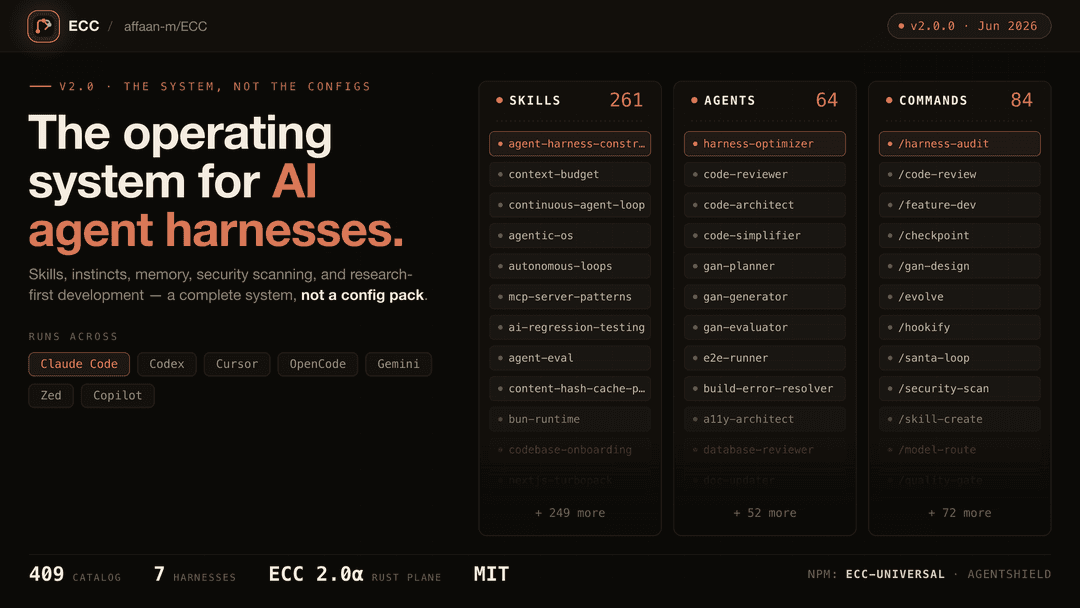
Access to 68 agents, 286 skills, and 94 legacy command shims, plus hooks, rules, memory, continuous learning, and AgentShield security scanning. The agents are specialized for planning, review, build repair, security, architecture, and domain work.
| Included | Count | What it gives you |
|---|---|---|
| Agents | 68 agents | Planning, review, build repair, security, architecture, and domain work |
| Skills | 286 skills | TDD, research, security, docs, frontend, data, ML, operations, and more |
| Commands | 94 commands | Convenient entry points while ECC moves to a skills-first surface |
| Hooks and memory | Runtime | Enforcement, session summaries, continuous learning, instincts, and context controls |
| Rules | Selective | Always-loaded standards you choose by language or project |
| AgentShield | Included | Scanning for prompts, hooks, MCP config, permissions, secrets, and agent files |

Install ECC
[!IMPORTANT] ECC 2.2 includes guided package setup for Claude Code, Codex, and Kimi Code. During registry propagation, run
npm view ecc-universal versionbefore using the package commands. If it still reports 2.1.0, the native Claude plugin commands at the top of this README remain available.
Pick one path only (per harness)
You can use ECC with Claude Code, Codex, and other harnesses at the same time. Choose one install method for each harness:
- Recommended default: run the guided Claude plugin setup below once
npm view ecc-universal versionreports 2.2.0 - Available throughout npm propagation: use the native plugin commands above
- Available in release 2.2: guided package setup for Claude Code, Codex, and Kimi Code
- Works: Claude Code plugin + Codex native plugin
- Works: Claude Code plugin + the legacy Codex sync flow
- Avoid: Claude Code plugin + full Claude manual install
- Avoid: Codex sync + Codex marketplace plugin
Do not stack install methods. Installing ECC twice into the same harness can duplicate skills, commands, hooks, or configuration; installing it once into multiple harnesses does not.
If you already layered multiple installs and things look duplicated, skip straight to Reset / Uninstall ECC.
Install trouble? Open the short install or runtime problem form, or run ecc feedback. ECC never uploads diagnostics automatically.
Claude Code details
Claude Code owns these built-in commands, including their errors when a marketplace, plugin, or conflicting scope already exists. ECC cannot intercept that parser. If either native command reports an existing install or scope conflict, use the 2.2 guided setup or resolve the conflicting Claude plugin scope before retrying; do not layer a manual install on top.
After ECC is installed, /ecc:configure-ecc is the namespaced in-Claude reconfiguration skill. It delegates to the same safe setup flow, but it is available only after the plugin is installed and cannot replace Claude Code's built-in /plugin command during a first install.
Claude Code plugins cannot distribute rules, so add only the rule packs you actually want:
git clone https://github.com/affaan-m/ECC.git
cd ECC
mkdir -p ~/.claude/rules/ecc
cp -R rules/common ~/.claude/rules/ecc/
cp -R rules/typescript ~/.claude/rules/ecc/  # replace with your stack
Start with rules/common plus one language or framework pack you actually use. If you install the plugin, do not run ./install.sh --profile full afterward.
Prefer settings.json? Add the marketplace declaratively
Add directly to your ~/.claude/settings.json:
{
  "extraKnownMarketplaces": {
    "ecc": {
      "source": {
        "source": "github",
        "repo": "affaan-m/ECC"
      }
    }
  },
  "enabledPlugins": {
    "ecc@ecc": true
  }
}
This gives you the same result as the two /plugin commands above.
Naming + migration note (ecc@ecc, affaan-m/ECC, ecc-universal)
ECC has three public identifiers, and they are not interchangeable:
- GitHub source repo:
affaan-m/ECC - Claude marketplace/plugin identifier:
ecc@ecc - npm package:
ecc-universal
This is intentional. Anthropic marketplace/plugin installs are keyed by a canonical plugin identifier, so ECC uses ecc@ecc to keep tool names and slash-command namespaces short enough for strict Desktop/API validators. Older posts may still show the former long marketplace identifier; treat that as a legacy alias only. Separately, the npm package stayed on ecc-universal, so npm installs and marketplace installs intentionally use different names.
npm releases are cut per version tag, not per commit, so ecc-universal tracks releases (2.1, 2.2, ...) rather than every push to main. Install from git if you want the bleeding edge.
If your local Claude setup was wiped or reset, that does not mean you need to repurchase anything. Start with node scripts/ecc.js list-installed, then run node scripts/ecc.js doctor and node scripts/ecc.js repair before reinstalling. That usually restores ECC-managed files without rebuilding your setup.
Codex App and CLI
Current Codex releases can install ECC as a native repo-marketplace plugin. The marketplace entry uses the repository root so Codex's cache receives the manifest together with all referenced skills, MCP configuration, hook runtime, scripts, and assets:
codex plugin marketplace add affaan-m/ECC
codex plugin add ecc@ecc
codex plugin list --json
node scripts/codex/check-plugin-cache.js
Both add commands are idempotent. To refresh later, run codex plugin marketplace upgrade ecc followed by codex plugin add ecc@ecc. Codex stores one enabled plugin state in the active CODEX_HOME; it does not offer Claude's user, project, and local scopes. Its native hooks require an explicit trust decision and do not use Claude's four ECC hook profiles. Inside Codex, invoke $configure-ecc for the guided provider-aware flow.
The older scripts/sync-ecc-to-codex.sh path is a deprecated compatibility option for users who intentionally need copied and merged configuration in ~/.codex; it is not required for the native plugin. New sync runs write an ownership manifest so cleanup can preserve modified user files. Run Codex once first so ~/.codex/config.toml exists, then:
git clone https://github.com/affaan-m/ECC.git
cd ECC
npm install
bash scripts/sync-ecc-to-codex.sh
To inspect or remove that legacy layer without touching Codex conversations or native plugin caches:
node scripts/ecc.js uninstall --legacy-codex-sync --dry-run
node scripts/ecc.js uninstall --legacy-codex-sync
Pre-manifest installations are handled conservatively: ECC removes its marked AGENTS.md block but preserves copied files it cannot prove it owns and reports them for review.
You can also open the ECC repository directly in Codex for a project-local setup. Codex reads the root AGENTS.md and the trusted project configuration in .codex/ without a global sync. Do not add the native marketplace plugin on top of the sync flow.
For repo navigation, surface ownership, and PR diff packet guidance, read the Codex ECC Navigation Map. See the .codex plugin notes for native lifecycle details.
Other agents and editors
Cursor, OpenCode, Gemini, Zed, Antigravity, Qwen, Hermes, OpenClaw, Kimi, CodeBuddy, JoyCode, Copilot
Clone ECC once, then choose the target that matches your harness:
git clone https://github.com/affaan-m/ECC.git
cd ECC
| Harness | Install or setup | Notes |
|---|---|---|
| Cursor | ./install.sh --profile minimal --target cursor | Project-local .cursor/ adapter |
| OpenCode | npm install && npm run build:opencode && ./install.sh --profile full --target opencode | Builds the plugin payload before the full install |
| Gemini CLI | ./install.sh --profile minimal --target gemini | Project-local .gemini/ config |
| Zed | ./install.sh --profile minimal --target zed | Project-local .zed/ adapter |
| Antigravity | ./install.sh --profile minimal --target antigravity | See the Antigravity guide |
| Qwen CLI | ./install.sh --profile minimal --target qwen | See the Qwen guide |
| Hermes | ./install.sh --profile minimal --target hermes | See the Hermes setup guide |
| OpenClaw | ./install.sh --profile minimal --target openclaw | Managed home-directory install |
| Kimi Code CLI | ./install.sh --profile minimal --target kimi | Project-local .kimi-code/ install |
| CodeBuddy | ./install.sh --profile minimal --target codebuddy | Project-local .codebuddy/ install |
| JoyCode | ./install.sh --profile minimal --target joycode | Project-local .joycode/ install |
GitHub Copilot support is already included in this repository. .github/copilot-instructions.md provides the instruction layer, .github/prompts/ contains the reusable /plan, /tdd, /security-review, /build-fix, and /refactor prompts, and .vscode/settings.json enables chat.promptFiles.
For a harness without a native ECC target, use the manual adaptation guide. It explains how to carry a small set of ECC skills and workflow instructions into chat-style tools without pretending hooks or native skill discovery are available.
Cursor installs agent definitions under .cursor/agents/ecc-*.md. Cursor-native loading behavior can vary by Cursor build. ECC does not install root AGENTS.md into .cursor/. The adapter keeps Cursor's context scoped to its native rules and agent surfaces.
Deep per-harness notes (feature parity, hook adapters, limitations) live in Platform Support below.
Self-Hosted Models and Custom Endpoints
ECC works through each harness's normal configuration, so you can use an official provider, a compatible custom API endpoint or model gateway, or a self-hosted model without changing ECC's workflows.
For Claude Code, ECC does not hardcode Anthropic-hosted transport settings. Minimal gateway example:
export ANTHROPIC_BASE_URL=https://your-gateway.example.com
export ANTHROPIC_AUTH_TOKEN=your-token
claude
If your gateway remaps model names, configure that in Claude Code rather than in ECC. ECC's hooks, skills, commands, and rules are model-provider agnostic once the claude CLI is already working. See Anthropic's LLM gateway documentation and model configuration documentation.
Run or self-host any open-source model behind that gateway using separate compute and serving setup. If you need GPU capacity, Itô is ECC's preferred compute sponsor; any GPU provider works. The sponsorship link is passive: it does not invoke an RFQ, reserve capacity, provision compute, or configure serving. Separately, ecc ito find invokes the explicitly configured canonical Itô CLI and submits a live authenticated RFQ; it does not reserve capacity. Managed inference through Itô is not live yet.
Self-host Kimi with ECC + Itô compute
The Kimi Code harness and the model-serving layer are separate. ECC configures the agent harness; you bring an API endpoint or self-host an open-weight Kimi model on your own GPU capacity. This adapter is verified against Kimi Code 0.31.x (@moonshot-ai/kimi-code):
|
1. Get GPU capacity Use Itô or any GPU provider. |
2. Serve Kimi Expose the chosen checkpoint through a compatible endpoint. |
3. Run Kimi Code with ECC Install project instructions and skills, then start Kimi Code. |
Configure the endpoint with Kimi Code's official provider guide, then install ECC:
bash ./install.sh --target kimi --profile minimal
node scripts/ecc.js doctor --target kimi
kimi
Kimi Code discovers the installed .kimi-code/AGENTS.md instructions and .kimi-code/skills/ workflows natively; project-level .agents/skills/ is also an official discovery location. ECC safely merges project MCP entries into .kimi-code/mcp.json and does not change the user-level ~/.kimi-code/config.toml. Kimi Code supports native hooks, but ECC's current managed-project adapter does not configure them, so this installer does not offer Kimi hook profiles. The installer dry-run and regression suite verify that every managed Kimi write stays inside the project-local .kimi-code/ root.
Itô compute CLI bridge
ecc ito delegates to the separately installed canonical Itô client; ECC does not maintain a second API client. ecc ito login [--no-browser] performs device authorization, opens the Itô verification page by default, and persists a device token in macOS Keychain; --no-browser suppresses the page handoff. ECC itself does no browser automation. ecc ito auth is validation-only and rejects --no-browser. The available operations are ecc ito login, ecc ito auth, ecc ito find, ecc ito status, and the separately gated ecc ito evals. The matching MCP tools remain ito_auth, ito_find, and ito_status; ito_auth validates existing credentials and node qualification is CLI-only.
The ito-compute-cli package is currently unpublished. Build it locally from the Itô runtime repo (private while the desk hardens; design partners get access) under cli/ito-compute-cli, run npm ci and npm run check, then set ECC_ITO_CLI_EXECUTABLE to that build's absolute dist/bin/ito.js path. Login never inherits ITO_API_KEY; auth, find, and status forward ITO_API_KEY directly when configured, and ITO_AUTH_MODE=legacy is not required. ecc ito logout revokes the current device credential and retains its local copy if remote revocation cannot be confirmed. Device tokens use macOS Keychain by default; explicit file fallback must retain owner-only directory/file permissions. ECC does not discover this credential-bearing client through PATH. See the ito-compute skill for the full RFQ authority and MCP setup contract.
find submits a live authenticated RFQ. It does not reserve capacity. evals requires both ITO_ENABLE_SIXTYTWO_LIVE=1 and --live-sixtytwo, a separately installed sixtytwo-cli==0.3.33, an explicit node list, and an existing absolute configuration directory. It cannot rent, launch, recover, repair, or purchase. ECC exposes no quote lock, purchase, workload, or inference path, and it never replaces a missing client or failed live call with a local result.
Advanced Install Options
The options stay here, directly under the main install paths, so you do not have to hunt through the README when the default setup is not the right fit.
Low-context install with no hook runtime
Low-context / no-hooks path
Use this when you want ECC's rules, agents, commands, platform config, and core workflows without runtime hooks:
./install.sh --profile minimal --target claude
Windows:
.\install.ps1 --profile minimal --target claude
This profile intentionally excludes hooks-runtime.
Claude manual installs place each skill directly under ~/.claude/skills/<skill-name>/ (or .claude/skills/<skill-name>/ for claude-project) so Claude Code can discover it. When upgrading an older ECC manual install, the installer migrates only nested skills/ecc/ files recorded in ECC install-state. If a flat skill directory is user-owned, ECC preserves it, prints a conflict warning, and keeps any older managed copy tracked for a safe uninstall instead of overwriting user files.
For the normal core profile with hooks disabled:
./install.sh --profile core --without baseline:hooks --target claude
Add the hook runtime later only if you want it:
./install.sh --target claude --modules hooks-runtime
Choose only the components you need
Find the right components first
Ask the packaged advisor which components match your work:
node scripts/ecc.js consult "security reviews" --target claude
It returns matching components, related profiles, and preview/install commands. Use the preview command before installing if you want to inspect the exact file plan.
You can also install explicit skills or capabilities:
./install.sh --target claude --skills tdd-workflow,security-review
node scripts/ecc.js install --profile minimal --target claude --with capability:machine-learning
Manual component-by-component copying also works. Each component is fully independent:
# Just agents
cp agents/*.md ~/.claude/agents/

# Rules directories (common + language-specific)
mkdir -p ~/.claude/rules/ecc
cp -r rules/common ~/.claude/rules/ecc/
cp -r rules/typescript ~/.claude/rules/ecc/   # pick your stack

# Core/general skills only (Claude Code loads skills from direct children
# of ~/.claude/skills; do not nest manual installs under ~/.claude/skills/ecc/)
mkdir -p ~/.claude/skills
cp -r .agents/skills/* ~/.claude/skills/
cp -r skills/search-first ~/.claude/skills/

# Optional: maintained slash-command compatibility during migration
mkdir -p ~/.claude/commands
cp commands/*.md ~/.claude/commands/
Retired shims live in legacy-command-shims/. Copy individual files from there only if you still need old names such as /tdd.
Project-local rules instead of global rules
Use project-local rules when ECC's standards should apply to one repository rather than every Claude Code session:
cd your-project
mkdir -p .claude/rules/ecc
cp -R /path/to/ECC/rules/common .claude/rules/ecc/
cp -R /path/to/ECC/rules/typescript .claude/rules/ecc/
Rules are always-loaded context, so begin with common and one pack for the stack you actually use. When copying rules manually, copy the whole language directory (for example rules/common or rules/golang), not the files inside it, so relative references keep working and filenames do not collide.
Fully manual Claude install
Use this only when you are intentionally skipping the plugin path:
git clone https://github.com/affaan-m/ECC.git
cd ECC
./install.sh --profile full
Windows:
git clone https://github.com/affaan-m/ECC.git
cd ECC
.\install.ps1 --profile full
If you choose this path, stop there. Do not also run /plugin install.
For hand-picked manual installs, Claude discovers skills as direct children of ~/.claude/skills/; do not nest them under ~/.claude/skills/ecc/.
Install hooks
Do not copy the raw repo hooks/hooks.json into ~/.claude/settings.json or ~/.claude/hooks/hooks.json. That file is plugin/repo-oriented; use the installer so hook command paths are rewritten correctly:
bash ./install.sh --target claude --modules hooks-runtime
That writes resolved hooks to ~/.claude/hooks/hooks.json and leaves any existing ~/.claude/settings.json untouched.
If you installed ECC via /plugin install, do not copy those hooks into settings.json. Claude Code v2.1+ already auto-loads plugin hooks/hooks.json, and duplicating them in settings.json causes duplicate execution and cross-platform hook conflicts.
On Windows, Claude's config root is %USERPROFILE%\\.claude; install the hook runtime with:
pwsh -File .\install.ps1 --target claude --modules hooks-runtime
Configure MCPs
Claude plugin installs intentionally do not auto-enable ECC's bundled MCP server definitions. This avoids overlong plugin MCP tool names on strict third-party gateways while keeping manual MCP setup available.
Use Claude Code's /mcp command or CLI-managed MCP setup for live Claude Code server changes; Claude Code persists those choices in ~/.claude.json. For repo-local MCP access, copy desired MCP server definitions from mcp-configs/mcp-servers.json into a project-scoped .mcp.json.
ECC ships exactly one default connector (chrome-devtools); everything else is a skill wrapping a CLI/REST API or an opt-in catalog entry. The rule and the June 2026 audit that retired the previous six defaults live in docs/MCP-CONNECTOR-POLICY.md.
If you already run your own copies of ECC-bundled MCPs, set:
export ECC_DISABLED_MCPS="chrome-devtools"
ECC-managed install and Codex sync flows will skip or remove those bundled servers instead of re-adding duplicates. ECC_DISABLED_MCPS is an ECC install/sync filter, not a live Claude Code toggle.
Important: Replace YOUR_*_HERE placeholders with your actual API keys.
Multi-model commands require additional setup
multi-* commands are not covered by the base plugin/rules install.
To use /multi-plan, /multi-execute, /multi-backend, /multi-frontend, and /multi-workflow, you must also install the ccg-workflow runtime. Initialize it with npx ccg-workflow.
That runtime provides the external dependencies these commands expect, including:
~/.claude/bin/codeagent-wrapper~/.claude/.ccg/prompts/*
Without ccg-workflow, these multi-* commands will not run correctly.
Reset, repair, or uninstall
Reset / Uninstall ECC
If ECC feels duplicated, intrusive, or broken, inspect the managed state before reinstalling:
node scripts/ecc.js list-installed
node scripts/ecc.js doctor
node scripts/ecc.js repair
node scripts/ecc.js uninstall --dry-run
For direct uninstall:
node scripts/uninstall.js --dry-run
node scripts/uninstall.js
If you are leaving, the uninstall command prints an optional 20-second feedback form. It is a public GitHub issue, never blocks uninstall, and ECC does not upload diagnostics. You can also run ecc feedback at any time to see the problem, feedback, and feature routes.
Plugin users should remove the plugin from Claude Code, then delete only the rule folders they manually copied and no longer want. ECC only removes files recorded in its install-state. It does not claim unrelated files in your harness directories.
If you stacked methods, clean up in this order:
- Remove the Claude Code plugin install.
- Run the ECC uninstall command from the repo root to remove install-state-managed files.
- Delete any extra rule folders you copied manually and no longer want.
- Reinstall once, using a single path.
Guided package setup in release 2.2
[!IMPORTANT] These package-runner commands require
ecc-universal2.2.0 or newer. Confirm registry propagation withnpm view ecc-universal version. The native Claude plugin install remains available throughout npm rollout.
For Claude Code plugin setup, updates, scope changes, and hook-profile changes:
npx ecc-universal setup
ECC 2.2 supports the same guided setup through modern package runners:
| Package runner | Guided setup command |
|---|---|
| npm / npx | npx ecc-universal setup |
| pnpm | pnpm dlx ecc-universal setup |
| Yarn 2+ | yarn dlx ecc-universal setup |
| Bun | bunx ecc-universal setup |
Yarn Classic 1 does not provide yarn dlx; use npx, install the package globally, or upgrade Yarn for a temporary one-shot run.
The wizard inventories the official marketplace and every native Claude install scope before making changes, then installs, updates, or safely moves ecc@ecc to the scope you choose. Rerun the same command whenever you want to update ECC, change scope, or change its hook profile. This setup wizard currently configures the Claude Code plugin; use the multi-harness wizard below for Codex or Kimi Code.
To configure more than one coding agent in one reviewed flow, use the multi-harness wizard:
npx ecc-universal install --guided
It lets you select any combination of Claude Code, Codex, and Kimi Code, shows each install channel and destination, preflights every selection before the first write, and asks for one final confirmation.
| Harness | Guided install behavior |
|---|---|
| Claude Code | Native ecc@ecc plugin with one user, project, or local scope and an ECC hook profile |
| Codex | Native Codex marketplace/plugin lifecycle; hook review and trust remain Codex-owned |
| Kimi Code | Managed project files under ./.kimi-code; ECC hooks, model/provider settings, and authentication are not configured |
For automation, make every provider-specific choice explicit:
npx ecc-universal install --guided \
  --harness claude --harness codex --harness kimi \
  --claude-scope local --claude-hooks standard \
  --profile core --yes
Verify the native guided Codex path and managed Kimi path without writing first:
npx ecc-universal install --guided --harness codex --dry-run
npx ecc-universal install --profile core --target kimi --dry-run
Additional package-name commands are also available through the 2.2 alias:
npx ecc-universal consult "security reviews" --target claude
npx ecc-universal install --profile minimal --target claude --with capability:machine-learning
npx ecc-universal doctor --target kimi
Do not use npx ecc-install --profile minimal --target claude: ecc-install is a binary name inside ecc-universal, not a separately published npm package.
ECC also ships advanced managed adapters for cursor, antigravity, gemini, opencode, codebuddy, joycode, qwen, zed, hermes, and openclaw. Those targets still use their documented ecc install --target ... paths until each adapter has passed the guided collision, update, repair, and uninstall lifecycle matrix. Neither wizard silently installs into every detected harness.
Start Using ECC
Start with the workflow you need, not the full catalog.
| What you are doing | Start here |
|---|---|
| Building a feature | /ecc:plan "describe the feature", then tdd-workflow |
| Fixing a bug | Reproduce it with a failing test, then use tdd-workflow |
| Reviewing new code | /code-review for a fresh-context review |
| Repairing a build | /build-fix |
| Cleaning a codebase | /refactor-clean |
| Checking context pressure | /context-budget |
| Ending a long session | /save-session or /learn-eval |
| Resuming later | /resume-session |
| Auditing agent config | /security-scan or npx -y ecc-agentshield scan --path . |
Plugin commands and manual commands
Claude Code plugin commands use the namespaced form:
/ecc:plan "Add authentication"
Manual installs may expose the shorter compatibility form:
/plan "Add authentication"
Skills are the primary workflow surface. Commands remain convenient entry points and compatibility shims. Check what is installed with:
/plugin list ecc@ecc
Which agent should I use?
Skills are the canonical workflow surface; maintained slash entries stay available for command-first workflows.
| I want to... | Use this surface | Agent used |
|---|---|---|
| Plan a new feature | /ecc:plan "Add auth" | planner |
| Design system architecture | /ecc:plan + architect agent | architect |
| Write code with tests first | tdd-workflow skill | tdd-guide |
| Review code I just wrote | /code-review | code-reviewer |
| Fix a failing build | /build-fix | build-error-resolver |
| Run end-to-end tests | e2e-testing skill | e2e-runner |
| Find security vulnerabilities | /security-scan | security-reviewer |
| Remove dead code | /refactor-clean | refactor-cleaner |
| Update documentation | /update-docs | doc-updater |
| Review Go code | /go-review | go-reviewer |
| Review Python code | /python-review | python-reviewer |
| Review F# code | (invoke fsharp-reviewer directly) | fsharp-reviewer |
| Review TypeScript/JavaScript code | (invoke typescript-reviewer directly) | typescript-reviewer |
| Develop HarmonyOS apps | (invoke harmonyos-app-resolver directly) | harmonyos-app-resolver |
| Audit database queries | (auto-delegated) | database-reviewer |
| Review production ML changes | mle-workflow skill + mle-reviewer agent | mle-reviewer |
Common workflows
Slash forms below are shown where they remain part of the maintained command surface. Retired short-name shims such as /tdd and /eval live in legacy-command-shims/ for explicit opt-in only.
Starting a new feature:
/ecc:plan "Add user authentication with OAuth"
                                              -> planner creates implementation blueprint
tdd-workflow skill                            -> tdd-guide enforces write-tests-first
/code-review                                  -> code-reviewer checks your work
Fixing a bug:
tdd-workflow skill                            -> tdd-guide: write a failing test that reproduces it
                                              -> implement the fix, verify test passes
/code-review                                  -> code-reviewer: catch regressions
Preparing for production:
/security-scan                                -> security-reviewer: OWASP Top 10 audit
e2e-testing skill                             -> e2e-runner: critical user flow tests
/test-coverage                                -> verify 80%+ coverage
What's New: ECC 2.1
[!IMPORTANT] NEW IN ECC 2.1: Plan Canvas · Kimi harness · self-hosted compute on Itô GPUs. See the full release notes →
Plan Canvas: review plans by pointing, not retyping
// faq
What is ECC-Antigravity?
🚀 Everything Claude Code (ECC) for Google Antigravity. Full runtime compatibility: 68+ specialized agents, 280+ skills, and automated safety/quality lifecycle hooks powered by Gemini 3.8.. It is open-source on GitHub.
Is ECC-Antigravity free to use?
ECC-Antigravity is open-source under the MIT license, so it is free to use.
What category does ECC-Antigravity belong to?
ECC-Antigravity is listed under devtools in the Claudeers registry of Claude-compatible tools.
// embed badge

[](https://claudeers.com/ecc-antigravity)
// retro hit counter

[](https://claudeers.com/ecc-antigravity)
// reviews
// guestbook
// related in Developer Tools
 🔓
The agent harness performance optimization system. Skills, instincts, memory, security, and research-first development for Claude Code, Codex, Opencode, Curs…
 🔓
Makes your AI agent think like the laziest senior dev in the room. The best code is the code you never wrote.
 🔓
AI coding assistant skill (Claude Code, Codex, OpenCode, Cursor, Gemini CLI, and more). Turn any folder of code, SQL schemas, R scripts, shell scripts, docs,…
 🔓
Use Garry Tan's exact Claude Code setup: 23 opinionated tools that serve as CEO, Designer, Eng Manager, Release Manager, Doc Engineer, and QA