
duo
Claude Code and Codex together: a local desktop app for chat, pair programming, debates, councils, and code reviews.
Install with your AI
Paste into Claude Code, Cursor, or any agent — it reads the repo and wires the tool into your project.
Install and set up duo (git-clone project) into my current project.
Found on https://claudeers.com/duo
Repo: https://github.com/Audatic07/duo
Homepage/docs: https://github.com/Audatic07/duo
Detected install method: git-clone → git clone https://github.com/Audatic07/duo
Category: devtools. Platforms: cli, api, desktop, web.
Read the repo's README for exact setup and env vars, then install it and wire it into my project.

Claudeers Health Verdict:
unknown; community-verified: false. Confirm the source before running anything.
git clone https://github.com/Audatic07/duo
// compatibility
| Platforms | cli, api, desktop, web |
|---|---|
| Operating systems | — |
| AI compatibility | claude |
| License | MIT |
| Pricing | open-source |
| Language | TypeScript |
Duo
Claude Code and Codex in one desktop app. Chat with either, run them side by side, or let them work on the same problem together: one writes the code while the other reviews it, they debate until every claim is agreed, or they cross-check each other's code reviews. Every prompt, tool call, token and credit is recorded.
Duo drives the official CLIs you already use, signed in with your own plans: Claude Code (Claude subscription) and the Codex CLI (ChatGPT subscription). Nothing goes through a third-party server.
Runs on Linux, macOS and Windows.
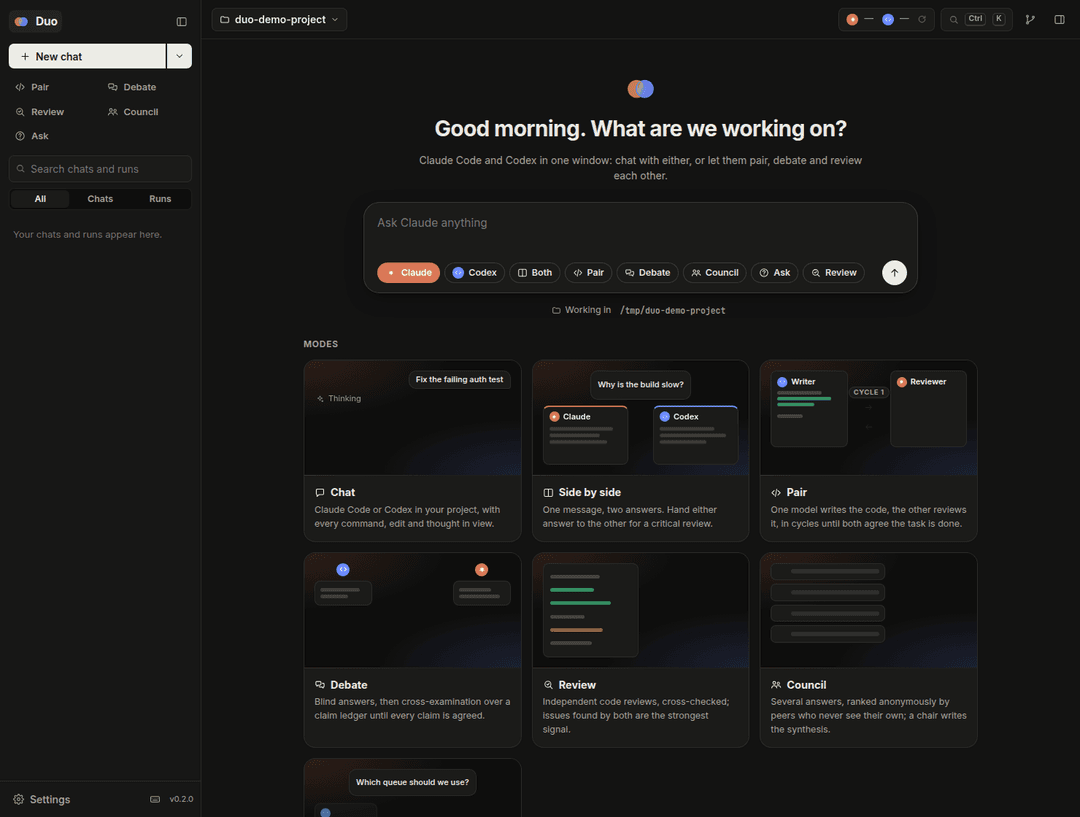
Modes
| Mode | What happens |
|---|---|
| Chat | Claude Code or Codex in a project folder (or none), streaming: thinking, commands with their output, file edits as diffs, plans. Pick model, effort and permissions per chat. |
| Side by side | One message, two answers. Hand either answer to the other for a critical review in one click. |
| Pair | One model writes the code in its own git worktree, the other reviews every change, and they cycle until the writer says done, the reviewer approves, and your check command passes. You then apply the result, keep the branch, or discard it. |
| Debate | Blind first answers, then cross-examination over a claim ledger until every claim is agreed (or the round cap). File citations are verified against your code. |
| Review | Independent code reviews of a diff, then each reviewer confirms or rejects the others' findings. Issues found by both are the strongest signal. |
| Council | Several answers, ranked anonymously by peers who never see their own; a chair writes the synthesis and keeps the dissent. |
| Ask | The same question to several models in parallel, answers side by side. |
The app shows an animated walkthrough of each mode on its home screen and next to the run form.
Install
You need:
- Node.js 22.18 or newer (Duo runs its TypeScript sources directly).
- git (pair mode and the Changes panel use it).
- Claude Code, installed and signed in: run
claudeonce and use/login. - A ChatGPT account for Codex: Duo bundles a pinned Codex CLI; sign in with
npx codex loginfrom the Duo folder, or through the ChatGPT desktop app.
git clone https://github.com/Audatic07/duo.git
cd duo
npm install
node bin/duo.js setup
duo doctor
duo setup adds an app launcher (the application menu on Linux, ~/Applications/Duo.app on macOS, the Start menu on Windows), the duo and duo-safe commands, a /duo skill for Claude Code, a $duo skill for Codex, and a Codex rule that pre-approves duo-safe. duo setup --uninstall removes all of it.
Then open Duo from your launcher, or run duo gui.
Notes:
npm installbuilds or downloads one native module (re2, used by claw-orchestrator). If your npm asks to approve install scripts, approvere2andelectron.duo doctor(or Settings → Setup check in the app) checks both CLIs, their sign-ins and versions; Test both sign-ins sends one tiny message through each to prove they work.
The desktop app
- Home: one box for everything. Type, pick Claude, Codex, Both, Pair, Debate, Council, Ask or Review, press Enter.
- Chats: live tool steps, thinking, diffs and plans; Claude permission modes from Plan to Full access, with Ask before acting approval cards; Codex sandbox modes; switch model or effort mid-conversation without losing the thread; retry, copy, hand an answer to the other model, or escalate a question to a debate, council or pair run.
- Runs: a live view of every seat while it works, the rounds or cycles as they land, the claim ledger, findings, rankings, the report, and every turn's exact prompt, reply, tool calls and reasoning. Stop a run at any time; continue a finished one with a note.
- Always in view: both plans' 5-hour and weekly usage, the project's git changes, and a token, time and cost trace.
- Quality of life: command palette (
Ctrl/⌘ K), keyboard shortcuts (Ctrl/⌘ /), pinned chats, search, drafts that survive restarts, desktop notifications when a long run finishes in the background, light and dark themes.
Pair mode
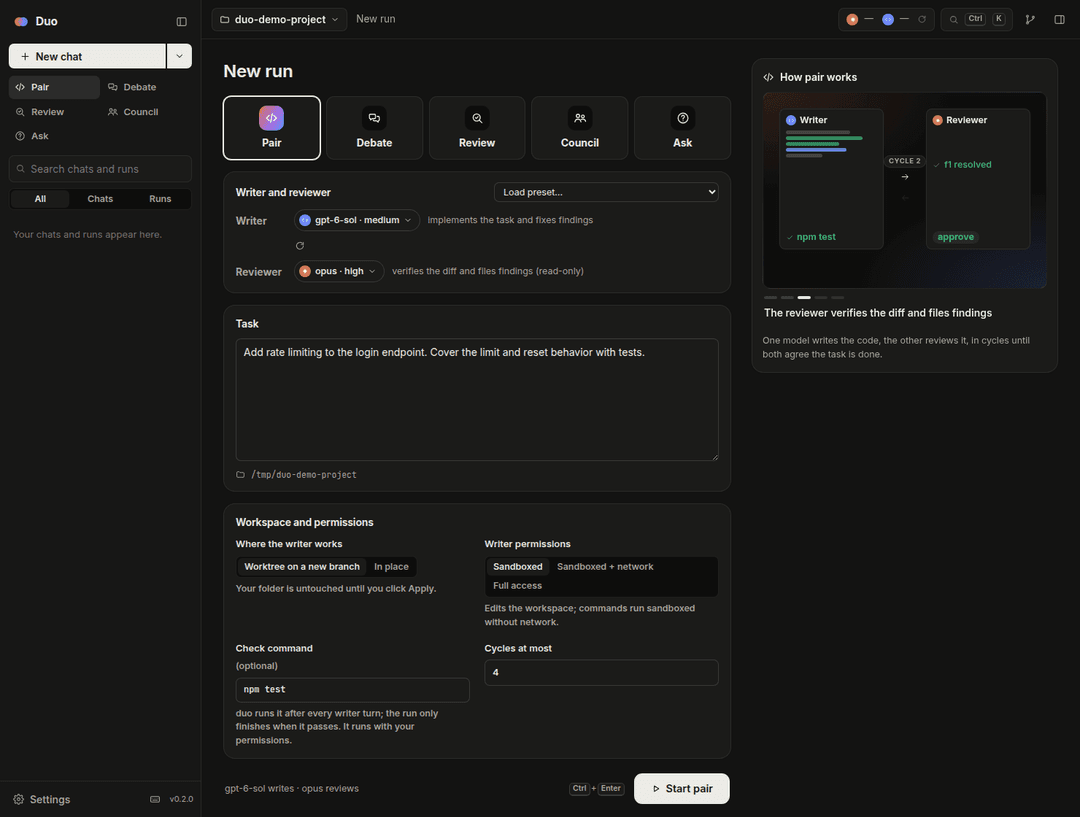
duo pair -s codex:gpt-6-sol@high -s claude:opus@high --check "npm test" -C ~/code/app "Add rate limiting to the login endpoint"
- Duo creates a git worktree on a new
duo/…branch fromHEAD(or, with--in-place, snapshots the folder so it can show and revert exactly what changed). - The writer (first seat) implements the task, runs what it can, and reports what it did.
- Duo runs your check command, if you gave one.
- The reviewer (second seat, read-only) verifies the diff against the request and approves or files findings with severity, location and fix.
- The writer fixes or disputes each finding; repeat.
It stops when the writer reports done, the reviewer approves with no P0/P1 finding open, and the check passes. It also stops if the writer is blocked, if the two deadlock on a finding (you decide), or at the cycle cap. Nothing touches your folder until you choose Apply (duo apply <run>), Keep branch, or Discard.
Writer permissions: Sandboxed (Codex workspace-write; Claude auto-accepts edits and runs commands in its sandbox where available), Sandboxed + network, or Full access.
Command line
Every mode the app runs is also a command.
engine[:model][@effort][+option...]

codex:gpt-6-astra@xhigh+verbosity=high+summary=detailed
codex:gpt-6-sol@high+web=live+tier=fast
claude:opus@max+web
claude:sonnet@medium+name=Skeptic+persona=@~/personas/skeptic.md
| option | engine | effect |
|---|---|---|
verbosity=low|medium|high | codex | model_verbosity |
summary=auto|concise|detailed|none | codex | model_reasoning_summary |
web[=live|cached|disabled] | both | Codex web search / Claude WebSearch |
tier=fast (or +fast) | codex | service_tier (2× credits) |
cfg:key=<toml> | codex | raw -c override (sandbox, approval, shell and MCP keys are refused) |
fetch | claude | WebFetch |
dir=PATH | claude | extra readable directory |
name=, persona=text|@file, timeout=SEC | both | label, role instructions, per-turn timeout |
duo pair    -s codex:gpt-6-sol@high -s claude:opus@high --cycles 4 --check "npm test" -C ~/repo -f task.md
duo debate  -s codex:gpt-6-sol@high -s claude:opus@high --rounds 4 --chair claude:opus@high -C ~/repo -f brief.md
duo debate  --no-project -s codex:gpt-6-sol@high -s claude:opus@high "Postgres or SQLite for a single-user desktop app?"
duo review  -s codex:gpt-6-astra@high -s claude:opus@high --base main -C ~/repo "concurrency and error paths"
duo council -s codex:gpt-6-astra@high -s codex:gpt-6-sol@high -s claude:opus@high --chair claude:opus@max "question"
duo ask     -s codex:gpt-6-luna@high -s claude:haiku "quick question"
duo continue <run> --rounds 2 "moderator note: focus on the migration risk"
duo apply <run> [--keep-branch | --discard]
duo runs · duo trace <run> · duo show <run> [--report] [--turn N --part reply|prompt|thinking|tools|meta|raw|json] · duo export <run> --format html|json|md · duo quota [--refresh] · duo models · duo doctor · duo config. Ctrl-C cancels a run cleanly (the record is kept).
Codex efforts: none, minimal, low, medium, high, xhigh, max, ultra (per model; duo models lists what the bundled client offers). Claude efforts: low, medium, high, xhigh, max. Presets live in the config file (duo config --init).
How the protocols keep models honest
- Structured output is enforced by the CLIs themselves (
--output-schema,--json-schema). Answers stay prose; claims, stances, findings and verdicts become machine-checkable. - Citation checks: every
path:linecitation and quote is verified against the file, and failures are shown to every seat the next round. - Strict convergence: verdicts alone are not trusted. Two seats can each say "agree" while holding the other's earlier position; only a ledger where every claim is agreed by every peer counts.
- Bounded ledgers: each seat keeps at most eight load-bearing claims, so peers can actually take a stance on all of them.
- Fail fast: an error retrying cannot fix (an outdated CLI, an expired sign-in, an unknown model, a plan limit) stops the run at once instead of letting the other seats spend your quota. A CLI process that died between turns is restarted on the same conversation; a model at capacity gets one retry after a pause; Codex reconnects are recorded as warnings, not failures.
- Isolation: discussion seats are read-only and see none of your installed Codex skills or rules; a pair writer edits only its own worktree;
DUO_DEPTHstops any seat from starting Duo again.
Traceability
Each run lives in its own folder in Duo's data folder (duo config prints it):
run.json        seats (+ Codex thread / Claude session ids), versions, git state, quota before/after, totals, outcome
transcript.md   every round, readable
report.md       outcome, final positions, claims, findings or cycles, usage
ledger.json     claims, evidence, citation results, stance history   (debate)
findings.json   merged findings with confirmations and rejections     (review)
council.json    anonymization maps, rankings, scores                  (council)
pair.json       cycles, checks, findings and their history            (pair)
turns/NN-<seat>-r<round>-<kind>/   prompt.md reply.md reply.json thinking.md tools.json meta.json raw.jsonl
taps/           the untouched CLI event stream of every seat
Codex turns are priced in plan credits from the Codex rate card (src/pricing.ts); Claude turns show the API-equivalent cost the CLI reports.
Where things live
| Linux | macOS | Windows | |
|---|---|---|---|
| config | ~/.config/duo/config.json | ~/Library/Application Support/duo/config.json | %LOCALAPPDATA%\duo\config.json |
| data (runs, chats, worktrees) | ~/.local/share/duo | ~/Library/Application Support/duo | %LOCALAPPDATA%\duo |
Override with DUO_CONFIG and DUO_HOME. DUO_CODEX_BIN and DUO_CLAUDE_BIN (or codexBin/claudeBin in the config) point Duo at specific CLIs; DUO_NODE picks the Node.js the app uses.
Security
The app is an Electron window over a local engine bound to 127.0.0.1. Every API call needs a random per-launch token that only the app's own window receives; the engine refuses non-loopback Host headers and cross-site origins, so no web page can drive it. Model output is sanitized before it is rendered. Chats run with the permissions you pick; discussion seats are read-only; pair writers are sandboxed unless you choose full access. See SECURITY.md.
Using Duo from the agents
- Claude Code:
/duo pair codex:gpt-6-sol@high writes, claude:opus@high reviews: <task>, or just ask for a Codex debate. The skill passes your model and effort choices through unchanged. - Codex:
$duo ...runsduo-safe, the restricted entry point (read-only seats, nocfg:, no WebFetch, no pair mode). The ruleduo setupwrites pre-approves onlyduo-safe; restart the Codex or ChatGPT app after setup.
Troubleshooting
- A Claude seat fails with "OAuth session expired" or "not logged in": run
claudein a terminal and use/login, then Continue the run. - "Claude Code x.y does not support this model; version … or newer is required": run
claude update(or Settings → Setup check → Update Claude Code). - "Selected model is at capacity": Duo retries once; try again later or pick another model.
- The app says it needs Node.js though it is installed: start it once from a terminal with
duo gui, or setDUO_NODEto yournodebinary. - Codex cannot write in pair mode on Linux: its sandbox needs Landlock or bubblewrap; choose Full access for the writer in a worktree, or check
codex sandbox --help.
Development
npm run check     # strict typecheck (engine and GUI) and all tests
npm run dev       # engine + GUI in a browser at http://127.0.0.1:47821/#dev
npm run smoke     # the desktop shell end to end, without showing a window
The tests run the whole engine through claw-orchestrator against fake Claude and Codex CLIs (test/fakes), so they need no network and no account and run the same on every OS. The GUI (gui/src, Preact + TSX) is bundled by esbuild when the engine starts. See CONTRIBUTING.md.
bin/          duo, duo-safe
desktop/      Electron shell (main.cjs), preload, icons
gui/src/      the app: Shell, Chat, Run, demos (animated mode walkthroughs), styles
src/          engine: seats, protocols (pair, debate, review, council, ask, continue), hooks, pricing, quota
src/server/   local HTTP + SSE server for the app: chats, runs, permissions, git
skills/       the /duo (Claude Code) and $duo (Codex) skills
test/         unit and end-to-end tests, fake CLIs, real stream fixtures
Credits
Built on claw-orchestrator (MIT), which drives both CLIs as persistent sessions. Protocol ideas from Karpathy's llm-council (anonymized peer ranking), STRML/cc-debate (contradiction rounds) and TorpedoD/claude-council (dissent preservation). Inter and JetBrains Mono fonts (OFL).
Duo is not affiliated with Anthropic or OpenAI. Claude and Claude Code are trademarks of Anthropic; ChatGPT and Codex are trademarks of OpenAI.
License
// faq
What is duo?
Claude Code and Codex together: a local desktop app for chat, pair programming, debates, councils, and code reviews.. It is open-source on GitHub.
Is duo free to use?
duo is open-source under the MIT license, so it is free to use.
What category does duo belong to?
duo is listed under devtools in the Claudeers registry of Claude-compatible tools.
// embed badge

[](https://claudeers.com/duo)
// retro hit counter

[](https://claudeers.com/duo)
// reviews
// guestbook
// related in Developer Tools
 🔓
🔓The agent harness performance optimization system. Skills, instincts, memory, security, and research-first development for Claude Code, Codex, Opencode, Curs…
 🔓
🔓Makes your AI agent think like the laziest senior dev in the room. The best code is the code you never wrote.
 🔓
🔓Use Garry Tan's exact Claude Code setup: 23 opinionated tools that serve as CEO, Designer, Eng Manager, Release Manager, Doc Engineer, and QA
 🔓
🔓AI coding assistant skill (Claude Code, Codex, OpenCode, Cursor, Gemini CLI, and more). Turn any folder of code, SQL schemas, R scripts, shell scripts, docs,…