
design-harness
Feed your agent papers and half-formed ideas — it links them into a system design you can defend. Markdown keeps the record; a visual canvas makes it readabl…
Install with your AI
Paste into Claude Code, Cursor, or any agent — it reads the repo and wires the tool into your project.
Install and set up design-harness (claude-plugin project) into my current project.
Found on https://claudeers.com/design-harness
Repo: https://github.com/tigerless-labs/design-harness
Homepage/docs: —
Detected install method: claude-plugin → /plugin install design-harness@tigerless-labs/design-harness
Category: skills. Platforms: cli, api, desktop.
Read the repo's README for exact setup and env vars, then install it and wire it into my project.

Claudeers Health Verdict:
active; community-verified: false. Confirm the source before running anything.
/plugin marketplace add tigerless-labs/design-harness
/plugin install design-harness@tigerless-labs/design-harness
git clone https://github.com/tigerless-labs/design-harness
// compatibility
| Platforms | cli, api, desktop |
|---|---|
| Operating systems | — |
| AI compatibility | claude |
| License | NOASSERTION |
| Pricing | open-source |
| Language | Python |
design-harness
Turn scattered reading and half-formed ideas into a system design you can defend. The human adjudicates, the agent runs the errands.
An Agent Skill (Claude Code plugin, works with any SKILL.md-compatible agent): feed it sources and rough ideas as you go — it files and links them, records how your thinking evolves, and assembles the evidence into a system design.
Markdown keeps the record; the canvas makes it readable — every source and idea you add lands on the board, one glance away from any decision's why.
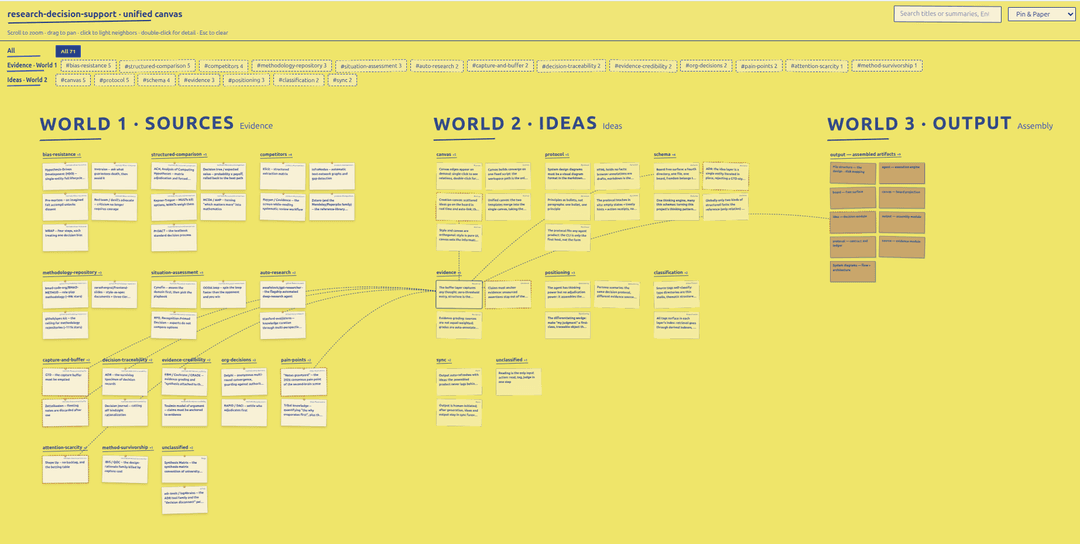
▶ Click the board to open the live canvas — this repo's own design workspace, dogfooded, rebuilt from the markdown on every merge.
What This Does
- Sources file themselves — drop papers, repos, blog posts; the agent files one card per source, grades it, and anchors every claim to where it came from.
- Ideas are yours alone — only a human creates an idea card; the agent links it to evidence, clusters neighbors, and surfaces conflicts instead of picking a side.
- Output assembles on your word — one command turns surviving ideas into the deliverable, and every later sync runs on your word too; edit output directly and it flows back into ideas.
- Everything is traceable — every design element links back through ideas to the sources that earned it, with an append-only log on every card.
- Plain Markdown, no lock-in — three folders in your repo; versionable, greppable, renders on GitHub. The agent is just the runtime.
- One visual canvas — a self-contained HTML projection of the whole board: no server, no dependencies, rebuilt on demand and thrown away.
Installation
Claude Code:
/plugin marketplace add tigerless-labs/design-harness
/plugin install design-harness@design-harness
Codex (CLI and the ChatGPT desktop app share one plugin system):
codex plugin marketplace add tigerless-labs/design-harness
then install from /plugins in the CLI or the desktop app's plugin directory.
For other SKILL.md-compatible agents, copy the skill folder into your agent's skill directory:
git clone https://github.com/tigerless-labs/design-harness
cp -r design-harness/plugins/design-harness/skills/design-harness \
  ~/.claude/skills/
Usage
Talk to your agent in plain language:
> file these papers onto the board
> assemble the design
- Drop material — the agent files and grades each source as a card.
- Think out loud — your judgments land as idea cards, linked to their evidence.
- Say go — the ideas assemble into the output your
target.mddeclares. - Ask for the canvas — the agent builds the board and hands you a clickable link.
Render your own workspace in ten seconds — the demo board is the same projection run on a real workspace:
python3 plugins/design-harness/skills/design-harness/scripts/build_canvas.py \
  path/to/your-workspace -o /tmp/canvas
open /tmp/canvas/canvas.html
Canvas Styles
Five skins ship with the canvas; switch live from the toolbar, Pin & Paper is the default. Screenshots below are this repo's own workspace, unretouched — the board view and a close-up for each style.
Pin & Paper (default)


A handmade pinboard: yellow paper ground, ink-blue hand script, pinned notes, taped slips, and dashed hand-drawn threads between them.
Notebook Tabs


Warm ivory stationery: serif italic headings, index cards with colored tab tongues, sticky-note ideas, stitched dashed connections.
Swiss Modern


White, ink, and one red accent: hairline grid, giant grotesk world titles with red ordinals, ruler-straight edges.
BlockFrame


Neo-brutalist pastel decks: thick borders, hard offset shadows, cyan / pink / yellow card blocks that tilt just enough to feel alive.
8-Bit Orbit


A CRT arcade in deep navy — scanlines, neon cyan / yellow / magenta frames, and orthogonal circuit-trace edges. Dark in both color schemes; a CRT has no daylight mode.
Philosophy
- The human adjudicates, the agent runs the errands — agents execute well and judge poorly, and a wrong design costs the whole branch of code built on it.
- Markdown is the only source of truth — every other surface, the canvas included, is a disposable projection.
- Rejected ideas are archived with their reasons, never deleted — six months later, "why didn't we do X?" has an answer.
- Every element of the output must answer "why?" with a link.
This repo is dogfooded on itself: its own design was produced by running the method on ~80 sources about decision-making methods.
License
MIT — vendored renderers (marked, DOMPurify) keep their original headers.
// faq
What is design-harness?
Feed your agent papers and half-formed ideas — it links them into a system design you can defend. Markdown keeps the record; a visual canvas makes it readable. An Agent Skill for Claude Code & any SKILL.md-compatible agent.. It is open-source on GitHub.
Is design-harness free to use?
design-harness is open-source under the NOASSERTION license, so it is free to use.
What category does design-harness belong to?
design-harness is listed under skills in the Claudeers registry of Claude-compatible tools.
// embed badge

[](https://claudeers.com/design-harness)
// retro hit counter

[](https://claudeers.com/design-harness)
// reviews
// guestbook
// related in Claude Skills
 🔓
🔓An agentic skills framework & software development methodology that works.
 🔓
🔓 🔓
🔓💫 Toolkit to help you get started with Spec-Driven Development
 🔓
🔓AI coding assistant skill (Claude Code, Codex, OpenCode, Cursor, Gemini CLI, and more). Turn any folder of code, SQL schemas, R scripts, shell scripts, docs,…