
codestatus
Track every Claude Code and Codex session from your macOS menu bar. Know which AI coding agents are working, done, or waiting on you - from their official li…
Install with your AI
Paste into Claude Code, Cursor, or any agent — it reads the repo and wires the tool into your project.
Install and set up codestatus (release-binary project) into my current project.
Found on https://claudeers.com/codestatus
Repo: https://github.com/henriquegpb/codestatus
Homepage/docs: https://codestatus.dev
Detected install method: release-binary → inspect the README
Category: automation. Platforms: cli, api, desktop, web.
Read the repo's README for exact setup and env vars, then install it and wire it into my project.

Claudeers Health Verdict:
active; community-verified: false. Confirm the source before running anything.
Grab the latest release asset from GitHub.
# download a build from https://github.com/henriquegpb/codestatus/releases
git clone https://github.com/henriquegpb/codestatus
// compatibility
| Platforms | cli, api, desktop, web |
|---|---|
| Operating systems | — |
| AI compatibility | claude |
| License | MIT |
| Pricing | open-source |
| Language | Swift |
CodeStatus
Stop watching AI work.
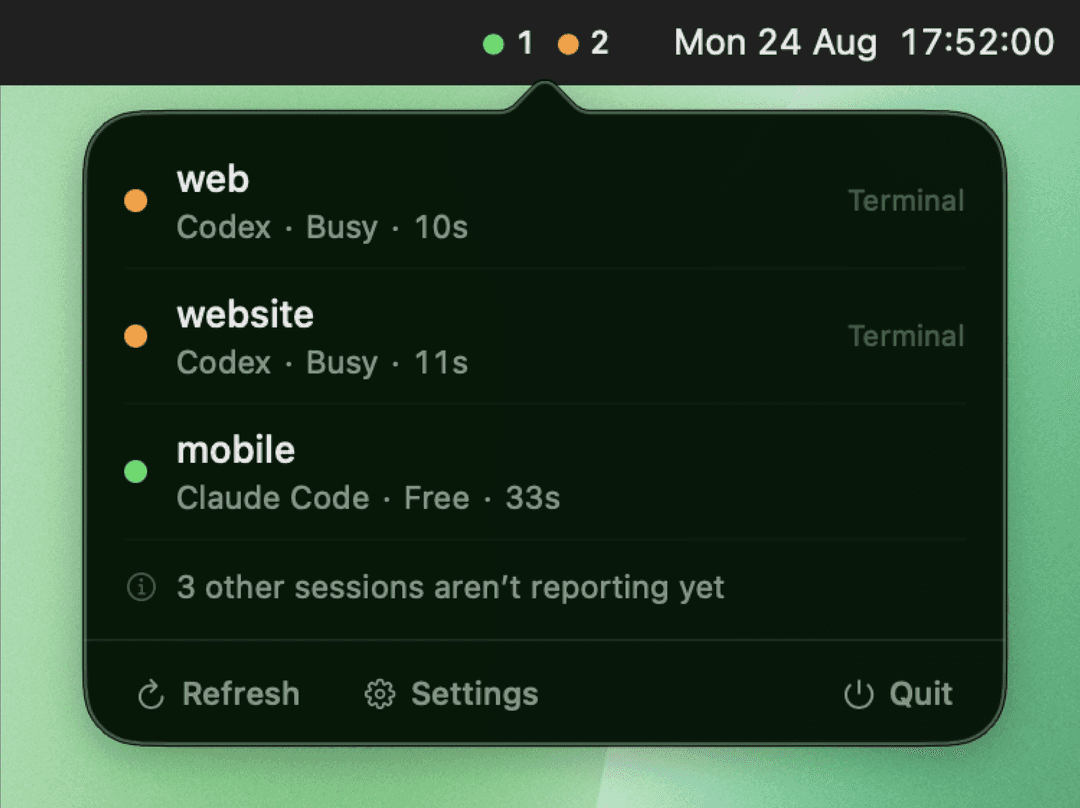
A menu bar, tray and panel app that tracks every Claude Code and Codex session on your machine and tells you the moment one finishes, needs approval, or is waiting on you. A native presence layer for coding agents: start several, keep working, and come back only when one is actually done or actually needs you.
Download for macOS · Download for Windows · Download for Linux · codestatus.dev
macOS 14 or later · Windows 10 or later · Linux · MIT · no account, no server, no telemetry
What it is
You run Claude Code in one terminal, Codex in another, maybe a third in VS Code. Then you spend the next twenty minutes tabbing between them asking "is it done yet?".
CodeStatus answers that without you looking. It tracks every Claude Code and Codex session on your machine, works out whether each one is working, free, waiting for your approval, waiting for an answer, or failed, and shows the counts in the menu bar — with a sound and a notification the moment one needs you.
● 1 free ● 2 busy ● 1 needs you
Click a session and you land back in the right terminal tab or the right workspace.
What it is not
It is not a prettier Activity Monitor, and it is not a wrapper around notifications.
Watching whether claude, codex, or node is burning CPU tells you nothing about whether the
agent is thinking, running a tool, or sitting idle waiting for you. CodeStatus uses the agents'
official lifecycle hooks as the source of truth. Process observation is used only for
discovery, enrichment, and knowing when a session genuinely died.
If we cannot determine a state, we show Unknown or Reconnecting. We never announce that a
session finished because it went quiet.
Platforms
Two apps, one repository. The macOS app is Swift and native; the other is Node and Electron and serves both Windows and Linux. The two share no build, no dependency, and no runtime.
| macOS | Windows | Linux | |
|---|---|---|---|
| Where | repository root | desktop/ | desktop/ |
| Built with | Swift 6, AppKit/SwiftUI | Node.js, Electron | Node.js, Electron |
| Status | in daily use | ported, needs hardware verification | installs and runs in CI; the tray needs eyes |
| Agents | Claude Code, Codex | Claude Code | Claude Code |
Package.swift  Sources/  Tests/  scripts/  Resources/   ← macOS
desktop/                                                ← Windows and Linux
website/  docs/                                         ← shared
The macOS app is the reference implementation: the state machine, the event vocabulary, and the honesty rules are defined there and ported. What keeps the two from drifting is that the test suites are written as the same cases in both languages — see desktop/README.md, which explains how that drift happened once already and what it cost.
Windows and Linux are one app rather than two because they are the same language and the same
runtime: a fork would mean a third copy of the state machine, and the second copy is what caused
the drift that section describes. What differs between them lives in desktop/src/platform/,
seven small files per platform, and CI fails the build if a process.platform check appears
outside it.
What Linux costs
The engine ports cleanly — /proc is a better process table than either of the others, and a
Unix socket is what the macOS app already uses. Two things do not, and both are stated in the app
rather than discovered:
- GNOME has no system tray. It was removed from the shell in 3.26. Ubuntu ships the AppIndicator extension enabled and the icon appears; on Fedora or vanilla GNOME you install it or you see nothing. KDE, XFCE, Cinnamon, MATE and Budgie all have one.
- Wayland cannot raise another application's window. Deliberately — it is how it stops apps stealing focus. Terminals running through XWayland still can be, which is most of them, and the rest fall back to opening the project folder.
So on Ubuntu, KDE or XFCE under X11 it is the Windows build's equal. On Fedora GNOME under Wayland it is a notifier that cannot always take you back. See the matrix.
Privacy
Everything happens on your own machine. There is no account, no server, no telemetry, and no network code in the product at all.
The privacy guarantee is structural rather than a promise. The hook binary that agents invoke never parses your payload into a general structure — it walks past everything that is not on a metadata allowlist without ever copying those bytes. Your prompts, the agent's responses, tool inputs and outputs, and transcript paths are incapable of reaching the socket, the logs, or the crash reporter, and there is a test that asserts exactly that.
What we do read through the hook: session id, provider, event name, timestamp, pid, tty, working directory, git root, workspace name, and host application.
One thing is read outside that channel, and it is worth being precise about. To label a row with
the name a session actually has — Calendar fix rather than a third row reading backend — the
app reads the name Claude Code has for the session and thread_name from Codex's session index.
Claude Code keeps that name in more than one place, and all three are read in this order: the
desktop app's own session list, which is the only place a rename typed into that list is stored;
then the newest custom-title record in the transcript; then ai-title, which is what a machine
driven from the CLI has instead. That happens in the app, not in the hook: transcript_path stays off
the hook's allowlist, and nothing about it crosses the socket. Only the title is kept; the bytes
read to find it are searched and dropped.
Because that title is written by a model out of your conversation, it is treated as content
rather than as metadata everywhere it could travel. It is never persisted — sessions.json has
no field for it, and there is a test that fails if one appears — and it is never included in the
diagnostics report you paste into a bug report.
It does appear in notifications, on the second line. Three sessions in one repository otherwise send three identical banners, and a banner is the thing that makes you stop what you are doing, so it is the surface where being unable to tell them apart costs most. The first line stays the repository: it reads as a sentence, and it is what survives when the system stacks or truncates banners.
It is also the one thing here read from a store the agents do not document. Every failure to read it falls back to the working directory, which is what the row said before.
Status
In development. The engine is built and covered by 184 tests. The interface works and is in daily use; its appearance has not been reviewed on hardware other than one machine.
| Area | State |
|---|---|
| State machine, event ordering, de-duplication | done, tested |
| Hook binary, Unix socket transport, spool fallback | done, tested |
| Session registry, persistence, sleep/wake reconciliation | done, tested |
| Config installers (byte-preserving), process watcher | done, tested |
| Menu bar item, notifications, session opening | built, needs visual verification on hardware |
| Diagnostics report and sanitised export | done, tested |
| Onboarding flow, settings window | done |
| Signed and notarised release pipeline | scripted; notarisation not yet exercised |
Verified working end to end on a real machine: the app launches as a menu bar
companion, creates its runtime directories 0700, listens on the socket, installs
its hook binary, and correctly takes a session from busy to free from real hook
invocations — while leaving ~/.claude/settings.json and ~/.codex/config.toml
untouched and keeping prompt and response text out of every artefact it writes.
In the same run the process watcher independently found the Claude Code and Codex
processes already running on the machine and reported them as unknown rather than
guessing — which is the behaviour this project exists to get right.
Capability matrix
Limitations are stated, not hidden. This is what we can actually do per environment.
| Environment | Discovery | Busy/free | Approval | Input | Open | Send prompt |
|---|---|---|---|---|---|---|
| Claude Code CLI | yes | yes | yes | yes | yes (tab) | no |
| Claude Code in VS Code | yes | yes | yes | yes | yes (workspace) | no |
| Codex CLI | yes | yes | yes | no | yes (tab) | no |
| Codex in VS Code | yes | unverified | unverified | no | yes (workspace) | no |
Why the gaps:
- Codex "Input" is no. Codex has no
Notificationevent, so "the agent is waiting for you to answer a question" is not observable through any official channel. Approval requests are, viaPermissionRequest. - A session you interrupt keeps its last state until you type again. Claude Code's
Stophook deliberately does not run when you stop a turn, and no other event takes its place — verified across every shape of cancel, with all 31 of its hook events registered. So pressing Esc on a question leaves CodeStatus showing "needs a reply" until your next prompt. We would rather be briefly wrong than guess a session went free while its question is still on screen. See spike 13. - Codex sees only the first tool use of each turn. Its hook payloads carry no
tool_nameortool_use_id, so tool uses cannot be told apart and the ones after the first are dropped as out-of-order — which means an approval Codex asks for late in a turn is missed. Claude Code supplies both and does not have this problem. - Codex in VS Code is unverified. It runs as
app-serverrather than the TUI, and it has not yet been confirmed thathooks.jsonevents are delivered in that mode. - "Send prompt" is no everywhere, for now. Typing into a session we did not launch would mean writing to a TTY or faking keystrokes, which can land your text in the wrong place. It will be enabled only for sessions CodeStatus starts itself through a PTY.
Keeping the Mac awake
Off by default. Turned on in Settings › Sleep, CodeStatus holds a
PreventUserIdleSystemSleep assertion while an agent is mid-turn, so a long turn is not
interrupted by the Mac idling out from under it. It releases the moment the turn ends.
It also releases while an agent is waiting on you. An agent blocked on an approval or a question is making no progress, so holding the machine awake spends battery for nothing. This is the one part that needs a real lifecycle state to get right: anything watching CPU or process liveness cannot tell "working" from "waiting for a human", and so stays awake through every approval prompt. On battery it also releases below a floor you set, and it honours Low Power Mode.
Closing the lid still sleeps the Mac, and we do not pretend otherwise. Lid close is a
separate path that ignores every assertion an unprivileged process can hold — Apple's own
documentation for the idle-sleep assertion says the system "may still sleep for lid close". Two
assertion types look like they would cover it and neither does: PreventSystemSleep and the
private InternalPreventSleep are both accepted from an app like this one and then not counted
in powerd's aggregate, so they have no effect. Suppressing lid close needs pmset disablesleep,
which needs root and sets a persistent system-wide flag — a different feature with a different
risk profile, and not one to hide behind a checkbox.
Display sleep is deliberately not held: the screen is the biggest draw on the machine, and nobody is looking at it.
What your agents are costing
The popover carries one line — today's spend, and how much of the plan's quota is gone — and clicking it opens the breakdown by day and by model.
The numbers come from your own machine. Agents already write a transcript of every session, and each assistant message in it carries the token counts the request was billed for. CodeStatus reads those counts and prices them at published list API rates. Nothing is uploaded, and no account is involved — the "no server, no telemetry" promise above is unchanged.
Only the token counts are read. Those transcripts also contain your prompts, the model's replies, tool inputs and file contents. The scanner walks past every key it was not asked for without copying its bytes, so conversation content is structurally incapable of reaching the screen, a log, or the snapshot — the same construction as the hook's scanner, and tested the same way. It can be switched off in Settings › Usage.
It is an estimate, not an invoice. A subscription, pay-as-you-go overage, batch pricing, or a negotiated rate all differ from list rates, and none of them are observable from a transcript. What it is good for is comparison: which day cost four times the others, which model the spend is actually in, and whether caching is working.
Two limits worth stating:
- Only Codex reports how much quota is left. Its rollout files carry the used percentage for the 5-hour and weekly windows, with reset times. Claude Code publishes no equivalent anywhere on disk — searched across every transcript and configuration file — so that row simply does not appear for a Claude-only machine rather than showing a bar we cannot fill honestly.
- Codex tokens are counted but not priced. Its models' rates are not ours to publish and were not verified against a source, and an invented rate in a table that looks authoritative is worse than a stated gap. Any model without a known rate is named in the breakdown rather than folded silently into the total.
The full pass reads every transcript once — 213 files and 83,000 lines took 5.2 seconds on the machine it was developed on — and every pass after that reads only the bytes appended since, which takes about 15 milliseconds. A line still being written is left for the next pass rather than parsed in half.
Updates
CodeStatus updates itself, and tries hard not to be noticed doing it.
Once a day it asks GitHub what the latest release is. If there is a newer one it
downloads it, checks that the bundle declares the version it promised, and verifies the
signature against the Developer ID team of the app that is running — nested code included, so a
tampered codestatus-hook cannot ride along. Only after all of that passes does anything on disk
change.
Then it waits. The swap happens when no agent is working or waiting on you, and the app restarts into the new version. That costs nothing: sessions live in the agents, their hooks point at a binary staged outside the bundle, and the snapshot is reloaded on launch. If your machine is never quiet, the menu bar offers a Restart button and you pick the moment.
It disables itself, visibly, when it cannot do this safely: a build that is not Developer ID signed, or an app running from a disk image or a translocated path. Turn the whole thing off in Settings.
How it works
Claude Code / Codex
        │  official lifecycle hook (async, never blocking)
        ▼
codestatus-hook          ← metadata allowlist applied here, 225 KB universal, no Foundation
        │  one NDJSON line over a Unix domain socket
        ▼
CodeStatus daemon
        │
        ├── StateReducer      pure, idempotent, tolerant of out-of-order delivery
        ├── SessionRegistry   the single source of truth
        └── ProcessWatcher    kqueue NOTE_EXIT — discovery and death, never state
                │
                ▼
        menu bar · sound · notification
Three design choices carry most of the weight:
- Hooks are registered with
async: true. An async hook cannot block, approve, deny, or alter the agent's flow — so "CodeStatus never interferes" is enforced by the agent, not by us being careful. - Config edits are byte-preserving text splices. Installing hooks does not re-serialise
settings.json; every byte outside the inserted entry stays identical, so your formatting and key order survive and your own hooks are never touched. - Nothing infers state from time. A session quiet for ten minutes in the middle of one long
tool call is still
busy. Only our confidence decays.
Building
Requires macOS 14+ and Swift 6.
swift build
swift test
Note for contributors: on macOS 26, UNUserNotificationCenter will not deliver from an unsigned
bundle — it fails silently. A local build needs at least an ad-hoc signed .app before
notifications appear. See CONTRIBUTING.md.
Documentation
docs/spikes/— the experiments behind every architectural decision, with results, limitations, and what each one changed. Start with the index.NOTICE— projects whose code we adapted, and what we changed.
License
MIT. See LICENSE.
// faq
What is codestatus?
Track every Claude Code and Codex session from your macOS menu bar. Know which AI coding agents are working, done, or waiting on you - from their official lifecycle hooks, never from CPU. Free, open source, no telemetry.. It is open-source on GitHub.
Is codestatus free to use?
codestatus is open-source under the MIT license, so it is free to use.
What category does codestatus belong to?
codestatus is listed under automation in the Claudeers registry of Claude-compatible tools.
// embed badge

[](https://claudeers.com/codestatus)
// retro hit counter

[](https://claudeers.com/codestatus)
// reviews
// guestbook
// related in Automation & Workflows
 🔓
🔓 🔓
🔓The API to search, scrape, and interact with the web at scale. 🔥
 🔓
🔓🌐 Make websites accessible for AI agents. Automate tasks online with ease.
 🔓
🔓Taste-Skill - gives your AI good taste. stops the AI from generating boring, generic slop